You can feel the difference before you can name it. One night you're scrolling job boards or answering a recruiter ping between meetings, and every opening looks interchangeable, same title, same vague stack, same promise of “fast-paced culture.” For an engineer who's already employed, that noise is exactly what makes looking feel like work instead of opportunity.
Curated hiring marketplaces change the experience by narrowing the funnel before you touch it. Instead of asking you to sort through a wall of generic listings, they surface a small set of pre-vetted roles, usually with clearer stage, stack, and company context. For startup hiring, that shift matters because the marketplace isn't just collecting applicants, it's controlling who gets through and how trust gets established. That's the core reason selective models keep showing up in startup recruiting conversations, and it's also why they feel so different from a job board sprint at 11 p.m. The rise and fall of Vettery and Hired is a useful reminder that the model lives or dies on how well that gatekeeping is done.
A mid-tenure engineer usually doesn't wake up wanting a job search. They're working, shipping, and maybe checking LinkedIn because a recruiter message came in or because a board opened in another tab after hours. That's where curated hiring marketplaces land differently, they don't ask that engineer to do all the filtering first.
On a job board, the burden sits on the candidate. You browse hundreds of similar-looking postings, then spend time trying to reverse-engineer whether the company is real, the role is current, and the compensation is even in range. On a curated marketplace, the work flips. A human or a structured matching layer has already rejected the low-signal roles on the employer's behalf, so the engineer sees fewer options but more relevant ones.
That's not a small UX tweak. It changes how the search feels. Candidates report fatigue when they're forced through generic application flows, and current research shows only 11% of candidates rate their latest application experience as excellent, while post-application engagement fell from 24/100 in 2023 to 9/100 in 2026 in one benchmark Criteria's 2026 candidate experience report. A curated marketplace is trying to solve that exact trust problem.
Practical rule: If a platform makes an employed engineer do more guesswork than a recruiter does, it's not really curated.
The difference is also practical. A selective marketplace usually compresses the search into fewer, higher-intent conversations, so engineers aren't firing off dozens of applications into silence. They're being routed toward companies that already think the fit is worth a real discussion.
That matters for passive candidates, especially those exploring startup work discreetly while still employed. In curated flows, anonymity and selective intros lower the social cost of looking, which is one reason these marketplaces appeal to engineers who want to test the market without broadcasting their search. For that audience, the platform isn't just a listing layer. It's a filter for attention.
A passive engineer and an overloaded startup founder usually experience the same hiring problem from opposite sides. The engineer sees too many vague openings and little context. The founder sees an inbox full of resumes and too little time to assess them. Job boards maximize access, agencies manage a search for a client, and curated marketplaces control which candidates, employers, and introductions enter the process. That distinction is easy to miss in comparison pages about job boards, agencies, and hiring marketplaces.
Job boards are built for volume. Anyone can apply, giving employers broad reach while creating a large cleanup task for recruiters. Agencies take a more controlled route. They source and qualify candidates under a contingency or retained mandate, often charging 20 to 30% of first-year salary. The firm manages the client relationship and typically controls how candidates are presented.
Curated marketplaces apply gates on both sides. A candidate may be reviewed before gaining access, while an employer may need to provide enough detail for the platform to judge whether the role is a credible match. Some models accept only a small share of applicants. One market example describes manual candidate review, acceptance of about 5% of applicants, and human-led matching Hired's model explanation. The result is a controlled introduction system rather than a public listing page.
That control has a cost. Candidates give up some choice over which companies they approach, and founders give up some control over the top of the funnel. In return, both sides may spend less time sorting irrelevant options. Passive engineers often value the discretion. Founders often value a shortlist they can review between product, fundraising, and team responsibilities.
Teams comparing sourcing infrastructure can also review talent sourcing API examples to see how structured intake and routing differ from a plain posting. The underlying principle is practical: capture better signals early, then keep low-relevance matches away from human reviewers.
| Dimension | Job Board | Recruiting Agency | Curated Marketplace |
|---|---|---|---|
| Access model | Open posting, anyone can apply | Closed by client mandate and recruiter control | Selective entry on candidate and employer sides |
| Candidate ownership | Mostly with the platform until contact happens | Strongly with the agency | Shared, with the marketplace controlling introductions |
| Screening style | Light filters, keywords, self-serve | Recruiter-led sourcing and qualification | Human review plus structured profile signals |
| Pricing model | Free posting, paid visibility, or similar self-serve spend | Often contingency or retained fee | Usually flat, success-based, or platform-specific pricing |
| Speed expectation | Fast inbound, slower signal cleanup | Depends on recruiter bandwidth | Slower than open apply, cleaner shortlist |
| Best use case | Broad, high-volume roles | Hard-to-fill, executive, or confidential searches | Scarce talent, startup roles, and selective matching |
The decision is whether the hiring team needs reach or control. Job boards favor reach, agencies favor delegated execution, and curated marketplaces favor signal quality. That trade-off suits startup software hiring when recruiter capacity is limited and a poor match consumes time on both sides.
The strongest curated marketplaces don't start by asking, “Who wants a job?” They start by asking, “Who is worth introducing?” That's a different question, and it shows up in the process long before a hiring manager ever sees a profile.
A typical flow starts with a short application, usually a resume, a portfolio or GitHub link, and a few written prompts about what the candidate wants next. In selective models, the platform isn't just collecting paperwork. It's testing whether the person can communicate scope, trajectory, and intent quickly.
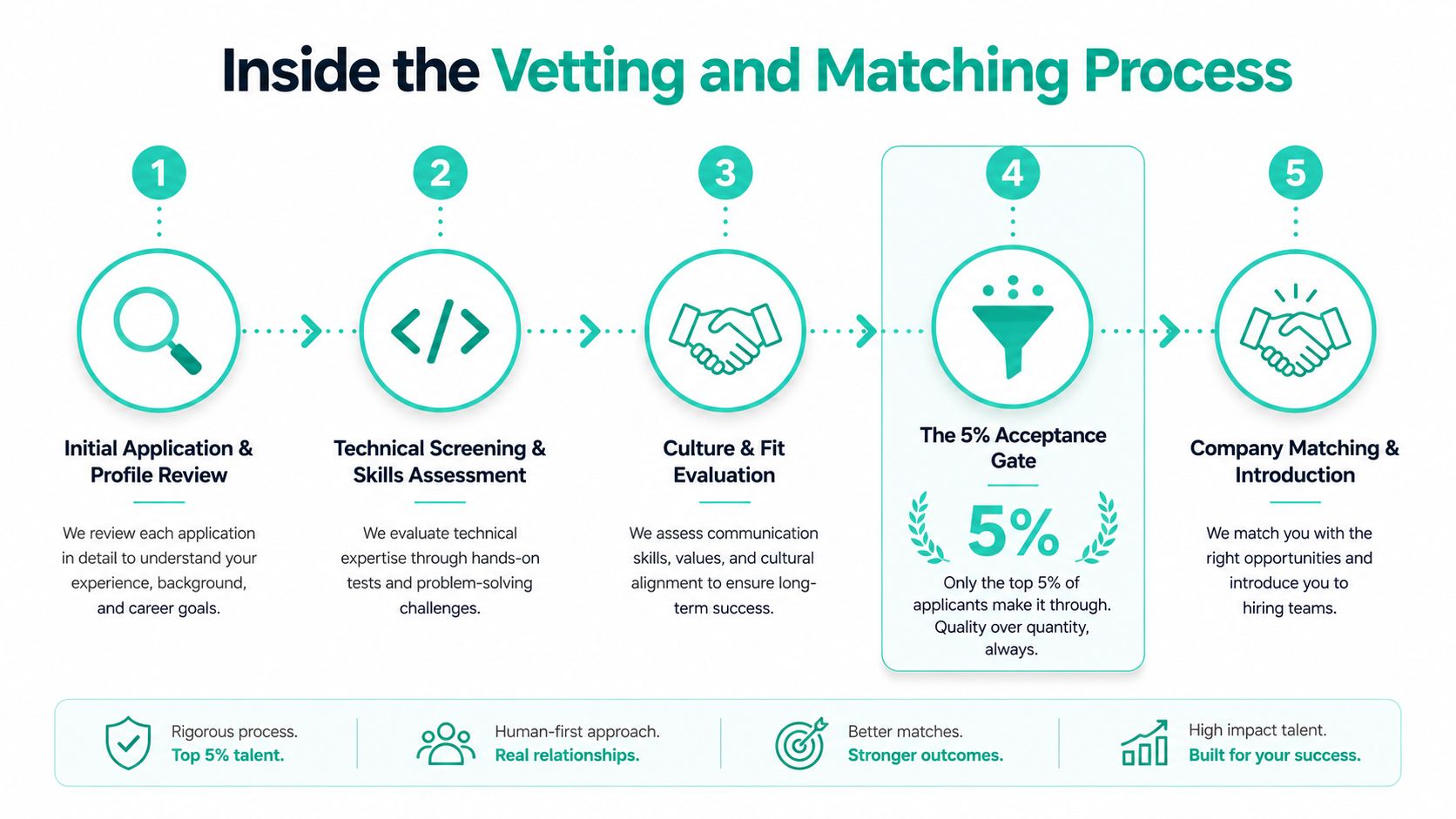
The second stage is usually a conversation with a reviewer who understands the role, often an engineer-curator rather than a generic screeners' pool. That person isn't trying to quiz trivia. They're checking whether the candidate's experience is legible enough to match against startup needs, which is closer to pattern recognition than test prep. A good example of this kind of gate is the reported 5% acceptance model used by Underdog.io how Underdog works.
After screening, the marketplace writes the profile into a narrative that emphasizes signal and hides unnecessary identifying details until mutual interest exists. That matters for employed candidates because it protects discretion. It also makes the shortlist easier for founders to read, since the platform has already translated raw resumes into something closer to a hiring brief.
The final step is routing. A curated batch goes to a small group of companies, and those companies decide whether to request intros within a defined window. That structure keeps the candidate from getting blasted across the market, but it also creates failure modes.
Some strong candidates get lost when batching is too slow or when a founder pauses hiring mid-cycle.
That's the hidden cost of curation. Human judgment helps quality, but it also adds latency, and latency hurts if the company side changes direction while the candidate is waiting. The process works best when both sides are active, responsive, and aligned on the same hiring window.
Curated hiring marketplaces are appealing because they reduce waste, but they don't remove trade-offs. They move the friction to different places. Candidates get better signal, employers get tighter shortlists, and both sides pay for that control in time, transparency, or flexibility.
For engineers, the obvious upside is fewer dead-end applications. Pre-vetted roles save time, recruiter intros don't depend on cold outreach, and the company context is usually clearer before the first meeting. That's especially useful when a candidate wants to compare startup stage, team size, or remote policy without scrolling through a generic board for hours.
The downside is slower access. A human reviewer sits between the candidate and the company, so curated doesn't mean instant. Rejection reasons can also be opaque, which frustrates people who want feedback after a long application process. If the platform is strict about geography or stack, a candidate may never even see roles they would have been willing to consider.
For founders and TA teams, the main benefit is shortlist quality. You get passive reach without opening the floodgates, and the marketplace's brand can help your startup look more credible than a cold post on a generic board. That can be useful when the company is early, the brand is still building, or the role needs a quieter search.
The cost side is real, though. Selective marketplaces often require premium pricing or other commercial arrangements, and employers can't rely on endless volume if the marketplace is doing its job well. That means you may wait longer to see a shortlist, especially if the role is niche, remote-only, or tied to a thin geography.
| Stakeholder | Key Benefits | Real Trade-Offs |
|---|---|---|
| Candidate | Better signal, less spam, more relevant intros | Slower process, opaque rejections, narrower role surface area |
| Employer | Cleaner shortlists, passive candidate access, stronger trust | Higher commercial cost, less volume, possible latency |
| Both | Better fit conversations, lower noise | More dependence on the marketplace's judgment |
The best mental model is simple. Curated is not the same as fast. It's the trade you make when fit matters more than raw intake.
Not every curated marketplace behaves the same way. Some are strong on screening but weak on transparency. Others have a polished candidate feed but little real supply in the exact stack you need. If you're hiring software engineers in the U.S., the right choice depends on who you are and what problem you're trying to solve.
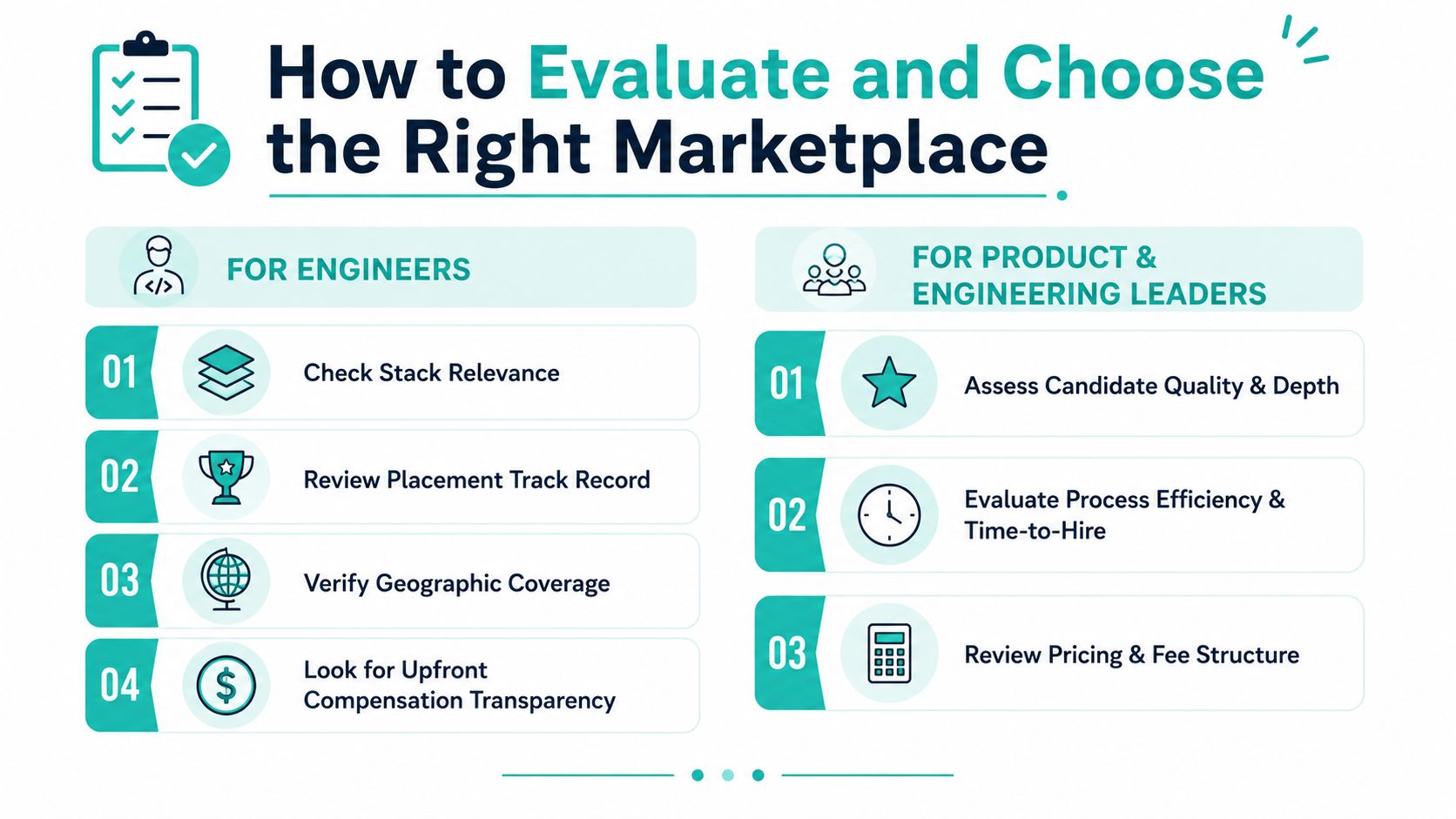
Engineers should start with stack relevance. If the platform doesn't consistently surface roles aligned to their language, seniority, and startup stage, it's just a prettier job board. They should also look for recent placement evidence, geography coverage, and whether compensation is visible early enough to avoid wasting time.
Product and design talent need a different lens. They should look for portfolio review depth, not just resume scanning, and for a healthy mix of non-FAANG companies if startup work is the goal. A marketplace that only surfaces the same brand names isn't really serving the startup market.
Startup founders should pressure-test time-to-shortlist, exclusivity clauses, and the pricing model. If a platform can't explain how long it usually takes to produce a useful shortlist, or if the commercial terms lock them in too early, the curation story may be covering a weak operational process. TA teams should add ATS integration, reporting, and employer branding support to the checklist.
A useful comparator for startup teams is Shopify Plus hiring from Refact, because it shows how specific role needs can shape sourcing strategy. The broader lesson is the same, role definition has to come before channel selection.
If the marketplace can't explain the gate, the shortlist is probably doing too much guesswork behind the scenes.
That checklist is short on purpose. You should be able to score a platform in fifteen minutes, not after a long sales cycle.
The right move depends on your role in the process. Engineers need to present signal cleanly. Founders need to define the hire tightly. TA teams need to test the channel before they roll it into the whole funnel.
Start by updating GitHub, LinkedIn, or a portfolio page so the most recent work is visible without digging. Then write a one-paragraph positioning statement that says what kind of team you want, what stack you're strongest in, and what kind of problems you want next. That makes the marketplace reviewer's job easier and improves match quality.
For product and design candidates, prepare case studies and references before you apply. Curated platforms move faster when they can see evidence of judgment and shipped work instead of only polished bullets. If you're employed, set your own response expectations with your current employer so you can stay discreet without disappearing from the process.
Founders should define must-have versus nice-to-have before they submit a req. That keeps the marketplace from surfacing candidates who look good but miss the actual constraint. A one-pager with team stage, stack, remote policy, and interview timeline saves a lot of back-and-forth later.
TA teams should pilot a single req before they scale the channel. Track time-to-shortlist, shortlist quality, and how often hiring managers want to speak with the candidates that come through. Then create a feedback loop with the marketplace rep so the next batch is tighter.
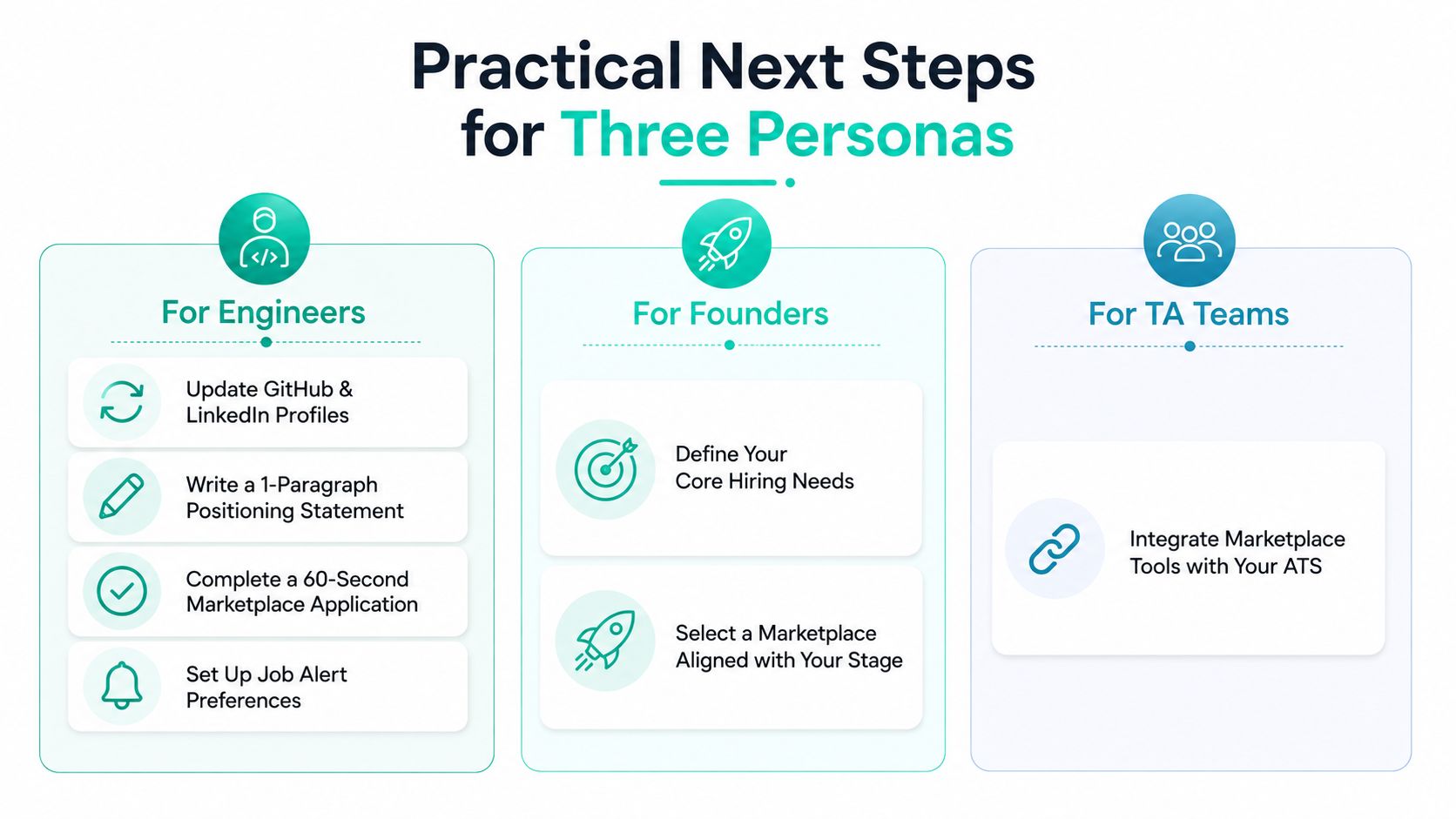
A simple 60-second flow looks like this. The engineer submits a short profile, adds GitHub or portfolio links, and chooses a few preferences. Within a few business days, a company either requests an intro or passes, which is exactly the kind of controlled, low-friction exchange curated marketplaces are built to support.
Underdog.io runs a curated hiring marketplace for tech talent and startups, with a single application that routes candidates into selective introductions instead of a public job-board pile. If you're hiring software engineers, or you're an engineer who wants startup roles without the usual noise, visit Underdog.io and see how a curated process changes the quality of the conversation.