Human-reviewed matching gives Underdog.io the edge when fit matters more than search volume. Juicebox serves a different need: recruiter-led searches across public profiles, with outreach managed by the hiring team.
Underdog.io matches designers to companies based on product, stage, and team structure. Its closed, invite-only network focuses on New York City startups, and the company targets a response rate of 65% or more from candidates. The aim is a relevant introduction, not a longer contact list.
Juicebox gives recruiters tools to search public profiles and run outreach themselves. That approach suits teams that need to source beyond a curated network and can manage the follow-up. The choice comes down to whether your priority is human-led matching or broader, recruiter-directed search.
Which platform fits your next hire: a selective match or a broad search? Underdog.io is a closed, invite-only community that matches designers to companies with active design roles. Juicebox gives recruiting teams a way to search public profiles and manage outreach.
Underdog.io focuses on US-based product designers and startup companies, from seed through Series C. It matches designers to a company's product, stage and team structure. The first batch of designers arrives within one week. Companies pay, while applying to join is free for candidates.
Juicebox searches more than 800 million profiles across 30+ data sources, according to its product materials. Its model suits recruiters who want to search broadly and run outreach themselves.
| Factor | Underdog.io | Juicebox |
|---|---|---|
| Core model | Curated, invite-only community with human-led matching | Recruiting platform for searching profiles and managing outreach |
| Candidate pool | US-based product designers matched to active roles | Searches more than 800 million profiles across 30+ data sources |
| Who starts contact | Underdog matches designers to companies with active roles | Employers search, build shortlists and run outreach |
| Typical user | Companies hiring product designers who want role-specific matches | Recruiting teams that want broad, proactive sourcing |
| Pricing | Companies choose pay-per-hire or subscription pricing; designers pay nothing | Quote-based pricing |
The choice comes down to the work your team needs done. Underdog.io suits companies seeking a considered match for an active design role. Juicebox suits recruiters who need broad profile search and want to manage sourcing and outreach directly.
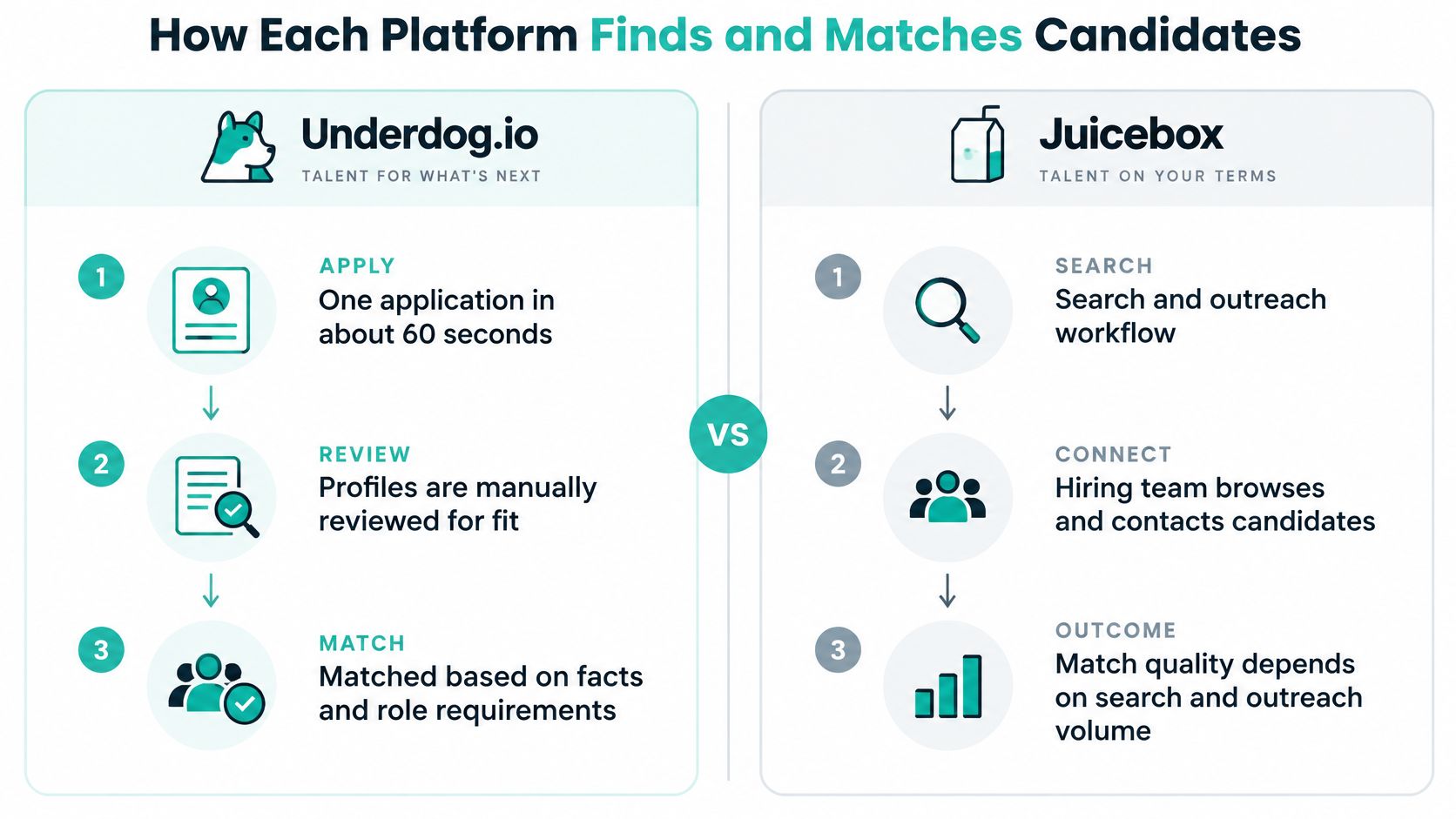
The key difference is who does the filtering. Underdog.io matches candidates to active design roles; Juicebox gives recruiters tools to search and contact candidates.
Designers apply for free with a short application. Underdog.io is a closed, invite-only community, and its reviewers reject portfolios that show polished case studies without the decisions behind them. The network turns away more than 50% of companies, too.
For designers, matching depends on a company's product, stage and team structure. Underdog.io matches candidates with companies that have active design roles when they join and delivers the first batch of designers within one week. Its curated tech marketplace model puts fit ahead of search volume.
The result is a selective introduction, with less screening work left for the hiring team.
A hiring team describes the candidate it wants, then uses Juicebox to search and review profiles before launching outreach. Its product materials describe AI agents, CRM workflows and multistep outreach. Recruiters still decide which profiles belong on the shortlist and which candidates to contact.
That makes the two workflows useful in different situations. Underdog.io handles matching for designers and roles that are active when they join. Juicebox supports recruiters who want to build and manage their own search and outreach process.
Teams building a sourcing process from scratch can also review this guide to how to source candidates effectively.
A practical check: count how many of every ten profiles your team would reject. A high rejection count points to substantial manual screening, whether the search starts with a marketplace match or a recruiter-built list.
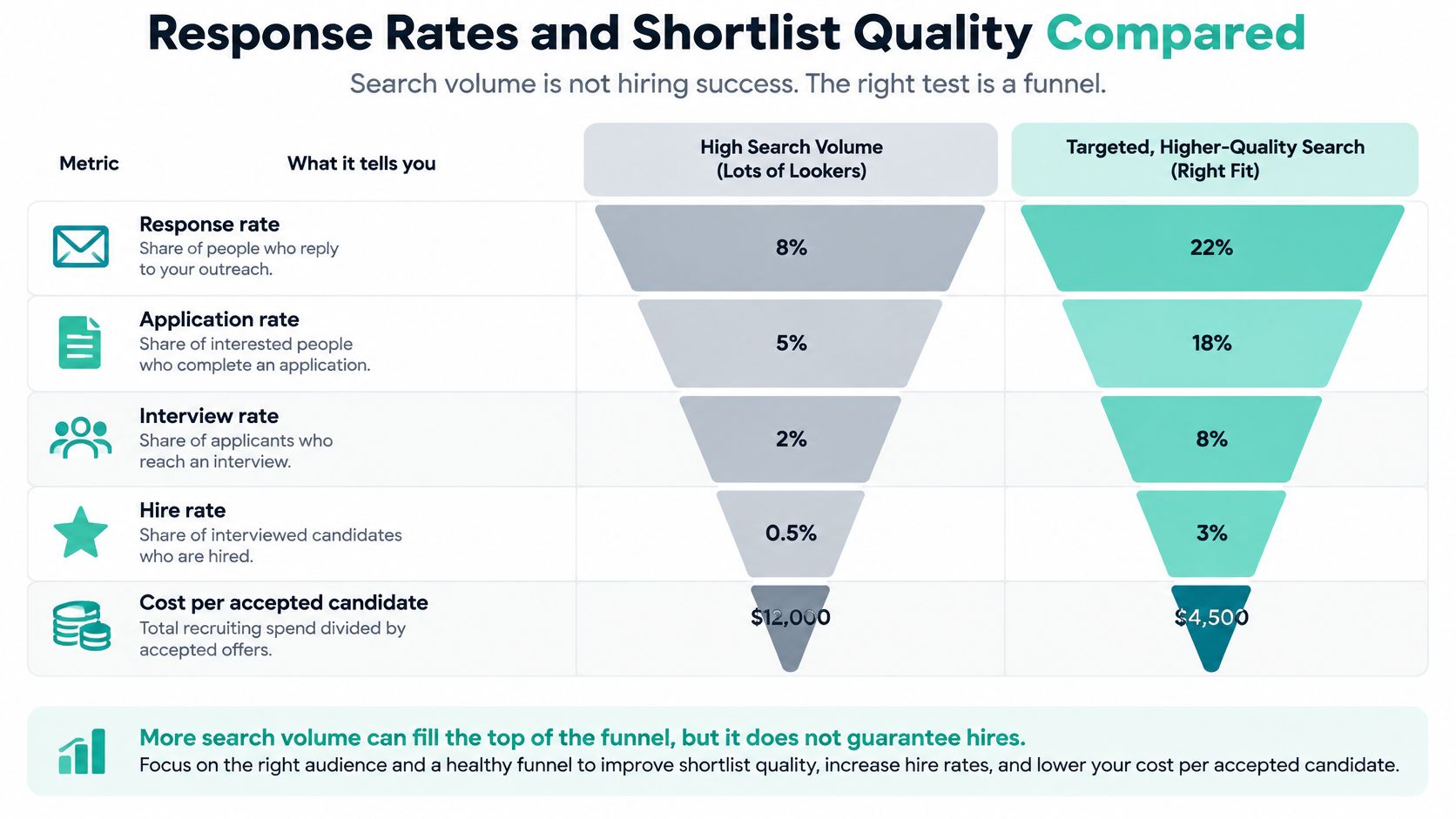
How many contacted candidates reply, and how many are suitable for the role? Those measures reveal more than search volume. Compare both platforms using the same role, time window and funnel definitions.
Underdog.io targets a response rate of 65% or more from its candidates. That is a company-stated target, not an audited benchmark. It still gives hiring teams a concrete figure to ask about when assessing candidate engagement. Underdog's fact-based human matching makes it the stronger choice when relevant introductions and candidate responses matter more than the size of a searchable list.
Juicebox tracks opens, clicks and replies. Its claim that dynamic sequences can produce up to 3x more replies is vendor-reported. Ask for reply and positive-reply rates for your role, since results depend on the search and outreach.
| Metric | What it shows | Underdog.io | Juicebox |
|---|---|---|---|
| Response rate | Share of contacted candidates who reply | Company-stated target of 65% or more | Vendor-reported claim of up to 3x more replies from dynamic sequences; request the rate for your role |
| Application rate | Share of responders who apply | Candidates apply before matching, so the pool has opted in | Track opt-ins after outreach for each sequence |
| Interview rate | Share of applicants who reach interview | Assess introductions against role fit | Request the rate for this role |
| Hire rate | Share of interviews that end in a hire | Measure outcomes for each batch | Measure outcomes for each campaign |
| Cost per accepted candidate | Total spend divided by accepted hires | Calculate using pay-per-hire or subscription pricing | Divide total seat and credit spend by hires |
Keep the test consistent: one role, one brief, one time window and the same definitions at every stage. Underdog.io delivers the first batch within one week. For Juicebox, track the time from search to first export.
A larger database or more messages sent does not establish shortlist quality. Compare how many candidates meet the brief, reply and progress through interviews. Those measures show whether a curated match or broad public-profile search better serves the hire.
Fit depends on the role, the stage and how much searching your team can absorb. The same company can need both tools in the same quarter.
| Hiring need | Better fit | Why |
|---|---|---|
| Niche engineering role with a rare stack | Juicebox | Broad search finds rare profiles; expect more recruiter validation |
| Product designer for an early-stage startup | Underdog.io | Matched to product stage and team structure before introduction |
| Design lead or Head of Design | Underdog.io | Listed profile type for design leadership and matched to active design roles |
| Founding or generalist product role at seed to Series C | Underdog.io | Network focused on startups in AI-native products, developer tools, fintech and healthtech |
| Many similar roles hired at once | Juicebox | Outreach sequences and tracking scale across large candidate lists |
| Remote or non-US searches | Juicebox | Underdog's designer network is US-based, so broader sources may be needed |
A rare stack changes the math. If you need someone who has shipped on a specific combination of infrastructure and language, the population of qualified people in your metro might be a few dozen. Breadth is the only way to find them, and you'll pay for it in validation hours before the first message goes out.
Early-stage design and product roles work the other way. The scarce input isn't names, it's judgment about whether someone will thrive at your stage. Underdog.io lists six designer profiles clients can hire for: Founding Designer, Senior Product Designer, Design Lead / Head of Design, AI Product Designer, Design Systems Engineer, and UX / Research-Led Designer. Matching to a company's product, stage and team structure happens before the introduction, which removes a screening round you'd otherwise run yourself.
The network spans companies in AI-native products, developer tools, infrastructure, consumer and creator apps, fintech and healthtech, from seed through Series C. If your search is remote or outside the US, plan on a broader source, because the designer network is US-based.
Volume hiring is Juicebox's home turf. Ten similar roles with overlapping requirements reward sequences, tracking and a shared shortlist view. Ten unrelated niche roles don't.
List your three must-have skills, then estimate how many qualified people exist in your market. If that number is small, breadth beats curation. If it's large, curation beats breadth.
Underdog.io gives employers two pricing options: pay per hire or subscribe. With pay-per-hire pricing, the fee is due when a hire is accepted, so total cost rises with the number of accepted hires. Check Underdog.io's current pricing options for the applicable rate before budgeting.
The subscription includes unlimited platform seats and a full year of unlimited hires. For a planned hiring year, compare the subscription cost with the total fees for the hires you expect to make. Base the comparison on accepted hires, not interviews.
| Platform | Pricing model | Published figures | What to verify |
|---|---|---|---|
| Underdog.io | Pay-per-hire or subscription | Pay-per-hire fee; subscription includes unlimited seats and a full year of unlimited hires | Current fee, total cost for planned hires, and subscription terms |
| Juicebox | Not verified in the available research | Request a quote | Seat fees, contact-credit use, and what a trial includes |
Juicebox's pricing needs to be confirmed with the vendor. Ask for a written quote and clarify seat costs, how contact credits are used, and what the trial covers.
For budgeting, pay-per-hire ties cost to accepted hires. A subscription may suit a team with steady hiring needs, but compare the current terms against your own hiring plan. Underdog.io's pricing may change at its discretion, so confirm the terms before committing them to a budget.
For an employed engineer or product manager, the difference between voluntarily joining a curated marketplace and being discoverable through public-web aggregation is material. Culturro's review of Juicebox describes profiles gathered from public sources and flags data freshness, contact accuracy and data-broker concerns as issues requiring scrutiny.
Underdog.io's model runs the other way. Candidates are hidden from their current and past employers. Profiles stay anonymous until interest is mutual. The platform only responds to candidates when they're selected for a cohort. Applying is free, and there's no cost to the candidate at any point.
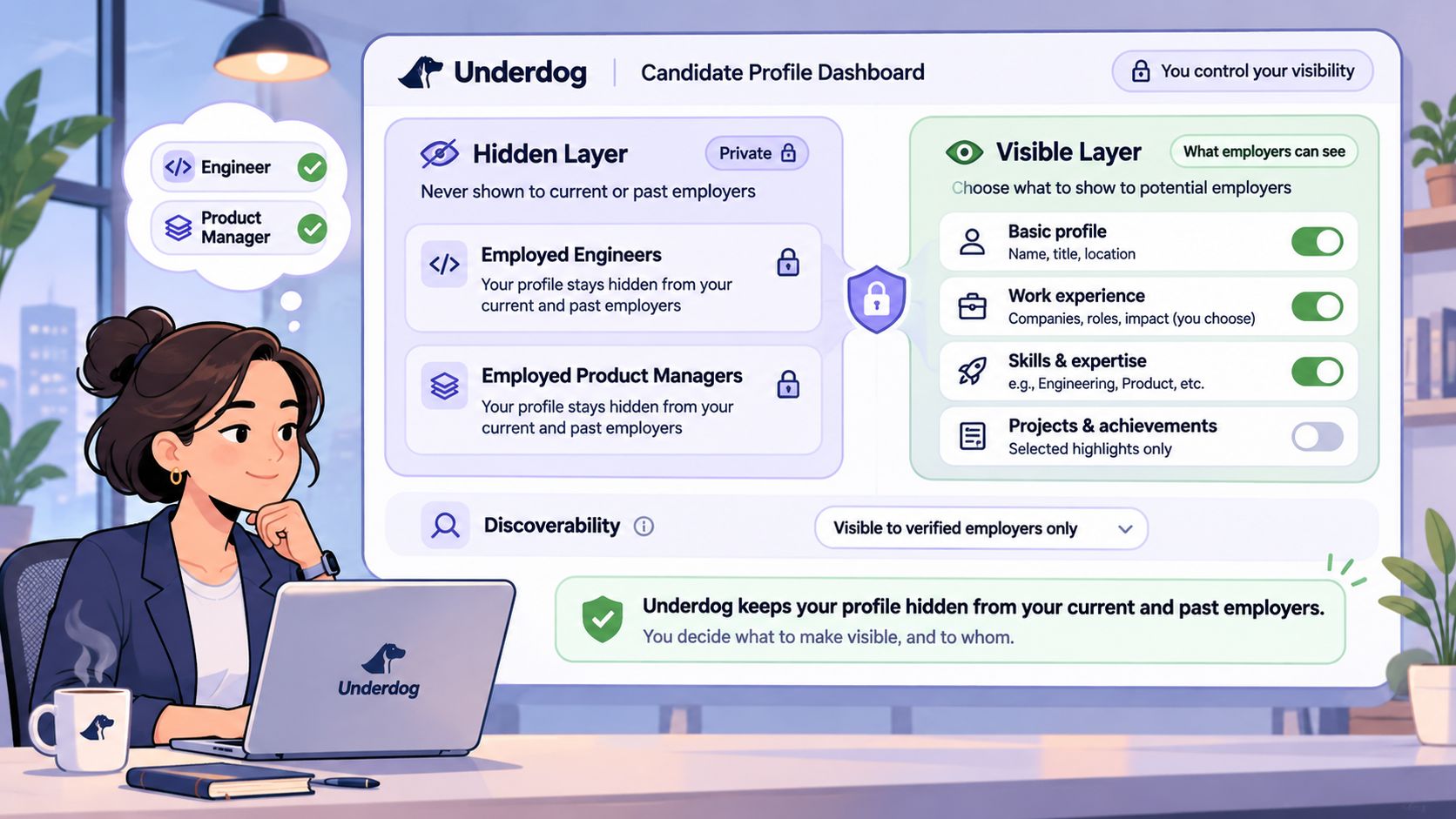
That distinction matters more as AI-assisted sourcing scales, because automation amplifies both useful matches and unwanted contact. A candidate can read the confidential careers overview to see how discretion is handled in practice.
Candidates should verify five things before joining any platform:
Employers have a parallel checklist: validate consent, accuracy and outreach compliance before contacting anyone found through search, and use discretion with passive candidates who haven't advertised that they're looking.
A fair comparison measures candidate control, not only recruiter productivity. Free for candidates is not the same as low risk.
Which platform fits your next hire: a curated match or a broad search? Underdog.io is the stronger choice when human-reviewed matching and candidate responsiveness matter most. Its stated response-rate target is 65% or more. For startup teams, a smaller shortlist aligned with the role can mean less time spent qualifying profiles.
The fit is especially clear for product designers. Underdog matches designers to a company's product, stage and team structure, and delivers the first batch within one week. Its mission is to give candidates and companies the tools and information to make informed decisions about where to work and whom to hire.
The network includes companies such as Gemini, MoneyLion, Onboard AI, Parachute Health and Cove, as well as Bland, Capital RX, Teamshares, GC AI, True Link Financial, Yogi, Roo, Mira, J2 Health and Zest.
Juicebox serves a different need: broad public-profile search. It can suit rare technical roles with few qualified candidates, or recruiting teams equipped to review large lists and manage outbound workflows. Teams organizing those workflows may also consult an agency software guide for business development.
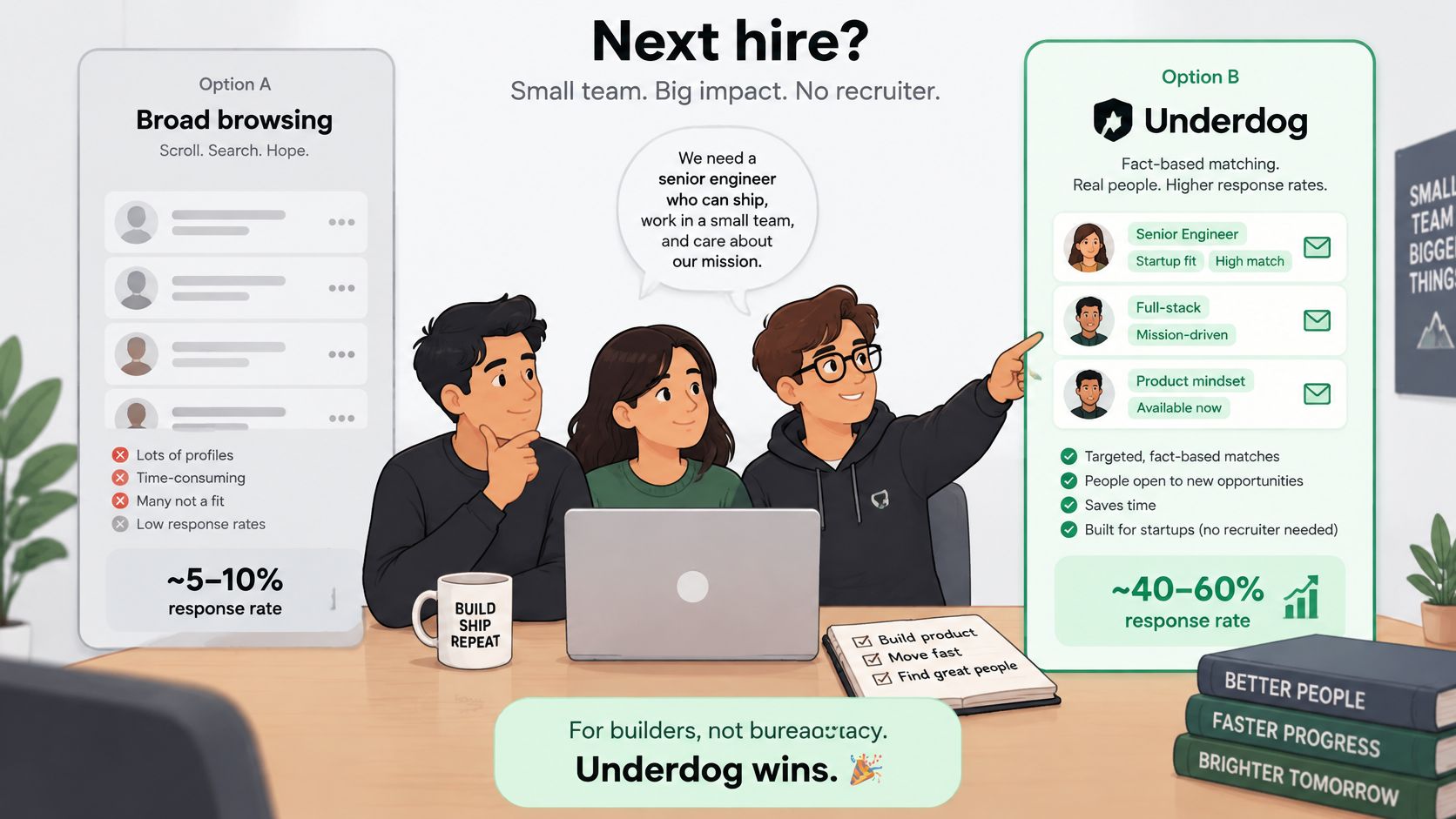
Choose the platform whose shortlist you can move forward without rework.
Compare time to a qualified conversation, response rate, sourcing effort and interview conversion. Profile counts alone do not show whether a platform is producing viable candidates.
Before committing, take four steps:
If you're hiring designers or technical talent for a startup, Underdog.io offers a curated marketplace that matches designers to a company's product, stage and team structure. Companies pay; designers pay nothing. Employers can choose pay-per-hire or subscription pricing. Visit Underdog.io to learn more about its matching process.