If there’s one hiring secret I’ve learned over the years, it’s that a well-executed referral program is your best bet for finding top-tier engineers. It’s more than just a source of candidates; it’s a high-trust filter that turns your team’s collective network into a powerful hiring engine.
This isn’t about passively collecting résumés. This is about you, the manager, actively sourcing talent. When you do it right, you build a faster, more effective pipeline for creating an elite engineering team.
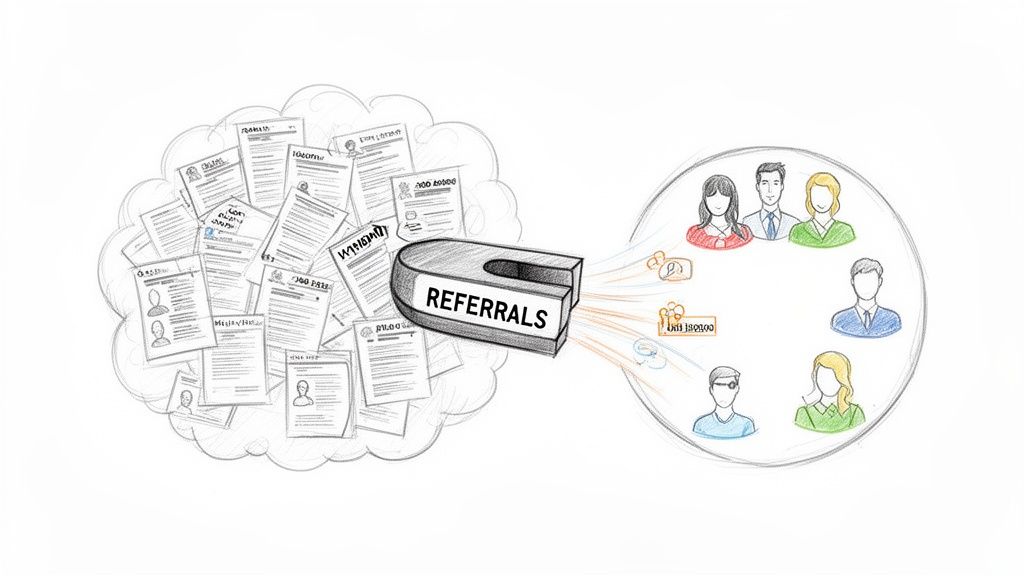
Let's be real. As an engineering manager, your success is measured by the team you build. But the usual hiring methods often feel like a losing game. You wade through hundreds of applications from job boards, burning precious hours just to find a few people who might be a fit.
A deliberate referral strategy completely changes this dynamic. I’m not talking about dropping a link in Slack and crossing your fingers. This is a fundamental shift that puts trust and quality ahead of sheer volume.
When one of your own engineers refers someone, they’re putting their professional credibility on the line. That alone is a powerful signal. It tells you the candidate likely has the technical chops and the kind of work ethic that fits your team's culture.
Think about the difference in context:
This built-in trust is a massive accelerator. You're not starting a conversation from zero; you're starting with a warm introduction and valuable context. It's one of the biggest reasons referrals are such a powerful hiring tool.
A referral isn't just another résumé. It's a recommendation backed by shared history. It says, "I've seen this person's work, and I believe they can succeed here." Sourcing transforms from searching for a needle in a haystack to a targeted effort built on proven relationships.
This isn't just about good feelings—the numbers don't lie. Data consistently shows that employee referrals blow every other hiring channel out of the water.
While referrals might only make up 6-7% of your total applications, they often account for 30-50% of all hires. It’s a massive difference in signal-to-noise.
For engineering roles, the contrast is even starker. Apply-to-hire rates from job boards can be a dismal 2-5%. Referrals? They can convert at rates of 28-34%. In the competitive tech world, it’s not uncommon for companies to source half their hires through referrals, with developer roles hitting 50% in well-run programs. These employee referral statistics show the full impact clearly.
This isn’t a small tweak to your process. It’s a strategic advantage that directly impacts your ability to build a world-class team.
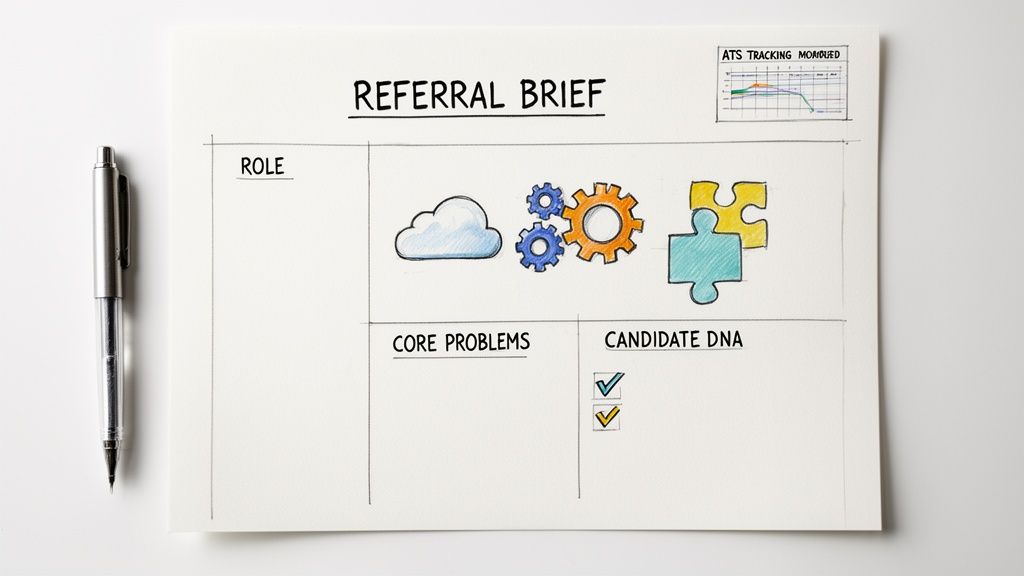
Before you even think about asking your team for referrals, you need a plan. Simply dropping a job description in Slack and hoping for the best is a recipe for noise. To turn your engineers into a genuine sourcing asset, you have to give them something better to work with.
The goal is to get everyone past the generic "we need a backend engineer" mindset. We need to equip them to think, "We need someone who can solve this specific scaling problem and would thrive in our team's high-ownership culture." Getting that clarity right is the foundation of the whole system.
A job description is for the public; it's designed to cast a wide net. A Referral Brief, however, is your internal playbook. It's a short, sharp document written for your team, designed to help them instantly recognize the right person in their network.
Think of it as the insider cheat sheet. It cuts through the HR-speak and translates your real needs into signals your team can actually act on. It’s all about the problems to be solved and the cultural fit, not just a laundry list of tech skills.
A powerful Referral Brief boils down to three core questions:
A Referral Brief isn't about listing every skill. It’s about crystallizing the three to five most important signals that tell your team, "This person would thrive here." It’s the difference between a vague search and a targeted mission.
Your candidate DNA is the combination of soft skills, work habits, and attitudes that you know lead to success on your team. These are the traits that are impossible to spot on a résumé, but a former colleague will recognize them in a heartbeat.
Your brief should bring these traits to life with concrete examples:
When you provide these kinds of tangible scenarios, you're giving your team a mental model to work with. They're no longer just scanning LinkedIn for keywords like "Go" or "Kubernetes"; they're searching their memory for a specific type of person. To see how this fits into a broader, more automated system, you can check out how VouchedIn’s system operates.
Finally, your playbook is useless without a system to back it up. Even the most helpful engineers will stop sending you names if their referrals disappear into a black hole. Before you kick things off, make sure your tracking is airtight.
This means every referral must flow directly into your Applicant Tracking System (ATS), whether you use Ashby, Greenhouse, or another platform. Each submission needs to be tagged with the source, the referrer, and the specific role. This creates a crystal-clear trail from start to finish.
A solid tracking setup gives you three critical advantages:
With a sharp Referral Brief and a reliable tracking system in place, you're ready to stop preparing and start sourcing.
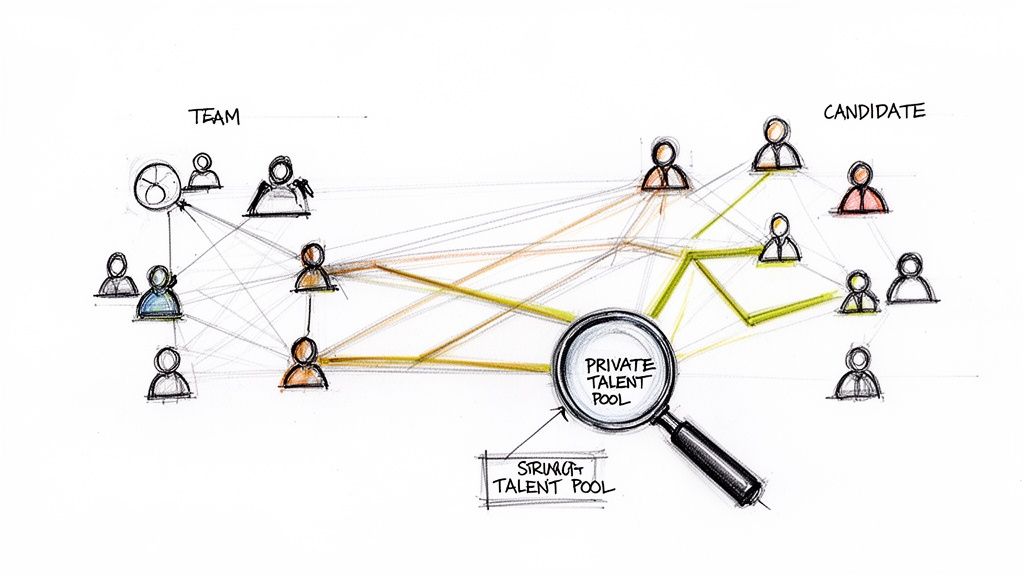
Alright, you’ve got a crystal-clear Referral Brief. Now for the fun part: moving from planning to action. This is where we stop passively waiting for referrals to trickle in and start proactively mining the gold in your team’s collective network.
The idea is to transform your team's disparate connections into a private, searchable talent pool. This is a huge mental shift. Relying on your team's memory or asking them to manually search LinkedIn is a recipe for failure. The average engineer has hundreds of professional contacts, but that network is completely invisible and untapped without a system. Building that system is your job.
We've all seen the old way of sourcing referrals. A manager posts a generic "Anyone know a great engineer?" message in a Slack channel, engineers are asked to "think about it," and maybe someone digs up a name from an old, dusty spreadsheet. It's not just slow—it's frustrating for everyone involved and the results are almost always disappointing.
Your engineers are paid to solve complex technical problems, not to act as amateur recruiters. Asking them to stop coding and manually trawl through their LinkedIn connections is a massive distraction and a misuse of their time. The friction is so high that even your most helpful team members will quickly tune out the requests.
The goal is to make it 10x easier for your team to identify a good match than it is for them to ignore your request. If finding a referral takes more than a few minutes, your system is broken.
This is where modern referral platforms completely change the game. Instead of relying on manual effort, you can create a unified, automated system. Tools like VouchedIn let your team securely sync their professional networks, turning thousands of individual connections into a single, searchable company asset. Privacy is built-in from the start; only professional data like names, titles, and work history get mapped. You get a shared talent graph without ever touching anyone's personal information.
Once this collective network is mapped out, you can go way beyond basic keyword searches. This is where the concept of a backchannel match really shines. It's a data-driven method for pinpointing the absolute best person on your team to make an introduction.
Instead of just telling you that a connection exists, backchannel matching technology analyzes the strength of that connection. It hunts for signals that point to a genuine professional relationship.
What kind of signals are we talking about?
This tech essentially automates what the best sourcers have been doing manually for years. It scores and ranks potential introducers so you can see, in an instant, who has the most credible and influential link to a candidate you want to talk to.
Let's walk through a real-world scenario. You're trying to hire a Senior Staff Engineer with deep experience in distributed systems. The traditional approach—the Slack blast—gets you nothing but silence.
With an automated system and backchannel matching, the process is completely different. The moment you open the role in your ATS, the system instantly cross-references the job requirements against your team's entire mapped network.
Within seconds, you have a prioritized list. The system might highlight: "Your engineer, Sarah, worked with a candidate named Mark at a previous company for four years. They were both on the platform team." This isn't just a random name; it's a warm, actionable lead with a high probability of paying off.
Now, your conversation with Sarah is completely different. Instead of a vague ask, you have a specific, data-backed request: "Hey Sarah, our system flagged that you worked with Mark for a few years, and he looks like a perfect fit for our new Staff Engineer role. Would you be open to reconnecting with him?"
This targeted approach respects your team's time and skyrockets the quality of your referral pipeline. You're no longer just asking for a favor; you're presenting a smart, data-driven opportunity. It’s a faster, more intelligent, and far more effective way to hire the talent your team already knows.
You’ve done the hard work of mapping your team's network and found the perfect person to make an introduction. Great. But a warm connection is useless if the outreach itself feels clumsy or spammy.
This is exactly where most referral efforts break down. Let's be honest: your engineers are paid to build incredible software, not to be recruiters. Asking them to craft the perfect cold outreach on their own is a recipe for inaction. They worry about sounding salesy and potentially damaging a good professional relationship.
As their manager, your job is to completely remove that friction. You need to arm them with outreach that is so personalized and effective they can send it with confidence. The goal is to turn this from a dreaded task into a simple copy-paste that gets results.
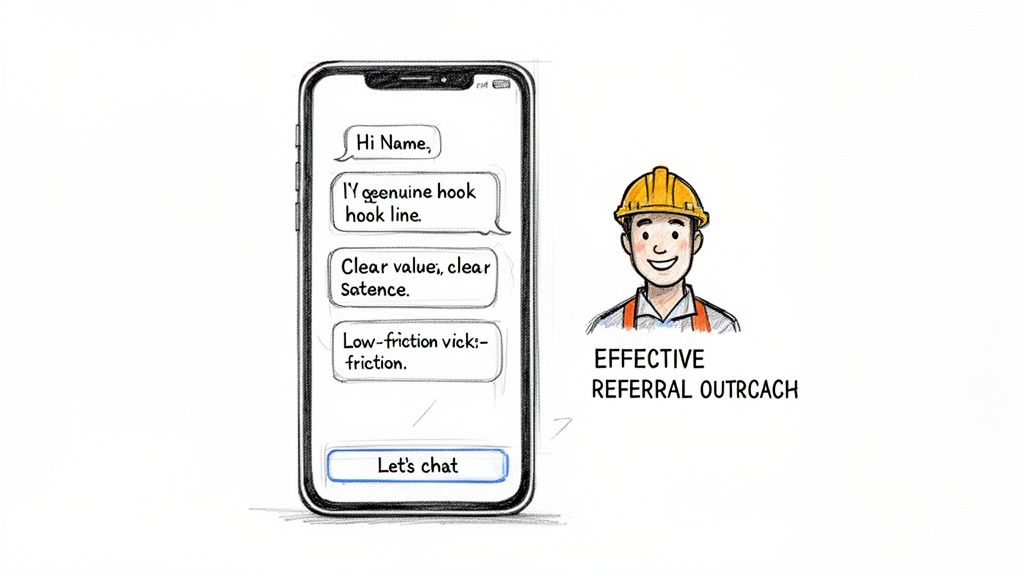
A truly great referral message never reads like a job ad. It feels personal, it's specific about the value, and it makes saying "yes" to a conversation incredibly easy. It has to respect the candidate’s time and intelligence from the very first sentence.
It always starts with the personal hook. This is where the referrer's genuine connection comes in, immediately answering the candidate's unspoken question: "Why are you reaching out to me?"
Next comes the clear value proposition. This is your chance to connect the dots between what you know about the candidate and the specific, interesting problems your team is solving. It should feel like a hand-picked opportunity, not a mass email.
Finally, you need a low-friction call to action (CTA). You're not trying to get them to commit to a full interview loop. The initial goal is much simpler: start a conversation. Make the next step informal and easy to agree to.
Your job is to pre-draft these messages for your team. This "ghostwritten" approach removes the cognitive load of crafting the perfect note, turning your engineers into efficient connectors rather than reluctant salespeople.
The secret to a good ghostwritten message is making it sound authentic to the person sending it. You’re not writing a rigid script; you're building a solid foundation that they can easily tweak with their own voice.
Here’s a simple structure I’ve seen work wonders. It gives your team member a natural framework to fill in the blanks.
This structure honors their past connection while clearly explaining why you’re reaching out now. It's respectful, direct, and incredibly effective.
Your involvement doesn't stop at creating a template. You need to be the one who tees up the entire interaction, removing every last bit of friction for your engineer.
Before you even ask someone on your team to make an introduction, you should have already done the prep work:
When you take on this prep work, you transform referring from a chore into a simple, high-impact action. It allows your team to tap into their valuable networks without derailing them from their primary focus, ensuring your referral engine runs smoothly and efficiently.
Let's be honest: a referral program built solely on cash bonuses is destined to fail. Sure, a financial incentive can kick things off, but it rarely builds a sustainable culture of great referrals. The real goal is to get your team to see themselves as partners in building the company, not just bounty hunters.
This means shifting the focus from a transaction to a shared mission. When your engineers feel a sense of ownership and see their contributions celebrated, the motivation becomes intrinsic. They'll start referring great people because they genuinely want to work alongside them and see the team succeed.
Money is a short-term fix. A bonus gets paid, spent, and is quickly forgotten. Recognition, on the other hand, has a much longer shelf life. It taps into a fundamental human need to be valued and respected by our peers.
Think about it. A private cash payment is nice, but a public shout-out has a ripple effect. It signals to the entire team what kind of behavior is valued. It says, "We see you, we appreciate the effort, and you're helping us all win." In my experience, that kind of genuine appreciation can be far more powerful than a few hundred dollars. This is what keeps your referral pipeline active long after the novelty of a bonus check has worn off.
For recognition to really work, it has to be both visible and consistent. One-off "thank yous" are good, but they don't build a culture. You need to weave celebration directly into your team's regular rhythms.
Here are a few simple ways I’ve seen this work wonders:
The trick is consistency. When your team sees that referrals are celebrated every single time, it becomes clear that this isn't a flavor-of-the-month initiative; it's just how you operate.
Don’t just reward the successful hire. Recognize the effort. Acknowledge every qualified referral that makes it to the interview stage. This encourages participation even if a candidate doesn’t get an offer, reinforcing that the act of helping is what truly matters.
While a bonus for a successful hire is standard practice, don't let it be your only tool. I've found that creative, non-monetary rewards often generate far more buzz and goodwill. They feel more personal and memorable than a number in a bank account.
The key is to offer things your team actually wants. Sometimes, the most valuable reward isn't more money, but more time or a unique experience they wouldn't buy for themselves.
Get creative and consider alternatives like these:
By diversifying your incentives, you show your team that you're putting real thought into how you say "thank you." It elevates the whole program from a simple transaction to a genuine partnership.
A proactive referral program is a fantastic way to build your team, but how do you know if all that effort is actually paying off? If you can't measure your program, you can't improve it. This is where you shift from simply running a referral program to strategically steering a high-performance hiring channel.
Tracking the right data does more than just make for a nice report—it’s how you prove your program's value to leadership and earn real credibility. Let's be honest, what gets measured is what gets managed.
To really understand the health of your referral program, you have to look beyond just the final hire count. Think of it as a funnel. Tracking the conversion rates between each stage will show you exactly where your process shines and, more importantly, where it’s breaking down.
The easiest way to do this is by pulling the data directly from your Applicant Tracking System (ATS), like Ashby or Greenhouse.
Here are the core metrics I always keep an eye on:
Your metrics aren't just numbers on a dashboard; they're diagnostic tools. When you analyze your funnel, you can pinpoint exactly what’s going wrong and take targeted action.
For example, I once saw a team with a huge number of referral submissions but a terrible referral-to-interview rate. That’s a classic quality problem. The team was engaged, but they were referring the wrong profiles. It was a clear signal to go back and refine the Referral Brief, getting much more specific about the “candidate DNA” and the exact problems the new hire would be solving.
Your data tells a story. A low offer rate for referrals might point to a disconnect in your interview process. A low acceptance rate could signal that your compensation isn't competitive. Use these signals to ask better questions and find the root cause.
On the flip side, what if your offer acceptance rate is fantastic, but you’re barely getting any submissions? That tells you the program works beautifully when people use it. The problem isn't the quality; it's participation. That’s your cue to rethink your recognition strategy, make the submission process dead simple, or just do a better job communicating which roles are a top priority.
Diving into these numbers is just one piece of the puzzle. To see the bigger picture, it helps to explore how they fit into a broader talent strategy. Reading more about various recruitment strategies can give you more context for fine-tuning your entire approach. Your data shows you the "what," and your understanding of the process gives you the "why." Connect those two, and you'll be making smart, data-driven decisions that turn your referral program into a true team-building engine.