The most popular advice about buying an AI sourcing tool is to measure how quickly it produces a shortlist. That's an incomplete test. A tool can return plausible profiles quickly while missing qualified people, overstating skills, or handing recruiters more verification work. Buy better candidate signal, not just faster search.
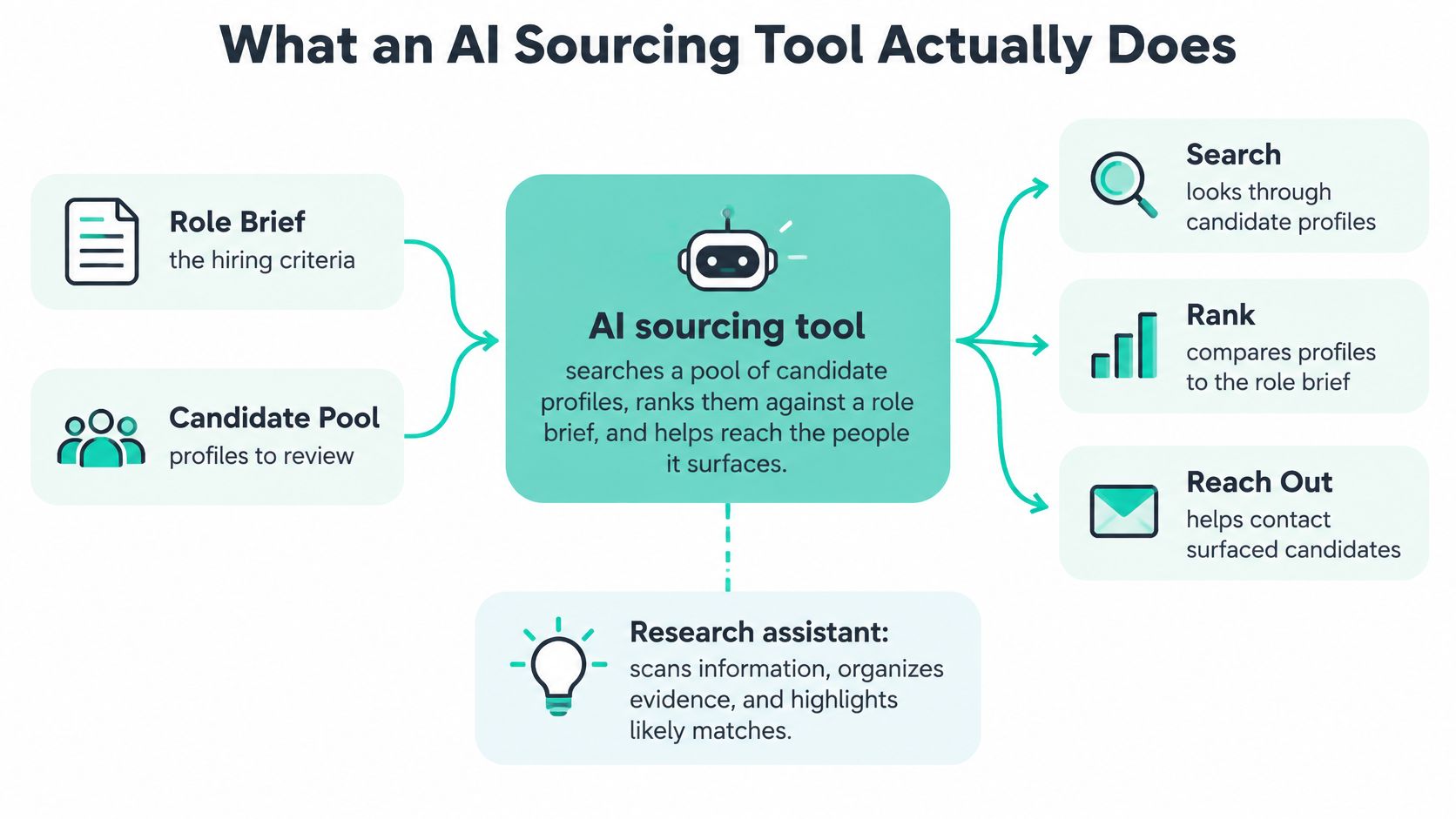
An AI sourcing tool searches a pool of candidate profiles, ranks them against a role brief, and helps reach the people it surfaces. Think of it as a research assistant who reads thousands of profiles overnight but knows only what you told them about the role.
Say you're hiring a backend engineer for a startup building payments infrastructure. If your brief says only Python, financial technology, and senior engineer, the assistant may return impressive profiles without distinguishing someone who owned a transaction system from someone who maintained an internal reporting service.
The workflow has distinct checkpoints:
Each stage can fail independently. A weak brief produces a confident but wrong list; stale profiles undermine an otherwise sensible ranking; accurate discovery still won't rescue irrelevant outreach.
SHRM's survey reported that 51% of organizations used AI for recruiting in 2025, while LinkedIn's research found 37% actively integrating or experimenting with generative AI, up from 27% the previous year, according to Apollo Technical's recruiting statistics overview.
Those figures measure different activities. Recruiting AI can mean sourcing, résumé screening, matching, drafting messages, or scheduling, so neither percentage tells you how many teams have delegated candidate discovery.
The same distinction belongs in a buying conversation. Ask the vendor to demonstrate the exact work its product performs, including what your recruiter must still do manually.
Before your next demo, write those workflow stages beside your next open role. Mark the stage you'll check first and name the person responsible for checking it.
| Tool | Discovery Model | Published Price | Volume Limit or Scope |
|---|---|---|---|
| Underdog.io | Curated pool with fact-based matching and human review | Pay-per-hire or subscription; subscription includes unlimited seats | Access to 300,000+ pre-vetted candidates; subscription includes a full year of unlimited hires |
| Noon AI | Agentic open-web search, recalibrated through hiring-manager feedback | Obtain a current vendor quote | Confirm search, outreach, and usage allowances in the quote |
| Pin.com, Solo | AI-agent-assisted candidate sourcing; confirm searchable sources | $99 per user per month | 500 contact-lookup credits and two AI agents |
| Juicebox, Starter | Candidate profile search; confirm database coverage and refresh rules | $99 per seat per month | 500 contact credits and 500 exports |
| Wrangle, Starter | Plain-language role search with scored matches | $199 per seat monthly, or $159 per seat with annual billing | 5,000 monthly credits; 500 searches per user per month |
| Metaview, Pro | AI candidate sourcing; confirm enabled search sources | $100 per user per month | 200 sourced profiles per user each month |
The Pin, Juicebox, and Metaview prices and allowances in this table are published in Noon AI's sourcing-tool comparison, which also describes Noon's open-web search and feedback-driven recalibration. Wrangle's prices, credits, and search ceiling come from its startup sourcing and outreach guide.
Treat these as comparison points rather than binding offers, and check each vendor's current pricing page and written terms before buying. One thing the table cannot show: how well each tool ranks the profiles it returns. A larger credit allowance means more candidates, not better ones, so read the volume column as capacity rather than quality.
Our marketplace uses a different buying model: employers choose pay-per-hire or subscription pricing, with unlimited platform seats and a full year of unlimited hires on subscription. The relevant comparison is access to relevant candidates and introductions, not matching a seat count to a contact-credit budget.
Noon AI is the agentic option here. It searches the open web and adjusts its evaluation through hiring-manager feedback. Ask what triggers a new search, how rejected candidates affect later recommendations, and which actions require approval.
For Pin.com and Juicebox, the contact allowances deserve close attention. Viewing a profile, revealing contact information, and exporting it are not interchangeable activities. Establish which actions consume credits and whether unsuccessful lookups consume them too.
Wrangle combines search, review, and outreach preparation from an existing inbox. Check both its search ceiling and its credit allowance, because leftover credits do not guarantee you can keep running searches.
Metaview's sourced-profile allowance raises a similar budgeting question. In a month requiring 300 profiles, two Pro seats would provide enough listed capacity and bring the subscription total to $200, assuming those allowances fit the team's workflow. A month requiring 800 searches would exceed Wrangle's single-user ceiling and require added capacity, likely a second seat rather than more credits.
Buying rule: Estimate monthly profiles, searches, contact lookups, and exports separately. Then price the workflow you'll actually run.
Index-based products can only return profiles already in their searchable database. Open-web agents carry a different coverage problem: establish which sources they can access and whether their results are reproducible when the same search runs twice.
Teams weighing adjacent business software alongside their recruiting stack can consult the Comredix small business AI rankings for a broader vendor list. It covers general small-business tools rather than sourcing, so keep the recruiting decision anchored to candidate evidence and usable monthly capacity.
Underdog.io treats matching as evidence work. Software narrows the pool; reviewers decide whether the facts support an introduction. We do not claim that AI independently understands who will succeed at a company, and a faster shortlist is only useful when the reasons behind it remain inspectable.
Candidates supply the starting facts: industries they have worked in, core skills, experience building AI products, and the career details stated in their profiles. Those statements give reviewers something concrete to compare with the employer's needs.
Our job-matching approach emphasizes pre-vetting for relevant experience and startup alignment, alongside human review. Reviewers examine profiles across product, engineering, design, data, and marketing, with introductions informed by company stage, product area, and team structure.
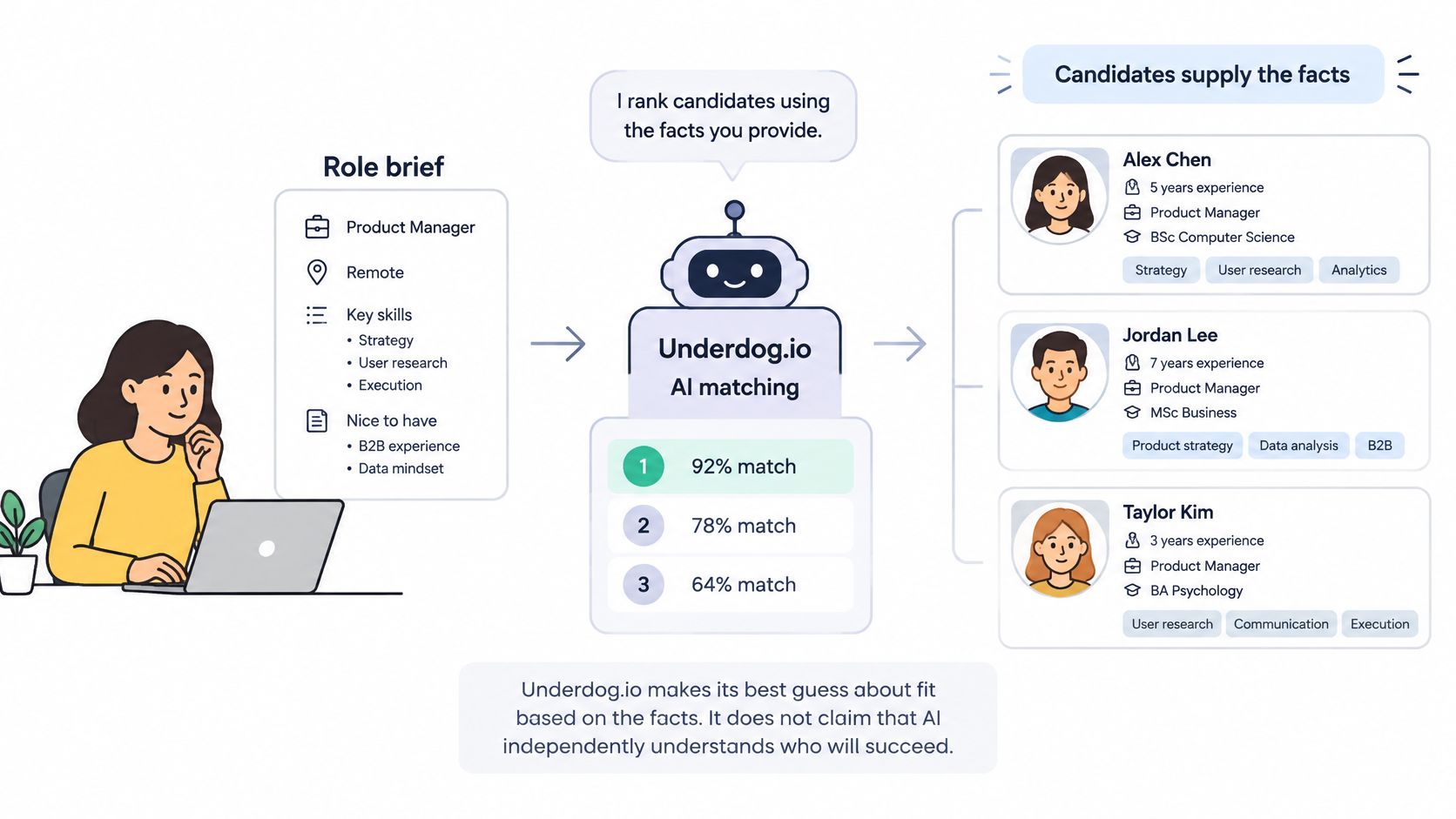
During Instant Match, the engine scans the evergreen pool for high-intent candidates. Human reviewers then check each profile and whether the candidate suits the startups hiring on Underdog.io.
A seed-stage company hiring a product engineer for an AI features team needs more than a headline that says “AI engineer.” The useful questions are plainer: what did the candidate build, which parts did they own, and how closely does that work resemble the scope this team needs?
A reviewer might examine:
A text-similarity system may rank a résumé highly because its language resembles the job description. That ordering can help organize review, but repeated terminology does not establish production experience or readiness for a founding-level role.
Fact-based matching has limits too. Candidate-provided information still needs interview validation, and reviewers should mark unanswered questions instead of filling gaps with assumptions.
We connect candidates directly with founders, hiring managers, and other key decision makers so the people defining the job can test those gaps.
Apply a simple test to any matching product: can you see which facts drove the recommendation, separate those facts from inference, and let a reviewer override the result?
Automation works best when the task is explicit and the output is inspectable. It becomes less dependable when recruiters treat a recommendation as an assessment.
| Capability | Limit and Practical Check |
|---|---|
| Natural-language role search produces scored matches from a plain-language brief | Ambiguous requirements remain ambiguous. Ask the tool to separate essential criteria from preferences before searching. |
| Open-web agentic search adjusts through hiring-manager feedback | Feedback can reinforce a narrow preference. Review what the system changed after a rejection. |
| Outreach drafts can be prepared from an existing inbox | Generated personalization may misstate someone's experience. Approve factual claims before sending. |
| Scheduling reduces coordination work | Availability doesn't establish interest or suitability. Define when a recruiter takes over. |
| Ranked results help prioritize review | Scores aren't proof. Inspect the evidence behind each proposed match. |
A search for payments infrastructure engineers can overlook someone whose profile says billing platform. Use synonym groups and exclusions deliberately; our guide to Boolean strings for sourcing software engineers can help translate a technical brief into testable search logic.
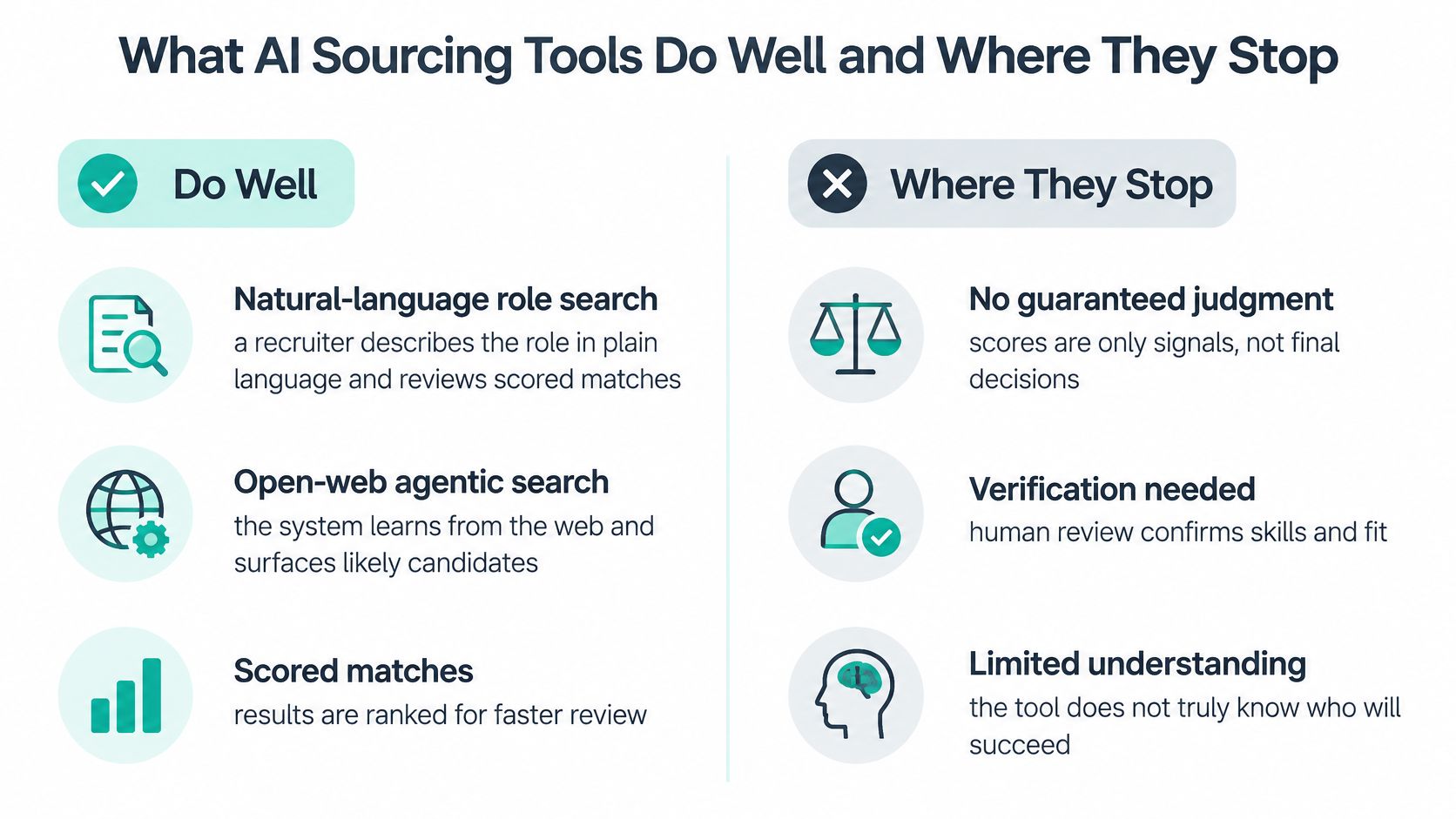
Public profiles rarely establish how someone communicates under pressure, responds to changing priorities, or chooses between competing product demands. Don't ask a sourcing score to answer those questions.
Self-reported skills also need scrutiny. A keyword-rich résumé can look highly relevant while leaving the candidate's actual contribution unclear. Ask for a project explanation that separates individual decisions from team accomplishments.
Operational limits matter too. Database coverage, search allowances, contact credits, and export restrictions can interrupt an otherwise useful workflow. Test the complete handoff into your recruiting process, not just the search screen.
Use AI for breadth and prioritization. Keep accountable human review responsible for evidence and fit before a candidate receives a decision.
A benchmark comparing AI recruitment sourcing tools with LinkedIn Recruiter found more relevant candidates in AI tools' top-ranked results, but its evaluation emphasized precision and didn't measure recall. That distinction prevents a clean shortlist from proving complete coverage.
Suppose the returned candidates all meet your criteria. Precision looks strong. But if qualified engineers with unconventional titles never appear, you still have a discovery problem.
Ordering matters independently. A tool that places its strongest candidates beneath marginal matches makes recruiters do unnecessary review work.
| Metric | What It Measures | Warning Sign |
|---|---|---|
| Precision@k | Share of the top k returned candidates who match the query | Irrelevant profiles occupy prominent positions; a clean but short list still doesn't establish coverage |
| Recall@k | Share of the full qualified pool appearing in the top k | Qualified engineers with unusual titles never appear |
| nDCG@k | Whether the strongest matches rank above weaker ones | Strong matches sit below weak ones |
Start with a clearly bounded candidate set. You can estimate recall against that set; you generally can't establish recall across the entire open web because you don't know everyone who qualifies.
An illustrative starting exercise is to label 30 to 50 profiles per role with two independent reviewers. That's a practical pilot design, not a universal sample-size requirement.
For nDCG, add graded relevance labels rather than relying solely on qualified or unqualified. Distinguish candidates who satisfy the essentials from those whose documented experience closely matches the actual scope.
Keep the reviewers blind to vendor scores until they've completed their labels. Otherwise, they may unconsciously adopt the tool's ordering as the answer.
Request Precision@k, Recall@k, and nDCG@k separately, with the cutoff and evaluation population stated. A blended quality score conceals whether the tool retrieves relevant people, misses qualified people, or orders results poorly.
A résumé-screening audit across nine occupations, using more than 500 résumés and 500 job descriptions, found that embedding-based retrieval models significantly favored White-associated names in 85.1% of tested cases and female-associated names in 11.1%; additional analysis reported that Black men could be disadvantaged in as many as 100% of cases.
Those are findings about the tested models and conditions, not a measured bias rate for every sourcing product. They're still a concrete reason to test ranking behavior rather than accept a fairness assurance.
Removing names alone doesn't establish fair ranking. Institutions, language patterns, and career histories can still function as identity-linked proxies.
Use a controlled testing sequence:
Apply these checks to discovery and outreach recommendations, not only final hiring decisions. Our strategies to reduce hiring bias offer complementary process controls.
The EU AI Act guide for HR and recruitment explains why employment systems that search and shortlist candidates can fall within high-risk requirements. Applicability requires a use-case-specific assessment, not an assumption that every sourcing feature has the same legal status.
Ask vendors which sources they're permitted to use, how long they retain information, and how candidates correct or remove it. Require documentation of ranking changes and human review.
Combining separately public facts can create an intrusive dossier. Collect information needed for the job, not everything an agent can find.
Our terms prohibit users from using scrapers, crawlers, or data-mining tools to scrape or download website data. Search-engine operators have revocable permission to use spiders for searchable indices. Technical access isn't permission to repurpose candidate information.
A fast shortlist proves nothing about quality. Recruiters frequently find that AI speeds up candidate discovery, yet verifying whether résumé skills are genuine remains the harder half of sourcing work. Speed and verification are separate outcomes, and a tool that wins on the first can still lose on the second. The European Commission's AI framework overview adds regulatory context here, since employment screening is treated as a higher-stakes use of AI and a purchasing decision should anticipate that scrutiny.
Time-to-shortlist is the wrong acceptance criterion. Measure whether your team can reach suitable people and validate their experience without creating more work downstream.
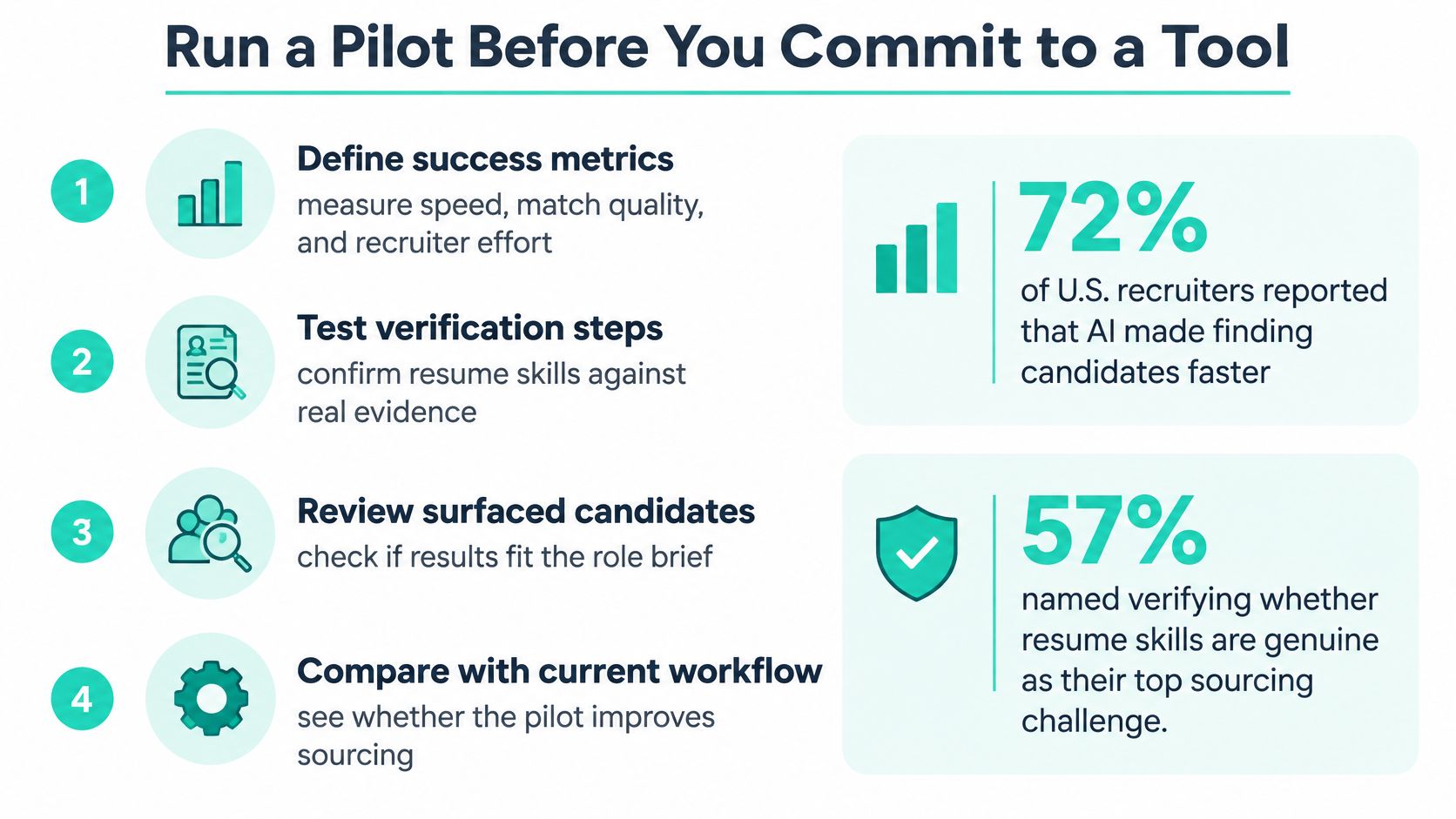
Use this illustrative pilot design:
Define qualified-response rate before starting. For example, count contacted candidates who respond positively and meet the agreed requirements, rather than counting every reply as success. Log duplicates and overlapping candidates so neither sourcing arm receives misleading credit.
If your team lacks manual sourcing capacity, a staffing partner such as nexusITgroup.com could run the comparison arm.
An illustrative pass rule could require an improvement of at least 10 percentage points in qualified-response rate, plus an evidence-based reason for every recommendation the tool produces. Treat that figure as a proposed buying threshold you set for your own funnel, chosen to clear the margin of error in a small sample, and adjust it to match your requisition volume.
Fold recruiter verification time and candidate experience into the same decision. A tool that surfaces fifty names but forces your team to re-screen each one by hand has shifted the workload, and a tool that spams candidates damages your employer brand even when reply rates look healthy. Use quality-of-hire metrics to plan the longer-term evaluation, since early outreach results alone cannot prove post-hire performance.
Our pricing inclusions cover a personalized employer page, candidate feedback analysis, hiring process data and analytics, new user training, dedicated support, ATS integrations, and diversity sourcing. Evaluate whether those capabilities support your evidence collection and workflow during the pilot, since a feature list tells you little about how the tool performs on your roles.
Continue when the tool meets your preset thresholds. Renegotiate when useful results require more capacity or support than the contract includes. Drop it when additional speed fails to produce defensible candidate quality.
Underdog.io offers a curated hiring marketplace with human profile review and a new vetted batch of candidates sent to employers every week. Visit Underdog.io to explore candidates for your next role and compare introductions against the evidence standards you've set for your sourcing pilot.