
The healthcare landscape is being reshaped by technology, creating a surge of opportunities for skilled engineers, product managers, and data scientists. From AI-driven diagnostics to virtual care platforms, health tech companies are tackling some of society's most pressing challenges. But navigating this dynamic sector to find the right role can be overwhelming.
This guide cuts through the noise. We'll spotlight seven standout health tech companies, categorized by their focus area, and provide actionable insights for job seekers. We'll detail what these companies do, what makes them unique, and most importantly, how you can strategically position yourself to join their teams. Beyond the well-known names, the health tech landscape is vibrant with numerous emerging companies. Exploring lists like these Top 15 Healthtech Startups can provide further insights into industry leaders and potential opportunities.
Whether you're passionate about improving patient outcomes, streamlining provider workflows, or building the data infrastructure for precision medicine, this roundup is your starting point for a meaningful career in health tech. For each company, we will provide:
We will also highlight how a curated platform like Underdog.io can be your secret weapon, connecting you directly with vetted, high-growth startups and bypassing the traditional application process. Let's dive into where innovation meets opportunity.
At the forefront of the shift to value-based care, Aledade is a standout among health tech companies for empowering independent primary care practices. Instead of replacing these vital community cornerstones, Aledade provides the technology, data analytics, and hands-on support they need to thrive in a healthcare system that increasingly rewards quality outcomes over service volume. Their model allows small practices, community health centers, and rural clinics to form Accountable Care Organizations (ACOs), giving them the collective power to negotiate better contracts with payers and share in the savings they generate from keeping patients healthier.
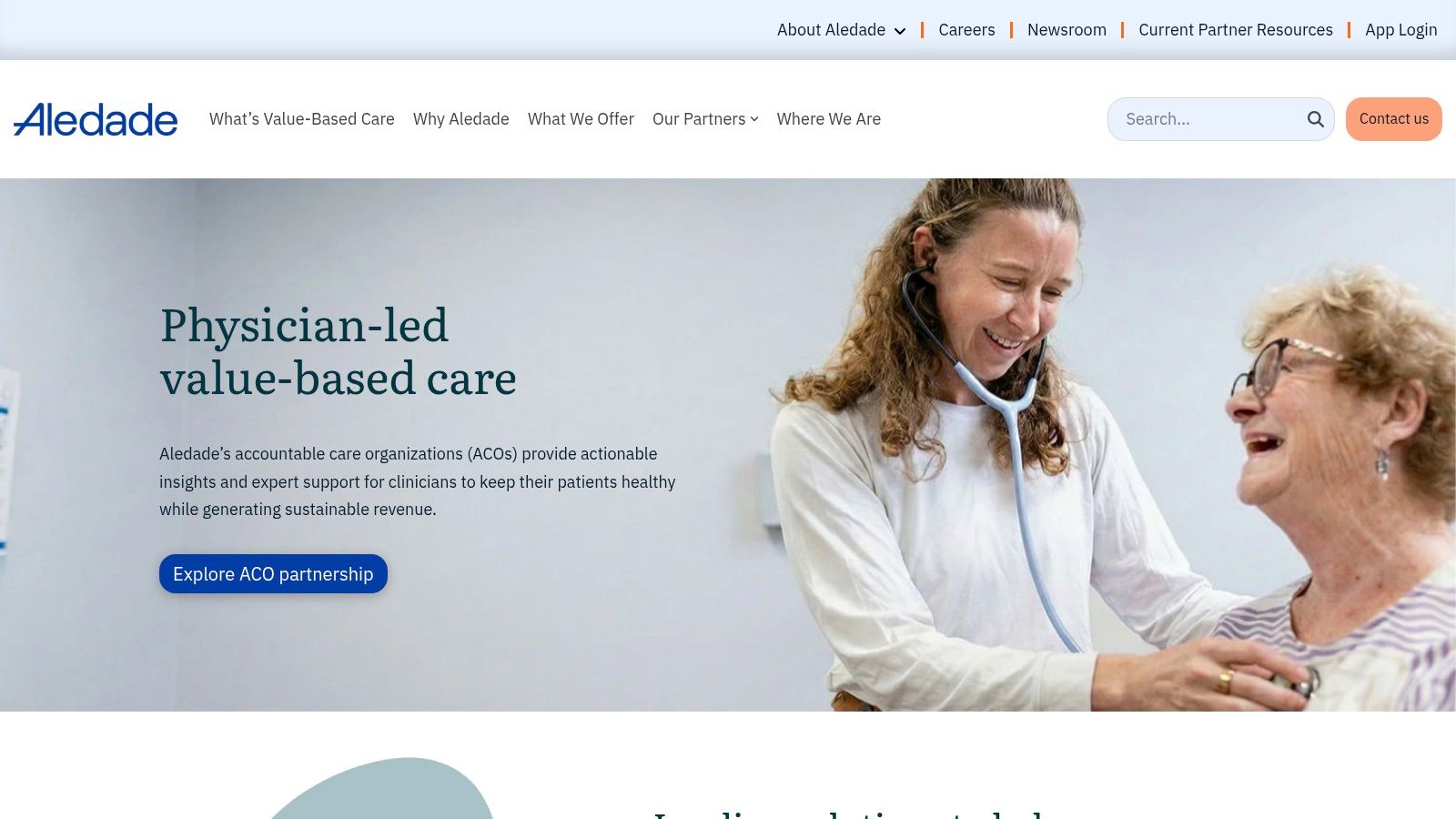
The company’s platform integrates with over 100 different Electronic Health Record (EHR) systems, a critical feature that solves a major technical headache for practices. This integration powers Aledade’s population health application, which gives physicians actionable insights at the point of care, such as identifying high-risk patients who are overdue for a wellness visit or need chronic care management. For example, a doctor might see a real-time alert for a diabetic patient who hasn't had an A1c test in six months, allowing them to schedule the test during that visit. It’s this combination of sophisticated software and in-person practice coaching that sets Aledade apart. They don't just hand over a tool; they embed their team with the practice to help redesign workflows and ensure the technology is used effectively.
Aledade's success is built on a foundation of practical, results-driven support for providers. Their core features are designed to directly address the operational and financial challenges of moving away from fee-for-service models.
The business model is primarily B2B, focused on primary care practices and community health centers. For practices, the cost is tied to the value-based care contracts and shared savings potential, so it's not a simple subscription fee. The investment is in a partnership where Aledade succeeds only when its partner practices do. While shared savings are not guaranteed and depend on performance, Aledade has a strong track record of generating significant savings and earnings for its network. This makes it an attractive choice for practices ready to commit to a new care delivery model.
Website: https://aledade.com
Tackling the rising tide of chronic disease, Omada Health stands out among health tech companies by offering a single, integrated virtual care platform for multiple conditions. Instead of forcing employers and health plans to piece together separate solutions for diabetes, hypertension, and musculoskeletal (MSK) issues, Omada combines them into one unified program. This approach simplifies vendor management for businesses and provides a seamless, consistent experience for members managing complex, often overlapping, health challenges. Their model pairs individuals with dedicated health coaches, provides connected devices like scales and blood pressure cuffs, and delivers personalized, science-backed interventions through a digital interface.

The platform is built for longitudinal care, meaning it supports members over the long term rather than through disconnected, episodic interactions. A member with both hypertension and pre-diabetes receives a consolidated care plan, interacting with their coach and tracking their data in one place. A practical example is a member stepping on their connected scale; if their weight trends upwards, their coach receives an alert and can proactively message them with encouragement and practical tips to get back on track. This integration is a key differentiator, as it allows for a more complete view of a person's health, addressing comorbidities directly. By combining human-led coaching with data from connected devices and app-based learning, Omada guides members toward sustainable behavior changes. This focus on long-term outcomes is a core part of its value proposition, attracting many employers looking for lasting impact.
Omada's platform is designed to drive member engagement and produce measurable clinical and financial outcomes for its enterprise clients. Its features address the entire chronic care journey, from prevention to management.
The business model is B2B, selling primarily to large employers and health plans. For members, access is typically offered as a covered benefit at no cost. The pricing for clients is contract-based and not publicly listed, but the option for performance-linked fees is a major draw. This model assures clients that they are paying for results, not just access to a platform. While the success of the program relies heavily on member adherence and the logistics of device delivery, Omada’s published case studies show significant cost savings and health improvements, making it a compelling choice for organizations serious about tackling chronic disease.
Website: https://www.omadahealth.com
Included Health tackles the often-fragmented and confusing patient journey by creating a unified front door to healthcare. For employees and health plan members, navigating benefits, finding a specialist, or getting a quick medical opinion can feel like an impossible maze. Included Health stands out among health tech companies by combining care navigation, advocacy, and direct virtual care services into one integrated platform. This model simplifies the experience for users while aiming to guide them toward higher-quality, lower-cost care options within their network, a win-win for the employers and health plans who are the primary customers.

The platform functions as a single point of entry for a wide array of services, from urgent and primary care appointments to behavioral health sessions and expert second opinions. A key differentiator is its deep focus on inclusive care, which originated from its roots as an LGBTQ+ focused healthcare service. In practice, this means when a member needs a gender-affirming care provider, their care team doesn't just provide a list; they actively find and vet specific doctors who are known to be competent and welcoming, and then help book the appointment. Instead of just offering a directory, Included Health provides a dedicated care team to help members with everything from understanding their benefits and finding an in-network therapist to resolving billing issues, making it a powerful advocacy tool.
Included Health's value proposition is built on simplifying access and guiding members through the complexities of the healthcare system. Its features are designed to consolidate multiple point solutions that employers might otherwise purchase separately.
The business model is B2B, selling directly to large employers and health plans who then offer the service as a benefit to their employees or members. Because access is tied to these contracts, there is no direct-to-consumer or self-pay pricing available. The success of the platform for an employer depends heavily on successful integration with their existing benefits ecosystem and effective campaigns to drive member awareness and activation. For members with access, it offers a single, trusted resource to manage their healthcare needs.
Website: https://includedhealth.com
Color Health is tackling two of the most significant and costly areas of healthcare: cancer and heart disease. Instead of focusing on treatment alone, the company has built a virtual clinic model centered on proactive risk assessment, early detection, and ongoing, physician-led support. By partnering with employers, health plans, and unions, Color makes its services available as a sponsored benefit, aiming to identify at-risk individuals long before symptoms appear and guide them through a complex healthcare system. Their approach is designed for the modern, distributed workforce, providing nationwide virtual access to specialized care.

The platform’s strength lies in its ability to create personalized care plans based on individual risk factors, including genetics, family history, and lifestyle. For members, this means getting a clear roadmap for screenings that is aligned with evidence-based guidelines, not just generic advice. A key differentiator for Color among health tech companies is its hands-on care navigation. For instance, if an at-home genetic test identifies a high risk for breast cancer, Color's clinical team doesn't just send a report. A physician contacts the member directly to explain the results, creates a personalized screening plan (e.g., annual mammograms starting at an earlier age), and helps coordinate appointments with in-network specialists. This human-centric layer helps close the loop between detection and action, a common failure point in traditional healthcare.
Color’s model is built on providing accessible, proactive care management for high-impact conditions. The features directly address the fragmentation and reactive nature of conventional health benefits.
The business model is B2B2C, selling directly to large employers and health plans who then offer it to their members. Because it is an employer-sponsored benefit, pricing is not available to individual consumers. The value proposition is clear: employers can lower long-term healthcare costs and improve productivity by catching serious diseases earlier. While members are still responsible for costs of diagnostic procedures through their regular insurance, Color’s coordination simplifies the process and removes barriers to getting necessary care. This focus on prevention and guided support makes it a powerful tool for population health management.
Website: https://www.color.com
Tempus AI is making significant strides in precision medicine by combining the power of artificial intelligence with comprehensive genomic and clinical data. Focused heavily on oncology, this company is one of the most compelling health tech companies because it provides clinicians with the advanced tools needed to make more personalized and data-informed treatment decisions. Their approach involves building a massive library of molecular and clinical data and using AI to uncover insights that can guide patient care, from diagnosis to therapy selection.

The company’s core technology bridges the gap between the laboratory and the clinic. Tempus offers a suite of clinical tests, including FDA-approved genomic profiling and liquid biopsy assays, which analyze a patient's tumor at a molecular level. The real distinction comes from what happens next: the results are contextualized within Tempus's vast, de-identified database. For example, an oncologist receives a report on a patient's lung cancer that not only identifies a specific genetic mutation but also shows data on how other patients with the exact same mutation responded to three different targeted therapies. This allows physicians to see how similar patients have responded to different treatments, giving them a powerful decision-support tool. It’s a B2B model that serves providers, academic medical centers, and life sciences companies, all of whom use the data platform for both clinical care and research.
Tempus AI's value is centered on its ability to generate and interpret complex data to make it clinically actionable. Its offerings are designed to support the entire cancer care continuum.
The business model is primarily B2B, with services accessed through healthcare providers. For patients, access to Tempus tests is typically initiated by their oncologist, and out-of-pocket costs can vary depending on insurance coverage and financial assistance programs. While patients do not interact with the platform directly, the company's work has a direct impact on their treatment journey. For providers and life sciences partners, Tempus offers a subscription or fee-for-service model for its data and testing services, positioning itself as a critical partner in the advancement of personalized medicine.
Website: https://www.tempus.com
Carbon Health is redesigning the patient experience by building a modern, tech-enabled healthcare network that blends virtual and in-person care. The company aims to make quality healthcare more accessible, understandable, and affordable, directly challenging the often confusing and fragmented nature of traditional providers. By combining urgent care, primary care, and telehealth into a single, cohesive system, Carbon Health provides a convenient access point for everything from a sudden illness to ongoing chronic condition management.

The core of the experience is the Carbon Health app, which serves as a central hub for patient records, appointment scheduling, and communication with providers. This digital-first approach allows for same-day or next-day appointment availability, both virtually and at their physical clinics. What truly sets them apart from many other health tech companies is their commitment to price transparency. For many common services, they publish clear, upfront self-pay prices. A patient needing stitches can look on the app and see the exact cost before booking, removing the guesswork and surprise bills that plague many patient journeys. This model is useful for consumers seeking straightforward care and for employers who need a distributed network to cover their workforce.
Carbon Health's platform is built around convenience and clarity, directly addressing common patient frustrations with the healthcare system. Its features are designed to create a seamless, patient-controlled experience.
The business model is a direct-to-consumer and B2B hybrid. Patients can pay directly with insurance or via the published self-pay rates. The cost for consumers varies by service, and while base prices are clear, additional services like labs or imaging may incur extra charges. For employers, Carbon Health offers occupational health and primary care solutions for their employees. This dual focus on individual patients and enterprise clients makes it a prominent choice for those seeking modern, accessible care.
Website: https://carbonhealth.com
Ro has established itself as a major player in direct-to-consumer healthcare, evolving from its initial focus on men's health into a vertically integrated telehealth platform. It stands out among health tech companies for its patient-centric approach to primary care-adjacent services, particularly in the high-demand area of weight management. Ro directly connects patients with physicians for virtual consultations and, crucially, integrates its own national pharmacy network for medication fulfillment. This end-to-end model gives the company control over the patient experience, from diagnosis to doorstep delivery.
The platform is designed for consumer-friendliness, tackling common healthcare frustrations like opaque pricing and insurance hurdles head-on. For its popular weight loss program, which includes access to GLP-1 medications like Ozempic and Wegovy, Ro publishes clear pricing for its membership and even provides an insurance concierge service to help patients determine their coverage. In practice, a patient fills out a questionnaire, has a virtual consult, and if prescribed a GLP-1, Ro's team handles the prior authorization paperwork with their insurance company, a notoriously difficult process for individuals to manage alone. This transparency and support builds trust and simplifies the decision-making process for consumers. By managing the entire care journey, Ro aims to provide a seamless, modern alternative to traditional care pathways for specific conditions.
Ro’s model is built on accessibility and a direct relationship with the patient. Its features are designed to remove friction from obtaining care and medication for a growing number of health concerns, with a current emphasis on metabolic health.
The business model is primarily direct-to-consumer (D2C), with patients paying for consultations, memberships, or out-of-pocket for medications. While the total monthly cost for cash-pay users, especially for weight-loss drugs, can be substantial due to membership fees and medication prices, the convenience and clarity are compelling. Ro’s upfront approach and support for insurance navigation make it a practical option for individuals seeking discreet, efficient care for specific health goals without the logistical challenges of the conventional system.
Website: https://ro.co
The health tech sector is not just growing; it's fundamentally reshaping how we access and receive care. Companies like Aledade, Omada Health, and Tempus AI are at the forefront of this movement, each tackling distinct challenges with powerful technological solutions. From Aledade's focus on value-based care for independent physicians to Color Health's large-scale public health infrastructure, the opportunities for impact are immense. We've seen how these organizations are not just looking for coders; they're searching for mission-driven engineers, product managers, and designers who want to solve complex problems in healthcare.
The common thread connecting these leading health tech companies is a relentless pursuit of talent capable of building secure, scalable, and user-centric platforms. Whether it's Ro developing direct-to-patient services or Carbon Health creating an integrated clinical operating system, the demand for skilled tech professionals has never been higher. Your technical expertise is the foundation, but demonstrating an understanding of the specific healthcare problem a company is solving will set you apart.
Breaking into one of these high-growth companies requires a deliberate and focused approach. Generic applications sent through massive job boards often get lost. To succeed, you need to align your personal narrative with the company's mission and the specific challenges of its sub-sector.
When you prepare your materials, go beyond just listing your technical skills. Frame your accomplishments as solutions to specific problems. An actionable way to do this is to describe your work using the "Problem-Action-Result" framework. For example, instead of saying you "built a data pipeline," describe it as "engineered a data pipeline (Action) to process terabytes of patient data daily (Problem), enabling a 20% faster diagnosis time in clinical trials (Result)." This connects your work directly to real-world impact.
What are health tech companies?Health tech companies are organizations that use technology to improve healthcare delivery, access, outcomes, or administration. The category is broad and includes companies building telehealth platforms that connect patients with physicians virtually, AI-driven diagnostic tools that help clinicians make more informed treatment decisions, population health platforms that manage chronic disease at scale, precision medicine companies that use genomic data to guide oncology care, and direct-to-consumer services that simplify access to medications and ongoing care. What distinguishes health tech from traditional healthcare is the technology-first approach: software, data infrastructure, and AI are core to how these companies deliver their value rather than an add-on to existing clinical services.
Several high-profile health tech companies are actively hiring engineering, product, and data talent heading into 2026. Aledade, which supports independent primary care practices in value-based care models, continues to expand its engineering and data teams as it grows its network of accountable care organizations. Omada Health is hiring for roles supporting its multi-condition digital chronic care platform. Included Health is building out its integrated navigation and virtual care product. Color Health is growing its engineering team to support its cancer and cardiometabolic screening programs. Tempus AI is hiring data scientists, engineers, and bioinformatics specialists to advance its precision oncology platform. Carbon Health is hiring for both its hybrid clinic technology and telehealth product. And Ro is actively building out engineering and product talent to support its direct-to-consumer telehealth and integrated pharmacy model.
Software engineering — particularly backend, full-stack, and infrastructure — is consistently the highest-demand discipline across health tech companies. Data engineering and data science roles are also in strong demand, especially at companies like Tempus AI and Color Health that operate data-intensive platforms centered on genomics, clinical records, and population health analytics. Product managers with experience in consumer-facing health products, B2B SaaS platforms, or regulated healthcare environments are highly sought after. Machine learning engineers are a growing priority as more health tech companies embed AI directly into clinical workflows. Additionally, security engineers and compliance-focused technical roles are increasingly important because of HIPAA requirements and the sensitivity of health data. Across all of these disciplines, candidates who combine technical depth with an understanding of healthcare workflows or patient experience tend to stand out significantly.
The most significant difference is mission weight — work at a health tech company has direct implications for patient outcomes, which creates a higher sense of purpose for many employees but also introduces real regulatory and compliance complexity. Engineers and product managers work within the constraints of HIPAA (the Health Insurance Portability and Accountability Act), which governs how patient data is stored, accessed, and transmitted. This adds meaningful overhead to product decisions and system design that you would not encounter at a typical consumer tech company. Health tech also involves navigating complex stakeholder ecosystems — products may need to work with electronic health records, insurance payers, clinical workflows, and direct patients simultaneously. For the right candidate, this complexity is intellectually rewarding; for candidates used to simpler product environments, it requires a meaningful adjustment period.
The core technical skills valued across health tech are similar to those valued across technology broadly — software engineering proficiency, data fluency, and product thinking. However, certain skills carry additional weight in the health tech context. Experience building HIPAA-compliant systems or handling personally identifiable information is a meaningful differentiator. Knowledge of healthcare data standards like HL7 and FHIR is highly relevant for engineers building integrations with electronic health records. For data and AI roles, experience with clinical datasets, genomic data, or behavioral health data signals domain readiness. On the product side, familiarity with regulated product development, clinical workflows, or the dynamics of B2B2C healthcare platforms — where the employer or health plan is the customer but the patient or member is the end user — is valuable. Across all roles, demonstrated curiosity about healthcare as a domain and the ability to articulate why improving patient outcomes matters to you will consistently come up in interviews at mission-driven health tech companies.
Health tech companies vary significantly in their remote posture depending on whether they have physical clinical operations. Companies that are purely digital — like Omada Health, Included Health, Color Health, and Ro — tend to be meaningfully remote-friendly for engineering, product, and data roles, since their products are delivered virtually and their teams are built around distributed collaboration. Companies with hybrid models that include physical clinic networks — like Carbon Health — may be more location-specific for roles tied to clinical operations or on-the-ground support, while their engineering and product teams often remain flexible. Precision medicine companies like Tempus AI, which have laboratory operations, tend to be more location-specific for lab and clinical roles while offering remote or hybrid flexibility for software and data engineering. In interviews, it is always worth asking specifically about the hybrid expectations for the particular team you would be joining rather than relying on the company's general remote policy.
Value-based care is a healthcare delivery model in which providers are reimbursed based on patient health outcomes rather than the volume of services they perform. In the traditional fee-for-service model, a hospital or clinic earns more by doing more — more tests, more visits, more procedures. Value-based care flips this by rewarding providers who keep patients healthier and out of the hospital, reducing total cost of care for insurers and government payers. For health tech companies, this shift is enormously consequential: software platforms that help providers identify high-risk patients before they get sick, track gaps in care, and manage chronic conditions proactively are central to making value-based care work at scale. Aledade's entire business model is built around helping independent primary care practices succeed in value-based contracts. For engineers and product managers entering health tech, understanding this distinction helps explain why population health, data analytics, and care coordination tools are so heavily funded and in-demand right now.
A direct healthcare background is not a prerequisite for most engineering, product, or data roles at health tech companies. These companies hire for technical excellence first and domain knowledge second — the expectation is that a strong candidate will develop healthcare domain fluency on the job. That said, demonstrating genuine curiosity about the healthcare problem a company is solving is consistently cited by health tech hiring managers as a differentiator. Concretely, this means researching the company's specific sub-sector (telehealth, value-based care, precision medicine, digital therapeutics) before interviews and being able to speak to the problem they are solving and why it matters. Framing your past technical work using the Problem-Action-Result method — connecting your engineering or product contributions to real-world impact — also translates well because health tech companies are deeply outcome-oriented. Platforms like Underdog.io are particularly effective for breaking into health tech because your profile is presented to vetted startups in the sector that are actively looking for technical talent, reducing the dependency on domain-specific keywords in your resume.
The terms overlap considerably and are often used interchangeably, but they carry loose distinctions. Health tech is the broadest category and generally refers to any technology applied to healthcare — it encompasses software, data, AI, devices, and platforms. Digital health is a subset that specifically focuses on software-based interventions delivered through digital channels: mobile apps, telehealth platforms, patient engagement tools, and digital therapeutics. Med tech (or medtech) traditionally refers to physical medical devices and equipment — things like diagnostic imaging systems, surgical robots, and wearable health monitors — though the line has blurred as devices have become increasingly software-driven. For job seekers, the practical implication is mostly about the regulatory environment: med tech companies often operate under more rigorous FDA device regulation, while digital health companies navigate primarily HIPAA compliance and, for clinical-grade software, FDA's software-as-a-medical-device (SaMD) guidance.
HIPAA (the Health Insurance Portability and Accountability Act) is the primary regulatory framework governing how health information is collected, stored, processed, and transmitted in the United States. Health tech companies are required to implement a comprehensive set of administrative, physical, and technical safeguards to protect individually identifiable health information, known as Protected Health Information or PHI. In practice, this means engineering teams design systems with encryption at rest and in transit, strict access controls and audit logging, data minimization principles, and business associate agreements with any third-party vendors who handle PHI. For engineers joining health tech companies, HIPAA compliance shapes architecture decisions in meaningful ways — cloud infrastructure configurations, database design, API security, and even development workflows must account for the requirements. Most health tech companies provide onboarding training on HIPAA obligations and have designated privacy and security officers who work alongside engineering teams to ensure compliance.
Deciding which type of health tech company aligns with your career goals is a critical first step. Are you drawn to the fast-paced, direct-to-consumer environment of a company like Ro? Or do you prefer the complex data challenges presented by an organization like Tempus AI? To get a better sense of the roles and responsibilities involved, it helps to see what opportunities exist across the wider tech landscape. As you consider your next steps, it's beneficial to explore diverse career paths by reviewing the types of roles available in the broader tech industry. This can provide valuable context for how your skills translate.
The ultimate challenge is getting your carefully crafted profile in front of the right people. This is where moving beyond traditional job search methods becomes a strategic necessity. The most sought-after health tech companies are actively sourcing candidates from curated talent marketplaces where they know the applicants are pre-vetted and serious about their next role.
Ready to skip the endless applications and connect directly with top health tech companies? Create a single profile on Underdog.io and let hiring managers from high-growth startups apply to you. Join the talent marketplace designed to put skilled tech professionals in front of the teams building the future of healthcare.


