Most startup teams hit the same wall. You post the role, sort through resumes, and end up with a stack of profiles that all sound polished and oddly similar. Everyone says they shipped products, moved fast, and worked cross-functionally. Very few give you real evidence.
That's why teams try to hire on GitHub.
Not because GitHub is some magic sourcing shortcut. It isn't. The value is that GitHub shows traces of how some engineers work. You can see ownership, consistency, collaboration, and technical judgment in a way a resume rarely captures. For startups, that matters more than pedigree. Early hires need to solve messy problems, communicate in public, and move without much structure.
The mistake is treating GitHub like a bigger LinkedIn with code attached. The startups that use it well read it more like a working portfolio. They look for evidence, not aesthetics. They care less about popularity and more about whether a person can build, iterate, and collaborate in an environment where nobody hands them a perfect spec.
A founder hiring their second or third engineer usually isn't struggling because there are no applicants. They're struggling because the signal is weak. Traditional job boards favor candidates who know how to package themselves. Startups usually need candidates who can operate in ambiguity, make good tradeoffs, and leave systems better than they found them.
GitHub changes the starting point. Instead of asking, “Can this person describe technical work well?” you get to ask, “What work have they chosen to do, and how did they do it?”
That's a better question.
GitHub is most useful when you treat it as a craftsmanship filter, not a full hiring system. It can reveal things that are hard to fake:
Those signals matter in startups because the job is rarely confined to a neat job description.
Practical rule: Don't use GitHub to decide who is qualified in the abstract. Use it to gather evidence about how someone works when nobody is managing the optics.
GitHub is not a complete talent market. It misses strong engineers who work mostly in private repos, people with security or confidentiality constraints, and developers who do not enjoy building in public. That means a weak GitHub profile shouldn't knock someone out by itself.
A quality-first hiring mindset is especially helpful. A curated approach beats a wide funnel full of flimsy signals. If you're hiring for a startup, you don't need the most profiles. You need a smaller set of candidates with credible evidence and a sensible way to validate what you see.
A simple operating model looks like this:
That's how to hire on GitHub without fooling yourself.
The biggest GitHub recruiting mistake is confusing visibility with quality. A profile can look impressive and still tell you almost nothing. Plenty of recruiters scan follower counts, stars, and contribution heatmaps as if they're a scoreboard. They aren't.
One reason is simple. GitHub is large, but the useful hiring subset is much smaller. One analysis found that only 17% of GitHub users pushed any code in the last year, while 83% had no commits in that period. The same analysis also noted that 88% had no followers, which shows how little public activity most profiles contain for hiring decisions (analysis of GitHub's limits for hiring).
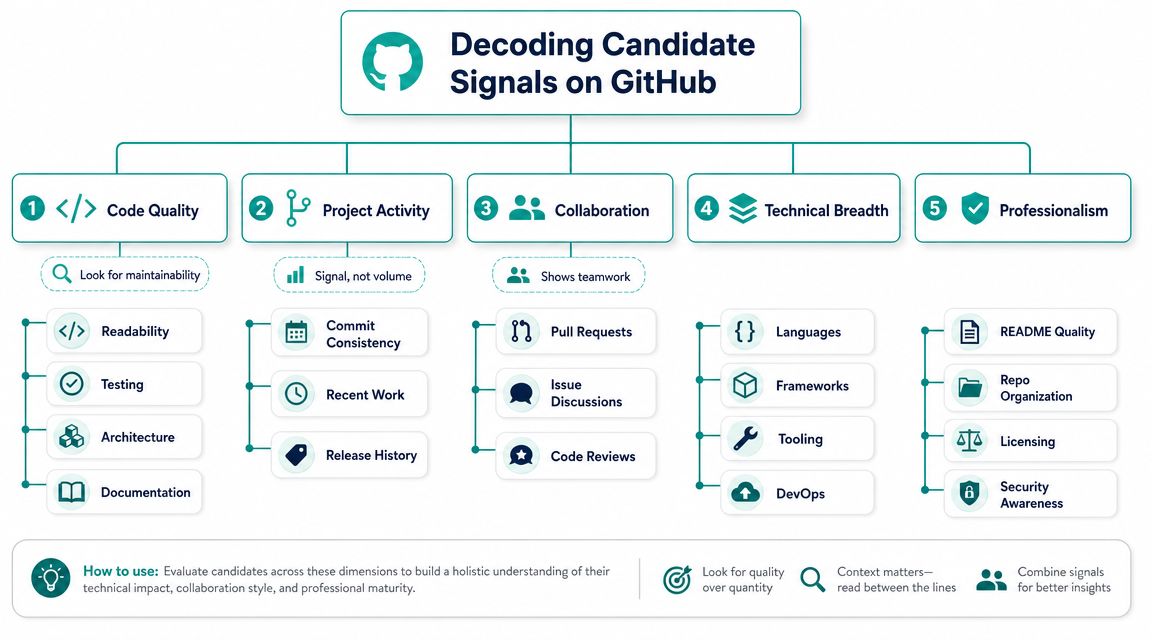
Follower count is noisy. So are stars in isolation. Even a packed profile can be misleading if the underlying activity is shallow, old, or disconnected from the kind of work your startup needs.
A fast first pass should screen out weak indicators like these:
| Weak signal | Why it misleads |
|---|---|
| Lots of stars | Popular repos can reflect distribution, trend timing, or novelty rather than engineering depth |
| Follower count | Social visibility isn't the same as technical ownership |
| Old side projects | Dormant work tells you less about current ability and engagement |
| Huge repo volume | Quantity without maintenance or substance often signals abandoned experiments |
That doesn't mean these metrics are useless. It means they need context.
Hiring managers who use GitHub tend to value traits that are easy to verify and harder to fake, especially frequency of activity and evidence of ownership. That makes GitHub closer to a portfolio review than a resume screen (summary of what hiring managers look for on GitHub).
The profiles worth your time usually show a pattern like this:
The question isn't “Is this person famous on GitHub?” It's “Is there enough public evidence to trust the next conversation is worth having?”
Startup-fit signals often sit between the lines. A candidate who improves documentation, responds well in pull request feedback, or steadily maintains a niche tool may be more valuable than someone with flashier public repos.
Why? Because startups need engineers who finish things, unblock others, and keep moving when requirements shift. GitHub can surface that, but only if you read behavior instead of scanning metrics.
Once you've found a profile worth opening, stop skimming and start inspecting. The repository review is where GitHub becomes useful. You're no longer asking whether the profile looks active. You're asking whether the work shows judgment.

A practical workflow is to combine language: searches with type:user, then screen for sustained signals like recent activity, meaningful repository ownership, and clear commit messages. Many teams then use a paid trial project to validate practical skill in the actual environment (practical GitHub hiring workflow from GitHub Community discussion).
A high-signal repo doesn't need to be huge. It needs to be legible.
Look for a few basics:
Then look one level deeper. Ask whether the person made tradeoffs a startup engineer would need to make. Did they keep things simple? Did they build only what the project demanded? Did they leave enough explanation for the next person?
Commit messages are underrated. A messy stream of “fix stuff,” “updates,” and “final final” isn't disqualifying, but it does reduce trust. Clear commits suggest the engineer can isolate changes, explain intent, and work in a way teammates can follow.
A useful pattern is to scan commit history for:
If you want to systematize that review at scale, tools and scripts can help summarize contribution patterns. For teams doing deeper sourcing analysis, exploring GitHub's contributions API can be a practical way to inspect public activity without relying on surface-level profile views.
A repository is strongest when you can tell what problem it solves, how the engineer approached it, and how they handled the boring but essential parts.
Personal repos are useful, but outside contributions can be even more revealing. They show whether someone can enter an unfamiliar codebase, follow conventions, and collaborate under review.
Here's a simple contrast:
| High-signal contribution | Low-signal contribution |
|---|---|
| PR includes context, reasoning, and follow-up changes | PR is dropped in with little explanation |
| Candidate responds thoughtfully to review | Candidate goes silent or gets combative |
| Work fits project standards and docs | Work solves the issue but ignores maintainability |
| Contribution improves code, tests, or docs | Contribution is cosmetic and isolated |
For startup hiring, this matters a lot. Most engineers won't build from a blank page. They'll join a moving system, inherit constraints, and need to improve things without drama. GitHub contribution history can show whether they do that well.
A final note. Don't confuse elegant code with job readiness. The profile review should earn the candidate a real conversation, not a job offer.
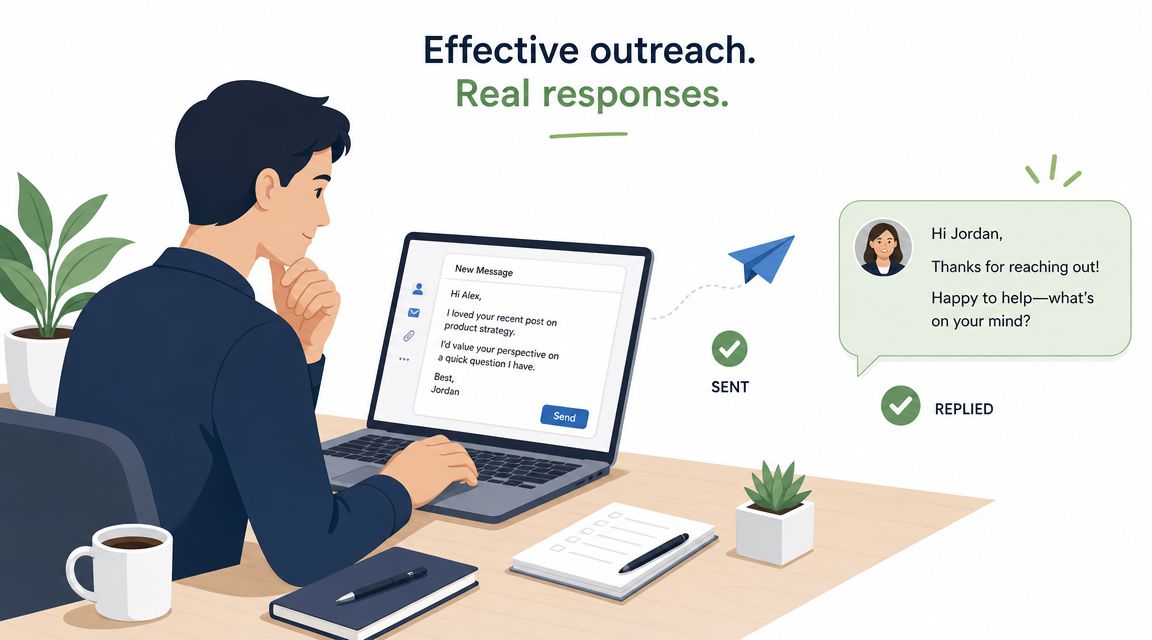
Most GitHub outreach fails because it reads like the sender never opened the profile. Candidates can tell in one sentence. If your message could be sent to fifty other engineers unchanged, it will be ignored like the other forty-nine.
Personalization isn't a nice extra. Recruiter guidance from Daily.dev says referencing specific public work, such as commits or pull requests, can increase response rates by up to 60% compared to generic bulk outreach (Daily.dev guidance on GitHub sourcing outreach).
Here's the bad version:
Hi, I came across your profile and was impressed by your background. We're hiring a talented full-stack engineer for an exciting startup. Competitive comp, great team, huge opportunity. Open to chatting?
It says nothing. It proves nothing. It puts all the work on the candidate.
A better version sounds like this:
Hi Maya, I found you through your work on a TypeScript tooling project and your pull request around build performance caught my eye. The way you explained the tradeoff in the discussion was especially relevant. We're hiring an engineer to improve developer workflows inside a small product team, and that part of your GitHub work maps closely to the job. If it's useful, I can send a short note on the problems we're trying to solve and what the team looks like.
That message works because it answers three questions immediately: why this person, why this role, and why now.
Keep the first note short, but make it specific.
For more practical outreach examples, Underdog's guide on how to write recruiting outreach that works is worth keeping in your playbook.
Subject lines matter more than many recruiters think, especially when the candidate doesn't know your company yet. If you want a quick refresher on formatting choices that affect readability, this guide on email subject line capitalization is a useful reference.
The follow-up cadence matters too. One thoughtful follow-up is normal. Repeated nudges with no new information feel lazy.
If your second message doesn't add context, it's not a follow-up. It's a repeat.
Also remember the privacy line. You're using public work, not granting yourself unlimited license to be invasive. Reference what's public, keep it relevant to the role, and don't write as if you've built a dossier.
The strongest GitHub hiring strategy doesn't start with search syntax. It starts with credibility. If your company has no visible engineering presence, your outreach asks candidates to trust a story they can't verify.
That's a hard sell, especially for experienced developers.
Broader recruiting research suggests using GitHub more as a community-engagement channel than a pure candidate database, because stronger opportunities often come from building credibility through contributions rather than direct search alone (GitHub recruiting perspective from HeroHunt).
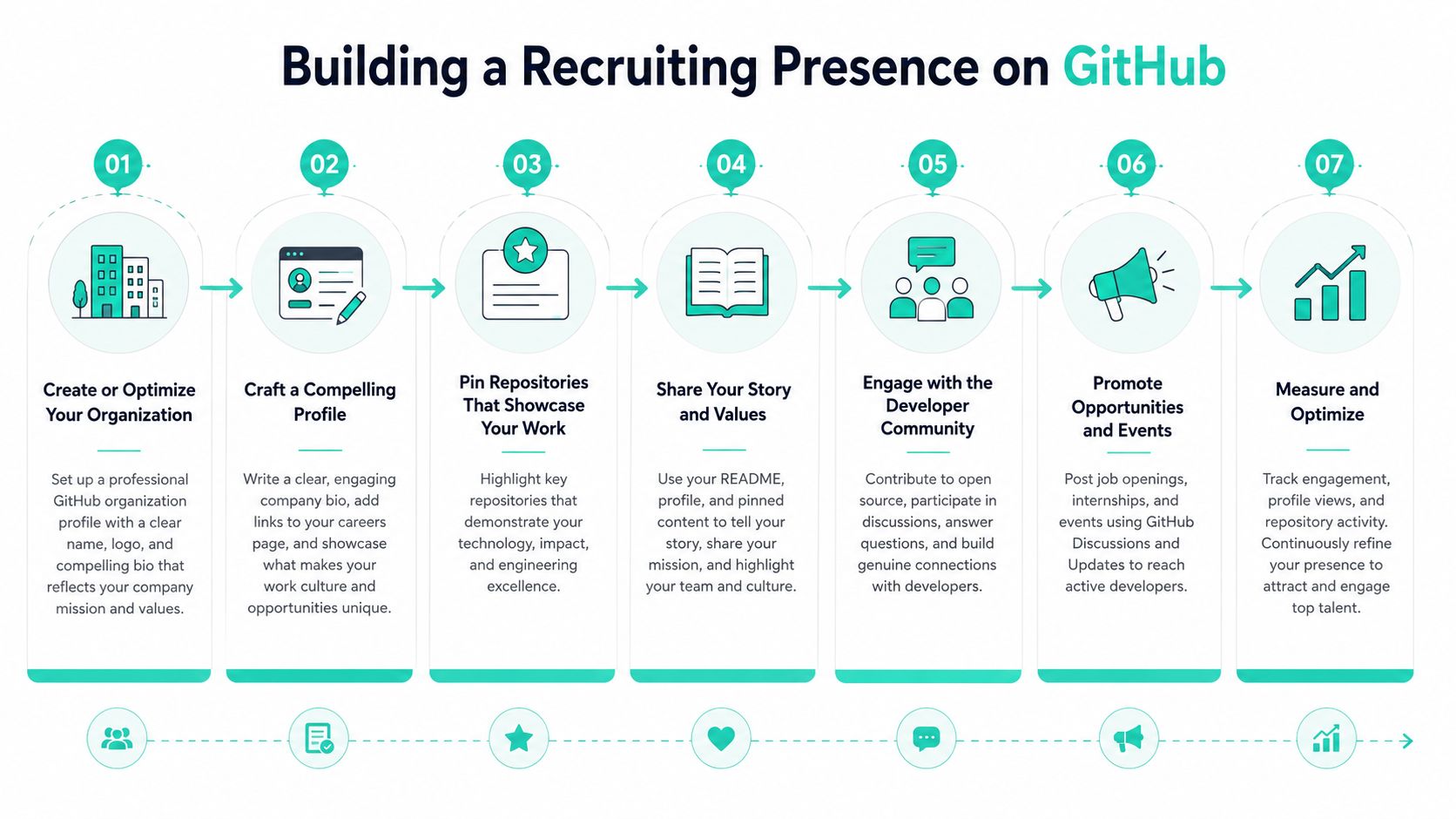
A startup doesn't need a huge open-source program to be visible on GitHub. It needs consistency and substance.
That usually means:
The goal isn't vanity. It's proof that your technical culture exists outside recruiting copy.
When engineers see your team fixing issues, shipping improvements, and participating constructively, they build an opinion about your company before any recruiter reaches out. That's the point where GitHub stops being only a sourcing tool and starts becoming part of your employer brand.
There's overlap here with broader company visibility work. If your team is thinking about how technical reputation fits into overall awareness, ClipCreator.ai's guide on brand building offers a useful framing for how repeated, credible signals compound over time. For startup hiring specifically, Underdog also has a practical resource on employer branding best practices.
A few concrete moves work well:
Open-source something small but useful
A deployment script, CLI helper, internal library, or starter kit can do more for credibility than a glossy careers page.
Make maintainers visible
Let engineers attach names and faces to public work when appropriate. Candidates trust people more than logos.
Respond well in public
How your team handles bugs, questions, and pull requests tells candidates what collaboration inside the company probably feels like.
Create a path from contribution to conversation
If someone engages actively with your repos, don't force them into a generic application funnel. Treat that contribution history as real signal.
The companies that hire well on GitHub usually look like participants first and recruiters second.
That's especially important for startups. You may not win on compensation brand or household recognition. You can still win on technical honesty, accessibility, and visible craftsmanship.
A candidate has a sharp GitHub profile, a few thoughtful pull requests, and a repo that suggests real ownership. Then the interview loop ignores all of it and falls back to whiteboard questions and generic behavioral prompts. That is how teams waste the signal they worked to find.
Public code should shape the interview plan. It gives you something far better than hypotheticals. You can ask about decisions the candidate made, trade-offs they faced, and feedback they handled.
The best interviews start from specific artifacts, not broad prompts. A maintained repo can tell you how someone scopes work, names abstractions, writes for other engineers, and cleans up after themselves. A pull request in someone else's project can tell you even more. It shows how they enter an unfamiliar codebase, respond to review, and work within constraints they did not set.
Use questions like these:
Those questions are especially useful for startups because startup hiring is rarely about raw coding ability alone. You are hiring for judgment under limited time, comfort with ambiguity, and the ability to collaborate without a lot of process overhead.
GitHub is strong evidence. It is not complete evidence.
Some candidates do excellent work in private repos. Others have impressive public projects that do not reflect how they work on a team. The cleanest way to close that gap is a paid trial project that resembles the actual job. Keep it narrow, pay for the time, and score it against the things that matter in an early-stage company: technical choices, written communication, iteration speed, and how the person handles feedback.
I trust this approach more than stretching a GitHub profile into a full hiring decision. The profile gives context. The work trial shows fit.
If you want to show candidates what stronger public signals look like from their side, Underdog has a practical guide on how to make your GitHub more impressive to employers.
A confident hire does not come from a polished profile alone. It comes from connecting visible work to a sharper interview, then confirming the missing pieces with structured evaluation. For startup teams, that usually leads to better decisions than a resume screen ever will.
If you're building a startup team and want a narrower, more curated pipeline alongside channels like GitHub, Underdog.io is one option to consider. It connects tech candidates and startups through a selective marketplace, which can complement community sourcing when you want stronger upfront filtering and a more focused set of introductions.