Your startup needs a Node.js developer now. The API is growing, the frontend team is waiting on stable contracts, and the next release depends on someone who can do more than complete a coding exercise. A candidate may describe years of JavaScript experience, then struggle with a failed deployment, an exhausted database pool, or an endpoint that blocks the event loop under load.
That gap is the core challenge in hiring Node.js developers. You aren't just looking for someone who can write JavaScript on a server. You need an engineer who can make sound trade-offs, protect production systems, communicate with product teams, and work across the stack when resources are tight. The strongest early-stage hire also may not be the deepest Node.js specialist. It may be the adaptable engineer who connects runtime knowledge to customer outcomes.
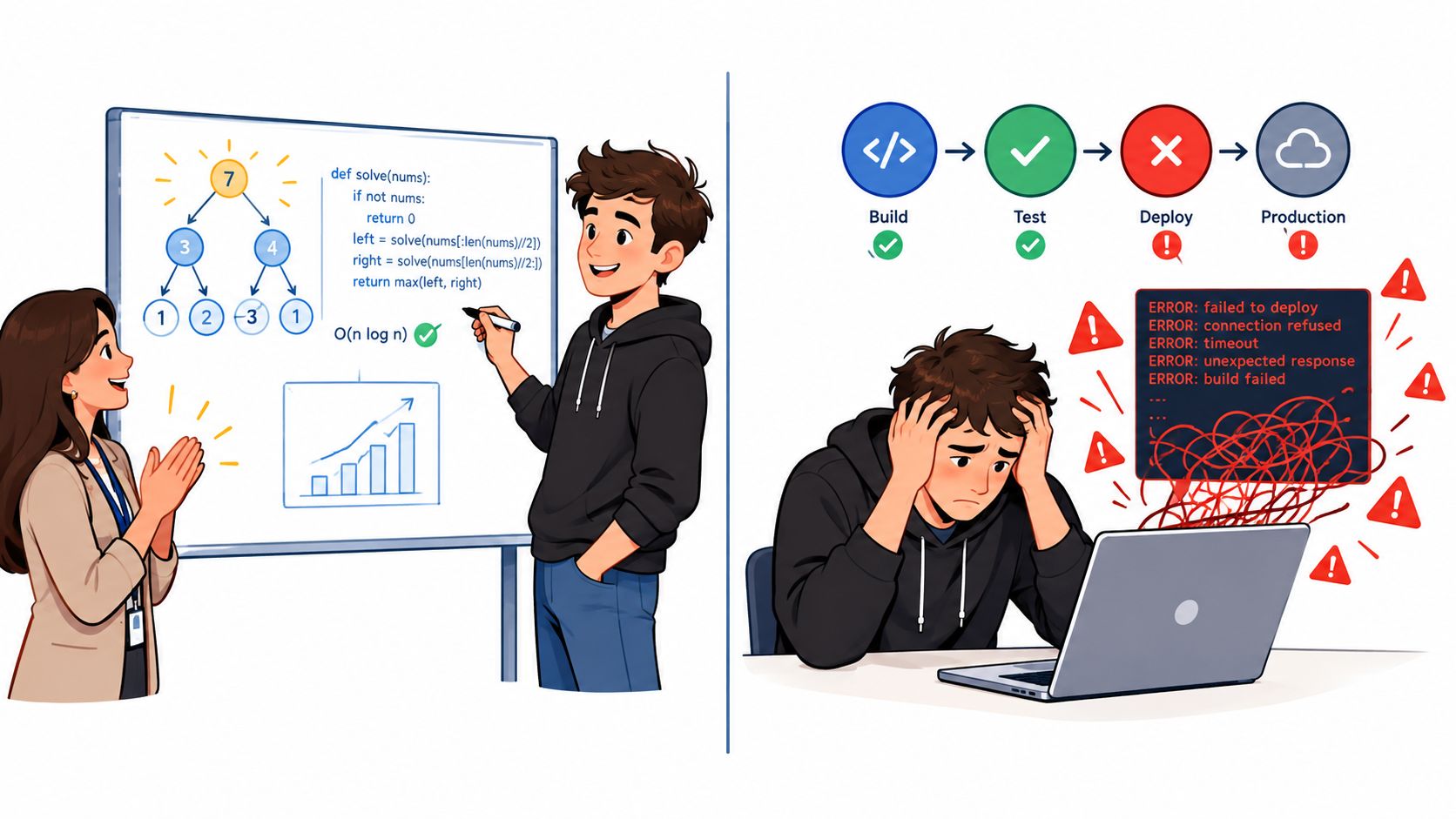
A common hiring failure looks impressive at first. The candidate solves algorithm questions quickly, explains framework terminology fluently, and has a polished résumé. Two weeks after joining, a deployment fails because an environment variable wasn't available, an API returns three different error formats, and nobody can explain why latency rises whenever a large payload arrives.
The problem isn't that algorithms are irrelevant. The problem is that algorithmic performance gets treated as a substitute for production judgment. Startups need engineers who can investigate, make changes safely, and leave the system easier to operate than they found it.
Node.js remains a durable part of the web-development market. In Stack Overflow's 2024 Developer Survey, 40.8% of respondents reported using Node.js, making it the most-used web technology in that survey, narrowly ahead of React at 39.5%. Usage also reached a historical high of 51% in the 2020 survey, which shows sustained adoption rather than a short-lived trend.
That breadth helps startups recruit across backend, full-stack, API, real-time, and JavaScript product teams. It also creates a screening problem. A résumé that says “Node.js” could represent anything from tutorial-level Express work to ownership of distributed services, observability, security, and deployment.
The wider labor market makes precision even more important. The U.S. Bureau of Labor Statistics projects software-developer employment to grow 17.9% from 2023 to 2033, compared with 4.0% growth for all occupations. The projection covers software developers generally, not Node.js-specific roles, but it describes the competitive environment your hiring team is entering.
Practical rule: Treat Node.js as a production operating environment, not a résumé keyword.
Replace trivia with evidence. Ask candidates to diagnose a slow endpoint, explain an unhandled Promise rejection, review a vulnerable dependency update, or design an idempotent webhook handler. These scenarios reveal how they think when requirements are incomplete and the consequences are real.
The best hire balances runtime depth with range. A specialist who knows every detail of one framework may be valuable on a mature platform team. An early-stage company often needs someone who can also shape API contracts, improve tests, read database plans, inspect logs, and work with cloud infrastructure. The right assessment makes that distinction visible before you commit your runway and your team's time.
A job description should tell qualified engineers what they'll own and give unqualified applicants a reason to opt out. “Node.js developer wanted” does neither. It attracts keyword matchers and leaves experienced candidates guessing about the actual operating environment.
Start with the product risk. If the engineer will own payment workflows, emphasize idempotency, failure handling, auditability, and security. If the role supports a real-time collaboration product, describe WebSocket behavior, connection management, and observability. If the first release is a small internal tool, don't demand deep Kubernetes expertise that the job won't use.
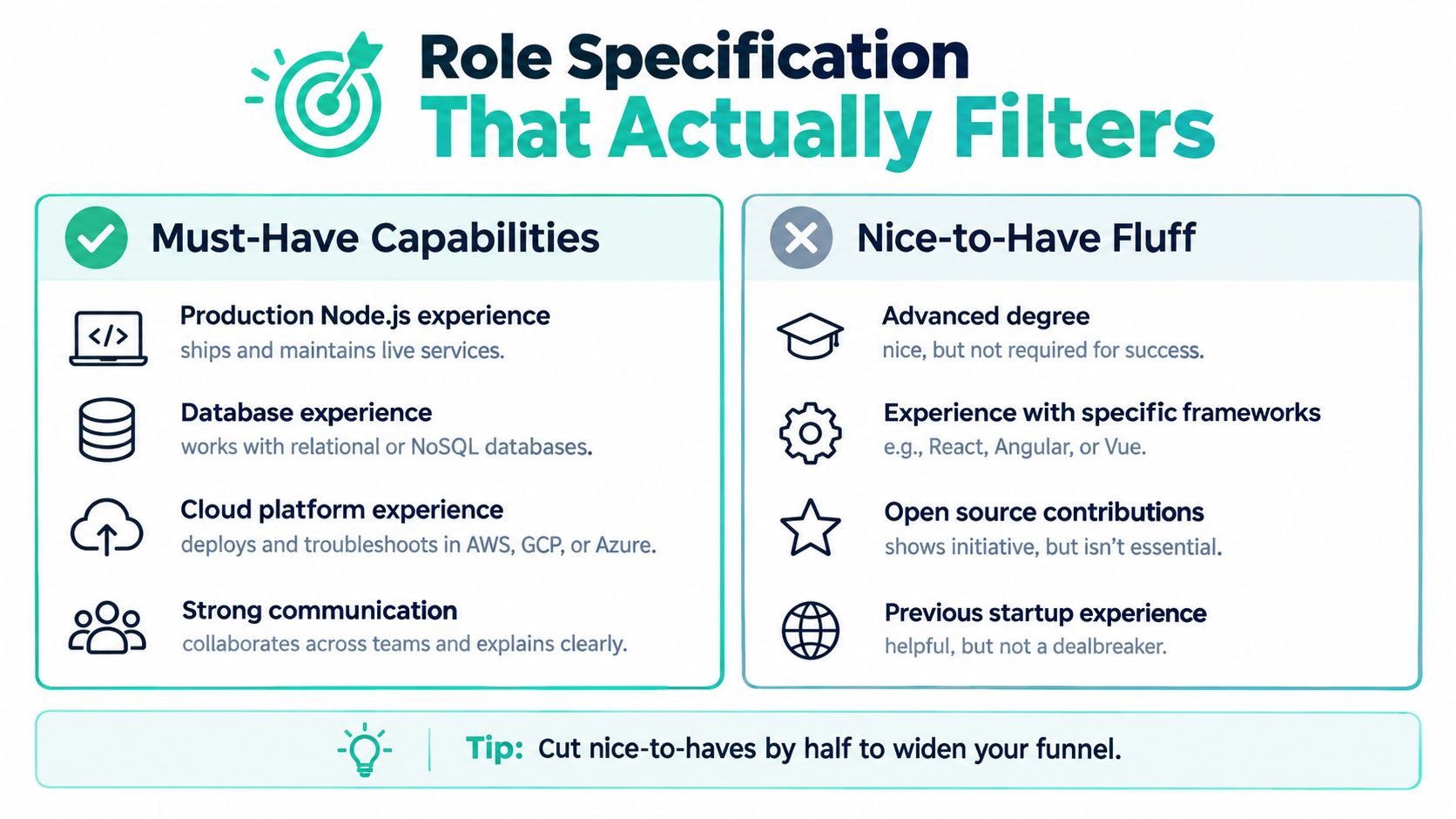
Write the scorecard in two layers. The first contains capabilities that transfer across frameworks:
async and await, event-loop behavior, backpressure, and the consequences of blocking work.The second layer lists context-dependent tools. Express, NestJS, Fastify, Prisma, PostgreSQL, AWS, Docker, and a specific CI/CD platform may matter, but don't turn every familiar tool into a hard gate. A strong engineer can learn a framework. Weak asynchronous reasoning and poor failure handling are harder to repair.
Include the runtime version policy, deployment model, database choices, TypeScript expectations, on-call responsibilities, and the first problems the hire will solve. Node.js documentation recommends using Active LTS or Maintenance LTS releases in production, so candidates should know whether they'll work on a supported release and what upgrade ownership looks like.
Then state what success means in practical terms. “Own the backend” is vague. “Stabilize the webhook service, introduce consistent error responses, add regression coverage around retries, and document the deployment path” gives candidates something concrete to evaluate.
A useful reference for defining the broader traits early-stage teams need is this guide to attributes to look for in early-stage employees. Adaptability matters, but don't use it as permission to create an unlimited wishlist.
Add a short “first 90 days” section, a realistic description of collaboration, and a clear explanation of the interview process. Candidates with production experience will use those details to judge whether the role is serious.
Remove requirements that don't connect to the work. A startup that needs an API owner shouldn't reject an excellent candidate because they used Fastify instead of Express. Conversely, a candidate who only lists framework names shouldn't pass if the role requires incident response, database debugging, and secure deployment.
The sourcing channel affects the signal you receive. Broad job boards maximize volume, but they also force your team to spend time separating tutorial familiarity from production experience. Curated communities and targeted outreach produce fewer conversations, yet those conversations often contain more context.
| Channel | Cost | Quality Signal | Speed |
|---|---|---|---|
| Curated startup marketplace | Success-based or platform-dependent | Strong, because profiles are reviewed and startup fit is considered | Fast once the role is approved |
| General job board | Posting and recruiting time | Mixed, with heavy résumé filtering required | Fast to publish, slower to qualify |
| Engineering communities | Usually low direct cost | Strong when contributions, discussions, or projects are visible | Moderate |
| Employee referrals | Referral incentive and coordination | Often strong because someone vouches for working style | Fast when your network is active |
| Targeted passive outreach | Recruiter or founder time | High when the message references relevant production work | Moderate |
| Nearshore partner | Engagement cost | Depends on technical vetting and delivery model | Can be practical for distributed teams |
The choice should match the constraint. If you have a strong engineering brand, a referral network may be enough. If you need a senior hire quickly and your internal recruiter doesn't understand event-driven systems, a curated pipeline can reduce wasted interviews. If time-zone coverage and distributed collaboration matter, research options such as nearshore hiring in Latin America before deciding that location alone determines quality.
Passive engineers ignore generic messages because generic messages reveal that nobody read their background. Mention the service problem, the team's current stack, and the decision the candidate would own. “We need someone who can improve our API” is weak. “You'd own the webhook platform, replace its inconsistent retry behavior, and work with a product team that already ships in TypeScript” gives the conversation a reason to exist.
Community participation works the same way. Don't enter a discussion only to advertise a role. Contribute to technical conversations, share a clearly described engineering problem, and invite people who have demonstrated relevant judgment. Production-ready talent usually wants to understand the quality of the engineering environment before discussing compensation.
A hiring funnel that produces hundreds of weak applications can feel active while making the decision slower. Define a short list of evidence signals before sourcing begins:
That standard also helps you evaluate agencies and staffing firms. Ask how they verify production experience, whether you'll see actual technical context, and what happens when a candidate looks good on paper but fails the work sample.
The technical screen should resemble the job. Give candidates a small TypeScript service with asynchronous database calls, input validation, rate limiting, and inconsistent error handling. Ask them to repair it, add tests, and explain the trade-offs they made.
Don't grade only the final diff. Watch how the candidate establishes a baseline, forms a hypothesis, and verifies the result. A strong engineer may pause to inspect logs, reproduce the issue, and identify the smallest safe change. Someone who immediately rewrites the service may be fast, but speed without diagnosis creates operational risk.
A consistent exercise makes comparison easier and reduces the influence of interviewer charisma. A practical review can score:
Research summarized by Schmidt and Hunter reports average validity of approximately 0.51 for structured interviews and 0.54 for work-sample tests in the source discussed by this analysis of technical interviewing and AI-assisted submissions. The figures don't turn an assessment into a perfect predictor, but they support using structured evidence rather than relying on unstructured conversation.
Give the candidate a service with a specific bottleneck, such as synchronous file access, excessive JSON processing, an unbounded in-memory cache, or a database connection-pool failure. Ask them to record a baseline for requests per second, p95 or p99 latency, error rate, CPU, and heap usage under the stated workload.
Then require a profile before an optimization. The candidate should explain the event-loop impact, make a change, add a regression test, and describe how they'd monitor the metric after deployment. Node.js performance guidance recommends establishing baselines for RPS, p99 latency, and error rate, then profiling before optimization.
Don't set a universal pass threshold. Hardware, payload size, database latency, and concurrency model change the result. Evaluate whether the candidate improves the original behavior without trading memory safety or error rates for raw throughput.
Use a code review rather than a vocabulary quiz. Ask the candidate to review a dependency update, identify a risky package change, and explain how the team should respond to an urgent vulnerability. Official Node.js security guidance recommends immutable dependency versions, committed lockfiles covering direct and transitive dependencies, and automated vulnerability checks in CI.
A useful follow-up asks how they'd handle a security fix that conflicts with a configured dependency cooldown. The answer should cover review, testing, release control, and risk communication. That reveals far more than asking whether they've run npm audit.
For a broader framework on evaluating backend candidates, use this guide to interviewing a backend developer. Keep the process compact: one standardized work sample, one architecture discussion, and one operating or values interview can provide strong evidence without exhausting candidates.
The offer has to answer three questions clearly. What will the engineer receive, what will they own, and why is this company worth the risk? Startups often lose candidates because they discuss equity vaguely, delay decisions, or present an exciting mission without explaining the practical terms.
Use market data as context, not as a fictional Node.js salary table. The BLS reports a 2024 median annual wage of $133,080 for software developers, but that is an occupation-wide figure, not a Node.js-specific salary benchmark. It should inform planning alongside location, seniority, scope, remote policy, and the candidate's production ownership.

Decide the cash range before interviews begin. Separate the budget for a generalist who can own services from the budget for a specialist who designs a complex platform. The deepest specialist isn't automatically the best investment if the startup needs someone who can move between backend work, deployment, customer issues, and product decisions.
Benefits also affect the decision. Explain health coverage, retirement options, paid leave, equipment, remote-work expectations, professional development, and on-call compensation or time off. Candidates compare the entire working arrangement, not just base pay.
Offer discipline: Never use equity to hide an unclear cash package or an undefined job.
Put the equity grant in writing and explain what it represents. State the number of shares or options, the relevant share information the company can disclose, the vesting schedule, the exercise implications, and what happens if the employee leaves. If there are restrictions or approval steps, say so plainly.
Don't promise an outcome. Equity may become valuable, remain illiquid, or expire without a return. Candidates can make an informed decision only when the company distinguishes known terms from uncertain possibilities.
A strong candidate may be evaluating several opportunities. Finish interviews promptly, gather independent scores, and tell the candidate when they'll receive a decision. If you need more information, ask for a targeted conversation instead of adding another vague round.
The offer conversation should connect the work to measurable ownership: reducing incident risk, making releases safer, improving API reliability, or creating the foundation for the next product milestone. Early-stage engineers accept uncertainty more readily when they can see the decisions they'll influence and the support they'll receive.
A founder starts with a short role scorecard instead of a long technology list. The first screen checks async reasoning and production ownership. The work sample asks candidates to repair a TypeScript service, profile a bottleneck, and explain a security decision. By the final interview, the team isn't debating who gave the most polished answer. It's comparing evidence.
That founder could source through referrals, engineering communities, targeted outreach, or a curated marketplace. Platforms such as nexusITgroup.com or Underdog.io can help startups reach professionals who understand the constraints of small teams. For additional perspective, Refact's approach to building a startup team is useful when connecting hiring decisions to product stage and operating needs.
The practical sequence is straightforward: define must-have capabilities, publish the problems, source selectively, run one consistent work sample, score independently, and make a transparent offer. Learn more about how Underdog.io works for companies before deciding whether a curated channel fits your search.
Underdog.io connects startups with curated, hand-reviewed technology candidates, including engineers with Node.js experience, so your team can spend less time filtering résumé keywords and more time validating production judgment. Visit Underdog.io to share your role requirements and build a focused candidate pipeline for your next Node.js hire.