Finding one of the many React JS remote jobs isn't about luck; it's about understanding a market that’s always shifting. These roles promise flexibility and great pay, but landing one means having a real strategy—knowing how to adapt, prove you’re remote-ready, and target the right kind of companies.

Let's cut through the noise. One week, headlines scream that remote work is ending. The next, it seems like opportunities are everywhere. The truth for React developers is much more stable—and frankly, much more optimistic.
While some large companies are pushing for a return to the office, the demand for skilled remote React developers has stayed strong. Why? Because countless tech companies have built their entire business model around distributed teams. For them, remote isn't a perk; it's how they operate.
To see the real picture, you have to look past the headlines and into the data. The market has definitely seen some ups and downs. For example, remote-specific roles made up 59% of all React job postings in March 2026, a dip from the 75% we saw the month before.
That kind of fluctuation doesn't mean remote work is disappearing. It just means the market is maturing. Some companies are settling into hybrid models, while a solid group of tech-first firms are doubling down on being fully remote. That's fantastic news if you know where to focus your search. A practical first step is to explore a list of specific companies that hire remotely to see who is truly committed.
Actionable Insight: Your goal isn't just to find any remote job. It’s to find a role at a company where remote work is part of its DNA, not an awkward adjustment. Those are the places that give you the autonomy and support to actually do great work.
Here’s a quick snapshot of the key stats that are shaping the job search for remote React developers this year.
These numbers tell a clear story: the market is healthy but selective. Companies are looking for experienced developers who can integrate quickly into established remote workflows.
This market correction actually works in your favor if you’re prepared. Companies can't get away with offering "remote work" without having the structure to back it up anymore. This naturally weeds out the disorganized employers and highlights the ones that have mastered managing distributed engineering teams.
Knowing the best collaboration tools for remote teams gives you a clear advantage. When you mention your experience with tools like Slack, Asana, or Jira, you’re not just listing software. You’re showing them you can plug right into their workflow from day one—that you’re not just a coder, but an effective remote teammate.
If your job search is just an endless scroll through massive, generic job boards, you’re almost certainly missing the best opportunities. The highest quality remote React jobs aren't usually found there. They’re hiding in more focused, community-driven spaces where real connections happen.
It’s time to move beyond the noise. Niche job boards are a solid first stop. Unlike the giant aggregators, these platforms are built for developers. They cut through the irrelevant listings and connect you with companies that actually understand and value technical talent. Think of them as a pre-vetted list of serious employers.
The real hidden gems, though, are often found in developer communities. This is where you can build relationships and uncover opportunities before they’re even formally posted.
Here are a few places to focus your efforts:
The key is to be authentic. Instead of leading with "I need a job," focus on contributing value. Share what you're learning, offer help, and engage in real technical conversations. This builds a reputation that makes people want to work with you.
Another powerful strategy is to skip the middleman entirely and go straight to the source. Identify companies that are built on a remote-first culture—their own careers pages are often the most reliable place to find openings.
These are companies built on asynchronous communication and trust, where your ability to contribute matters far more than your physical location.
Actionable Insight: A common mistake is only looking at companies that are actively advertising roles. Many forward-thinking startups are always open to connecting with great talent. A well-crafted, direct email can often open doors that a standard application never could.
This direct approach shows initiative and a genuine interest in their mission, which is a massive plus for any hiring manager.
For developers tired of the "resume black hole," curated platforms like Underdog.io offer a completely different model. Instead of you applying to hundreds of companies, companies apply to you.
After you go through a single, vetted application, your profile gets shown to top startups actively hunting for remote React talent. This flips the traditional job search on its head. It saves you a ton of time, cuts out the noise, and puts you in direct contact with decision-makers at high-growth companies. It’s an incredibly efficient way to find high-quality remote React jobs without the usual grind.

When you're applying for a remote role, your portfolio and resume do more than just list your skills. They're your primary evidence that you can actually thrive without a manager looking over your shoulder. Hiring managers are hunting for proof of autonomy, rock-solid communication, and professional discipline.
It’s all about building a narrative that shows you’re a self-sufficient, high-impact developer. This means you need to reframe how you present your experience. It's not just about what you built, but how you built it—especially in a way that proves you’re ready for a distributed team.
Your resume's bullet points need to tell a story of independence and accountability. Go through your past projects and ask yourself: Where did I demonstrate skills that are critical for remote work? Did I own a feature from concept to launch? Did I have to coordinate with a team scattered across different time zones?
Here’s a practical example of how to translate your experience:
See the difference? The revised version screams ownership, full-cycle development, and measurable impact. These are the exact qualities that make a remote hiring manager's ears perk up. You're not just a coder; you're a project driver.
Actionable Insight: A powerful resume shows you can operate without constant check-ins. It demonstrates that you understand the "why" behind your work and can manage your own priorities to deliver results. This is the core of what it means to be remote-ready.
The projects you showcase are your single best chance to prove you can deliver high-quality work on your own. A hiring manager for a remote position isn't just glancing at the final product; they're digging into your entire process.
Your portfolio shouldn't be a random collection of small, isolated components. Instead, focus on one or two substantial projects that demonstrate your ability to build, document, and deploy a complete application from the ground up.
Consider projects like these for maximum impact:
The global demand for React developers is incredibly strong, largely because of its dominance in web frameworks and a wider industry shift toward platform-oriented development. React has consistently maintained a usage rate of over 40% among developers globally, which tells us the need for skilled pros will easily persist well into 2026.
For any project in your portfolio, your README.md is just as important as your code. Think of it as your primary communication tool with someone who can’t just tap you on the shoulder and ask a question. A great README is a huge signal of professionalism and strong asynchronous communication skills.
At a minimum, your README should include:
A well-documented project shows you’re a thoughtful and communicative teammate—two non-negotiables for finding great remote React jobs. If you want to take it a step further, check out our guide on how to make your GitHub more impressive to employers for even more tips.
Remote interviews are a different beast entirely. Sure, you need a stable internet connection, but acing the process for a remote React job is about proving you can communicate, collaborate, and manage yourself effectively through a screen.
Hiring managers aren't just ticking boxes on your technical skills. They’re trying to answer one crucial question: can you be a productive, proactive member of their distributed team? Every stage—from the first call to the final system design discussion—is your chance to show them the answer is a resounding yes.
That first call, usually with a recruiter or an engineering manager, is much more than just a resume verification. Think of it as a "culture fit" and communication check. They want to hear how you talk about your work and solve problems.
Instead of just rattling off a list of technologies, connect them to real-world outcomes. When they ask about your React experience, don't just state the facts; tell a quick story.
A good response sounds less like, "I have five years of experience with React, Redux, and Node.js," and more like this practical example:
"At my last role, I led the refactor of our main customer dashboard using React and Redux. We broke down a huge monolithic component into smaller, reusable hooks, which cut page load time by 30% and made our future development cycles much faster."
This approach immediately demonstrates your impact and your ability to articulate technical decisions. It proves you're not just a coder—you're a problem-solver who gets the business value behind the work.
The take-home challenge is where you get to shine without the pressure of a live audience. This is your moment to prove you can deliver high-quality, professional-grade work independently. Companies use this to evaluate your coding standards, attention to detail, and ability to follow instructions.
To make your submission truly stand out, you need to go beyond the basic requirements:
README.md is your closing argument. It should explain what the project does, how to run it, and—most importantly—the technical decisions you made along the way. Why did you choose a certain state management library? What trade-offs did you consider?Actionable Insight: A well-documented take-home project is a powerful signal. It tells the hiring manager you're a thoughtful, communicative developer who can work asynchronously—a non-negotiable trait for any remote team.
Live coding isn't about writing flawless code under pressure. It's about showing your work. The interviewer wants to see how you approach a problem, not just whether you can spit out the right answer on the first try.
The secret is to narrate your thoughts out loud.
Start by restating the problem in your own words to confirm you understand the goal. Talk through your initial ideas, even the ones you end up discarding. For instance, you could say:
"My first instinct is to use a map function here, but since the order of these elements might change, a traditional for loop could give me more control. Let's start with the map and see if that assumption holds up."
This constant narration transforms a silent, high-pressure test into a collaborative problem-solving session. It proves you can communicate effectively while working through technical challenges, which is exactly what you'd be doing in a remote pair programming session.
Alright, you’ve navigated the interviews and impressed the team. Now comes the part that makes many people sweat: talking about money. But negotiating your offer for a remote React job isn't a confrontation; it's a conversation about your value. Let's walk through how to handle it with the confidence of a seasoned pro.
The bedrock of any strong negotiation is research. You have to know your worth in the current market. For remote React developers, the earning potential is significant. As of March 2026, the average salary for a remote React role in the US hovered around $111,845 per year, with top-tier developers commanding as much as $151,500. Knowing these numbers is your first step.
In any negotiation, the first number dropped on the table acts as a psychological anchor, influencing the rest of the discussion. Your goal is to be the one to set that anchor, and to do it from a position of strength backed by data.
When a recruiter inevitably asks for your salary expectations, don't just throw out a number. Frame your response around your research, your specific skill set, and the value you bring.
Example Script: "Based on my research for senior-level React roles requiring expertise in Next.js and GraphQL, and looking at the scope of this position, I'm targeting a salary in the range of $145,000 to $155,000. Of course, I'm flexible and happy to discuss the total compensation package."
This kind of response immediately shows you've done your homework. It anchors the conversation high but also signals that you're open to discussing the complete offer, not just the base number. For a much deeper look into compensation trends, our 2025 Tech Salary Guide is an invaluable resource.
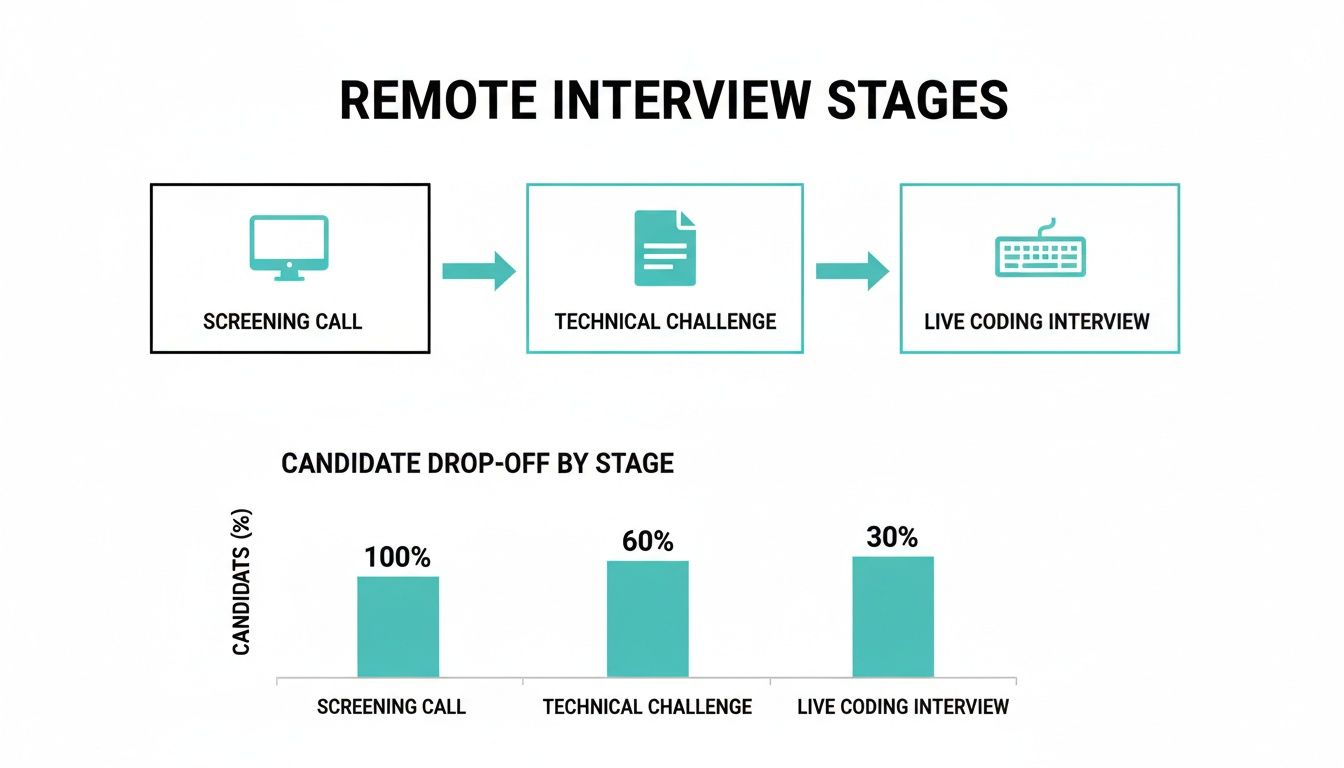
Understanding the interview funnel, from the initial screening all the way to a live coding session, helps you time your compensation discussions perfectly. Usually, the right moment comes after they've made it clear they want you.
To give you a clearer picture, here's how salary expectations can vary based on experience and the type of company you're joining, especially in the competitive US market.
Notice that startups often supplement a slightly lower base salary with equity, which can be incredibly valuable in the long run. Enterprise roles, on the other hand, typically offer higher base pay and more structured corporate benefits.
A truly great offer is about more than just the number on your paycheck, especially in a remote role. The total compensation package includes benefits that directly impact your work-life balance, out-of-pocket expenses, and overall job satisfaction.
Here are some of the most valuable remote-specific perks you should be ready to negotiate:
When the offer comes in, don't feel pressured to accept it on the spot. If the base salary isn't quite what you were aiming for, a well-negotiated benefits package can easily bridge that gap. A company that invests in a great home office and your personal wellness is a company that understands how to support a thriving remote team.
When you start digging into the world of remote React jobs, a handful of questions almost always surface. Let's cut through the noise and get you some straight answers based on what we see every day from top tech companies.
Not always, but you absolutely have to prove you’re remote-ready. Hiring managers are looking for developers who can thrive without constant supervision, and it's your job to show them you fit the bill.
A practical way to do this is to frame your past projects to highlight autonomy and stellar communication. Instead of just listing tasks, talk about how you "owned a feature from concept to deployment with minimal supervision" using tools like Slack, Jira, or GitHub. A well-documented personal project on GitHub can often be more compelling than a brief, unrelated remote gig.
It’s incredibly important, even for jobs labeled "fully remote." Many US companies can only hire within the United States because of tax laws and legal compliance. Some are even more specific, restricting hiring to certain states or time zones.
Keep an eye out for phrases like "Remote (US Only)" or "Remote (PST Timezone)" in the job description.
Actionable Insight: If the location requirements are vague, make it one of the first questions you ask the recruiter. Getting clarity on this early on saves everyone from wasting time on an interview process for a role you might not even be eligible for.
Take-home assignments are a pretty standard part of the interview process for React developers. They're not a red flag on their own, but they must be respectful of your time. A reasonable challenge should take somewhere between 2-4 hours to complete.
The red flag goes up when an assignment is excessively complex, feels like free work on the company’s actual product, or comes with an impossibly tight deadline. It's perfectly fine to ask about the expected time commitment upfront. A good practical step is to say, "To help me plan, could you give me an estimate of how long this task should take?" If the answer feels unreasonable, you can professionally push back or decide to walk away. Your time is valuable.
Beyond the job hunt itself, it’s smart to think ahead. Once you land that great new role, you'll want to be as effective as possible from day one. To get a head start, you can optimize your remote work setup for focus and efficiency.
Yes, and by a significant margin. Remote roles made up 59 percent of all React job postings as of March 2026, meaning the majority of available React opportunities are still fully remote or remote-friendly. While that figure represents some moderation from the 75 percent share seen in the prior month, the underlying demand for skilled React developers remains strong. The market has matured rather than contracted — some companies are settling into structured hybrid arrangements while a committed group of tech-first firms continue to operate as fully distributed teams. For developers who target remote-first companies specifically rather than those treating remote work as a reluctant accommodation, the availability of quality roles is healthy heading into the rest of 2026.
As of early 2026, the average salary for a remote React developer role in the United States sits at approximately $111,845 per year. Top-tier developers with expertise in high-demand skills like Next.js, TypeScript, and GraphQL can command significantly more, with senior and lead-level roles reaching $151,500 and above. Salary also varies by company stage: mid-level developers at startups typically earn in the $110,000–$130,000 range (often supplemented with equity), while equivalent roles at enterprise companies tend to offer $120,000–$140,000 in base pay with more structured benefits. Senior developers at startups generally earn $135,000–$160,000, with enterprise equivalents ranging from $145,000 to $175,000. Lead and principal-level roles at either type of company commonly exceed $165,000.
Beyond core React proficiency, the skills that consistently command the highest demand and compensation in remote React roles are Next.js (for server-side rendering and modern full-stack React development), TypeScript (for type safety in larger codebases), and GraphQL (for flexible API querying). Strong candidates also demonstrate fluency with state management approaches — whether React's built-in hooks, Zustand, or Redux depending on the codebase — and with testing frameworks like Jest and React Testing Library. On the soft-skills side, remote hiring managers specifically look for demonstrated proficiency with async collaboration tools like Slack, Jira, and GitHub, strong written communication, and the ability to own work independently from design through deployment. The combination of modern technical skills with clear evidence of remote-ready working habits is what separates top candidates in this market.
The most effective approach moves away from high-volume boards like Indeed or LinkedIn and toward more targeted channels. Curated hiring marketplaces like Underdog.io take a particularly efficient approach: you build one profile and vetted startups reach out to you directly, which means you bypass the mass-application process entirely and enter every conversation with a mutual signal of interest. Venture capital portfolio job pages are another strong source, since funded companies actively seeking React talent are often listed directly. Developer communities — Discord servers, GitHub Discussions on popular React libraries, and Slack groups like those attached to major newsletters — frequently surface roles before they're formally posted. Targeting the careers pages of companies that are explicitly remote-first (rather than those that are merely "remote-friendly") is also worth the research investment, since those companies tend to have better systems for supporting distributed teams.
Not necessarily, but you do need to demonstrate that you are capable of thriving in a remote environment. Hiring managers cannot rely on in-person cues or direct observation, so they look for concrete evidence of autonomy, proactive communication, and professional discipline in how you present your work. The most persuasive signals are a well-documented GitHub portfolio where projects include clear README files, explained architectural decisions, and instructions for local setup — all of which demonstrate async communication skills. Framing your past experience around independent ownership of features, tools you've used for remote coordination, and measurable outcomes rather than tasks also goes a long way. A strong portfolio project with professional-quality documentation can be more convincing than a brief, unrelated remote job title.
Remote React interviews typically follow three to four stages. The initial screen is a recruiter or engineering manager conversation focused on your background, your enthusiasm for the company's mission, and your ability to communicate clearly about technical work. This is followed by a take-home challenge or live coding session, where companies evaluate the quality of your code, your attention to naming and structure, and — for take-home assignments — whether your README clearly documents your decisions and trade-offs. Mid-level and senior candidates often face a system design or architecture round, where the emphasis is on how you reason through a problem and communicate trade-offs rather than finding a single right answer. The final stage typically includes interviews with the broader team or a founder, probing for cultural alignment and the kind of ownership mindset that distributed teams depend on.
A reasonable take-home challenge for a React developer role should require somewhere between two and four hours to complete well. Within that window, the expectation is working, clean code that follows consistent style, some level of testing for core logic, and a README that explains the project's purpose, setup instructions, and the technical decisions made. Assignments that feel significantly longer than four hours, that require building something suspiciously close to the company's actual product, or that come with an unreasonably tight deadline are worth questioning. It is entirely appropriate to ask a recruiter for an estimate of the expected time commitment before you begin — and if their answer feels unreasonable, that itself is useful information about how the company values candidate time. Your time and effort have genuine worth, and good companies understand that.
Beyond base salary and equity, remote roles open up a distinct set of negotiable benefits worth pursuing. A home office stipend — either a one-time setup budget or an annual allowance — helps cover the cost of an ergonomic workspace, quality monitors, and reliable peripherals. A monthly wellness allowance for gym access, mental health support, or fitness apps reflects a company's understanding of the isolation and sedentary risks of remote work. Flexible working hours — real flexibility to structure your day outside of a few core collaboration windows, not just permission to start an hour early — meaningfully affects quality of life. A professional development budget for courses, conferences, and certifications signals that the company invests in keeping its engineers current. For a role where the base salary falls short of your target, a well-negotiated benefits package can close a meaningful gap in total value.
The most effective portfolios for remote React roles are not random collections of small components or isolated widgets — they are showcases of complete, documented, and deployed applications that prove you can independently own a project from start to finish. One or two substantial projects carry more weight than a dozen small demos. Ideal projects include full-stack applications (demonstrating understanding of the entire development lifecycle), meaningful open-source contributions (proving you can collaborate asynchronously, navigate an existing codebase, and communicate through pull requests), or tools built to solve a real problem in a specific niche. For every project, the README is as important as the code itself: it should clearly explain the purpose, how to set up and run the project locally, and the technical choices and trade-offs you made. That level of documentation is a direct preview of what you'd be like as a remote teammate.
Location matters significantly even for roles explicitly advertised as fully remote. Many US-based companies can only hire within the United States due to employment tax compliance, labor law requirements, and benefits administration. Some go further, restricting hiring to specific US states or requiring overlap with a particular time zone — Pacific Standard Time requirements are especially common at West Coast startups. International candidates should look specifically for companies that have established legal entities or use employer-of-record services in their country. The clearest way to avoid wasting time on an interview process for a role you cannot legally be hired into is to ask the recruiter directly and early in the process: "Can you clarify the geographic requirements for this role?" Getting a specific answer upfront protects everyone's time and sets expectations correctly from the start.
Finding the right remote React role shouldn't feel like sending your resume into a black hole. With Underdog.io, you apply once and get your profile in front of hundreds of top, vetted startups looking for talent just like you. Let the best tech companies apply to you. Sign up for free at Underdog.io.