You've got twelve tabs open, three versions of the same posting, and a portfolio link you've already pasted into six application forms. One listing in SoMa wants a senior generalist, the next is in Oakland, and a third calls itself flexible without saying what that schedule means. That's the normal starting point for people hunting UX design jobs in San Francisco, and clicking faster doesn't fix it.
Use each source for a specific job. Let a curated marketplace filter for fit, let local and startup boards map who's hiring, and let employer career pages confirm the final details on location, level, and qualifications. Before you apply anywhere, answer four questions for that role. Is the company funded, is the work hands-on or mostly coordination, is the pay range realistic for your level, and can the work arrangement fit your life?
Treat the seven sources below as different tools, not duplicates. You'll also save time capturing notes as you compare roles, whether that's in a doc or with voice-to-text for Figma teams after a portfolio critique. The list starts now.
Underdog.io reverses the usual application flow: you submit one profile on Underdog.io in about 60 seconds, and vetted startups come to you. The marketplace concentrates on early-stage and high-growth companies hiring in New York City, San Francisco, and remote roles across the U.S., so you skip general-board noise entirely.
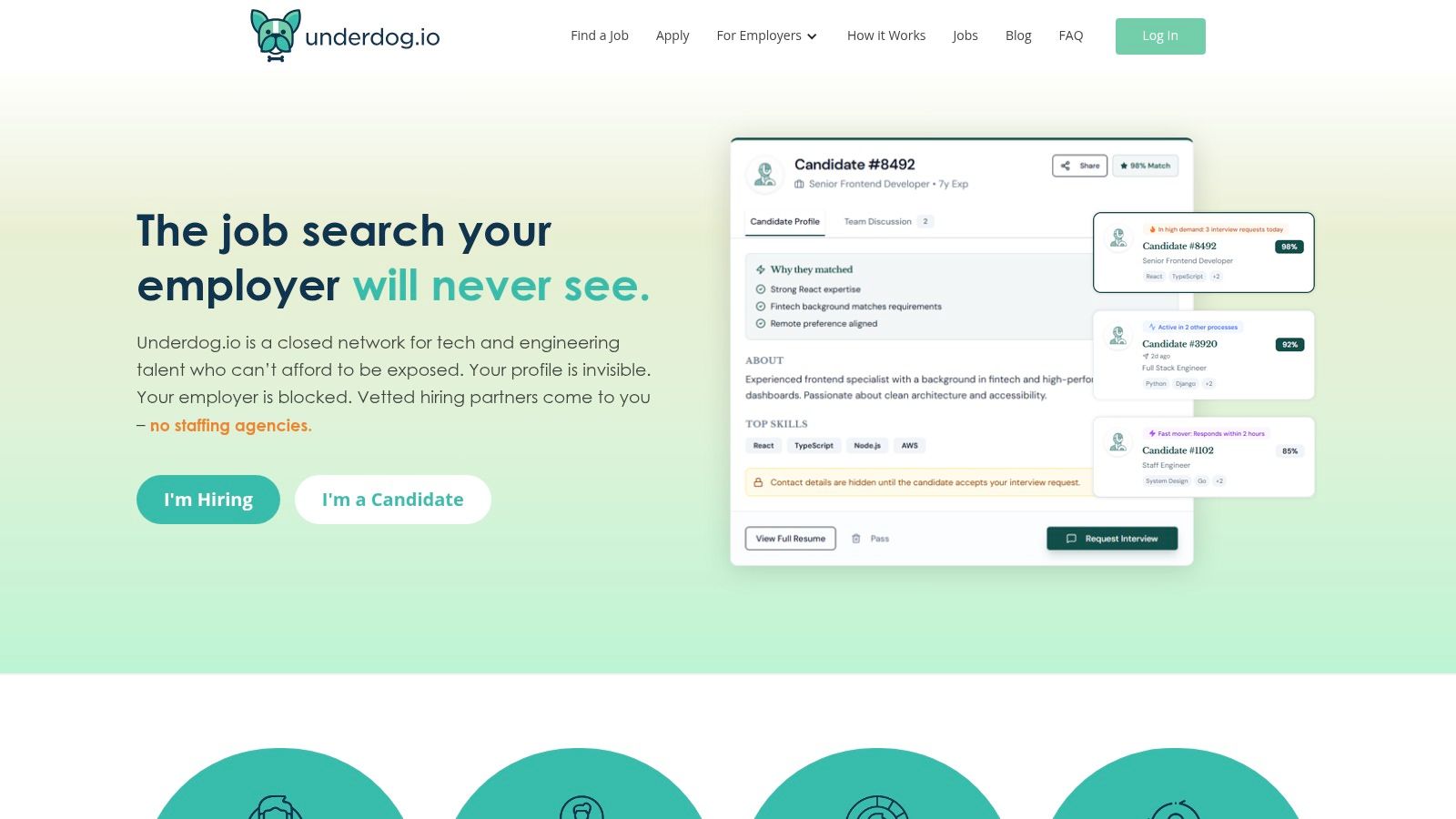
Screening runs in both directions. Candidates are reviewed before joining, and companies are vetted for funding, team quality, and product viability. Underdog.io says it turns away most companies that apply to list, and matching relies on human review plus targeted search rather than a stream of generic alerts. The result is a short list of introductions spread across each month, not a queue of hundreds.
Write for the senior-heavy market you're entering. A local sample reported roughly 45% of openings at senior level, 15% at lead level or above, and only about 5% entry-level, with prototyping appearing in about half of postings and Figma in 45%, according to San Francisco UX opening patterns on Callings. Lead with shipped outcomes. Then connect your research, interaction decisions, prototypes, and design-system contributions to those results.
Privacy is the practical advantage if you're employed. Profiles stay hidden from your current employer, you can block specific companies, and your identity is shared only when interest is mutual. It's free for candidates because companies pay on a success-based hiring model. For hiring teams, the draw is verified candidates, unlimited role postings, and a response rate the company reports as strong.
Put the time you save on applications into case-study narratives, and read what's broken about the UI and UX design interview process before your first portfolio review. If a staffing firm ever enters your process outside this marketplace, get the fee structure, the client list, and the submission terms in writing before you share your resume.
Go to Wellfound's San Francisco UX Designer search when you want to discover startups you haven't heard of yet. It's built for early-stage and growth-stage companies, which makes it more useful than a general board if you want venture-backed teams and smaller product orgs. Company profiles help you judge stage and focus before you spend time on an application.
Some listings show salary, equity, work location, experience level, and hiring activity upfront. Use that detail aggressively. Check the range against your target, then ask whether the equity story is specific or just decorative.
Headline pay can mislead you if you don't separate advertised ranges from who can realistically get hired. Recent listings show advertised UX salary ranges centered around $169,000 to $225,000, while a separate salary source places the local range at approximately $133,960 to $197,540, as summarized in Callings data on the San Francisco UX job market. If your experience sits below the level a posting describes, a strong range doesn't make the role accessible.
Don't apply on salary alone. Apply where your portfolio evidence already matches the ownership the role demands.
Wellfound works best as a discovery and comparison tool. Save promising companies, compare their stage and product focus, then apply to a short list with customized case-study order. An enterprise workflow example should lead for a B2B tool, while an experimentation story should lead for a consumer app.
Verify freshness before you invest. If a listing lacks a date, location clarity, or clear seniority, deprioritize it until you've checked the company's own page.
Use Built In San Francisco's Design and UX listings for local market research, not just applications. It pairs job postings with employer profiles and workplace information, so you can compare Bay Area tech employers side by side. That context matters when two roles share a title but describe very different teams, scopes, and expectations.

Listings cover local, remote, and hybrid roles, and some include salary ranges, seniority, and skills. Browse adjacent titles while you're there. If pure UX titles look thin at your level, compare them with product designer jobs in San Francisco to see whether your experience maps better to broader product ownership.
Built In is a good place to sanity check pay before you negotiate. The San Francisco, Oakland and Fremont market had an estimated 6,630 web and digital interface designers in May 2025, with a reported median annual wage of $163,810 and a 25th to 75th percentile range of about $110,100 to $211,120, according to local UX designer salary figures for San Francisco. Those figures exclude equity, bonuses, and benefits, so compare total packages, not base salary alone.
Geography needs the same discipline. Listings here span the wider Bay Area, not only San Francisco, and results can be UX-adjacent or mismatched in seniority. Filter by commute tolerance first, then by title, then read the responsibilities line by line.
A practical routine works well. Shortlist five employers, read each profile for team size and product focus, then open only the roles that match your strongest case studies. You'll apply less, but your hit rate should improve because each application will reflect a deliberate choice.
If early-stage chaos energizes you, go straight to Y Combinator Jobs for San Francisco and filter into design. The board focuses on companies in the YC network, so you're looking at a narrower and more recognizable startup pool. Some listings show compensation and work location, which helps you screen quickly.

Expect fewer UX openings than engineering or product roles, and expect them to appear intermittently. Don't treat a quiet week as a dead channel. Check back on a schedule, and keep a one-page case-study summary ready so you can move fast when a relevant role appears.
Early-stage design roles rarely stop at screens. You'll likely frame ambiguous problems, run lightweight research, prototype, and hand off to engineering without layers of support. Show that range in your portfolio, including how you work with developers and how you use newer tools with judgment.
That AI fluency now belongs in your evidence. Figma survey data reports 85% of designers and developers expect AI to be essential to future success and 78% say AI significantly accelerates workflows, with designer use cases including data analysis at 40%, customer research at 38%, asset generation at 33%, and initial interface drafts at 22%, per Figma's compiled design statistics. The same source notes 84% of designers collaborate with developers at least weekly.
Portfolio check: State where AI helped, where you overrode it, and what user evidence settled the decision.
Don't neglect accessibility while showcasing speed. A claim of accessible design carries little weight without keyboard navigation checks, contrast testing, semantic structure, and screen-reader notes. Document the defects you found and fixed.
The trade-off is clear. YC gives you a direct route to early teams, but roles can be broad and underdefined. Apply only if you want ownership more than structure.
Use Indeed's San Francisco UX design search for breadth. It covers employers of different sizes and sectors, which makes it useful when you want to look beyond startups or test adjacent titles. You'll find UX, product design, research, and related roles in one search.
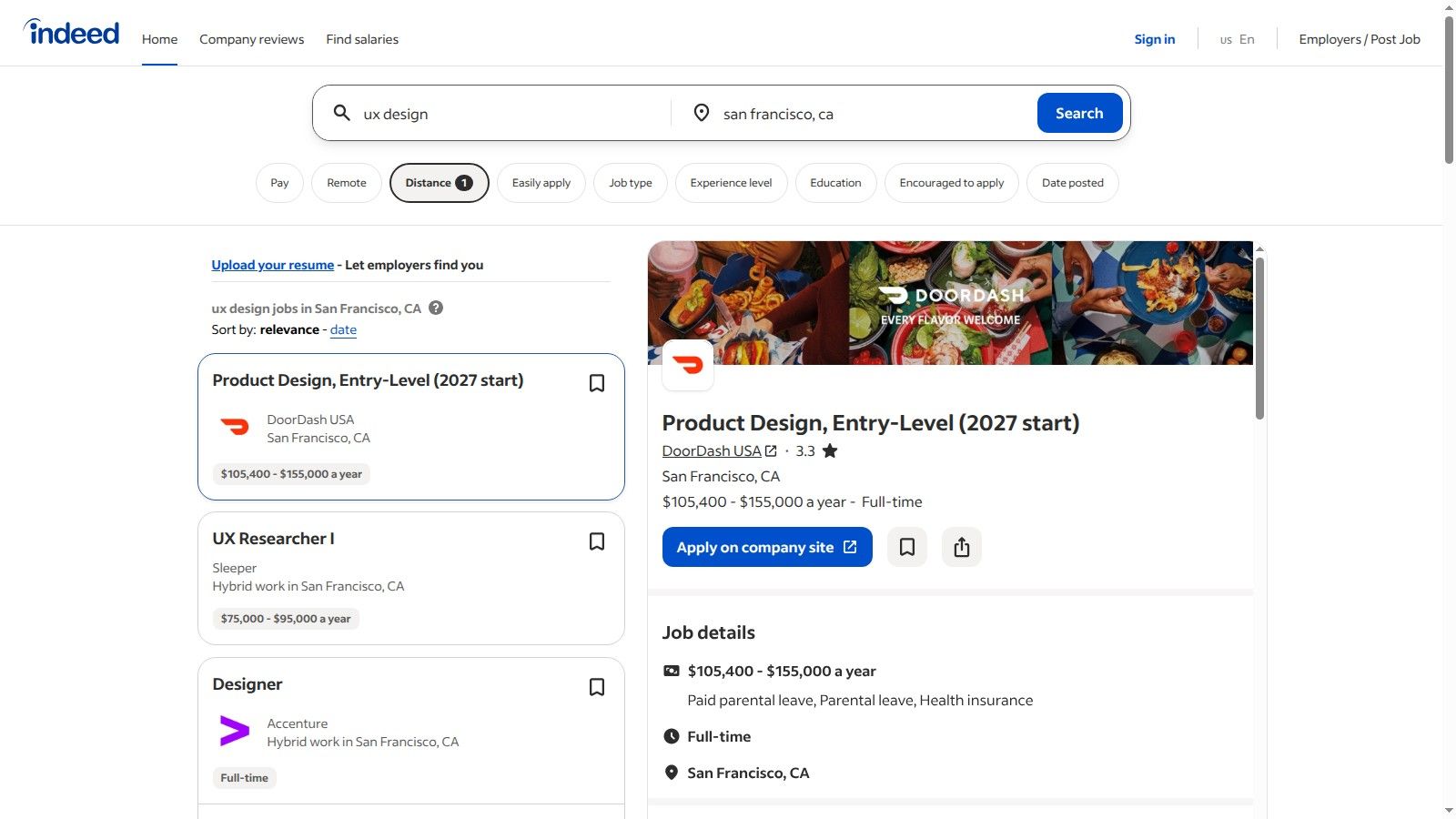
Breadth comes with noise. Duplicates, outdated posts, and loosely related results are common, and some listings redirect you to an employer's application site. Filter hard by posting date, exact location, employment type, and seniority before you open anything.
If you're junior or mid-career, don't limit yourself to one exact title. A 2026 hiring-market summary reported 56% of teams hiring UX designers were seeking senior talent while only 25% were hiring junior candidates, with AI-tool proficiency required by 73% of design leaders and AI product experience prioritized by 79%, according to Standout's summary of UX designer jobs in San Francisco. Adjacent searches for product design, UX research, design systems, and AI product design can surface roles that fit your evidence better.
Build three saved searches instead of one. Pair a strict San Francisco UX search with a Bay Area product-design search and a remote search tied to your specialty. For vocabulary and role framing across those titles, skim this overview of UI and UX jobs and mirror the language employers use.
Treat Indeed as your radar. When a role looks real and well matched, cross-check it on the employer's own site before applying.
Targeting a large, established design org requires a different source and a different portfolio order. Google Careers listings for UX roles in San Francisco give you the employer's own postings for UX, interaction design, product design, and user research. You get stated requirements and the actual application process without a third-party rewrite.

That authority is the main benefit. If a role demands a specific research method, platform experience, or years of ownership, believe the posting and tailor accordingly. Large-scale product work rewards depth, systems thinking, and clear collaboration across many partners.
Google is one employer, so keep the wider occupation in view while you decide whether to wait for the right opening. The U.S. Bureau of Labor Statistics classifies many UX and UI roles under web and digital interface designers, an occupation with approximately 132,700 jobs nationally in 2025 and a median annual wage of $104,000, with employment projected to reach about 140,800 by 2035, or 6% growth, according to the BLS outlook for web developers and digital designers. That national baseline helps you judge how much of a premium a San Francisco role should carry.
Location still needs verification. Results can include Bay Area sites outside San Francisco, and roles may be specialized and highly competitive. Check the exact office before you picture your commute or relocation.
Apply selectively. Pick the one or two postings closest to your strongest work, rewrite your case-study intros around scale and cross-functional influence, and don't submit the same generic portfolio you'd send a seed-stage startup.
Some designers don't want a marketplace at all. They want one company, one ecosystem, and the discipline that comes with it. Apple Jobs search for UX Designer roles in San Francisco is the direct source for UX, interaction, and product-design openings across software, services, hardware, and connected experiences.

Go here for authoritative requirements rather than volume. Openings can be infrequent because you're tracking a single employer, and some Bay Area positions won't be in San Francisco. Read each posting's location and arrangement carefully instead of assuming the search filter settled it.
That location check isn't a formality in this market. One dataset covering 30,556 salary-disclosing San Francisco tech postings found 23% offered remote or hybrid arrangements, split into 10% fully remote and 13% hybrid, according to GetUHIRED insight on San Francisco tech postings. A vague flexible label doesn't tell you the in-office cadence, so confirm it in the first conversation.
Neighborhood and industry context can also sharpen your targeting across direct employer sites. Listings cluster in SoMa, the Financial District, and Mission Bay, with demand from fintech, enterprise software, consumer applications, and health technology, and named employers including Meta, OpenAI, and Atlassian, per Migrate Mate's San Francisco product designer listings. Tailor your lead project to that context, whether it's workflow complexity, trust, or engagement.
Use Apple Jobs as a precision channel. Check it on a routine, apply only to close fits, and keep your broader pipeline running elsewhere.
| Platform | Search Effort | Employer Coverage | Expected Outcome | Best Suited For |
|---|---|---|---|---|
| Underdog.io | Low: one short application; candidates are screened | Vetted startups in NYC, San Francisco, and remote U.S. roles | A small number of selective, confidential introductions | Candidates seeking startup roles with discreet, curated matching |
| Wellfound | Moderate: browse listings and check availability | Early-stage and growth-stage startups | Startup roles, sometimes with salary and equity details | Product designers targeting startup employers |
| Built In San Francisco | Moderate: search listings and compare company profiles | Bay Area tech employers; local, remote, and hybrid roles | Design and UX listings with some company and compensation details | Candidates researching local tech companies and roles |
| Y Combinator Jobs | Moderate: search a focused job board | YC-backed startups | Early-stage opportunities; UX roles may be intermittent | Candidates interested in the YC startup network |
| Indeed | Moderate to high: filter results for relevance and freshness | Employers across sectors and company sizes | Broad range of UX and related roles, with possible duplicates or stale listings | Candidates seeking wide coverage beyond startups |
| Google Careers | Moderate: search and apply to individual openings | Google only | Direct access to Google design roles and employer requirements | Designers targeting large-scale products and established teams |
| Apple Jobs | Moderate: search and apply to individual openings | Apple only | Direct access to Apple design roles across product areas | Designers interested in consumer products and complex ecosystems |
Run these sources as a pipeline, not a pile of tabs. Start with a curated marketplace for selective startup introductions, widen through Wellfound, Built In San Francisco, and Y Combinator, use Indeed to catch adjacent titles you'd otherwise miss, and finish on direct employer sites for authoritative details. Each stage should eliminate weak fits before you write a word of application copy.
For every application, tailor the portfolio example to the company's product stage and the role's stated outcome. A seed-stage team needs proof you can frame a problem, prototype quickly, and talk to engineers without a handoff gap. A mature company needs proof you can work inside a design system, influence partners, and improve a metric at scale. Prepare a concise explanation of your research method, your trade-offs, and your measurable design impact, then rehearse it out loud until it sounds like a decision, not a tour of screens.
Sharing work cleanly helps that story land. Send reviewers a focused case-study page or use trackable prototype sharing links so hiring teams open the exact flow you want discussed. Don't make a hiring manager hunt through an unlabelled file for the interaction you're describing.
Interview the company back. Ask who holds design decision rights, how critique works, what constraints the team faces now, and which metrics define success for the role in its first months. Vague answers about ownership today usually become frustrating ambiguity after you start.
Compensation deserves the same rigor as craft. Compare base salary, bonus, equity strike price and vesting schedule, medical benefits, parental leave, and the expected in-office schedule before you accept anything. Ask for the vesting and exercise terms in writing, and model the offer as if the equity were worth zero to see whether the cash package still works for your life in San Francisco.
A strong search for UX design jobs in San Francisco isn't about collecting the most listings. It's about finding transparent expectations, meaningful ownership, and pay that matches the risk you're taking. Choose fewer targets, bring better evidence, and you'll stand out in a market that rewards judgment over volume.
If you want vetted San Francisco startups to reach out to you instead of chasing listings one by one, create one short profile and get selective, confidential introductions matched to your design experience. Visit Underdog.io to apply in about 60 seconds and start exploring startup UX roles on your terms.