That moment a startup job offer lands in your inbox is a huge win. But what you do next is what truly counts. The best way to accept a job offer isn't a single action—it's a deliberate, three-part process: first, you need to deeply understand the entire compensation package, then negotiate the key terms, and finally, formally accept your new role in writing.
Following this game plan makes sure the opportunity is actually the right fit for your career and prevents any nasty surprises down the line. For example, a candidate who accepts a verbal offer without a written confirmation of their equity grant might discover months later that the terms are different from what they discussed. This process prevents that.
Getting the offer is exciting, but it also kicks off a critical evaluation period. Don't let the adrenaline rush you into a quick "yes." This decision is about more than just the base salary; it’s a calculated move that will shape your career, your finances, and your day-to-day happiness for years to come.
Especially in the competitive tech and startup world, you have to be thoughtful. The goal is to move past the initial buzz and dissect the offer with the same level of detail you put into the interviews. This guide is your roadmap for turning a good offer into a great career move.
The job market is always in flux, and knowing the current trends gives you a real edge. Right now, there's a fascinating dynamic playing out: companies are finding it tough to hit their hiring goals, yet candidates are feeling more confident than ever.
In fact, offer acceptance rates in tech hiring climbed to 84% in 2025, a solid jump from the peak of the Great Resignation. This tells us that while the competition for top talent is fierce, candidates are becoming more decisive once they find the right fit. You can read more about the latest tech recruiting benchmarks to see how these trends might affect your own situation.
The journey from offer to acceptance can be broken down into three clear, actionable phases.
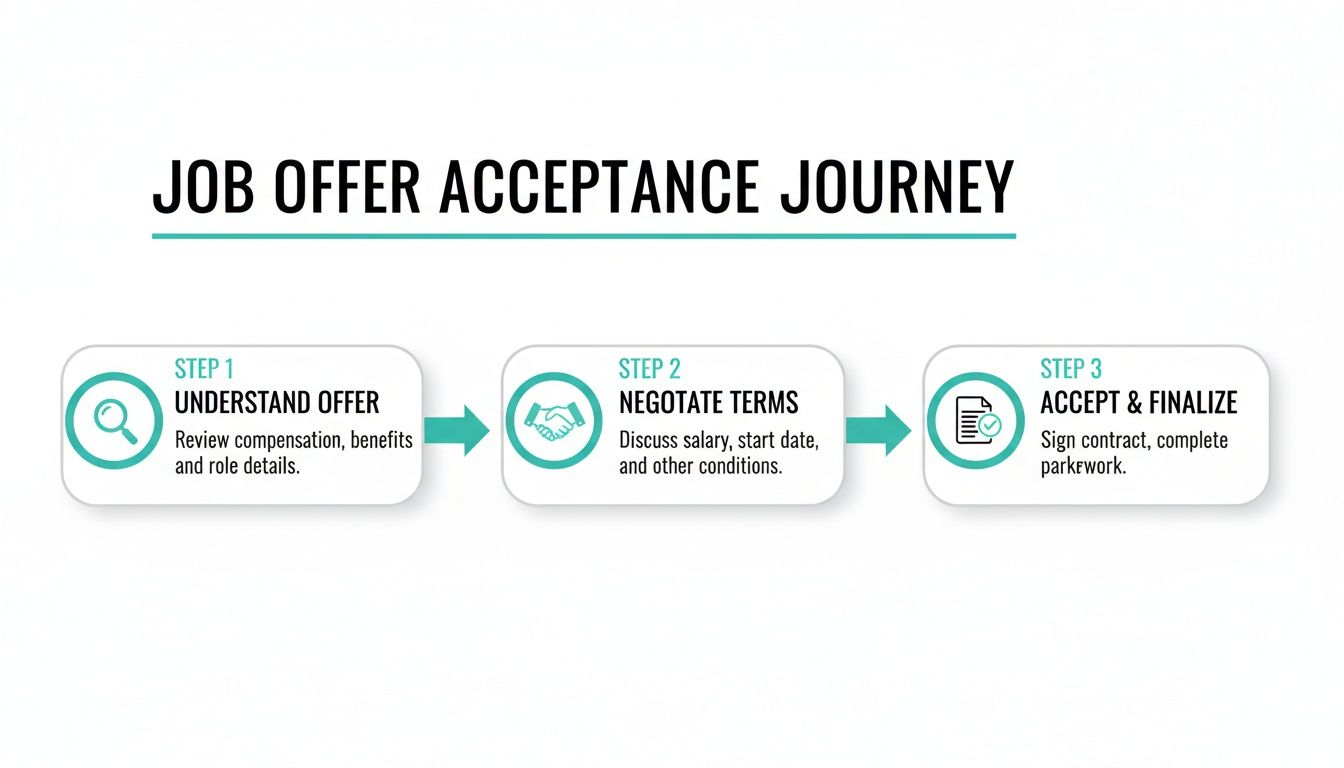
This isn't just a single step. It's a multi-stage strategy that demands careful analysis and clear communication.
Think of this as your personal playbook for making a confident, well-informed choice. These aren't just administrative hoops to jump through. Each step is an opportunity to clarify expectations, advocate for your value, and start your new job on the strongest possible footing. Mastering this approach ensures the startup role aligns perfectly with your long-term ambitions.
The best job offers are not simply accepted; they are carefully evaluated and thoughtfully confirmed. Your diligence at this stage sets the foundation for your success and satisfaction in the new role.
We’re going to walk through how to:
The number on the offer letter grabs all the attention, but it's rarely the full story. Before you get anywhere near accepting, you need to put on your detective hat and dig into every single component to understand what the offer is really worth. A big base salary can easily hide weak benefits or an equity package that sounds impressive but holds little actual value.
Think of the offer not as one number, but as a portfolio of assets. Everything—base salary, bonus potential, equity, and benefits—adds up to your Total Compensation Value (TCV). Using TCV as your framework is the only way to make a true apples-to-apples comparison between different opportunities.
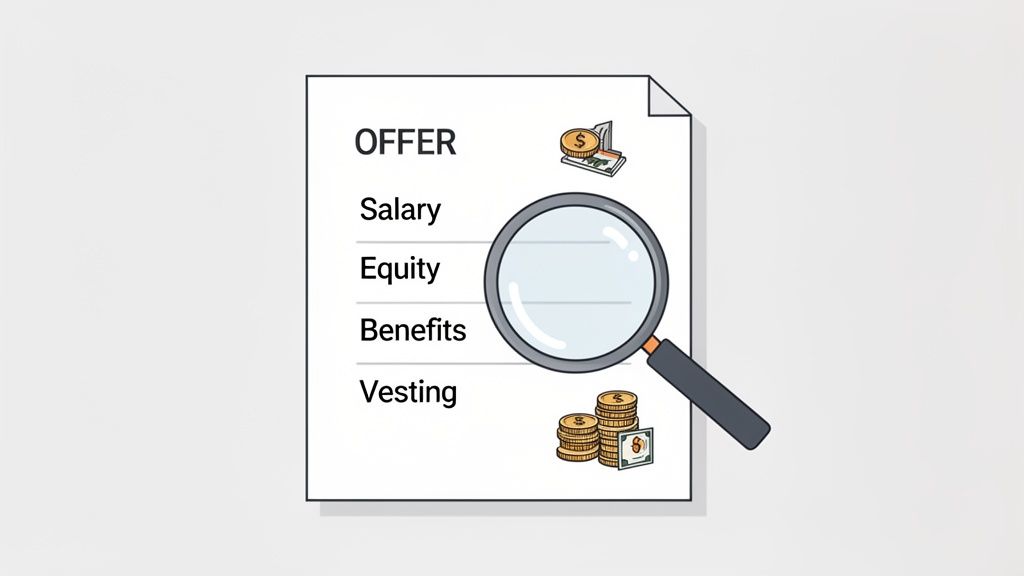
Your base salary is the bedrock—it’s the guaranteed cash you’ll take home. But it’s just the starting point. Performance bonuses, whether they're tied to your individual work or the company hitting its targets, add another important layer. You need to get clear on how bonuses are calculated, when they get paid out, and, critically, what percentage of employees actually received them in the last cycle.
It’s common for startups to dangle a lower base salary balanced by a beefy bonus potential. For instance, you might see an offer for a $130,000 base with a 20% target bonus, while another company offers a flat $145,000. To compare those accurately, you have to get a feel for how likely it is you'll actually hit that bonus target. Looking beyond the base is the first step when you compare salary and uncover your true value.
For a lot of people, equity is the most exciting—and most confusing—part of a startup offer. It's your piece of the company's potential upside, but that value is far from guaranteed. Don't let a big share count distract you. The number of shares means nothing without context.
To size up your equity grant, you have to ask some tough questions:
A grant of 20,000 options in a company with 10 million fully diluted shares gives you 0.2% ownership. That same grant in a company with 2 million shares gives you 1.0% ownership. The context is everything.
Getting the fundamentals right is crucial. If this is new territory for you, it’s worth spending time on the details. A great resource is this guide on the startup equity basics for job seekers, which breaks these concepts down really well.
Benefits are the quiet workhorses of your total compensation. Health insurance is the big one. A company that covers 100% of the premiums for a great plan could be saving you thousands of dollars a year compared to a company that only covers 75% of a high-deductible plan.
This checklist helps you break down the financial impact of the whole benefits package.
Each of these items translates directly into dollars in your pocket. A solid 401(k) match, for example, is literally free money that grows over time. Never underestimate its long-term power when you're making your decision.
Let’s get one thing straight: negotiation isn’t a fight. Think of it as your very first project with a new employer—a collaborative effort to build a partnership that works for everyone. The time between getting the offer and choosing to accept a job offer is your single best chance to champion your value and kick things off on the right foot.
Too many people, especially in tech, shy away from negotiating. They’re worried about looking greedy or, even worse, having the offer pulled. But here’s the inside scoop: most startups expect you to negotiate. A smart, well-researched counteroffer shows you know your worth and can communicate with confidence—exactly the kind of traits every startup is looking for.
Before you even think about picking up the phone, your first job is to figure out what a “win” actually looks like for you. Is it a higher base salary for more cash in your pocket now? Or is it a bigger slice of equity for a potentially massive long-term payout? For early-stage startups where cash is often tight, knowing how to play with these two levers is everything.
A Seed-stage company, for instance, might not have the budget to bump your salary by $15,000. But they might have plenty of room to grant you an extra 5,000 stock options. When you know what you’re optimizing for, you can steer the conversation toward a solution that makes you both happy.
You also have to read the room—the job market, that is. In 2025, tech hiring has gotten a lot more selective. Filled positions actually dropped by a staggering 84% between July and September. For anyone looking at a startup role, that means locking in a well-negotiated offer is a seriously smart move. And while roles in hot fields like AI and data engineering are taking over 60 days to fill—giving skilled candidates some real leverage—it also shows how valuable it is to secure a great position when you find one. You can dig into these selective hiring trends on JobTarget.com.
Walking into these conversations with a few phrases in your back pocket can make them way less nerve-wracking. Just remember to keep your tone enthusiastic, grateful, and collaborative.
Scenario 1: You Need More Time to Decide
It’s completely fine—and smart—to ask for a few days to think things over. Never let yourself be rushed into a huge decision.
On the phone, you can say:
"Hi [Hiring Manager Name], thank you so much again for the offer. I'm incredibly excited about the opportunity to join the team. This is a big decision, and I want to give it the thoughtful consideration it deserves. Would it be possible to have until Friday to get back to you with my final answer?"
This approach works because it reinforces your excitement while professionally asking for the space you need. Any company that genuinely wants you will almost always say yes.
Scenario 2: Making a Counteroffer (Focusing on Base Salary)
When you come back with a counter, don't just pull a number out of thin air. Ground your request in real data—market rates for your role, your specific experience, and your location—and tie it back to the unique value you're bringing to the table.
In an email, you could write:
Subject: Re: Job Offer from [Company Name]
Hi [Recruiter Name],
Thank you again for extending the offer for the [Job Title] position. I’ve had some time to review the details, and I remain very excited about the mission and the impact I could make on the team.
Based on my research into similar roles in [City/Remote Market] and considering my experience in [mention 1-2 key skills, e.g., scaling data infrastructure], my salary expectation is closer to $165,000. I feel this figure more accurately reflects the market value for my skill set and the contributions I can bring to your team.
I am confident we can find a number that works for both of us. Looking forward to hearing your thoughts.
Best,
[Your Name]
See how that’s data-driven and confident, not demanding? That's the sweet spot.
A competing offer is fantastic leverage, but you have to use it tactfully. This isn’t about starting a bidding war or issuing an ultimatum. It’s about creating transparency and a little bit of urgency. The real goal is to give the company you actually want to work for a chance to meet you where you need them to be.
Here's the game plan:
Over the phone, it might sound like this: "I want to be transparent with you. I've received another offer with a base salary of $170,000. However, I'm much more excited about the product vision at [Company Name] and see a better long-term fit with your team. Is there any flexibility to adjust the base salary to make my decision easier?"
That incredible offer from an exciting startup feels like you’ve crossed the finish line. Not so fast. Before you even think about accepting, you need to switch gears from candidate to investigator. Your new mission is to make sure the amazing picture they painted during the interviews is what the company is actually like day-to-day.
Think of this due diligence phase as your insurance policy against a terrible career move. The startup world is notoriously volatile, and a company that looks perfect on paper can easily be a chaotic mess behind the scenes. It's time to peek behind the curtain.
Some warning signs are subtle, others are screaming alarms. One of the most common—and most telling—is the exploding offer. This is when you're given a ridiculously short deadline, like 24 or 48 hours, to make a life-changing decision. This isn't a sign of high demand; it's a pressure tactic designed to stop you from thinking clearly or weighing other options. A great company that truly wants you will respect your need for a few days to make a thoughtful choice.
Also, keep an ear out for vague, slippery answers to your questions, especially when you ask about funding or team dynamics. If you ask about the company's financial runway and get a non-answer like, "We're in a strong position for growth," you should gently press for specifics. Real confidence is transparent.
Another huge red flag is high employee turnover. The good news is you can often dig into this on your own.
To get a real feel for the place, you have to talk to people who aren't the hiring manager. Your goal should be to get on a call with potential peers—these are the conversations where you’ll get the unvarnished truth about the culture and what your daily life will actually be like.
Here are a few questions that cut through the fluff when you talk to your future teammates:
These kinds of questions get to the heart of what it’s like to work there. For a much deeper dive, our guide on how to vet startup culture has even more tactics and specific questions to help you make a truly informed decision.
I know, asking about a startup's finances can feel a little awkward, but it's absolutely essential. The company's stability directly impacts your job security and whether your equity will ever be worth anything. You have every right to know if you're joining a business on solid ground.
You’re not just taking a job; you’re making an investment of your time and talent. Like any investor, you need to understand the financial health of the business you’re joining.
The key is to frame your questions respectfully, tying them to your desire to commit long-term. For instance, you could say, "Since I'm really thinking about this as a long-term move, I was hoping you could share a bit about the company's funding situation. When was the last round, and what's the current runway look like?"
A healthy, confident startup will be ready for this question. They might not give you the exact balance in their bank account, but they should be able to clearly communicate their funding stage (e.g., "We closed our Series A six months ago") and their runway (e.g., "We have over 18 months of runway at our current burn rate"). If they hesitate or get defensive, consider that a major cause for concern.
You've navigated the negotiations, done your due diligence, and the finish line is in sight. Now it's time to make it official and start the delicate dance of leaving your current role. Trust me, handling this last stage with professionalism is everything—it protects your reputation and sets you up for a smooth start at your new company.
The very first thing you need to do is formally accept the job offer. While a verbal "yes" feels great, always follow it up in writing. This creates a clear paper trail and makes sure everyone is on the same page about the final terms before any official contracts are signed.
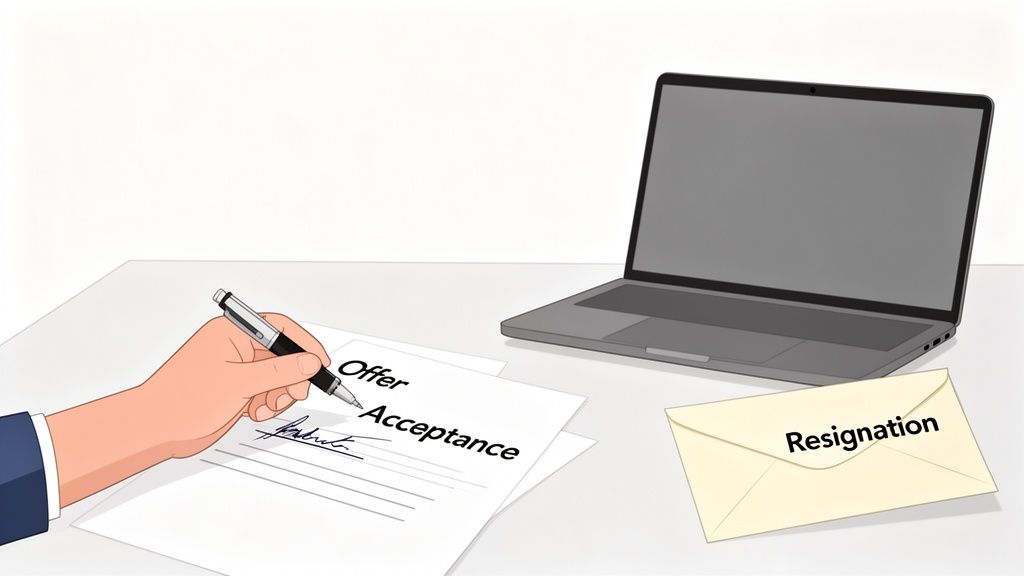
Your acceptance email should be enthusiastic, but it also needs to double as a confirmation of the key details you've agreed on. Don't think of this as just a formality; it's your final chance to document everything in one place.
Here’s a practical template you can adapt:
Subject: Offer Acceptance - [Your Name]
Hi [Hiring Manager Name],
I am thrilled to formally accept the offer for the [Job Title] position at [Company Name]. I'm incredibly excited about the opportunity to join the team and contribute to [mention a specific goal or project].
As we discussed, I am accepting this offer based on the following terms:
I look forward to receiving the official employment agreement to sign. Please let me know if you need anything else from me in the meantime.
Best regards,
[Your Name]
This simple, direct approach confirms the most critical parts of your offer, which really cuts down on the risk of any "he said, she said" confusion later.
Once you have a signed offer in hand, it's time to resign. The whole point here is to leave on good terms and preserve the relationships you've spent time building. Always schedule a private meeting with your manager to deliver the news—in person or on a video call is best. Please, never do it over email or Slack.
Keep the conversation brief, professional, and positive. Thank your manager for the opportunity and just state your decision clearly. You really don't need to get into the weeds about your new job or vent about any frustrations with your current one.
After that conversation, follow up with a formal resignation letter. This is mostly a document for HR records, so keep it straightforward. If you're wondering what to say, our post on what to write on a two week notice has some great examples and tips for hitting the right tone.
Don't be surprised if your current employer comes back with a counteroffer to try and keep you. It happens all the time. They might throw more money at you, dangle a promotion, or promise new responsibilities.
While it's flattering, accepting a counteroffer is almost always a mistake. Think about it: the core reasons you wanted to leave—whether it was the culture, the leadership, or a lack of growth—rarely disappear just because you got a pay bump. The data backs this up, showing a huge percentage of people who take a counteroffer end up leaving within a year anyway.
The best move is to politely decline and reiterate your commitment to the new opportunity. As you plan your exit, understanding COBRA continuation coverage is vital to manage any potential gaps in your health benefits. Making sure that's sorted out ensures your transition is not just professional, but secure, too.
Even after you’ve dotted the i's on your negotiation and feel good about the numbers, a few practical questions almost always pop up at the finish line. These are those tricky, last-minute "what-if" scenarios that can create a bit of anxiety right before you say yes.
Let's walk through the most common ones that come up when you're ready to make it official.
Generally, you can expect about three to five business days to consider an offer. That’s a pretty standard, reasonable window that gives you enough breathing room to review everything without making the company feel like you're dragging your feet.
Now, you might run into what's known as an "exploding offer," especially with early-stage startups. This is when they pressure you for a decision within 24-48 hours. They’ll often frame it as just moving fast, but be wary—it’s usually a tactic to stop you from exploring other opportunities or getting a competing offer on the table.
It is always okay to ask for more time. A simple, confident request usually does the trick. Try something like this: "Thank you so much for the offer! This is a big decision, and I'd like to give it the thoughtful consideration it deserves. Would it be possible to have until Friday to get back to you with a final answer?" A company that genuinely wants you will almost always say yes.
Legally, you can typically walk away any time before you've signed an actual contract. But I'll be blunt: don't do it. The tech and startup world is incredibly small, and your professional reputation is one of the most valuable things you own.
Word gets around, and fast. Backing out after giving your word can seriously ding your credibility with recruiters, founders, and even future colleagues.
Only give a verbal "yes" when you are 100% ready to commit. If you're still on the fence, it’s far better to be upfront and ask for the time you need to think it over. Integrity matters way more than a quick answer.
Once you’ve sent off that "I'm in!" email, the ball is back in their court. The next thing you should see is the official employment agreement. Your job here isn't to just skim it—read every single word.
Make sure every detail you negotiated is spelled out correctly in the contract. Double-check everything:
If you see a mistake or something is missing, don't sweat it. Just send a polite email to your contact, point out the discrepancy, and ask for a corrected version. Do not sign until it is perfect. After the contract is signed, you'll usually hear from HR or your new manager with onboarding instructions and paperwork. This is also the perfect time to give notice at your current job.
Absolutely. Asking to adjust your start date is a completely normal part of wrapping up a job offer. Most companies are already expecting you'll need to give a standard two-week notice to your current employer.
If you need a bit more time—maybe for a pre-planned vacation, to handle a move, or just to take a mental break between gigs—bring it up during the final negotiation stages, right before you formally accept.
Just frame the request clearly and professionally. Something like: "I'm very excited to accept the offer. Regarding a start date, I have a prior commitment and would be available to begin on [Your Desired Date]. I hope this timeline works for the team." For the right person, most companies are incredibly flexible and will gladly work with you to find a date that makes sense for everyone.
The first step is to express your enthusiasm and ask for the offer in writing. A simple, "Thank you so much, I'm very excited about this opportunity! Could you please send over the formal offer letter and complete details in writing so I can review everything?" This ensures you have all the specifics (salary, benefits, start date, etc.) before making a commitment.
Review the offer letter carefully for accuracy. Confirm the exact job title, the detailed breakdown of your compensation (base salary, bonus structure, equity/options), the start date, work location policy (remote, hybrid, in-office), and a summary of benefits. Ensure everything matches your earlier discussions before you formally accept a job offer.
While it's fine to express your intent verbally, it is a standard and expected professional practice to formally accept a job offer in writing (via email). This creates a clear record for both you and the employer. A verbal "yes" should be followed promptly by your written acceptance email.
Your acceptance email should be professional, clear, and gracious. Key elements include: a clear subject line (e.g., "Offer Acceptance - [Your Name]"), a thank you to the hiring team, a formal statement of acceptance, confirmation of the key terms (job title, start date, salary), and a positive note about looking forward to joining.
No, the offer acceptance is the final step after any negotiation is complete. If you wish to negotiate aspects like salary or benefits, you should do so after receiving the written offer but before you send your formal acceptance. Once you accept, the terms are typically considered final.
Do not resign from your current position until you have a signed written offer from the new company. Once you have formally accepted the new offer, you can prepare a professional, concise resignation letter for your current employer, typically giving two weeks' notice. Avoid sharing details about your new role during the resignation conversation.
Most companies expect a decision within a few days to a week. If you need more time—for example, to wait for another offer—it's perfectly professional to ask. You can say, "Thank you for the offer. I am very interested and will need until [specific date] to provide you with my final decision. Does that work for your timeline?"
Finding the right startup role is about more than just a good offer—it's about finding the right fit. At Underdog.io, we connect top tech talent with hundreds of vetted, high-growth companies. Stop shouting into the void of job boards and let the best opportunities come to you. Sign up for free and get matched with your next great role.