It feels like a paradox, doesn't it? The demand for talented software engineers has never been higher, yet landing the right role feels more competitive than ever. If you're tired of getting lost in the noise, you've come to the right place.
This guide is your playbook for navigating the modern job market, with a sharp focus on the high-growth startups where your work can make a real impact. We’ll help you decode the different types of roles, understand what career levels actually mean, and show you how to position yourself to land the job you want.

The job market for software engineers is a strange beast. On one hand, the field is absolutely booming with opportunities popping up all over the globe. On the other, the competition is brutal, and it takes more than a solid resume to even get noticed.
Think of it like trying to find your perfect seat in a massive, sold-out stadium. Without a map, it’s incredibly easy to get lost in the sea of endless job boards and generic applications. This guide is that map, designed to help you cut through the chaos and find your spot in today’s fast-moving startup world.
The global software engineer workforce has exploded. The U.S. Bureau of Labor Statistics projects a jaw-dropping 17% growth in jobs by 2033. That translates to over 327,900 new positions—a rate that dwarfs most other occupations.
And yet, a paradox has emerged. Despite a massive pool of talent, there are still critical shortages for engineers in specialized roles like AI/ML and cloud security.
For candidates, especially those aiming for high-growth startups in hubs like NYC and San Francisco, this means two things:
In this kind of environment, the old "spray and pray" approach to job searching just doesn't cut it anymore. Simply blasting your resume out on mainstream job boards often means it ends up in a digital black hole. You can read our guide on the best job boards for engineers to get a better sense of that landscape.
An actionable first step is to flip your strategy. Instead of chasing companies, focus on letting the right opportunities find you. This means creating a strong, searchable profile on curated platforms and clearly articulating your unique skills—for instance, “experience building scalable GraphQL APIs in a high-traffic e-commerce environment.”
For anyone looking to thrive, a deep understanding of the Top Software Engineering Best Practices is non-negotiable. This knowledge doesn't just get you through interviews; it proves to potential employers that you’re a professional who cares about quality. By focusing on quality over quantity, you can transform your job search from a frustrating marathon into a targeted, successful sprint.
Not all software engineer positions are the same. When you're scanning job listings, you'll see specializations like "Frontend," "Backend," or "Full-Stack" pop up constantly. Getting these distinctions right is the first step to finding a role that actually fits your skills and what you enjoy building.
Let's think about a software application like a high-end restaurant. The whole experience is split into two connected worlds: the dining room where guests are, and the kitchen where all the magic happens behind closed doors.
A Frontend Engineer is in charge of everything a user can see and touch. In our restaurant analogy, they own the entire dining room experience. They build the "client-side" of an application, which is just another way of saying "the part the user interacts with."
Their job is to make sure the app isn't just functional, but also intuitive and looks great. They are the architects of the user interface (UI) and the broader user experience (UX).
A practical example: a frontend engineer might spend their day turning a designer’s Figma mockup into a pixel-perfect, interactive registration form using React, ensuring it works flawlessly on both desktop and mobile browsers.
While the frontend is the visible part of the show, the Backend Engineer works behind the scenes in the "kitchen." They build and maintain the "server-side" systems that power the entire operation.
You can't see their work directly, but absolutely nothing would function without it. They're responsible for the core business logic, the databases, and the APIs that handle requests and manage all the data.
Backend engineering is the art of building the robust, invisible systems that make the visible parts of an application possible. It’s about ensuring data is stored securely, retrieved efficiently, and processed correctly every single time.
A backend engineer tackles a completely different set of challenges and technologies.
A practical example: a backend engineer at a startup could spend their day designing a new database schema in PostgreSQL to support a future "user reviews" feature, or writing a Go microservice to handle image uploads and resizing.
This table gives you a quick snapshot, but there's one more role that ties it all together.
A Full-Stack Engineer is the versatile "Executive Chef" who can operate in both the dining room and the kitchen. They have a solid working knowledge of both frontend and backend development, which lets them build and manage an entire application from start to finish.
This broad skillset makes them incredibly valuable in fast-paced startup environments where roles are fluid and teams are lean. They can jump from fixing a visual bug on the homepage to optimizing a database query without missing a beat. Their ability to see the "full picture" helps bridge the communication gap between the frontend and backend, ensuring the final product feels cohesive and well-integrated.
While they may not be the deepest expert in every single technology, their adaptability is their greatest strength.
A software engineering career isn't just a list of titles you collect over the years. It’s a journey of expanding impact. Early on, your work is like dropping a small pebble in a pond—it makes a splash, but the ripples are small and contained. As you advance, you start dropping bigger rocks, creating waves that can change the entire pond.
This progression follows a pretty standard career ladder. While every startup has its own quirks and titles, the core levels are surprisingly consistent. Getting a handle on these stages is crucial for figuring out where you are, where you're going, and how to get there.
Even with specializations like frontend and backend, a full-stack mindset—knowing how the whole system connects—is often what opens the door to those higher-impact roles, especially in a fast-moving startup.
This table maps out the general expectations, but the real journey is in how your day-to-day responsibilities and your influence evolve.
Most engineers start their journey as a Software Development Engineer I (SDE I) or an equivalent junior-level role. At this stage, your world revolves around two things: execution and learning. You’ll be handed well-defined, bite-sized tasks—like fixing a specific bug in the checkout flow or adding a new field to an existing API endpoint.
Your job is to get it done, write clean code with good test coverage, and absorb as much as you can about the codebase and team processes.
Once you’ve proven you can handle tasks with less and less hand-holding, you’ll move into an SDE II role. Here, your scope starts to broaden. You're not just implementing tickets anymore; you're contributing to the design of smaller features. For instance, you might be tasked with drafting a technical plan for a new user settings page and then leading its implementation.
Becoming a Senior Engineer is a major turning point in your career. This is where you officially graduate from being a task-doer to a problem-owner. A senior engineer is trusted to take a vague product requirement—like "we need a notification system"—and drive it all the way from initial technical design to a successful launch.
This means you’re the one writing the design document, making key architectural calls (e.g., "should this be real-time with WebSockets or use polling?"), and owning the project's outcome. You're also expected to be a force multiplier, mentoring junior engineers through code reviews and actively improving team standards.
After the senior level, the path splits. You face a choice between continuing down the Individual Contributor (IC) track to solve increasingly complex technical problems, or moving onto the Engineering Management track to focus on people, processes, and strategy.
Both paths are equally valid and offer parallel tracks for growth, influence, and compensation. One isn't "better"—it all comes down to what you're passionate about. The best startups not only recognize this but actively reward excellence on both sides.
For a deeper dive into how these levels and tracks affect compensation, check out our guide on how much money software engineers make.
For engineers who love getting their hands dirty and tackling the gnarliest technical puzzles, the IC track leads to roles like Staff Engineer and Principal Engineer. These aren't just "super-senior" roles; they are architects and technical leaders for huge chunks of the company.
A Staff Engineer’s impact bleeds across team boundaries. They’re the ones leading a massive, cross-functional project like migrating the entire authentication system to a new provider, or designing a core data pipeline that three different product teams will depend on. Their scope isn't a feature; it's a system.
At an even higher altitude, a Principal Engineer is shaping the company's technical DNA for years to come. They operate at the level of the CTO, tackling problems so ambiguous they might not even be fully defined, such as "How should our architecture evolve to support international expansion over the next five years?"
Startup job descriptions can feel like trying to solve a puzzle. They're often a mix of bold vision, ambitious goals, and a healthy dose of jargon. Learning to read between the lines is a critical skill for figuring out if an opportunity is a genuine fit or just a collection of enticing buzzwords.
Think of a job description not as a contract, but as a marketing document. The company is selling you on their vision, and your job is to be an informed buyer. To really decode what you're reading, it helps to understand how to write a job description from the employer's perspective.
Green flags are signs of a healthy, well-organized company that knows what it's looking for. These are the details that suggest a thoughtful hiring process and a supportive work environment.
Look for these positive indicators:
Just as important as spotting the good signs is learning to recognize the bad ones. Red flags in a job description can signal a chaotic culture, unrealistic expectations, or a role that is completely undefined.
A job description filled with hyperbole and vague requirements often reflects a company that values perception over substance. Pay close attention to the language they use—it speaks volumes about their internal culture.
Be wary of these common red flags:
Before you even think about applying, run the opportunity through a mental checklist. This goes beyond the role itself and helps you assess the overall health of the startup.
Consider these key evaluation points:
Landing a software engineering role at a startup is a whole different beast. Startups aren’t just looking for someone who can code; they’re hunting for builders. They need people who are wired for action, take real ownership, and can adapt on the fly.
That means your approach has to change, right from the first impression: your resume. Frame every single bullet point around what you actually accomplished using the "Problem, Action, Result" framework. For instance, instead of saying, "Wrote code for the user dashboard," try something like, "Reduced dashboard load time by 30% by refactoring legacy frontend components, which led to a 15% drop in user bounce rate." This shows you think about business goals, not just tickets.
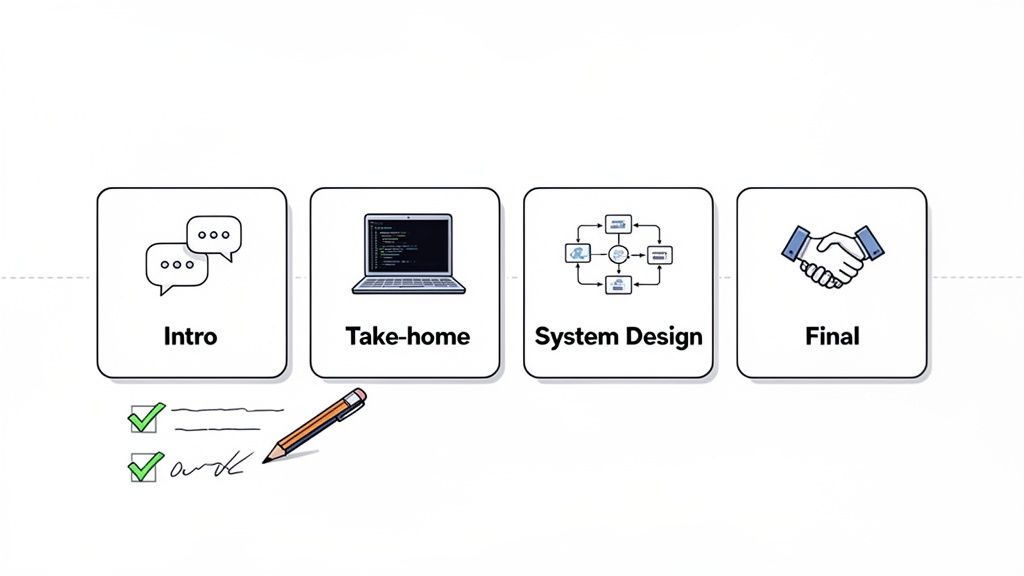
While every startup adds its own spin, most interview loops follow a fairly predictable path. Knowing what each stage is designed to test gives you a playbook for success.
Here's how it usually breaks down:
README.md explaining your design choices and how to run the project. It shows professionalism.Beyond just your technical skills, startups are hiring for a specific mentality. They need people who can operate effectively without a giant corporate safety net.
Despite hype about AI replacing developers, CompTIA's 2025 report forecasts that U.S. tech jobs will climb to 7.03 million by 2035, with software developer roles set to grow by 297%. For candidates with a builder’s mentality, this signals a massive opportunity.
At its core, the startup mindset is about ownership. It’s the difference between asking "What should I do next?" and saying "I noticed this problem, so I drafted a solution. Here's what I think we should do."
To prove you have this mindset, use concrete examples. When asked about a challenge, don't just describe the problem. Frame your story with a bias for action: "Our user sign-up flow was clunky. Instead of waiting for a design overhaul, I built a quick A/B test with a simplified form. The new version increased conversions by 10%, and we rolled it out." This immediately shows initiative and a focus on results.
You can find more practical advice in our complete guide on how to prepare for a software engineer interview.
Ultimately, every stage of the startup interview is a test of not just what you know, but how you think and act. Show them you’re not just a coder waiting for instructions. Show them you’re a partner who is ready to help build the business from the ground up.
Are you tired of firing your resume into a digital black hole? The standard job search for software engineers has become a full-time job of its own. One senior engineer recently told us their 2025 search involved 150 applications, which led to 80 companies not even bothering to reply. It’s a demoralizing cycle of customizing resumes and getting nothing but silence in return.
This process burns out even the most talented engineers. You spend hours fine-tuning your profile for an application tracking system, only to be one of thousands fighting for the attention of a keyword-scanning algorithm.
But what if you could flip that entire model on its head? Imagine a world where, instead of you chasing companies, the most promising startups were competing for your talent. That’s the core idea behind a curated, candidate-first approach. Instead of spamming applications, you create one strong, confidential profile.
From there, the platform handles the heavy lifting. Experts who live and breathe the startup world hand-pick opportunities that actually align with your skills, experience, and career goals.
This model is built on a few key principles:
This approach transforms your job search from a high-volume, low-return chore into a focused, high-value experience. You’re no longer just another resume in a giant digital pile; you become a sought-after candidate.
Instead of shouting into the void of a massive job board, you’re having quiet, meaningful conversations with founders and hiring managers who are already excited to talk to you. It's a fundamental shift from seeking approval to being actively recruited.
A curated method respects your time and your talent. By connecting you directly with the decision-makers at companies that are a genuine match, it cuts through the noise. You get to focus on what actually matters—finding a software engineering role where you can build something you’re truly passionate about. You stop chasing opportunities and let the best ones come directly to you.
As you dig into the startup job market, a few common questions always seem to pop up. Let's tackle some of the big ones we hear from engineers all the time.
Equity can vary wildly based on the company's funding stage and your seniority. For a senior engineer joining an early-stage company (Seed or Series A), an equity grant between 0.1% and 0.5% is a standard ballpark. For a later-stage startup (Series B or C), that range typically shifts to 0.05% to 0.2%.
A percentage only tells you part of the story. An actionable tip is to always ask for the total number of outstanding shares to calculate your grant's potential value. Also, confirm the vesting schedule is a standard 4-year plan with a 1-year cliff before any shares are yours.
The best answer really hinges on the startup's stage of growth.
In the very early days (pre-Series A), companies are desperate for generalists—full-stack engineers who can comfortably jump between the frontend, backend, and infrastructure.
Once a company scales (Series A and beyond), specialization starts to pay off, and demand spikes for deep expertise in areas like backend systems or mobile. The most sought-after engineers are often "T-shaped"—they have a broad base of knowledge across the stack but possess deep, specialized skills in one core area.
System design interviews are about how you think through architecture and weigh trade-offs. You don't need to have designed massive systems to succeed.
A great starting point is to study common architectural patterns, like microservices versus monoliths. Then, practice whiteboarding the designs for popular apps.
The key isn't to find one "correct" answer. Instead, focus on clearly communicating your thought process. An actionable tip is to use the "Clarify, Design, Refine" approach: first, ask clarifying questions about requirements; second, sketch a high-level design on the whiteboard; third, discuss potential bottlenecks and how you would refine the system to handle scale.
The three most common software engineering specializations are frontend, backend, and full-stack. Frontend engineers own everything the user sees and interacts with — they build interfaces, implement visual designs, and ensure the application works responsively across devices, typically using frameworks like React, Vue, or Angular. Backend engineers build the server-side systems that power an application: the databases, APIs, business logic, and infrastructure that users never see but entirely depend on, usually using languages like Python, Go, Java, or Node.js. Full-stack engineers work across both layers, which makes them particularly valuable at startups where team sizes are lean and someone needs to build an entire feature from the database to the user interface. Beyond these three, there are also specialized roles in mobile development, site reliability engineering, data engineering, and machine learning infrastructure that represent distinct and growing career paths.
Software engineering careers generally progress through a consistent set of levels, even if exact titles vary by company. Entry-level engineers (often called SDE I or Junior Engineer) focus on executing well-defined tasks, writing clean code, and absorbing the codebase. Mid-level engineers (SDE II) take on more ownership — they independently lead small features and begin reviewing code from junior colleagues. Senior engineers own entire features and projects end to end: they write design documents, make architectural decisions, and mentor junior engineers. Beyond senior, the path forks into the individual contributor track (Staff Engineer, Principal Engineer) for those who want to go deeper technically, or the engineering management track for those who want to lead people and teams. Staff and Principal engineers operate at a cross-team or company-wide scope, shaping technical strategy rather than executing individual features.
The U.S. Bureau of Labor Statistics projects a 17 percent growth rate in software developer and engineer jobs between 2023 and 2033, translating to more than 327,900 new positions. This growth rate significantly outpaces the average across other occupations. Importantly, this overall growth exists alongside critical shortages in specialized areas — particularly AI and machine learning engineering, cloud security, and distributed systems — meaning that engineers with expertise in high-demand specializations face a meaningfully different job market than the broad averages suggest.
The differences are primarily about scope of work, degree of independence, and the type of impact expected. A junior engineer is given clearly defined tasks with close guidance — the goal is execution and learning. A mid-level engineer takes on full ownership of small features from start to finish with minimal oversight and is expected to contribute to technical discussions and code reviews. A senior engineer's job shifts from execution to ownership and leadership — they take a vague product requirement, translate it into a technical design, make architectural decisions, drive the project to completion, and actively make the engineers around them more effective. Each level represents a meaningful expansion of judgment, influence, and accountability rather than just accumulated time.
A startup job description is better understood as a marketing document than a precise contract — the company is selling you on their vision, and your job is to evaluate it critically. Green flags include a clearly stated mission and customer problem, a focused and realistic tech stack (rather than a wishlist of every technology), and specific language about ownership and growth paths. Red flags include terms like "rockstar" or "ninja" (which often signal unrealistic expectations), an overwhelming and undifferentiated list of responsibilities (which suggests the role is not well defined), and vague promises of "growth opportunities" with no concrete detail. Beyond the description itself, researching the company's funding history on Crunchbase, assessing founder backgrounds on LinkedIn, and looking for evidence of product-market fit through customer reviews and press coverage will tell you far more about the opportunity than the job listing alone.
Most startup interview loops follow four stages. The first is an initial recruiter or hiring manager conversation focused on enthusiasm for the company's specific mission and your high-level background. The second is a technical challenge — either a take-home project or a live coding session — where clean, practical code matters more than algorithmic cleverness. The third stage (more common for mid-level and senior candidates) is a system design round where you walk through how you'd architect a real system, with the emphasis placed on your thought process and how you handle trade-offs rather than any single correct answer. The fourth is a final round of interviews, often including a founder, that probes for a startup mindset: ownership, adaptability, and bias toward action. The entire loop tends to move faster than corporate interviews and is oriented around practical problem-solving rather than abstract puzzles.
Equity varies significantly based on the company's funding stage and your seniority. For a senior engineer joining an early-stage company at the seed or Series A level, an equity grant of approximately 0.1 to 0.5 percent is a common range. At later-stage companies (Series B or C), that range typically shifts to 0.05 to 0.2 percent, reflecting a higher valuation with less remaining upside. Raw percentages only tell part of the story — you also need to know the total number of fully diluted shares outstanding and the company's most recent 409A valuation to estimate the actual paper value of your grant. The standard vesting structure is a four-year schedule with a one-year cliff, meaning no equity vests until your first anniversary, at which point 25 percent of your grant vests immediately, with the rest vesting monthly over the following three years.
The answer depends on where you are in your career and the stage of the company you're targeting. At early-stage startups — pre-Series A especially — the highest demand is for generalists and full-stack engineers who can move fluidly across the frontend, backend, and infrastructure layers without needing dedicated support. As companies scale past Series A, demand for deep specialization increases alongside team size. The most sought-after engineers at growth-stage and mature startups tend to be "T-shaped": they have a broad working knowledge across the stack but possess genuine depth in one core area, like distributed systems, mobile platforms, or machine learning infrastructure. Early in your career, building breadth is usually the right move; developing a clear area of deep expertise becomes increasingly important as you progress toward senior and staff-level roles.
System design interviews test your ability to think through architecture and weigh engineering trade-offs, not your ability to recall a single correct answer. Effective preparation starts with studying common architectural patterns — understanding the difference between microservices and monolithic architectures, how to design for horizontal scalability, how to approach database selection, and how caching, message queues, and load balancers fit into distributed systems. Practicing the design of recognizable products (a URL shortener, a social media feed, a real-time notification system) builds the fluency needed to structure your thinking under pressure. In the interview itself, the most important habit is narrating your reasoning out loud: clarify requirements and constraints first, sketch a high-level architecture, and then proactively identify bottlenecks and discuss how you'd address them at scale. Interviewers are evaluating how you think and communicate, not whether you arrived at a textbook answer.
The most efficient approach is to move away from high-volume job boards where your resume competes against hundreds of similar candidates and toward curated channels that pre-screen for company quality. Curated hiring marketplaces like Underdog.io invert the traditional dynamic: you build one detailed, confidential profile and vetted startups reach out to you based on your skills and experience, which means every conversation starts with a mutual signal of interest rather than a cold application. For engineers at all levels, this approach dramatically reduces time spent on low-signal applications and increases the quality of conversations. Contributing to open-source projects, maintaining an active GitHub profile, and engaging with technical communities relevant to your stack are additional channels that can generate inbound interest from startup engineering teams who are already evaluating your work before they ever reach out.
Ready to stop applying and let the best startups come to you? At Underdog.io, we flip the script. Create one private profile and get matched with top, vetted tech companies in NYC, SF, and remote. Find your next role at https://underdog.io.