So, what exactly is an AI Engineer? Forget the vague job descriptions for a moment. At its core, an AI Engineer is the person who takes a brilliant but fragile AI model out of the research lab and makes it work in the real world—reliably, at scale.
They’re the builders who bridge the gap between a data scientist’s promising Jupyter notebook and a scalable, money-making product feature. While a researcher might discover a new algorithm, an AI Engineer is the one who puts that discovery into production to serve millions of users. For startups, this role isn't just important; it's everything.
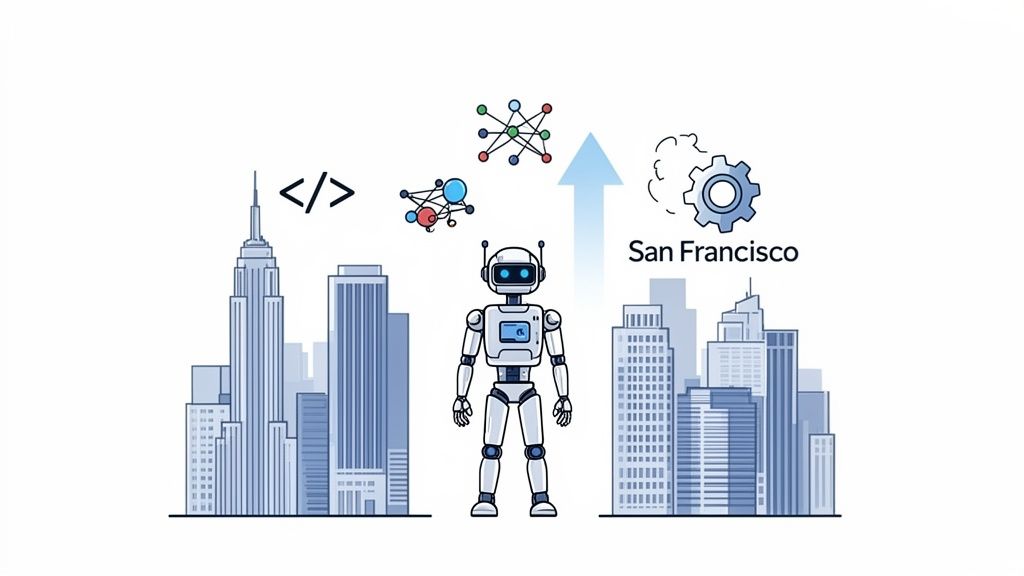
Let's cut through the hype. "AI Engineer" isn't just another buzzword. It’s a reflection of a massive shift in what tech companies—especially startups—need to survive and win. For years, the tech world had neat little boxes: software developer, data scientist, DevOps engineer. The most valuable player today is the one who can wear all three hats.
This new breed of engineer doesn't just train a model. They build the entire ecosystem around it. They’re responsible for the infrastructure that serves the model, the APIs that expose it, and the monitoring that ensures it all runs smoothly without a human constantly watching over it.
Think about the traditional roles. The software developer writes application code. The data scientist explores datasets and tunes algorithms. The DevOps specialist builds deployment pipelines. The AI Engineer lives at the intersection of all three.
Imagine a startup building an AI-powered customer support tool. They need one person who can take practical, end-to-end ownership. For example, they might need to:
This end-to-end ownership is precisely why the role is so critical. Startups can't afford siloed teams and long handoffs. They need versatile builders who can take an idea from a whiteboard sketch to a live, production-ready feature. That's the modern AI Engineer.
This isn't just a feeling; the numbers are staggering. The global economy is seeing an explosion in AI-related jobs. LinkedIn data shows that 1.3 million new positions were created in just two years. In the US, job postings that mention AI have shot up by 134% since early 2020. You can dig into the full report on AI's impact on the workforce from the World Economic Forum.
This surge is creating what's being called "new-collar" work, where the demand for AI-specific skills is growing much faster than the supply of qualified talent.
For ambitious developers, this is a massive opportunity. Mastering AI engineering isn't just about learning a new library; it's a strategic move to build a career that's incredibly durable and in-demand.
High-growth startups, especially in hubs like New York City and San Francisco, are in a fierce race for this talent. They know the first company to ship a working AI feature often captures the market. They aren’t just hiring a title—they're looking for people who can deliver real impact and accelerate the product roadmap. This is your chance to get on their radar and build a career on the absolute cutting edge.
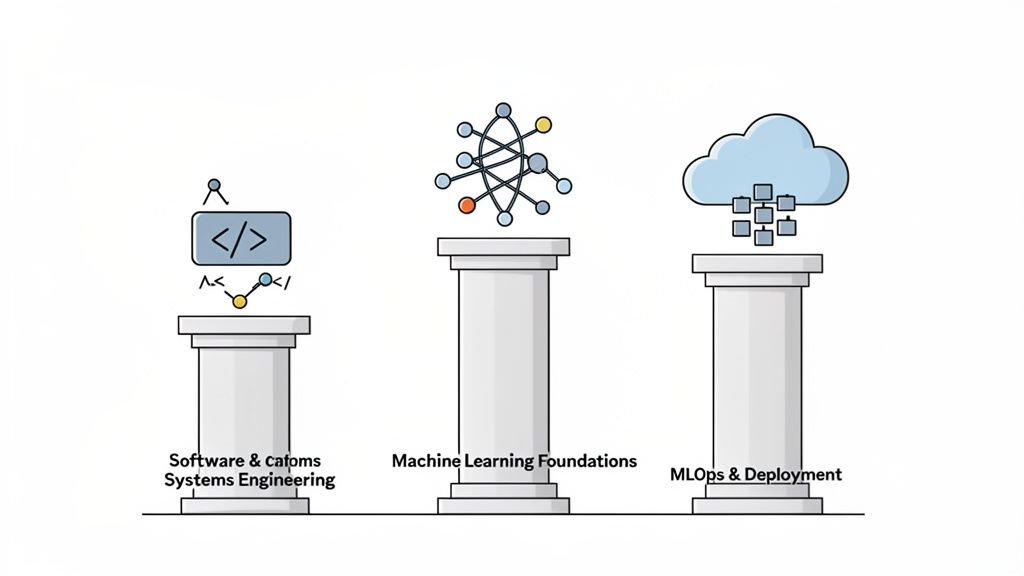
To make it as an AI Engineer, you need a skill set that goes way beyond just training models. It’s not about notebooks and research papers; it's about building, deploying, and maintaining entire AI-powered systems.
Think of the role as being built on three core pillars: rock-solid software engineering, deep machine learning know-how, and practical MLOps and deployment expertise.
Nailing these areas is what separates someone who can build a cool prototype from a true engineer who can ship a production-ready AI feature that real customers use. Let's break down the technical skills that actually matter in a startup and what they look like in the wild.
To give you a clearer picture, here’s how these pillars break down into concrete skills and real-world startup applications.
Each pillar is critical. A model with no software around it is useless, and a great app with a bad model is just a great app. Let's dig into the details of each.
Before you can build intelligent systems, you have to be a strong software engineer. This is the non-negotiable foundation. An AI model is worthless if the application wrapped around it is slow, buggy, or falls over the moment it sees real-world traffic.
The language of choice here is Python. Its massive ecosystem of libraries like NumPy, Pandas, and FastAPI makes it the default for nearly every AI team out there. But just knowing the syntax isn't the bar. You need to write clean, efficient, and testable code that others can actually read and maintain.
Just as important is a firm grasp of data structures and algorithms. When you’re processing millions of data points for a recommendation engine, choosing the right hash map over a simple list can be the difference between a response time of 50 milliseconds and five seconds. That's a lifetime for a user.
Finally, you need system design chops. This is all about architecting services that are both scalable and resilient. For instance, if you're asked to design an API that serves a computer vision model processing hundreds of live video feeds, your practical plan might involve a load balancer to distribute requests, an asynchronous task queue like Celery to handle long-running video processing jobs without blocking the API, and failover mechanisms to ensure high availability.
With a solid engineering base, the next pillar is truly understanding the "AI" part of the job. This isn't about having a Ph.D. in mathematics. It's about having practical, applied knowledge of machine learning concepts so you know exactly which tool to pull out of the toolbox for the job at hand.
This starts with a strong command of both classical ML models and deep learning:
The most valuable skill for a modern AI engineer is knowing the trade-offs. It's about understanding when a simple model is "good enough" versus when you genuinely need the power—and the cost—of a large-scale deep learning solution.
For a real-world example, I once worked on a product recommendation engine. We started with a simple collaborative filtering model. It was fast and effective but choked on new users (the "cold start" problem). Only then did we graduate to a more complex deep learning model using embeddings, which finally solved the issue. This iterative approach—start simple, measure, then improve—is a core engineering discipline.
This final pillar is what truly defines the modern AI Engineer role. It’s all about bringing models to life in a production environment and—just as importantly—keeping them running reliably. Machine Learning Operations, or MLOps, is the set of practices that bridges the gap between a model on your laptop and a feature in your product.
Your skills in this area should be rock-solid:
A practical MLOps task might be deploying a computer vision model that analyzes security footage. This means creating a Docker container for the model's API, deploying it to a Kubernetes cluster on AWS, and setting up a pipeline that automatically retrains and redeploys the model with new data each week. This full-cycle ownership is the essence of the job.
Technical skills are just the price of admission. Your portfolio is what actually gets you through the door. Hiring managers, especially at fast-moving startups, don’t have time to guess what you’re capable of. They need to see tangible proof that you can build, deploy, and maintain real-world AI systems.
A great portfolio is so much more than a collection of cloned tutorials or dusty Jupyter notebooks. It’s a curated set of end-to-end projects that tells a compelling story about your skills as an engineer. It proves you can move beyond theory and deliver something that actually works.
This is more critical than ever. We're seeing AI Engineer roles explode 300% faster than traditional software engineering positions, driven by a brutal supply-demand imbalance. Companies are desperate for people who can finally bridge the gap between a cool prototype and a production-ready system.
The first rule of a great portfolio? Solve a unique problem. Anyone can follow a step-by-step guide to build another "cat vs. dog" image classifier. While that’s fine for learning the ropes, it does absolutely nothing to impress a hiring manager who has seen dozens of them.
Instead, find a problem that genuinely interests you and build a complete solution around it. Your projects should clearly demonstrate the three pillars of the AI engineer role: software engineering, ML fundamentals, and MLOps.
Of course, once you’ve built these impressive projects, you need a place to show them off. It's essential to learn how to create an online portfolio for free to present them professionally. A polished portfolio site dramatically boosts your credibility.
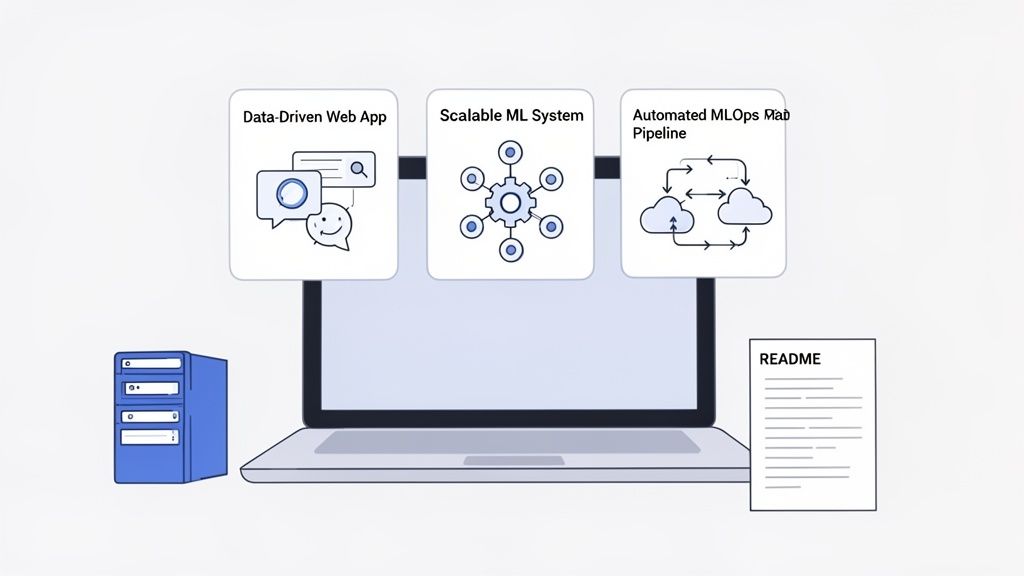
You’ll want to focus your energy on projects that mirror the work you'll actually be doing. Here are three types of projects that consistently get positive attention from startups and high-growth tech companies.
1. The Data-Driven Application
This project shows you can build a full-stack application powered by an AI model. It’s proof that you can handle everything from the user interface down to the model inference and data management.
2. The Scalable ML System
This kind of project proves you can deploy a machine learning model as a robust, scalable service. The focus here is less on the novelty of the model and more on the engineering that makes it usable in a real-world production environment.
3. The Automated MLOps Pipeline
This is the most advanced type of project and is highly valued by companies with mature AI teams. It demonstrates your ability to automate the entire machine learning lifecycle, from training and validation to deployment and monitoring.
A crucial tip: You don't need all three. One deeply developed, well-documented project from this list is far more valuable than three shallow ones. Choose the one that best aligns with your interests and the types of roles you're targeting. For a deeper dive into available roles, you might be interested in our overview of machine learning engineer remote jobs.
Your code is only half the story. The other half is your documentation. A detailed GitHub README is your chance to guide a hiring manager through your project, explaining your thought process and the "why" behind your technical decisions.
A great README should always include:
Your portfolio is your single most important asset. Treat it like a product you're building for your most important user: your future employer.

A killer portfolio gets your foot in the door, but a sharp resume and a confident interview are what ultimately land you the job. In a market this competitive, your resume is your one-page pitch. It has to scream "impact" from the very first glance, because recruiters only spend a few seconds on each one.
I see the same mistake over and over again: candidates describe their duties instead of their accomplishments. For an AI Engineer, this is a fatal error. You need to prove you don't just "work on models"—you build systems that drive real business results.
Every single bullet point on your resume needs to tell a story of value. Forget passive descriptions. You need active, quantifiable achievements. The best way to frame this is using the Problem-Action-Result (PAR) framework.
Let's break down a common, weak bullet point I see all the time:
This tells a hiring manager almost nothing. Let's reframe it to show actual impact:
See the difference? This version is packed with power. It names the tech (PyTorch), specifies the action (developed and deployed), and—most importantly—quantifies the business outcome (a 40% improvement). For a deeper dive on this, our guide on how to write a tech resume has more examples.
Always lead with your strongest, most quantifiable achievements. Place your projects section high on your resume, right after your experience, and link directly to the GitHub repos with those well-documented READMEs we talked about.
Once your resume lands you that first call, you’ll enter a multi-stage interview gauntlet designed to test your skills from every possible angle. While every startup has its own flavor, the process generally follows a predictable pattern. Knowing what to expect is your biggest advantage.
The typical interview loop for an AI Engineer looks something like this:
Technical Screen: This is all about your core software engineering chops. Expect classic data structures and algorithm questions. You need to write clean, efficient Python and clearly articulate your thought process as you go. They want to see a strong engineer first and foremost.
ML System Design: This is often the make-or-break round. A common prompt might be: "Design a system to detect fraudulent transactions in real-time." Your job is to walk the interviewer through the entire lifecycle—from data collection and feature engineering to model selection, deployment, and monitoring. Have a framework ready: clarify requirements, estimate scale, sketch the high-level architecture, and then drill down into the specifics.
ML Knowledge Deep-Dive: Here, they'll probe your practical ML understanding. You'll get questions designed to see how you think on your feet, like:
Behavioral Interview: Don't brush this off. The interviewer wants to know how you collaborate, handle conflict, and learn from your mistakes. Use the STAR method (Situation, Task, Action, Result) to frame your answers around past project experiences. It keeps you focused and impactful.
Finally, with so many interviews happening remotely, your on-camera presence is part of the evaluation. To make a great impression in virtual settings, it helps to learn how to do a video interview with confidence. A little preparation goes a long way in proving you're the right person for the job.
Okay, your portfolio is sharp and your resume is ready. Now for the hard part: getting it in front of the right people. Landing a top AI engineer role isn’t about blasting your resume into the void of generic job boards and praying for a response.
It’s about a targeted strategy that puts your profile in front of decision-makers at high-growth startups—the very companies that will value your end-to-end skills the most. This means you need to get away from the noise of massive platforms like LinkedIn or Indeed, where your application can easily drown in a sea of thousands.
The fastest way to bypass the resume black hole is to use curated hiring marketplaces. These platforms are a powerful filter, connecting pre-vetted talent (that’s you) with equally vetted startups. The advantage is twofold: companies trust the platform to bring them serious candidates, and you get direct access to hundreds of incredible opportunities without applying to each one individually.
Take a platform like Underdog.io. You create one in-depth profile, which is then reviewed by a human team. Once you’re approved, that single profile gets seen by hundreds of top startups in NYC, San Francisco, and across the US. The dynamic flips completely—instead of you chasing them, founders and hiring managers reach out to you if they see a fit. This saves you countless hours and puts you on the fast track to speaking directly with decision-makers.
If you want to explore more options, check out our guide on the best sites for startup jobs, which breaks down other valuable platforms.
Beyond curated platforms, the best way to prove your credibility is to become an active, visible member of the AI community. This isn't just about "networking"—it's about proving your skills through action.
As you start getting interviews, the conversation will inevitably turn to compensation. You have to understand that specialized AI roles command a significant premium. We're not just talking about salary; we're talking about the potential for life-changing equity, especially at early-stage startups.
Recent market data makes this crystal clear. An analysis of AI compensation trends from Ravio shows an 88% year-over-year growth in AI/ML roles, which come with salary premiums of 12%. Their research also shows that machine learning engineers account for 45% of these hires as companies fight for a competitive edge. This is a massive contrast to more commoditized tech jobs, where entry-level roles have cratered, hitting junior engineers the hardest.
When you negotiate, don't just focus on the base salary. Equity is where real wealth is built in startups. A slightly lower salary with a more generous equity grant at a promising company can be a much, much better long-term financial decision.
Here’s how to approach the negotiation table:
Your ability to build and deploy AI systems is one of the most valuable skills on the market today. By using a smart job search strategy and negotiating from a position of knowledge, you can land a role that not only challenges you but also rewards you for the incredible value you bring.
Once you decide to go after an AI Engineer role, the practical questions start piling up. Let's tackle some of the most common ones we hear from engineers looking to make the leap.
A ton. Simple as that. An AI Engineer is a software engineer first, one who specializes in building and deploying AI systems. This isn't a research role where you can get by with Jupyter notebooks and theoretical work.
You’ll be writing clean, efficient, production-ready code every single day. A rock-solid understanding of software engineering fundamentals, data structures, and algorithms is non-negotiable.
Absolutely not. A PhD is rarely a requirement for AI engineering roles, especially at startups. While a doctorate is common for AI research scientists who are inventing new algorithms, hiring managers for engineering roles care far more about your practical, hands-on skills.
Your ability to build and deploy systems is what gets you hired. A strong portfolio of projects and demonstrable experience in software engineering and MLOps are significantly more valuable than academic credentials for this specific career path.
For most companies, proof of implementation matters more than proof of publication.
Honestly, the lines are incredibly blurry, and in most startups, the roles are one and the same. The titles are often used interchangeably in job descriptions.
If there is a distinction, it's usually subtle:
In practice, the responsibilities almost completely overlap. Both roles are expected to take a model from a prototype and turn it into a scalable, production-grade service. Don't get hung up on the title; focus on the actual skills listed in the job description.
Your timeline really depends on where you're starting from.
If you're already a software engineer with a good foundation, you can become a competitive candidate in 6-12 months with dedicated study. Your core skills are directly transferable, so you just need to layer on ML fundamentals and MLOps practices.
If you're starting from scratch without a programming background, the path is longer. Realistically, expect it to take 2-3 years. You have to build a strong software engineering foundation first before you can even begin to specialize in AI.
An AI engineer is a software engineer who specializes in building, deploying, and maintaining AI-powered systems at production scale. Unlike a data scientist or AI researcher who focuses on developing new models and algorithms, an AI engineer takes those models and wraps them in the engineering infrastructure — APIs, pipelines, monitoring, deployment systems — needed to make them work reliably for real users. They sit at the intersection of software engineering, machine learning, and DevOps, and are especially valued at startups where one person often needs to own the entire lifecycle of an AI feature from prototype to production.
The role is built on three core pillars. The first is strong software engineering fundamentals — proficiency in Python, data structures and algorithms, system design, and the ability to write clean, production-ready code. The second is applied machine learning knowledge — understanding classical models like XGBoost alongside deep learning frameworks like PyTorch or TensorFlow, and knowing the practical trade-offs between them. The third is MLOps and deployment expertise — containerization with Docker, orchestration with Kubernetes, cloud platforms like AWS or GCP, and building automated CI/CD pipelines for model training and deployment. Hiring managers weight all three roughly equally, so weakness in any one area is noticeable.
A data scientist's work typically centers on exploration, analysis, and model development — building a model that performs well in a controlled environment. An AI engineer picks up where the data scientist leaves off, taking that model and turning it into a production-ready system that can serve real users at scale, reliably and cost-effectively. In practice at many startups, especially smaller ones, the same person does both. But as teams grow, the roles become more distinct, with data scientists owning model quality and AI engineers owning the systems that put those models to work.
In most job postings and at most startups, the titles are used interchangeably. If a distinction exists, it's usually that "machine learning engineer" implies a tighter focus on the MLOps side — building training pipelines, monitoring model drift, and managing model infrastructure — while "AI engineer" can sometimes signal a broader scope that includes generative AI, natural language processing, or computer vision systems. In practice, the day-to-day responsibilities overlap almost entirely. The best advice is to look past the title and evaluate the actual skills listed in the job description.
No. A PhD is generally required for AI research scientists who are inventing new algorithms or publishing papers, but it is rarely a requirement or even a strong preference for AI engineering roles. Hiring managers at startups care far more about your ability to build and ship production systems than your academic credentials. A strong portfolio of end-to-end projects — a deployed application, a containerized model API, an automated MLOps pipeline — demonstrates practical capability in a way that a degree alone cannot. Proof of implementation consistently matters more than proof of publication for this career path.
The timeline depends heavily on your starting point. If you already have a software engineering background, you can become a competitive candidate by layering on machine learning fundamentals and MLOps skills, which typically takes six to twelve months of focused study and project work. If you're starting without a programming background, you first need to build that software engineering foundation, which extends the realistic timeline to two to three years. In both cases, building a portfolio of real, deployed projects accelerates the process significantly more than coursework or certifications alone.
A strong AI engineer portfolio typically includes two or three end-to-end projects that demonstrate all three skill pillars. A data-driven application shows you can integrate a model into a full-stack product. A containerized model API proves you can deploy a machine learning service as a scalable, production-ready system. An automated MLOps pipeline demonstrates you can manage the entire model lifecycle, from training through deployment and monitoring. Each project should be paired with a detailed GitHub README that explains the problem, the architecture, the tech choices, and what you'd do differently — because hiring managers evaluate your thinking as much as your code.
Most AI engineer interview loops include four stages. A technical screen tests core software engineering skills — data structures, algorithms, and clean Python. An ML system design round asks you to architect a complete AI system from scratch, testing your ability to think through requirements, trade-offs, and scalability. An ML knowledge deep-dive probes your practical understanding of model selection, debugging production issues, and handling edge cases like imbalanced data. A behavioral interview evaluates how you collaborate, handle ambiguity, and learn from failure. Startups tend to move through this process faster than large companies, sometimes compressing from first call to offer within a week.
AI engineers command a significant premium over generalist software engineers. Recent market data shows an 88% year-over-year growth in AI and ML roles, with AI specialists earning roughly 12% more than equivalent non-AI engineering roles. At the senior level, total compensation at well-funded startups and large tech companies frequently exceeds $200,000 when base salary, performance bonuses, and equity are included. At early-stage startups, the base salary may be lower, but equity grants can represent meaningful upside if the company grows. Negotiating the full package — base, equity, and signing bonus — is especially important in AI roles where compensation structures vary widely between company stages.
Demand is growing at a pace that far outstrips supply. LinkedIn data points to 1.3 million new AI-related positions being created in just two years, and job postings that mention AI have increased by 134% since 2020 in the United States. AI engineer roles specifically have been growing roughly three times faster than traditional software engineering positions, driven by a widening gap between how many companies need AI capabilities and how many engineers can actually build and deploy them. This supply-demand imbalance is the primary reason the role commands a salary premium and remains one of the most resilient career paths in tech heading into 2026.
Ready to stop just applying for jobs and start having top startups compete for you? At Underdog.io, we flip the script. With one application, you get your profile in front of hundreds of vetted, high-growth companies looking for talent just like you. Let the best AI engineer roles find you. Sign up on Underdog.io today.