Writing a tech resume isn't just about listing your past jobs. It's about building a strategic document that can charm both automated screeners and seasoned human recruiters. You have to quantify your impact, perfectly align your skills with the job description, and showcase projects that scream, "I get things done." Nail this, and your resume won't just get seen—it'll get read.
Let's be real: crafting a resume for a tech role feels a lot like its own coding challenge. You're engineering a marketing document designed for two completely different audiences, and the first one isn't even human.
Your initial gatekeeper is the Applicant Tracking System (ATS), the software that nearly every company uses to filter candidates before a recruiter ever sees their name. Botch the formatting or miss the right keywords, and you're out. A staggering 75% of resumes get filtered out by these systems, which is a tough pill to swallow when you realize that over 99% of Fortune 500 companies rely on them.
But getting past the bot is only round one.
Once your resume lands on a recruiter's screen, you have just a handful of seconds to make your case. They aren't there to read a laundry list of your old responsibilities; they're scanning for hard evidence of your impact.
A great tech resume tells a story of problems solved, value created, and technologies mastered. It moves beyond "what I did" to "what I achieved," turning job duties into compelling case studies of your skills in action.
This guide will show you exactly how to build a resume that aces both challenges. We’ll break down how to structure your content for maximum readability, translate your work into powerful, metric-driven achievements, and strategically tailor every application. The goal is to create a document that not only sails through the initial screening but convinces a hiring manager you're the one they need.
We'll build this resume on three core pillars:
To kick things off, here's a quick breakdown of what makes a high-impact tech resume tick. Think of this as your roadmap for everything we're about to cover.
With this structure in mind, you're ready to start building a resume that doesn't just list your history—it sells your future potential. Let's get started.
Before you even think about writing those killer bullet points, you have to get the architecture right. Think of your resume's structure like the foundation of a house—if it's unstable or confusing, everything you build on top of it will crumble. The goal is to create a dead-simple, logical flow that guides both bots and human eyes straight to your most impressive stuff.
A clean, single-column layout is your best friend here. Seriously. Those flashy, multi-column templates with cool graphics might look slick, but they're the number one enemy of Applicant Tracking Systems (ATS). These systems read resumes like a book, top to bottom, and complex formatting can make them garble your info or skip entire sections. You get an automatic rejection before a person ever even sees your name.
This flowchart shows the first hurdle your resume has to clear.
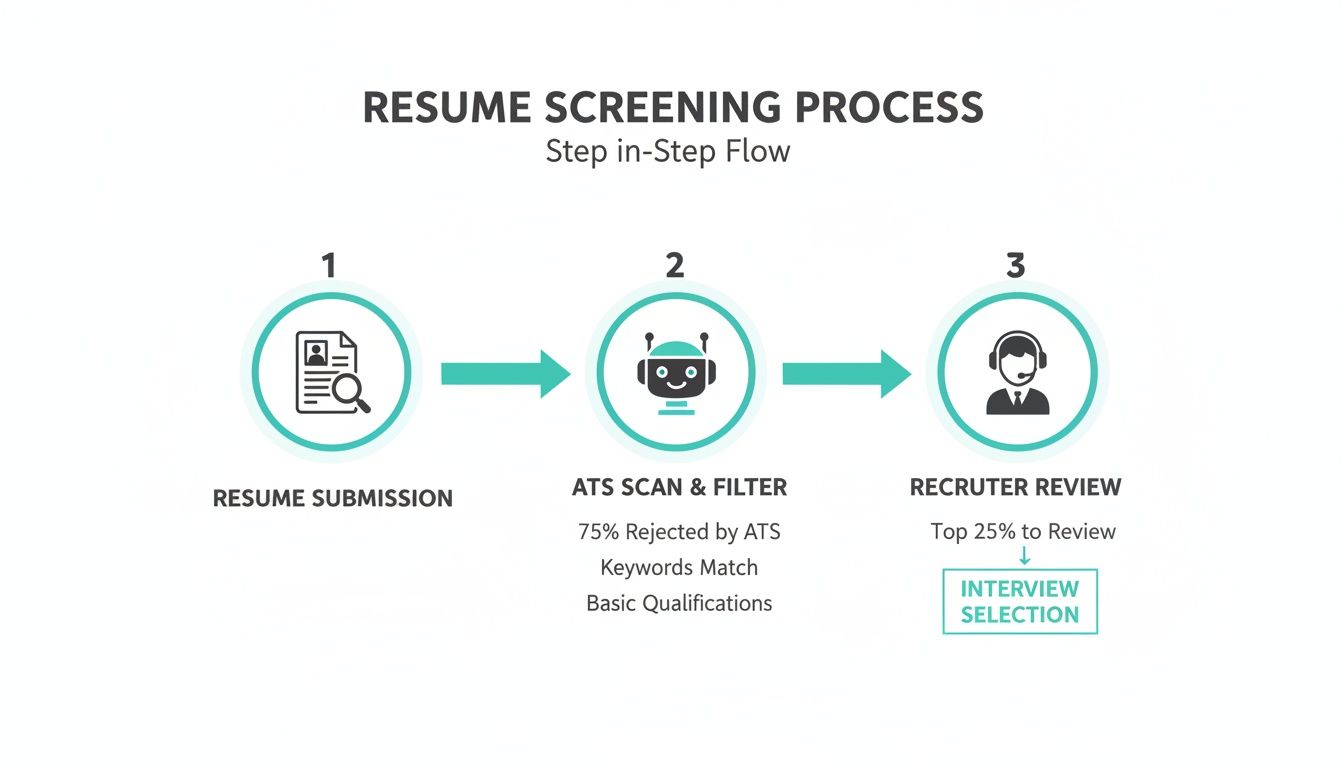
As you can see, beating the ATS scan is the non-negotiable first step. A clean structure is paramount.
Every part of your resume has a specific job to do. Sticking with a reverse-chronological format (most recent stuff first) is the standard for a reason. It’s what recruiters expect, and it lets them see your latest, most relevant experience immediately.
Here's the essential order and why each piece matters:
Actionable Tip: Don't just dump every technology you've ever touched. Curate this list based on the job description. If the role requires Python, Django, and AWS, make sure those are front and center. For example, you can create a "Core Competencies" subsection within your Skills section and place those three technologies there.
Once you've set the stage with your summary and skills, you get to the heart of your resume—the part where you prove you can actually do the work. This is where you demonstrate your value, not just declare it.
Experience
This is your professional history, listed in reverse-chronological order. Each entry needs your title, the company name, its location, and the dates you worked there. The bullet points under each role are where the real magic happens, but we'll dive deep into that next.
Projects
For engineers early in their careers or anyone switching specializations, the projects section is your MVP. It’s concrete proof that you can build things. Pick 2-3 of your most impressive projects and provide links to the code on GitHub or, even better, a live demo.
Education
Finally, keep the education section short and sweet. List your degree, university, and graduation date. If you're a recent grad with a high GPA (3.5 or above) or relevant academic honors, feel free to include them. Otherwise, as you gain more experience, this section fades into the background.
And one last thing: always, always save and submit your resume as a PDF. It locks in your formatting so what you see is what the hiring manager sees, no matter their device. Naming the file FirstName-LastName-Resume.pdf is a small but professional finishing touch.
Great tech resumes do one thing exceptionally well: they prove your value with numbers. Hiring managers and recruiters don't want to read a laundry list of your old job duties; they want to see the direct, measurable impact of your work. This is where you stop just describing responsibilities and start showcasing results.
It’s the difference between saying you "participated in a project" and proving you "drove the project to a successful outcome." That simple shift in framing is what separates a resume that gets a polite "no thanks" from one that lands you an interview.
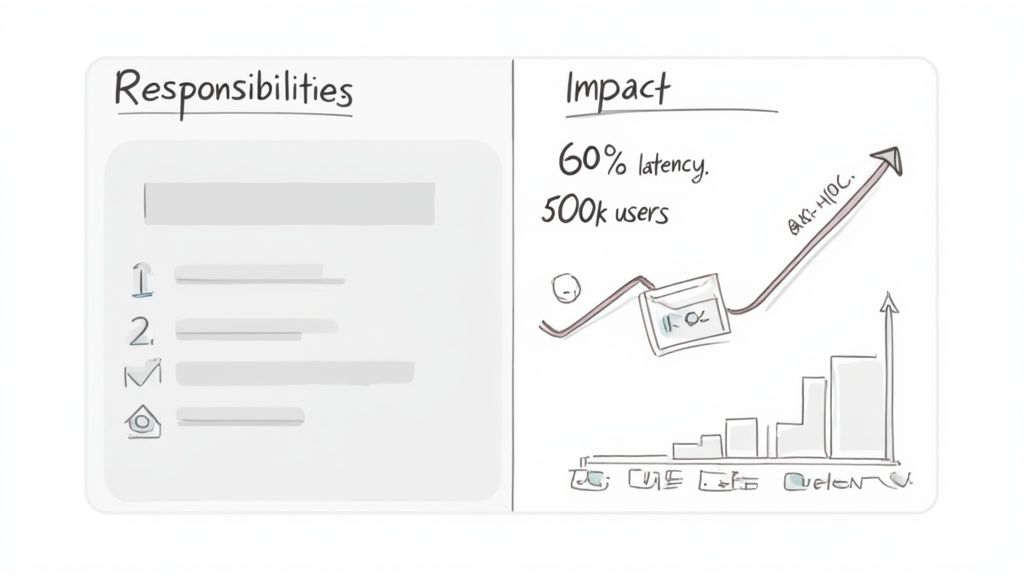
Quantifiable achievements are the engine of a winning tech resume. In fact, resumes that feature hard metrics get up to 40% more responses from recruiters who are trained to look for tangible results over vague descriptions. Brevity plus numbers—that’s the key. You can dig into more of the data behind this in this detailed report on resume statistics.
The best way to communicate your wins is by using a simple, powerful formula for every single bullet point in your experience section. This structure forces you to focus on the outcome, not just the activity.
The formula is: Action Verb + What You Did + Quantifiable Result
Let's break it down:
"But what if I don't have exact numbers?" I hear this all the time. It's a common hurdle, but the metrics are almost always there if you know where to look. You don’t need to have personally tracked every single KPI to find solid data. Just think about the purpose behind your work.
Every technical task is ultimately meant to improve something. Your job is to identify what that 'something' was and find a number to represent that improvement.
Not sure where to start? Look in these areas:
Even if you don't have the exact figure, a well-reasoned estimate is far better than no number at all. You can often find this data in old performance reports, team dashboards, or even by just pinging former colleagues.
Let's put the formula into practice. The transformation from a responsibility-focused bullet to a results-driven one makes the power of this approach crystal clear.
Software Engineer Example
DevOps Specialist Example
Data Scientist Example
Each "After" example is a mini-story of success. It tells the recruiter not just what you did, but how well you did it and why it actually mattered to the business. This is how you craft a tech resume that doesn't just get scanned—it gets you hired.
A long list of programming languages is just that—a list. True proficiency comes from what you build, and that's what gets you past the resume screen and into an interview. This is where you connect your skills to your impact, proving you can not just talk the talk, but build, optimize, and deliver.
It all starts with a dedicated, scannable skills section. This isn't a place for paragraphs; it's a keyword-rich zone designed for both ATS bots and the human recruiters skimming for specific tech.
The goal here is pure clarity. Grouping your skills into logical categories makes your expertise immediately obvious. Whatever you do, avoid rating yourself with proficiency bars or stars—they're subjective and pretty much meaningless to a hiring manager. Just list the tech.
Here’s a practical way to structure it:
This format lets a recruiter see in five seconds if you have what they need. And remember, the market is always shifting. It’s smart to periodically review guides on the top 10 essential skills for a software developer to make sure your list is current.
Going beyond the standard stacks can give you a serious edge, especially when it comes to AI and machine learning. In fact, 47% of hiring managers now rank AI abilities like machine learning and generative AI as top hard skills.
With roles like Big Data Specialists and AI/ML Engineers projected to be among the fastest-growing through 2030, showing you have some skin in the game through projects or certifications is no longer optional.
Your skills section lists what you know; your projects section proves how you use it. This is arguably the most critical part of your resume, especially if you're early in your career or switching fields. It’s your portfolio of proof.
Don't just list a project title. You need to frame each one as a miniature case study that tells a complete story. A hiring manager should immediately get the context, the challenge you faced, and the outcome.
The best project descriptions are concise narratives. They answer three fundamental questions: What was the problem? How did you solve it? What was the result?
This simple structure transforms a school assignment or a side hustle into a powerful demonstration of your problem-solving chops. Every project you list should also be on your GitHub, with a clean repository and a detailed README. For a deeper dive, check out our guide on how to make your GitHub more impressive to employers.
To keep this section clean and impactful, use a consistent framework for the 2-3 best projects you want to feature. This guides the reader through your work logically. And if you have a live demo link? Huge bonus.
Here's a straightforward framework to help you structure your project descriptions for maximum impact.
This "Problem, Stack, Accomplishment" formula gives your project context, showcases your technical choices, and—most importantly—highlights a measurable result. It’s the kind of proof hiring managers are looking for, turning a simple list of skills into a showcase of applied expertise.
Sending out a generic, one-size-fits-all resume is the digital equivalent of a limp handshake. It’s a dead giveaway that you're not that interested, and it’s one of the fastest ways to get your application tossed in the virtual trash bin.
The truth is, both automated systems and human recruiters are scanning for an obvious match. A generic document just doesn’t make the cut.
This doesn't mean you need to rewrite your entire life story for every single application. That's exhausting and a terrible use of your time. Instead, you need a smart system for customizing your resume to put a spotlight on the most relevant parts of your experience for that specific role. You’re not fudging your skills; you’re strategically framing your story to connect with a specific audience.
Before you touch a single word on your resume, put on your detective hat. The job description is your primary piece of evidence. I find it helps to either print it out or copy it into a separate document and just start pulling it apart. The goal here is to identify the core requirements and pick up on the company's lingo.
Look for patterns. What skills, technologies, and qualifications do they mention over and over again? These are your keywords.
This quick analysis gives you a blueprint of what the hiring manager cares about most. It tells you exactly what to emphasize to get past the initial ATS scan and, more importantly, catch a human’s eye.
Once you have your list of keywords, it’s time to weave them into your resume. The trick is to make it feel completely natural, not like you're just stuffing in terms to please a machine.
Your best opportunities for this are in two key places:
Actionable Tip: Don't just make a laundry list of technologies. Weave them into your accomplishment-driven bullet points. Instead of a line that just says "Used AWS," write something like, "Architected and deployed a scalable microservices architecture on AWS ECS, improving system uptime to 99.98%." See the difference? Context is everything.
Tailoring goes beyond just keywords. You also need to adjust your tone and focus depending on the company you’re applying to. Startups and big corporations are looking for slightly different things.
By creating a solid "master resume" that includes all your wins, you can then quickly copy and customize a version for each application. This targeted approach might take an extra 10-15 minutes per job, but believe me, it dramatically increases your chances of actually getting noticed.
You’ve poured hours into crafting the perfect tech resume, and you're almost ready to hit "send." But don't let a simple oversight sink your application now. The final review is just as critical as writing the bullet points themselves. This is your last chance to catch those small errors that send big signals of carelessness to a hiring manager.
First, proofread your resume. Then, do it again. Seriously. A single typo or grammatical mistake can be a red flag, suggesting a lack of attention to detail—a fatal flaw for any technical role. Read it out loud, run it through a grammar checker, and then, most importantly, ask a friend to review it with fresh eyes. You'd be surprised what you miss when you've been staring at the same document for hours.
Beyond just spelling, you need to check for consistency across your entire professional footprint. Your LinkedIn and GitHub profiles should be up-to-date and tell the exact same story as your resume. Make sure your project links actually work and that your GitHub READMEs are clean and presentable. Nothing screams "unprepared" louder than a recruiter clicking a link only to find a 404 error or a completely empty repository.
Some mistakes are far more common than you'd think, and they can be absolute deal-breakers for startups. As you do one last pass, keep a sharp eye out for these specific issues:
resume.pdf is an amateur move that gets lost in a sea of other files. Always use a professional format that makes it easy for the recruiter, like FirstName-LastName-Resume.pdf.Think of your resume as a product you're shipping to a potential employer. Just like a final code review catches bugs before deployment, a thorough final check ensures your application is polished, professional, and ready to make an impact.
It's also worth understanding how modern recruitment systems might view your resume before a human ever does. To get a better handle on how AI is shaping the hiring process and what that means for avoiding common pitfalls, check out the articles on Parakeet AI's blog on AI in recruitment. Knowing how these systems work can help you sidestep the simple mistakes that get your application automatically filtered out.
Even with the best guide, you’re bound to run into a few tricky situations when you’re in the thick of resume writing. Let’s tackle some of the most common questions that pop up for tech professionals.
For almost everyone with less than 15 years of experience, the answer is a hard no. A single page is your friend. It forces you to be ruthless about what you include, ensuring only your most powerful achievements make the cut.
Remember, recruiters spend just a few seconds on their first pass. A tight, focused one-pager is infinitely more effective. Now, if you're a Principal Engineer or an exec with a massive track record, a two-page resume can work—but every single line on that second page has to earn its spot.
This is where you flip the script. Instead of focusing on a professional history you don't have, you lead with your demonstrated potential.
Make your 'Projects' section the star of the show. Put it right at the top. For every project, break down the problem you tackled, the specific tech you used, and what you actually accomplished. Did you build a full-stack app? Contribute to an open-source library? Show it off.
Your 'Skills' and 'Education' sections should also be front and center. Use a short professional summary to convey your passion for tech, what you know, and what you’re hungry to learn. It shows drive, and that’s exactly what startups want to see.
At the end of the day, your resume’s job is to prove you can code and solve real problems. Without formal experience, your GitHub and personal projects are your best evidence. They’re tangible proof of your skills.
If you have any professional experience, go with a Professional Summary. Think of it as your 2-3 sentence elevator pitch. It’s your chance to immediately broadcast your top skills and biggest wins, showing a hiring manager the value you can bring from day one.
An Objective Statement, on the other hand, is really for recent grads or people making a major career change. It’s more about your goals and helps explain why you're making the move you are.
Ready to put that polished resume to the test? Underdog.io is where top tech talent connects with innovative startups and fast-growing companies. One application gets you in front of hundreds of vetted firms. Find your next great role at Underdog.io.