You open your inbox, see the take-home assignment, and immediately start doing math in your head. How many hours will this take? Is this going to be a toy puzzle or a disguised work sample? Are they testing Python, algorithm knowledge, or whether you freeze when the prompt is vague?
That reaction is normal. A coding challenge in Python doesn't just test whether you can write syntax from memory. In startup interviews, it often acts as a compressed simulation of the job itself. You get imperfect requirements, limited time, and pressure to produce something correct, readable, and discussable.
The good news is that most candidates overcomplicate this. They prepare for rare trick questions when they should be building a practical system for understanding problems, choosing sane trade-offs, and communicating clearly while they code.
A seed-stage startup is hiring its second backend engineer. The founder, one product engineer, and a part-time recruiter need a fast read on whether a candidate can contribute in a small codebase with very little hand-holding. A Python coding challenge works well in that setting because it shows how someone handles ambiguous requirements, writes readable code, and makes trade-offs under a deadline.
The challenge format persists because it tests work that shows up in real jobs. Parsing input, transforming data, choosing between a list and a dict, handling edge cases, and writing functions another engineer can extend next week are all normal Python tasks. The prompt may be small, but the signal is useful.
That matters more at startups than many candidates expect.
Early-stage teams are rarely screening for obscure algorithm trivia. They are looking for pragmatic problem-solving. Can you get to a correct solution without thrashing? Can you keep the code clear enough for a teammate to review quickly? Can you explain why you chose the simpler approach first, then point out what you would optimize if the input size grew?
Basic problems still separate prepared candidates from candidates who only recognize patterns after seeing the answer. A short exercise on strings, arrays, or dictionaries reveals a lot: whether you understand Python well enough to avoid fighting the language, whether you check assumptions before coding, and whether you leave behind code that is easy to trust.
I have seen candidates lose points on easy prompts because they chased a clever solution before they had a correct one. Startups usually reward the opposite behavior. A straightforward solution with clear variable names, a couple of edge-case checks, and a short explanation of complexity is a better interview artifact than a half-finished optimization.
If you are coming from JavaScript, it helps to tighten up the Python-specific habits interviewers notice, especially around iteration, built-ins, and data structures. This guide on Python for JavaScript developers is useful prep for that transition.
A Python challenge is usually doing three jobs at once:
Python helps because the syntax is compact and readable. Interviewers can spend less time decoding boilerplate and more time looking at your reasoning. That is one reason the language remains common in interview loops for product, data, and backend roles.
This also explains why startup interviews often value explanation as much as raw speed. A candidate who can describe why a dictionary lookup beats repeated list scans for this input shape is showing the same skill they will need in production work. Clear reasoning scales better than memorized tricks. You see the same pattern in technical learning projects like Wonderment Apps' neural network guide, where the useful signal comes from building and explaining each step rather than copying advanced code blindly.
The best candidates don't improvise from scratch every time. They use the same mental loop on almost every prompt, then adapt it to the details.
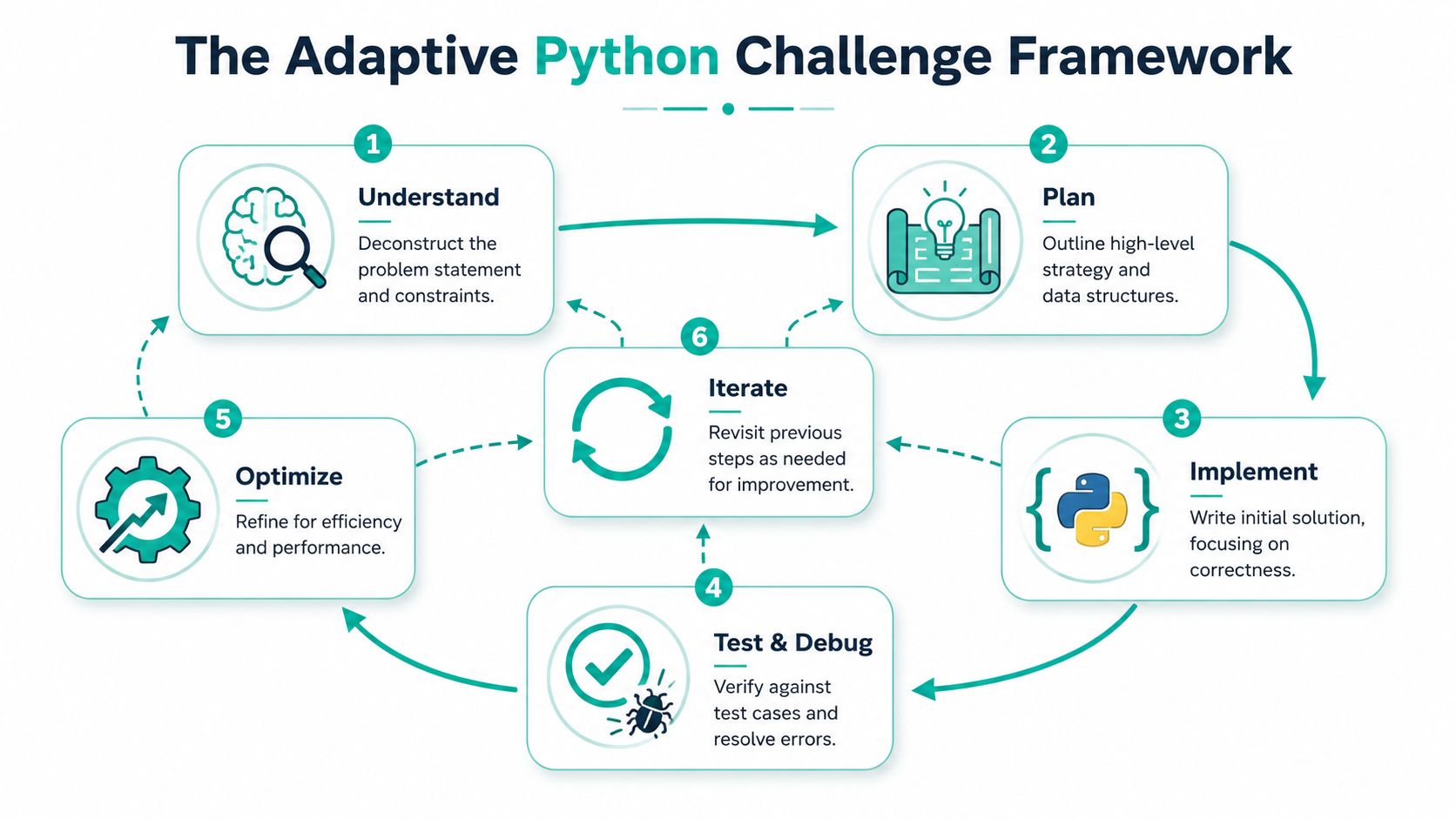
Strong interview guidance tends to recommend the same order of operations: identify the pattern, write the simplest correct solution, then optimize only after you know what the code is doing. That workflow is emphasized in Real Python's practice problem guidance, and it lines up with how experienced engineers work under pressure.
Before writing code, answer these questions out loud or on paper:
That last question is the key. Most prompts are just old problems wearing new clothes. Maybe it's a counting problem hiding behind a product story. Maybe it's a lookup problem disguised as “find matching events.” Maybe it's just string parsing with extra narrative around it.
If you're coming from another language, it helps to sharpen your Python instincts separately. This guide for Python concepts through a JavaScript developer's lens is useful because many interview mistakes come from carrying over habits that don't fit Python well.
A lot of failed interviews come from coding too early. The candidate sees a familiar shape, rushes into implementation, then spends the rest of the session patching around a bad first idea.
A better approach is to sketch a tiny plan:
For more advanced intuition on building things from first principles, Wonderment Apps' neural network guide is a good example of thinking through structure before implementation. It's not an interview-prep article, but it models the habit that matters: break a system into understandable components first, then code.
Say your plan before you commit to it. Interviewers are often grading your reasoning as much as the final function.
Don't aim for “final answer” code on line one. Aim for stable progress.
A reliable build order looks like this:
Optimization without a working baseline turns into guessing. Once you have correct behavior, you can improve with intent.
The framework isn't linear. You'll bounce between understanding, planning, implementation, testing, and refinement. That's normal. Senior engineers do this constantly. They just do it without panicking.
What doesn't work is treating the first idea as sacred. If your approach gets awkward after ten lines, that's a signal. Step back. Rename the problem. Try a simpler structure.
You are ten minutes into a startup interview. The prompt looks unfamiliar, but the interviewer is not checking whether you memorized a niche trick. They want to see whether you can classify the problem quickly, choose a reasonable Python tool, and explain why.
That is what pattern recognition does. It turns a new prompt into a familiar shape.
In practice, many Python interview questions reduce to a small set of recurring moves: track what you have seen, count occurrences, scan from both ends, keep a running result, or traverse connected data. Once you can spot those shapes, you stop wasting time forcing every problem into a custom solution.
String problems often hide a small decision with big consequences. Are you inspecting each character once, comparing characters at two ends, or building counts? A palindrome check, an anagram check, and a compression task all involve strings, but they reward different structures.
Array and list questions usually test whether you can avoid repeated work. If you are checking membership inside a loop, ask whether a set removes that cost. If the prompt cares about adjacent values or ordered input, index-based scans or two pointers often read better than nested loops.
Counting problems are common because they reveal how you think. A dict or collections.Counter is often the cleanest path, but I usually start with a plain dictionary in interviews because it shows the mechanics clearly. That trade-off matters at startups. Clear code and clear reasoning beat a slightly shorter answer that looks copied from memory.
| Problem Pattern | Keywords or Clues | Best Python Tool | Typical Complexity |
|---|---|---|---|
| Duplicate detection | duplicate, unique, seen before | set | Often O(n) |
| Frequency counting | count chars, count words, most common | dict | Often O(n) |
| String reversal or symmetry | reverse, palindrome, mirrored | slicing or two pointers | Often O(n) |
| Running totals or sequence build | Fibonacci, cumulative, rolling result | loop with variables or list | Often O(n) |
| Search in ordered data | sorted, lookup range, target position | binary search | Often O(log n) search after setup |
| Filter and transform | keep valid items, clean input, map values | list comprehension or loop | Often O(n) |
| Pair comparisons | two values sum, compare ends, move inward | two pointers | Often O(n) after sorting when needed |
| Graph-like traversal | neighbors, path, shortest route, connected | queue, stack, adjacency dict | Varies by graph size |
Use the table as a triage tool, not a script.
The prompt usually gives away more than candidates realize:
setdictA common mistake is pattern-matching too aggressively. Candidates learn sliding window on Monday and try to use it on every string problem by Friday. Good interview performance comes from choosing the simplest pattern that matches the constraints.
Large companies sometimes reward polished algorithm trivia. Startups usually care more about whether your solution would survive first contact with production code.
That changes how you should use Python. A list comprehension is great for a small transform. It is a poor choice when the logic needs branches, logging, or explanation. Counter is convenient, but a plain dict can be easier to discuss line by line. Recursion may look neat, but an iterative solution is often easier to debug under interview pressure and safer for real inputs.
If you want extra reps building this kind of practical fluency, upskill with AI coding for professionals.
A good pattern choice makes two things happen at once. The code gets simpler, and your explanation gets shorter. That is usually the signal you are on the right track.
A strong interview answer often starts with a weak algorithm. That's fine, as long as you know why it's weak and how to improve it.
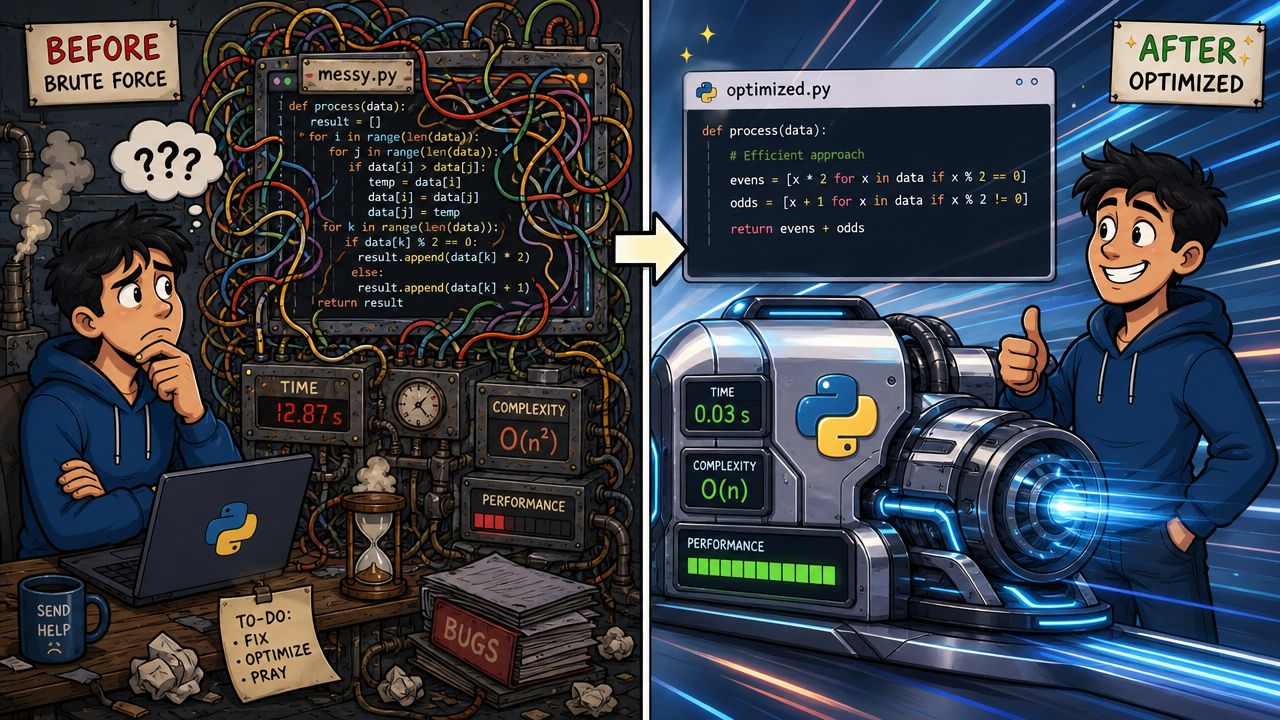
Take a common prompt: “Given a string, return the first character that appears more than once.”
The brute-force approach compares each character against the characters after it.
def first_repeated_char(s):for i in range(len(s)):for j in range(i + 1, len(s)):if s[i] == s[j]:return s[i]return NoneThis is not elegant, but it's a valid first move in an interview if you say what you're doing. It's easy to reason about, and it establishes correctness.
The cost is the nested scan. For longer strings, repeated comparisons pile up. You're checking more than you need because the moment you've seen a character once, the second appearance is enough.
The need isn't “compare every pair.” It's “track what has already appeared.”
That changes the data structure.
def first_repeated_char(s):seen = set()for char in s:if char in seen:return charseen.add(char)return NoneNow the code matches the problem more directly. You walk the string once, use a set for membership checks, and return as soon as repetition appears.
Candidates have the chance to distinguish themselves. Don't just present the better code. Explain why it's better and what it costs.
That explanation is often more important than the optimized code itself. Interviewers want evidence that you understand design choices, not that you memorized one “best” answer.
If you're trying to improve this skill outside interviews, structured practice with feedback helps. Resources that upskill with AI coding for professionals can be useful for generating alternative implementations and reviewing trade-offs, as long as you still explain the changes yourself instead of copying output blindly.
Candidates often sabotage themselves in this phase by optimizing too aggressively:
Good optimization in interviews is boring. It removes waste with a clearer model of the problem.
At a startup, “best” rarely means theoretically perfect. It usually means correct, readable, and efficient enough for the constraints you have.
That's a different mindset from puzzle solving. If the input size is modest and the direct solution is easy to maintain, a startup interviewer may prefer that over a more complex approach. They're imagining whether they'd trust you in a production codebase, not whether you'd top a leaderboard.
So use the pattern: get it working, identify the waste, replace the waste with a better structure, and narrate the trade-off without theatrics.
You can write solid code and still fail the interview if you test it like a gambler. Many candidates run the happy path once, hope for the best, and crumble when the interviewer asks about edge cases.
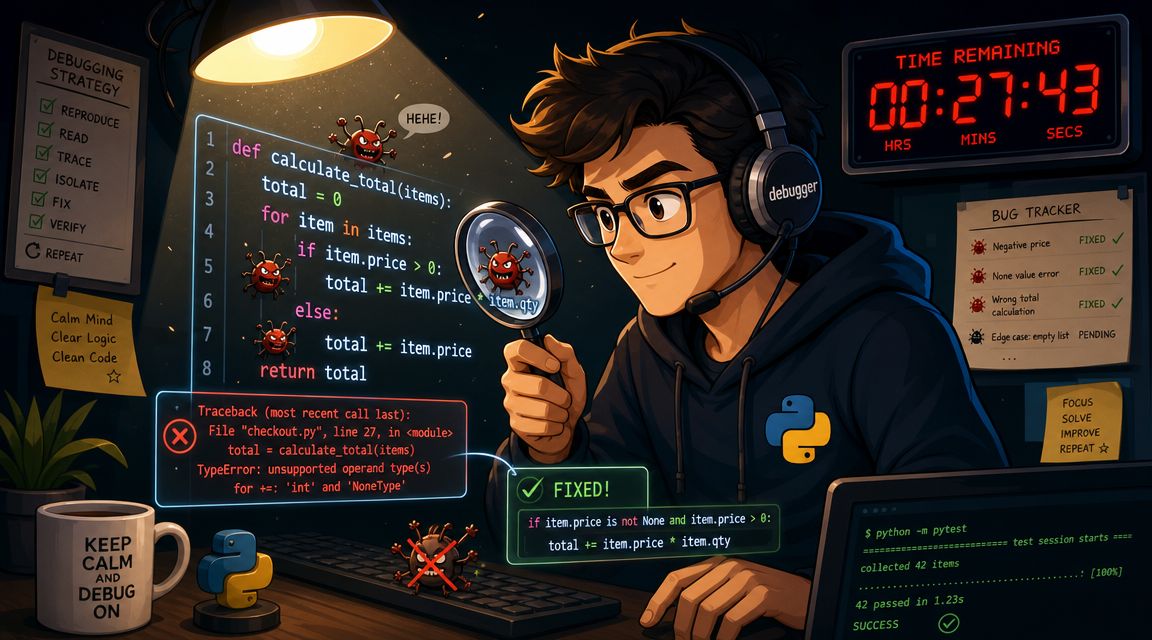
A simple habit works well. Create a small mental checklist and hit each category on purpose:
This shows discipline. You're not just hoping the code works. You're trying to break it before the interviewer does.
When something fails, don't go silent and start thrashing. Walk through the state.
Useful live-debug moves include:
That process matters even more in interviews where collaboration is part of the evaluation. If you use an LLM during a permitted take-home, it helps to understand the boundaries first. This article on using LLMs appropriately in a coding interview is worth reading because a significant risk isn't just misuse. It's losing the ability to explain and verify what the code is doing.
Bugs don't automatically hurt you. Unstructured debugging does.
A common panic response is to rewrite large chunks of the solution after one failed test. That usually creates more bugs.
Change one thing. Re-run the relevant case. Confirm the behavior changed in the way you expected. If it didn't, your mental model was wrong, and that's useful information.
In interviews, a calm debugging loop sends a strong signal. Startups need people who can stay useful when the first version fails.
You get a Python prompt that looks simple at first. Ten minutes in, the interviewer changes one requirement, asks how you would test edge cases, and wants to know why you chose that data structure. That moment is closer to startup work than any memorized LeetCode answer.
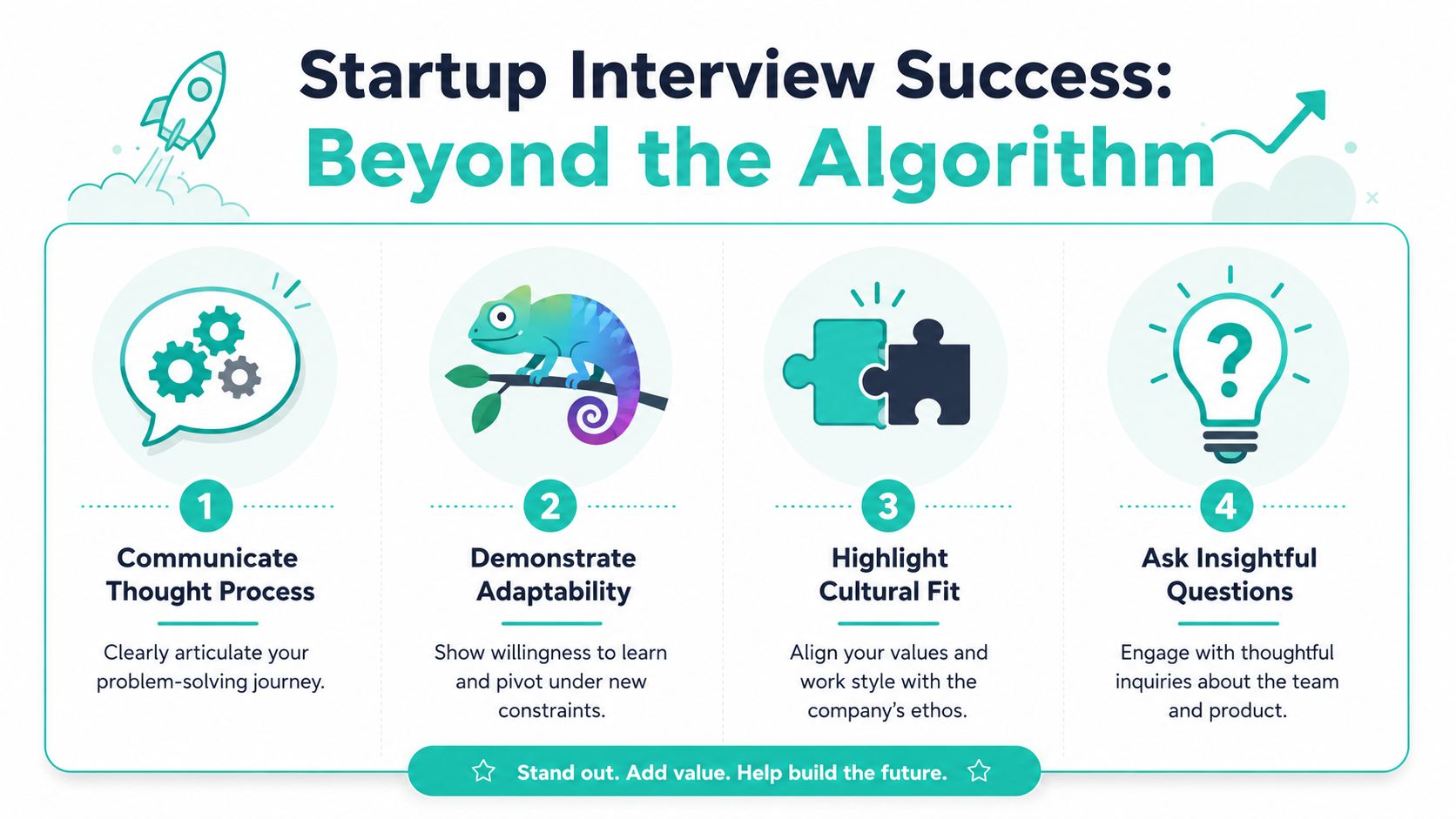
Startup teams rarely care about obscure tricks for their own sake. They are trying to answer a simpler question. Can you take a messy problem, make reasonable assumptions, write clean Python, and explain your choices without drama?
That gap shows up fast in interviews. A candidate can recall a known pattern and still struggle once the input rules change. Another can write an optimal solution but fail to explain why it is better than a simpler version. In an early-stage team, that second failure matters. You will spend more time discussing trade-offs with other engineers than performing perfect algorithms in isolation.
I have seen strong candidates stand out by saying, "I can make this linear time, but I would start with the clearer version unless the input size makes that too slow." That is a good startup answer. It shows judgment.
Interviewers are watching for working habits, not just output. In a startup setting, a Python challenge often acts as a small sample of how you would work on a real feature with limited time and incomplete specs.
Focus on signals like these:
Ground the problem in reality when you can. If the task involves deduplication, mention conflicting records and dirty inputs. If it involves parsing, mention malformed strings. If you choose extra memory, say whether that is acceptable for a service handling moderate traffic versus a hot path under heavy load.
Startup interviewers are often asking whether you will be useful on a busy week with vague requirements and shipping pressure.
A coding challenge in Python is also a communication exercise. The best candidates make the interviewer feel like they are working with a future teammate, not watching a solo performance.
Ask clarifying questions that remove real risk. Narrate decisions when the trade-off is meaningful. Leave the code cleaner than you found it after the first draft. Those habits signal that you can contribute in a fast-moving environment where specs change, priorities shift, and nobody has time for fragile code.
That is also why broad software engineer interview preparation for startup-style roles matters. The coding round is one data point. Teams are also evaluating judgment, communication, and whether your style fits a small group that has to ship quickly.
If your prep has focused only on obscure algorithm practice, rebalance it. Spend time explaining solutions out loud, writing code another engineer can extend, and making reasonable product-minded trade-offs under pressure.
If you're targeting startup roles and want companies to reach out to you instead of throwing resumes into a black hole, Underdog.io is built for that workflow. You apply once, stay confidential until there's mutual interest, and get introduced to vetted startups that are actively hiring.