You know the feeling. You open LinkedIn, and the inbox is a digital wasteland. A recruiter from a faceless agency blasts you about a “100% remote Senior Dragon Tamer role” that matches none of your skills. Another connection request from someone whose headline is just “Top Voice 10x Growth Hacking Guru.” A notification pops up: “Your profile was viewed by the VP at your current company.” Your stomach drops.
You’re open to new opportunities—maybe even eager for one—but the thought of “activating” your job search here fills you with dread. Updating your profile feels like a public performance. Applying feels like shouting into a void. The entire experience is transactional, noisy, and oddly vulnerable.
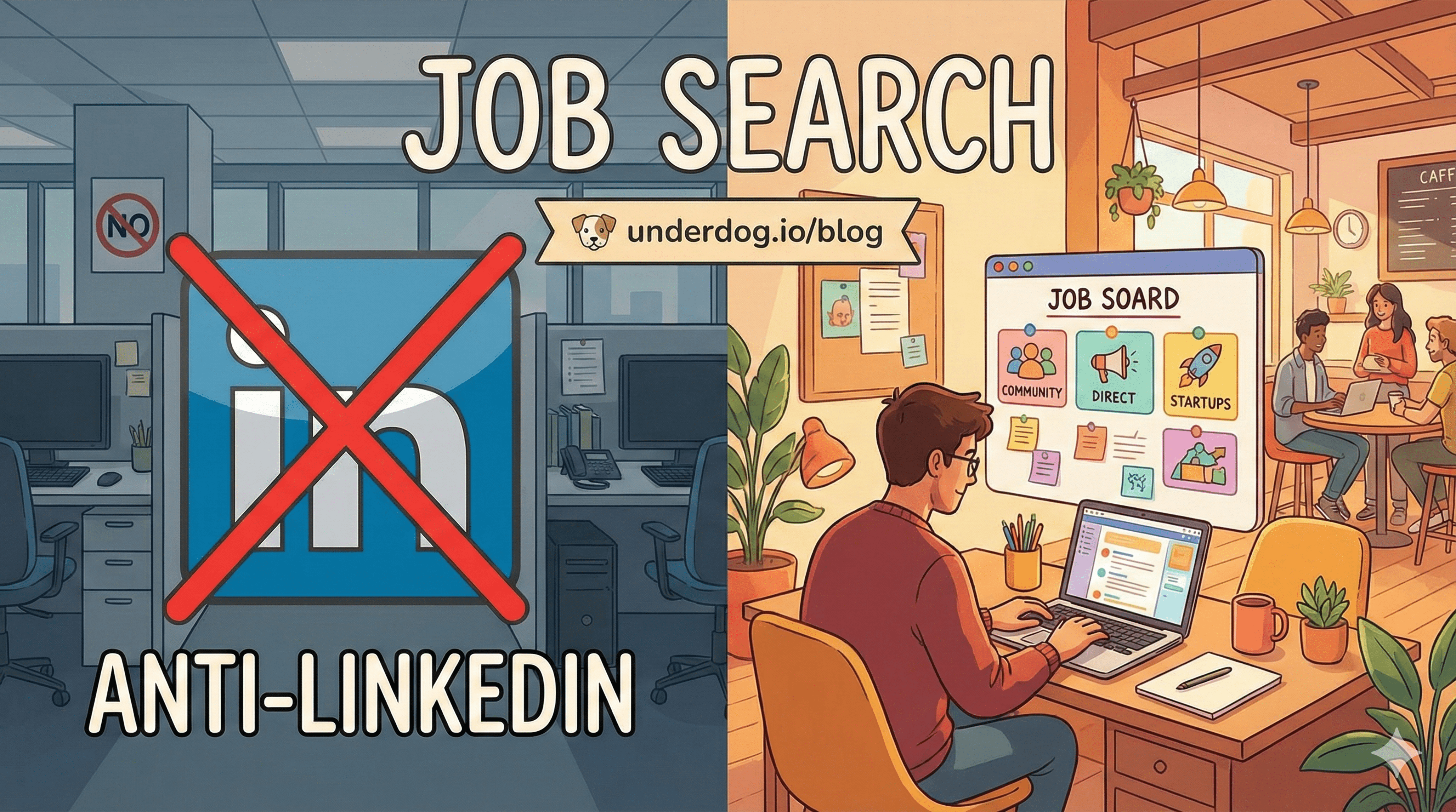
What if there was a better way? A method designed not for the masses, but for professionals who value their time, privacy, and career trajectory. Welcome to the anti-LinkedIn job search.
This isn’t about declaring war on a platform. LinkedIn serves a purpose—it’s a digital Rolodex, a content broadcast channel, a place for industry news. But as a tool for a focused, confidential, and quality-driven job search, it falls painfully short for experienced professionals. The modern job seeker’s dilemma is real, and it’s time for a smarter path.
LinkedIn succeeded by becoming the de facto public square of professional life. But that’s precisely its flaw when it comes to job searching. Your search becomes a public spectacle, governed by algorithms optimized for engagement, not for meaningful career matches.
LinkedIn operates on a broadcast model. You polish your personal brand and cast your line into an ocean of 1 billion profiles. Recruiters do the same, using soulless Boolean searches to net as many fish as possible. The result is immense noise.
Your inbox fills with templated InMails that miss the mark. You’re urged to “Easy Apply” to hundreds of jobs, turning the profound decision of your next career move into a mindless, one-click numbers game. This spray-and-pray approach devalues everyone. You’re not a candidate; you’re a data point in a massive, inefficient transaction. The fatigue isn’t just from applications—it’s from maintaining the “always-on” professional persona required to even play the game.
For the passive candidate—the employed professional open to a stellar opportunity but not desperate—LinkedIn is a minefield. That innocuous “Open to Work” banner (even the “private to recruiters” one) feels like a giant, flashing neon sign to your network. Updating your skills or experience? Your entire company gets a notification. Simply viewing a company’s page can spark rumors.
Job searching shouldn’t require you to tip off your current employer. The anxiety of being “found out” forces many talented people to stay out of the market entirely, or to search in a paranoid, limited way. This serves no one—not the candidate missing a great role, not the company missing great talent.

At its core, LinkedIn’s job matching is algorithmic. It scans for keywords, job titles, and tenure. But a career move is a human decision. It’s about team culture, working style, growth trajectory, mission alignment, and subtle skills no keyword can capture.
A keyword-stuffed profile gets attention. A thoughtful, nuanced one gets lost. You might be a perfect fit for a “Head of Product” role that’s listed as “VP, Technology,” but the algorithm will never know. You’re reduced to a collection of buzzwords, matched against a job description written by someone who may not fully understand the role. The result is a constant stream of almost-right opportunities, which is often more frustrating than radio silence.
The alternative isn’t another, slightly different job board. It’s a fundamental shift in philosophy. The anti-LinkedIn job search is built on principles that respect your professionalism, your time, and your discretion.
This philosophy isn’t theoretical. It’s the operating system of Underdog.io. We built our platform as the antithesis to the noisy, impersonal broadcast model. Here’s what that looks like in practice.
Forget the public performance. You start by creating a simple, private Underdog.io profile. This isn’t a SEO-optimized personal branding document; it’s a true, concise summary of your experience, skills, and what you’re looking for next. It takes minutes, not hours. And it’s visible only to our curation team and the companies you explicitly approve. Your current employer won’t know. Your network won’t see a thing.
This is where the magic happens. When a company posts a role on Underdog.io, our team vets it for quality—compelling company, realistic requirements, fair compensation. We turn away a significant number.
Then, our candidate curation begins. We don’t blast your profile to every company. Instead, we manually review your background against specific, vetted opportunities. We ask: “Is this a genuine, compelling step forward for this person’s career?” This double-check—vetting both the role and the candidate—is the human-powered filter that algorithms can’t replicate.
The “Easy Apply” black hole is eliminated. Here’s our process:
You are never applying into a void. You are always being introduced with intent.
This system is ideal for the passive candidate. You can create your profile, set your preferences, and then go about your life and work. Every few weeks or months, you might get an email from us about a single, truly interesting opportunity. It requires minimal active effort from you, but keeps you connected to the market’s best openings. It’s job searching on your terms.
Let’s be clear: this curated, confidential path isn’t for everyone. It’s a specialized tool for a specific type of professional.
This approach IS for:
This approach is NOT for:
The traditional job search has it backwards. It asks you, the talented professional, to do all the work: to brand yourself, to broadcast your availability, to sift through noise, and to throw applications into the abyss, hoping for a response.
The anti-LinkedIn job search turns this model on its head. It’s built on the premise that if you are great at what you do, the right opportunities should be able to find you—quietly, respectfully, and through a channel of trust.
You don’t have to choose between staying put in comfort and diving into the public, chaotic marketplace. There is a third path: one of selective exploration, powered by human insight and protected by privacy.
If the broadcast model has left you underwhelmed and underappreciated, it’s time to try the curated approach.
Ready to start your smarter search? Create your private, candidate profile on Underdog.io. It takes just a few minutes. The right opportunity might just find you.