The average associate product manager salary in the US ranges from $81,669 to $95,000 in base pay in 2026, with total compensation — including bonuses — often climbing above $89,000. Your actual offer depends heavily on location (San Francisco and New York pay 15 to 25 percent more), company stage (big tech offers higher base, startups offer more equity upside), and experience. This guide covers every component of your APM compensation, how it grows as you advance, and exactly how to negotiate an offer that matches your market value.
When you’re starting out as an Associate Product Manager (APM), figuring out your salary expectations can feel like navigating a maze. But getting a firm grasp on the numbers is the first step toward landing a competitive offer.
The good news? An APM's earning potential is strong, even right at the beginning of your career. The compensation package breaks down into a few key pieces: base salary, bonus, and sometimes equity. For an entry-level role, that base salary is the core of your cash compensation.
The associate product manager salary in the United States in 2026 averages between $81,669 and $95,000 in base pay. When performance bonuses — which average around $7,592 — are factored in, total cash compensation typically reaches $89,261 or more.
However, these national averages mask significant variation. Location is one of the biggest drivers: APMs in Tier 1 tech hubs like San Francisco and New York City commonly earn base salaries 15 to 25 percent higher than roles in other cities, thanks to fierce competition for product talent among high-growth companies. Company stage also matters — large, public tech companies offer higher, more structured base salaries (often $105,000 to $125,000+), while seed-to-Series B startups typically pay lower bases ($85,000 to $100,000) but compensate with meaningful equity grants in the form of stock options.
The full compensation picture includes three components: base salary (the guaranteed cash foundation), performance bonus (typically a 5 to 15 percent target tied to individual and company goals), and equity (RSUs at public companies or stock options at startups, representing a share of the company's future value). The APM role is designed as a career accelerator — with 15 to 30 percent salary increases common when transitioning from APM to a full Product Manager role, often within one to two years.
Let's talk numbers. In 2026, we're seeing average base salaries for APMs in the U.S. fall between $81,669 and $95,000.
When you factor in additional cash like bonuses—which average around $7,592—total compensation often climbs to $89,261 or more. These figures really highlight the financial appeal of the APM track, especially if you’re targeting roles in major tech hubs.
Of course, these are just averages. Think of them as a solid baseline for your expectations, but remember that your specific offer will hinge on factors we'll dig into later, like location and company size.
An APM role is often a high-growth position where your compensation can increase quickly. Within just one or two years, as you demonstrate your ability to deliver results and take on more ownership, you'll be well-positioned to move into a higher-paying Product Manager role.
If you’re just breaking into the field, it’s smart to look at the wider compensation landscape. This comprehensive entry-level product manager salary guide offers a fantastic deep dive for new entrants.
To stay on top of broader market shifts, our own 2026 Tech Salary Guide also provides crucial context on how compensation is shaking out across different roles in the industry.
https://underdog.io/blog/2026-tech-salary-guide
An offer letter for an Associate Product Manager role is a lot more than just a single number. To really know what an offer is worth, you have to break it down into its core pieces. Think of it like a recipe: the final dish is the total compensation, but the individual ingredients—the base, bonus, and equity—are what give it its flavor and value.
The three main pillars of your compensation package are base salary, performance bonus, and equity. Getting a handle on how each of these works is crucial for comparing offers, especially when you're weighing a stable tech giant against a high-growth startup.
Your base salary is the most straightforward part of your pay. It's the fixed, guaranteed amount of money the company will pay you over the year, usually broken down into bi-weekly or monthly paychecks. For most APMs, this is the largest chunk of their cash earnings and provides a predictable income you can build a budget around.
This number isn't just pulled out of a hat. It's typically determined by a few key factors:
Your base pay is your financial bedrock. While a bonus or equity can add significant upside, a strong base is the foundation of any competitive offer.
On top of your base salary, many companies will offer a performance bonus. This is extra cash you can earn by hitting specific goals—whether they're your own, your team's, or the company's as a whole. It’s a direct reward for a job well done, tying your impact to the company's bottom line.
Bonuses are very rarely guaranteed. They're usually expressed as a percentage of your base salary, with a typical target for APMs falling somewhere between 5% and 15%. So, if your base salary is $90,000, a 10% target bonus means you could earn an extra $9,000 if you and the company meet all performance targets.
Actionable Insight: Always ask the recruiter how bonuses have historically paid out for the team. A question like, "Could you share what percentage of the target bonus the team has achieved over the past two years?" can reveal if the company consistently meets its goals or if the bonus is more of an optimistic dream.
This simple breakdown shows how base pay and bonuses come together to form your total cash compensation.
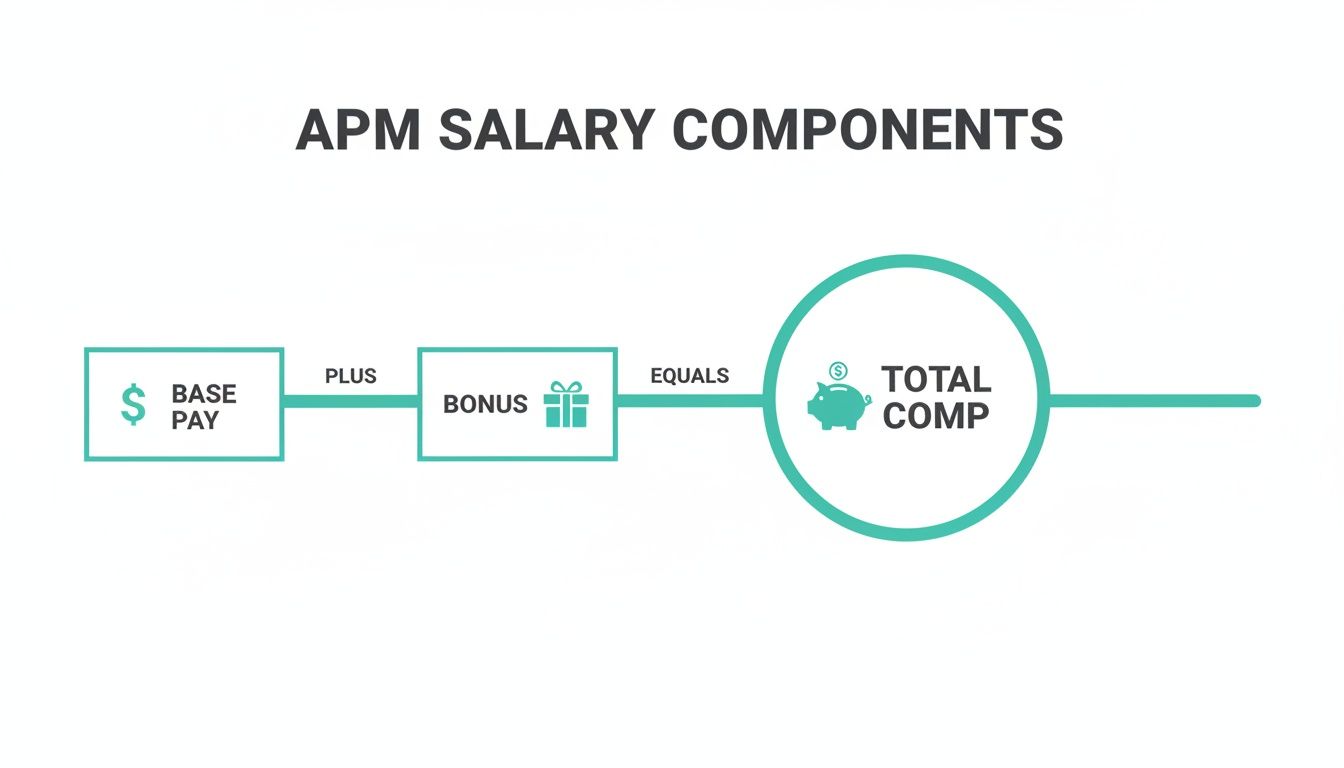
As you can see, your total cash earnings are more than just that initial base number.
This is where compensation gets a little more complicated, but also where the real wealth-building potential lies, especially in the startup world. When a company offers you equity, it's giving you a slice of ownership. It's often called "paper money" because you can't spend it right away—its value is only unlocked after a future event, like an IPO or the company being acquired.
For APMs, equity typically comes in two flavors:
Equity is almost always tied to a vesting schedule, which is just a timeline for when you officially earn your shares. A classic schedule is four years with a one-year "cliff." This means if you leave before your first anniversary, you get nothing. After you hit the one-year mark, 25% of your equity vests, and the rest typically vests monthly or quarterly over the next three years.
Evaluating equity is a game of weighing risk versus potential reward. It’s a crucial skill to develop when you're looking at APM offers, particularly in the high-stakes, high-growth startup scene.
It’s no secret: where you live and work has a huge say in your paycheck. Think of location as a multiplier for your APM salary. The same skills, the same drive, and the same role can fetch wildly different numbers depending on whether your office is in a bustling tech hub or a quieter city.
The classic heavyweights are, of course, San Francisco and New York City. These cities are packed with high-growth startups and tech giants, all fighting over the same pool of talent. That fierce competition naturally drives compensation way up, creating a significant "location premium" for anyone working there.

And this isn't just talk. An APM job in the Bay Area can easily come with a base salary that's 15-25% higher than an identical role in a city like Austin or Chicago. Yes, the sky-high cost of living will take a bite out of that, but a higher starting salary sets a powerful benchmark for your entire career's earning trajectory.
The salary gap isn't just about the cost of living—it’s about the sheer concentration of opportunity. When you look at the salary data, the story becomes crystal clear. For example, fresh 2026 numbers show that while 20% of APM jobs nationwide fall into the $61,500-$68,499 range, only a tiny fraction of roles break into the top tier.
Just 2-4% of APM jobs nationally push past $81,500, and you can bet a huge portion of those are in major markets like San Francisco where high-growth companies cluster. You can dig into more granular salary data and discover more insights about APM pay on ZipRecruiter.
Here’s a quick breakdown of how this plays out in the real world:
Actionable Insight: Calibrate your expectations to your target city. Before an interview, use a cost-of-living calculator to compare your current city to the potential new one. This helps you determine the minimum salary increase you'd need just to break even, giving you a solid floor for your negotiation.
The explosion of remote work has thrown a fascinating new variable into the salary game. Companies are no longer recruiting from a single city, which has led to a few different schools of thought on how to pay a distributed team. As a remote job seeker, you need to figure out which playbook a company is using.
There are really three main models you'll encounter for remote pay:
When you're interviewing for a remote role, make it a point to ask the recruiter how the company thinks about remote compensation. Knowing their philosophy upfront gives you the context you need to negotiate effectively and make sure the final offer works for you.
The career path you choose as an Associate Product Manager is a classic fork in the road. Heading down the big tech route is like taking a well-paved highway, while joining a startup is more like an off-road adventure. The experience, the culture, and especially the paycheck are worlds apart.
This isn't just about whether you prefer free kombucha on tap or a sprawling corporate campus. It's a fundamental financial decision that hinges on your appetite for risk. The core difference boils down to a trade-off: guaranteed cash today versus a potential lottery ticket for tomorrow.
For any APM who puts a premium on financial stability and a predictable income, big tech is the undisputed king. At massive, publicly traded companies—think Google, Meta, Amazon, and their peers—compensation is highly structured, transparent, and built to attract top talent with cash.
These giants compete using established pay bands, which means you’re looking at higher base salaries right out of the gate. An offer from a large tech firm is heavily weighted toward cash components you can take to the bank.
On top of a strong base, you can almost always expect:
This structure is designed to minimize your financial risk. You know exactly what your shares are worth, and your annual cash earnings are high. The trade-off? That explosive, 100x growth potential is far less likely than at a scrappy startup.
Jumping into an early-stage startup as an APM is a bet. It’s a bet on the founders, on the product’s vision, and on your own ability to make an impact with limited resources. The compensation model reflects this all-or-nothing gamble.
Startups, especially those in the Seed to Series B stages, have to be careful with their cash. They simply can't compete with the base salaries offered by the big players. Instead, they sell you on the mission and offer the one thing they have in spades: ownership.
The real prize here is equity, almost always given as stock options. Unlike RSUs, which are shares, options give you the right to buy shares at a predetermined low "strike price" down the road. If the startup takes off and its valuation soars, you get to buy your shares on the cheap and potentially cash in on a life-changing return.
Actionable Insight: When evaluating a startup offer, ask for the total number of shares outstanding. This allows you to calculate what percentage of the company your options actually represent. An offer of 10,000 options sounds great, but it means very different things in a company with 1 million shares versus one with 10 million.
Of course, this is a huge "if." The hard truth is that most startups fail, which means those stock options become completely worthless. When you're looking at a startup offer, you have to be genuinely comfortable with the idea that your equity could end up being worth $0. It's a decision that has to match your personal finances and your stomach for risk.
So, what does this all look like when an offer letter lands in your inbox? Let's break down the fundamental differences with some typical numbers to make it concrete. These figures illustrate the very different philosophies behind how these companies build their compensation packages.
Ultimately, there's no right or wrong answer here. The choice between a startup and a big tech firm comes down to what you value most at this stage in your career. Are you seeking the stability and higher cash flow of a large, established company? Or are you drawn to the thrill of building something from the ground up, with the potential for a massive payday, even if it means taking a serious financial risk?
The Associate Product Manager role isn't just a job—it's a launchpad. Think of it as the first stage of a rocket, designed to get you into orbit before the real boosters kick in. Your time as an APM is all about learning the fundamentals, shipping your first features, and building the credibility you need for the next big jump in your career and, just as importantly, your compensation.
This progression isn't simply about a new title on LinkedIn. It’s a direct reflection of your growing impact on the product and the business. As you move from shadowing a Senior PM to owning a small feature, and then to leading a discovery cycle, your value to the company skyrockets—and your paycheck should follow.
The path from APM to Product Manager (PM) is one of the biggest salary accelerators you'll find in the early stages of a tech career.
Your first year as an APM is about being a sponge. You'll get your hands dirty with tools like Jira and Figma, learn to write a crystal-clear user story, and spend countless hours in meetings, soaking it all in. But after a year or two, you’re no longer just learning; you’re contributing in a real, measurable way. This is the inflection point where your salary potential starts to climb.
Experience is the single biggest lever for salary growth. An analysis of 2026 data shows some stark jumps as APMs level up:
This trend holds true for bonuses, which can scale from $2,000 for entry-level roles to $14,000 for seasoned managers. When you factor in things like profit sharing, the total pay band can stretch from $60,000 all the way to $118,000. You can explore the full dataset on PayScale to see how experience shapes these numbers.
Actionable Insight: The transition from APM to PM often comes with a salary increase of 15-30%. To trigger this, don't wait for your annual review. Proactively schedule a meeting with your manager 3-4 months beforehand to discuss your progress against PM-level competencies and align on what's needed to secure the promotion.
So, what actually unlocks this promotion and pay bump? It's not just about putting in the time. It's about having tangible wins you can point to that directly impacted the product.
You need to build a track record of success that becomes your ammunition during performance reviews and salary negotiations. These are the milestones that signal you're ready for what's next. To learn more about building these skills, check out our guide on the product manager career path.
Here are the key achievements to focus on:
When you focus on these concrete achievements, you're not just waiting for a promotion—you're building an undeniable case for it. This gives you the powerful talking points you need to map out your growth and make a compelling argument for a significant jump in your pay.
Getting the job offer feels like crossing the finish line, but it’s not. It's the starting line for the most critical conversation you'll have in your job search—the one where you lock in your compensation.
Negotiating your salary is a skill. It’s not about being confrontational or demanding; it's about having a thoughtful, data-backed discussion. A great negotiation leaves both you and your new employer excited about the outcome. And it all starts with solid prep work.

Walking into a salary conversation without data is like trying to build a product without user research—you’re just guessing. Before you even think about a counteroffer, you need to anchor your request in hard numbers.
Your research should hit a few key points:
With this information in hand, you're no longer just asking for more money. You're presenting a reasonable request based on what the market is actually paying.
Market data shows what the role is worth. Your interview performance shows what you are worth. A killer negotiation connects your unique skills directly to the company’s pain points.
Think back to your interviews. What made the hiring manager's eyes light up? Was it that side project you built? Your sharp data analysis skills? Your obsession with user-centric design? Whatever it was, that’s your leverage. Frame your value around the problems they have that you are uniquely qualified to solve.
Actionable Insight: When making your case, tie your value directly back to the interview process. For example: "Based on our conversations about the need to better understand user engagement, I'm confident my experience using Amplitude to drive feature adoption can make an immediate impact here. That expertise is a key reason I'm seeking compensation at the higher end of the market range for this role."
This simple shift reframes the entire conversation. It’s not about "I want more money"—it's about "Here's the extra value I bring, which justifies this compensation." For a deeper dive into the tactics, it helps to review how to counter a job offer without creating friction.
This is where your heart might start beating a little faster. But the key is to stay cool, polite, and prepared. Whether you’re on the phone or drafting a note, the tone should always be collaborative, not combative. Knowing how to write a strong salary negotiation email is a massive advantage here.
Here are a few phrases to help you navigate the conversation gracefully:
Remember, companies expect you to negotiate. It’s a standard part of the process. If you come prepared with data, confidence, and a collaborative spirit, you can land an offer that truly reflects your value.
When you're starting out, figuring out APM compensation can feel like a puzzle. There's a lot of information floating around, and it's hard to know what's real. Let's clear things up and tackle the questions I hear most often from aspiring and early-career product managers.
Yes, without a doubt. Product management is a well-compensated career path, even right from the start.
At the associate level, you can expect a competitive salary. A typical APM base pay in the US falls between $69,000 and $108,000. As you get your footing and climb the ladder to a mid-level or senior PM role, your total compensation—especially with bonuses and equity factored in—can grow dramatically.
Think of the APM role as a product management apprenticeship. You’re not expected to know everything on day one. Instead, you'll work closely with senior PMs, learning the ropes of how to define what gets built, why it matters, and how to tell if it's successful.
Your day-to-day will be a mix of crucial tasks:
Essentially, you're building the core skills you'll need to eventually own a product or feature set all on your own.
This is a big one, and the answer might surprise you: you don't need years of direct product experience. In fact, APM programs are specifically built for people early in their careers.
Key Insight: Many companies love hiring APMs straight out of college or from completely different fields. They're betting on your potential, your curiosity, and your analytical mind—not the length of your resume. Experience from internships, side projects, or even jobs that required sharp problem-solving and communication is incredibly valuable here.
Let's be real: any job with high expectations can have its moments. As an APM, you're often the hub of communication between engineering, design, marketing, and leadership. Juggling all those priorities and deadlines can definitely be intense.
But that pressure is often what makes the role so rewarding. There’s nothing quite like the feeling of seeing a feature you guided from idea to launch actually make a difference for users. For many, that responsibility is more energizing than stressful—it’s what makes the job exciting.
The average base salary for an associate product manager in the United States in 2026 falls between $81,669 and $95,000, depending on the data source. Including average cash bonuses of approximately $7,592, total compensation commonly reaches $89,261 or more. Entry-level APMs with less than one year of experience may see total compensation closer to $77,000, while those with one to four years can expect around $82,000. At the top of the APM tier, experienced professionals at the 90th percentile earn over $112,000 in total compensation. The full range, including profit sharing and other cash components, spans from approximately $60,000 at the low end to $118,000 at the high end.
At large, publicly traded tech companies — commonly referred to as FAANG or big tech — APM base salaries typically run $105,000 to $125,000 or more, along with structured performance bonuses (usually 10 to 15 percent of base) and RSU grants that vest over four years. These companies compete aggressively for product talent and offer higher, more standardized cash compensation than most startups. In return for the higher base and more liquid equity, the upside from any single RSU grant is more limited because the company's valuation is already large and mature, making exponential growth less likely than at an early-stage startup.
Yes, by most measures the APM role is one of the best-compensated entry-level positions in technology. A base salary range of $81,669 to $95,000, combined with a performance bonus, puts APMs well above the median entry-level salary across industries. APM programs at top tech companies and funded startups are specifically designed as a career accelerator — and the financial compensation reflects that. The role is also notable for how quickly compensation can grow: the transition from APM to full Product Manager, typically within one to two years, commonly delivers a 15 to 30 percent salary increase.
The core difference is the structure and risk profile of the compensation. Big tech companies offer higher base salaries, structured annual bonuses with clear targets, and RSUs that have a defined, liquid market value from the moment they vest. Startups, particularly those at the seed to Series B stage, offer lower base salaries — typically $85,000 to $100,000 — but compensate with larger stock option grants. If the startup succeeds and exits at a high valuation, those options can be worth far more than any RSU package. If the company fails, they are worthless. Choosing between the two is fundamentally a question of your current financial needs and your tolerance for risk.
Location is one of the most significant factors in APM compensation. San Francisco and New York City offer base salaries that are typically 15 to 25 percent higher than the national average for identical roles, reflecting both the higher cost of living and the concentration of well-funded companies competing for product talent. Tier 2 cities like Seattle, Boston, and Austin are competitive — often just below Tier 1 levels — while emerging hubs like Atlanta, Denver, and Raleigh offer lower nominal salaries that can translate to higher purchasing power after cost of living is factored in. For remote roles, you should ask specifically about the company's remote pay philosophy: some pay based on HQ location, some use location-adjusted bands, and some pay a single national rate.
A complete APM compensation package has three components. Base salary is the fixed, guaranteed amount paid in every paycheck and forms the cash foundation of the offer. Performance bonus is a variable cash payment, typically expressed as a 5 to 15 percent target tied to individual or company results — always ask how the bonus has historically paid out relative to the target. Equity is the third component: RSUs at public companies are actual stock grants that vest over time with a clear market value, while stock options at startups give you the right to buy shares at a fixed strike price, with value that depends entirely on the company's future success. Total compensation — base plus bonus plus the annualized value of equity — is the only accurate number for comparing offers.
The typical timeline from APM to full Product Manager is one to two years, depending on the company and your individual performance. The salary increase that accompanies this promotion is substantial: a jump of 15 to 30 percent above your APM base pay is common. To accelerate this transition, focus on building a track record of concrete achievements rather than simply putting in time — specifically, shipping a major feature end to end, leading a product discovery cycle with real user research, making data-driven decisions with tools like Amplitude or Mixpanel, and successfully influencing the roadmap. These are the milestones that give you the talking points needed to make a compelling case for promotion and the associated pay increase.
Effective APM salary negotiation starts with thorough market research — using tools like Levels.fyi and role-specific salary databases to anchor your request in real data for your experience level, target city, and company type. When asked for your salary expectations early in the process, try to redirect the question by asking for the company's approved salary range first, which becomes your negotiating anchor. Once you have an offer, build your counter on three pillars: market data showing the competitive range for your profile, specific skills or achievements that connect directly to the company's stated needs, and language that frames the conversation as collaborative rather than adversarial. If base salary is genuinely fixed, pivot to negotiating the signing bonus, equity grant size, or performance bonus target percentage — companies typically have more flexibility on these components.
Many APM roles, particularly at startups, include an equity component. At startups, equity typically takes the form of stock options (ISOs) rather than RSUs. Options give you the right to buy a set number of company shares at a fixed strike price — usually the fair market value at the time of your grant — with the hope that the company's value will grow substantially above that price, creating a profitable spread. Unlike RSUs, options require you to purchase the shares and may expire if not exercised within a specific window after you leave. Before accepting any equity offer, ask for the total number of fully diluted shares outstanding so you can calculate your true ownership percentage — the raw number of options is meaningless without knowing what fraction of the company it represents.
The APM role involves meaningful responsibility — you are typically a coordination hub between engineering, design, marketing, and leadership, managing competing priorities and deadlines across each. The intensity varies significantly by company culture and team size; at startups especially, the scope of responsibility can be broad and the pace fast. That said, the stress is often paired with high engagement, because APMs typically have visible impact and direct involvement in decisions that shape the product. Most people who thrive in APM roles describe the responsibility as energizing rather than draining, particularly once they have the foundational skills to manage the workload. Asking about day-to-day workflows, team size, and what support is available during the onboarding period gives you a useful preview of the actual working environment before you accept.
Ready to find the APM role that values your skills and ambition? At Underdog.io, we connect talented tech professionals like you with top-tier startups and high-growth companies. Stop searching and let the best opportunities find you. Create your free profile today.