Before you even think about writing a counter-offer email or picking up the phone, the most important work happens in your own head. You have to get your mindset right.
So many people, especially in tech, worry that countering an offer comes off as greedy or ungrateful. They're afraid they might blow the whole opportunity.
Let's just dismantle that fear right now.

In reality, negotiation is a totally standard, even expected, part of the hiring game. This is especially true in the fast-paced world of startups and tech, where your skills are in high demand.
Thinking of this as some kind of high-stakes confrontation just creates a ton of unnecessary anxiety. The company has already sunk a ton of time and resources into picking you. Trust me, they want you to say yes.
Your counter-offer isn't a demand; it's an invitation to finalize a partnership that works for everyone.
Here's the truth: you are not asking for a favor. You're discussing the terms of a professional contract based on the immense value you're bringing to the table. And the data backs this up. A recent study showed that 87% of people who negotiated their salaries got at least some of what they asked for. Companies expect this. They build it into their budgets.
It all comes down to a few key mindset shifts:
Negotiation is the art of letting them have your way. Your goal is to align your needs with the company's desire to hire top talent, creating a win-win scenario where both parties feel valued and respected.
Confidence is everything in a negotiation. It lets you state your case calmly and clearly, without letting emotion get in the way of good judgment.
Feeling the nerves? That’s normal. Grab a friend and practice your key talking points out loud. Say the numbers. Get comfortable with the words coming out of your mouth. For a deeper dive, you can explore strategies for building confidence in communication that work for any high-stakes professional chat.
This prep work shifts your entire posture from defensive to collaborative. You stop feeling like you’re on the back foot and start acting like you’re discussing a business deal—which is exactly what this is. When you anchor your mindset in your own value, you’ve already set the stage for a better outcome before the conversation even starts.
So, you’ve got the offer. Great news! But remember, a job offer is a package deal, not just a single number. If you only focus on negotiating the base salary, you’re leaving serious value on the table—especially in the startup and tech world. The best negotiations treat the offer as a collection of different levers you can pull.

While base salary is obviously important, it’s often the least flexible piece of the puzzle, especially if the company uses standardized pay bands for roles. The real magic often happens when you look at the other parts of the compensation package. These can have far more wiggle room and, frankly, can create immense long-term wealth and improve your day-to-day life.
Let's dive into the key financial components you should be looking at. These elements can have a much bigger impact on your total compensation than a small bump in salary.
The absolute best negotiations don't just fatten your wallet; they improve your daily experience and set you up for future success. It's easy to overlook these powerful—and often underestimated—bargaining chips.
Your official title actually matters. A lot. It impacts how people see you internally, your perceived seniority, and how you position yourself in future job searches. If you’re on the fence between two levels (like "Software Engineer" vs. "Senior Software Engineer"), asking for the higher title is a low-cost, high-value win. It costs the company virtually nothing but gives you a long-term career boost.
A job title costs the company nothing but can significantly shape your career path. Negotiating a title like 'Lead' or 'Senior' can unlock future opportunities that a higher salary alone cannot.
Finally, think about the perks that directly impact your well-being and growth. These are often the easiest "yeses" you'll get.
Each of these elements is a piece of your total package. By figuring out what matters most to you, you can craft a counteroffer that builds a genuinely better job, not just a bigger paycheck.
To help you see all the moving parts, here’s a quick breakdown of the different levers you can pull in a negotiation.
By thinking about your offer as a collection of these components, you can be much more strategic. If they can't budge on salary, you can pivot to asking for a larger signing bonus or more equity, creating a win-win scenario.
Going into a negotiation with a vague sense of what you think you deserve is a recipe for disappointment. A strong counteroffer isn't built on feelings—it’s built on cold, hard data.
When you frame your request around evidence, you transform the entire conversation. It’s no longer an emotional plea; it becomes a logical business case. This shift is critical because it gives the hiring manager the justification they need to go to bat for you.
Before you even think about a specific number, your first move is to anchor your expectations in reality. That means doing some serious market research to figure out a credible salary range for your specific role, experience, and location.
Start digging into reliable salary platforms. Sites like Levels.fyi, Glassdoor, and Payscale are your best friends here, offering crowdsourced data that gives you a solid baseline.
But don't just grab the first number you see. The real power comes from getting granular with your filters:
Once you’ve collected this raw data, our guide on how to calculate your target salary range can help you crystallize those numbers into a confident personal target.
Your research isn’t just for you—it’s the ammo for your negotiation. When you make your counter, you can confidently say something like, "Based on my research for similar roles at Series B companies here in NYC, the market rate falls between $X and $Y."
Next, you have to connect that market data directly to your value. It's time to audit your own accomplishments. Dust off your resume and pull up past performance reviews, looking for achievements you can quantify.
How did you actually move the needle at your last company?
Don't just say, "I improved user engagement." Get specific: "I led the project that drove a 15% increase in daily active users in Q3, which directly contributed to an estimated $50,000 in new monthly recurring revenue." See the difference?
This is especially crucial if you have in-demand skills. While some parts of the tech market have cooled, hiring for specialized talent is as aggressive as ever. With 98% of tech leaders focused on AI upskilling and a global shortage of nearly 4 million cybersecurity pros, specialists have incredible leverage. By directly linking your unique skills to the company’s goals, you’re not just asking for more money—you’re proving you're a high-return investment.
Alright, this is where all that prep work pays off. It’s time to deliver your counter. The key here is to blend confidence with genuine enthusiasm—you want this to feel like a collaborative final step, not a confrontation.
You can do this over the phone or via email, and both have their pros and cons. The core principles are the same regardless of the medium. Always lead with sincere gratitude and excitement for the role, then pivot smoothly into your data-backed case. Keep the tone positive and focused on getting to a win-win.
A phone call is personal. It gives you a chance to build a real-time connection, read the hiring manager’s tone, and adjust your approach on the fly.
Here’s a structure that works well for a live conversation:
One of the hardest but most important things to do is to pause after you make your ask. Fight the urge to fill the silence. Give the hiring manager a moment to process and figure out their response.
An email gives you the time to get every word just right. It also creates a written record that the hiring manager can easily forward to HR or leadership for approval, which can be a huge plus.
Here’s a simple, adaptable script you can use as a starting point:
Subject: Job Offer - [Your Name]
Hi [Hiring Manager's Name],
Thank you so much again for offering me the [Job Title] position. I am incredibly excited about the prospect of joining the team and contributing to [mention a specific project or company goal].
After carefully reviewing the offer and looking at market data for similar roles in the tech industry, I would like to discuss the compensation. Given my experience in [mention a key skill, e.g., scaling backend systems] and the market rate for this level of responsibility, I was hoping we could get the base salary closer to [Your Target Salary].
I am confident that I can deliver significant value, and a salary at this level would make my decision to accept an easy one. Please let me know if this is something you can accommodate.
Thank you again for this amazing opportunity. I’m eager to finalize the details and get started.
Best,
[Your Name]
This template strikes a nice balance between excitement for the role and a clear, justified request. If you're currently employed, many of the same principles apply. Check out these tips on how to ask for a salary increase for some more ideas on how to frame the conversation.
Ultimately, the best counter offers are built on solid evidence. In the tech world, savvy candidates are managing to boost their compensation by up to 40%, sometimes without another offer in hand. This works because the market is tight— 37% of tech firms had trouble finding talent last year, which gives skilled people a lot of leverage. You can find more on this strategy from negotiation coaches helping tech workers secure major pay hikes on YouTube. When you come prepared with data, you're not being difficult; you're just being a well-informed professional ready to find the right terms for a great partnership.
You’ve sent the counter. Now, the ball is back in their court. This waiting game can be pretty nerve-wracking, but if you know the potential outcomes, you can stay in the driver's seat. You’ll typically get one of three responses: they accept your terms, they come back with a revised offer, or they hold firm.
More often than not, the company will meet you somewhere in the middle. This is a great sign. It shows they value you enough to find a compromise and are genuinely invested in bringing you on board.
When the response lands in your inbox, it's easy to focus only on the numbers. But pay close attention to the way they say it. The tone and language they use can reveal a lot about their flexibility and the company culture. Is the reply collaborative and open, or is it curt and final? You'll need to analyze their reply carefully; this guide can provide help understanding someone's response, especially if it feels a bit ambiguous.
This decision tree visualizes that initial choice between a call and an email for delivering your counter.
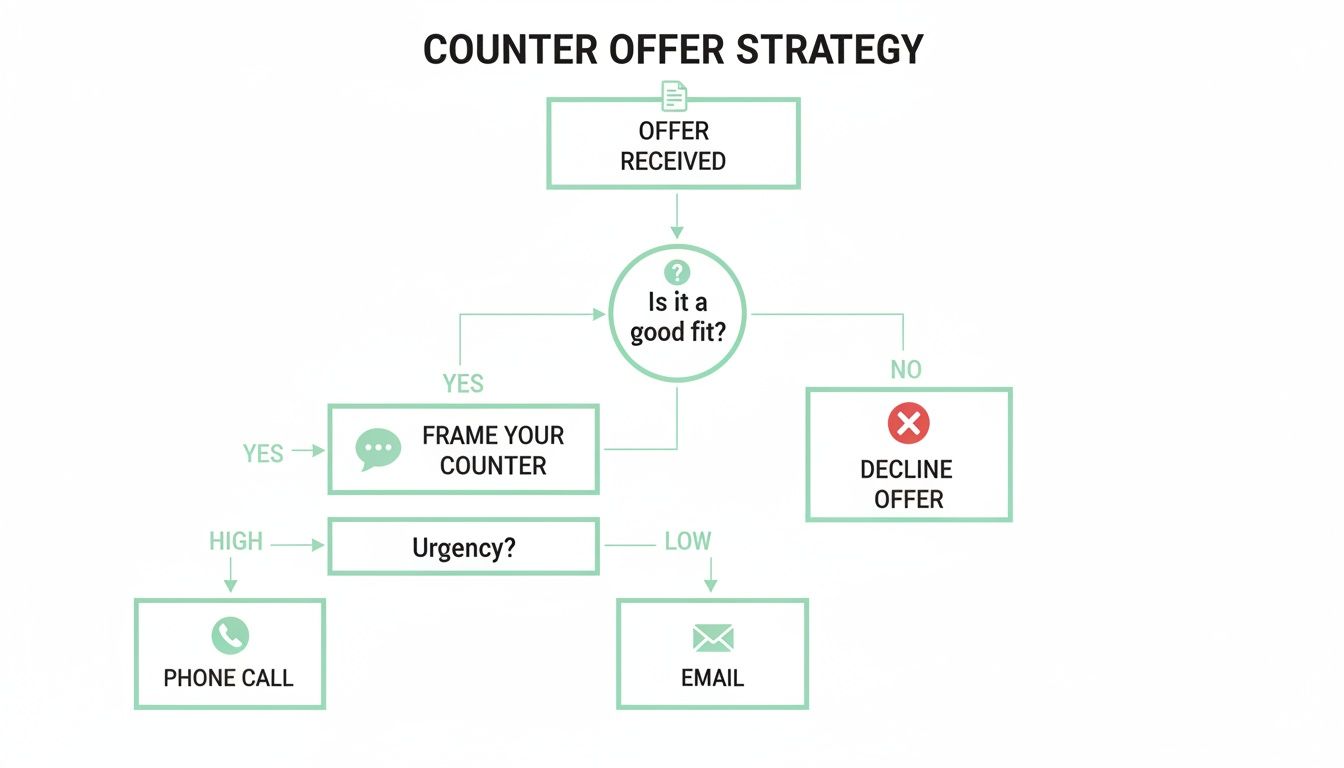
The key takeaway here is that both paths get you to a negotiation, but your choice of medium—a direct conversation versus a written record—sets the initial tone for the whole exchange.
It happens all the time. You hand in your resignation, and suddenly your current boss slides a counteroffer across the table to get you to stay. It's tempting, for sure, but accepting is almost always a short-term fix for a long-term problem. The reasons you wanted to leave in the first place—whether it was the culture, management, or a lack of growth—rarely vanish just because of a pay bump.
The data on this is pretty stark. 52% of employees who accept a counteroffer from their current company are gone within six months, and a whopping 80% leave within a year. The root issues that sent you job hunting in the first place are almost never solved by more money.
Accepting a counteroffer from your current employer is like putting a bandage on a broken bone. It might feel better for a moment, but it doesn't fix the underlying issue, and your trust with leadership is often permanently damaged.
As you navigate these final stages, be careful to avoid these common pitfalls:
By handling these final steps with care, you can lock in a deal you're genuinely excited about and kick off your next chapter on the best possible note.
Look, even with a perfect game plan, negotiation can throw you a curveball. It's totally normal to have those last-minute "what if" questions pop into your head.
Let's walk through some of the most common tricky situations so you can handle them with confidence, not anxiety.
First, take a breath. When a recruiter or hiring manager says an offer is "final," it often just means the base salary number has hit its ceiling. It doesn't always mean the entire package is locked in stone.
Think of it as a signal to shift your focus. You can respond with something like:
"I really appreciate the clarity and I'm still very excited about this opportunity. I understand the base salary is firm. With that in mind, would there be any flexibility on a one-time signing bonus or perhaps an increased budget for professional development?"
This approach shows you're listening and respecting their boundaries, but you're still creatively exploring how to make the total package work. If they say no to everything, then the ball is truly in your court to decide if the offer, as is, meets your bottom line.
The sweet spot is between 24 and 48 hours. You want to be thoughtful, but you don't want to drag it out.
When you first get the offer, your immediate response should be to thank them and set expectations. Say something like, "Thank you so much for the offer! This is exciting. I'd like to review the details carefully and will get back to you by end of day tomorrow."
This does two things: It shows you're professional and organized, and it gives you the breathing room you need to research your market value and frame your counter-offer without looking like you're playing games.
Negotiation isn't just about getting more money. It's the first step in building a professional relationship. A timely, well-reasoned response shows you're the kind of serious, thoughtful person they want on their team.
This is a classic dilemma, but my advice is to hold that number back. Sharing the exact salary of a competing offer can accidentally turn the negotiation into a simple bidding war.
Why is that bad? It might cap what they're willing to offer. Instead of them paying you what you're worth for their role, they'll just focus on beating the other company by a tiny margin.
Instead, frame it like this: "I do have another offer that is more competitive from a total compensation perspective."
This gives you leverage without anchoring the conversation to a specific number. You want to negotiate based on your value in the market, not just get them to inch past a competitor's offer.
While it's technically possible, it is incredibly rare for a reputable company to pull an offer just because a candidate negotiated. In fact, most hiring managers in the tech and startup world fully expect you to.
Honestly, if a company did rescind an offer over a polite, professional negotiation, consider it a massive red flag. It tells you a lot about their culture and how they handle conflict or challenges.
As long as your counter is backed by market data, delivered respectfully, and your requests are reasonable, the risk is practically zero. Negotiating doesn't make you difficult—it makes you a professional who knows their worth.
Ready to stop searching and start getting noticed by top startups? Underdog.io flips the script by connecting you with hundreds of vetted, high-growth tech companies in NYC, SF, and across the US with a single 60-second application. Find your next big opportunity today.
In most professional scenarios, it is perfectly acceptable and expected to negotiate a job offer respectfully. Employers typically build some negotiation room into their initial offer. A well-reasoned, professional counter-offer is highly unlikely to result in a rescinded offer. However, using an aggressive or entitled tone can damage the relationship.
Always begin by expressing genuine enthusiasm and gratitude for the offer. A simple, "Thank you so much for this opportunity. I am very excited about the prospect of joining [Company Name] and contributing to [specific project/team]" sets a positive, collaborative tone before you transition to discussing terms.
A typical range is 10% to 20% above the initial offer, but this depends entirely on your research. Your counter should be justified by data: market rates for the role in that location (using sites like Glassdoor, Levels.fyi, or salary guides), your specific experience and skills, and the value you bring. Be prepared to share this rationale.
If the salary is truly fixed, pivot to negotiating other elements of the compensation package. You can ask for a sign-on bonus, a performance review and potential raise in 6 months instead of 12, additional equity or stock options, a better title, more vacation days, or a higher contribution to health insurance or retirement plans.
It is generally recommended to have the initial negotiation conversation over the phone or a video call. This allows for clearer communication of tone and intent. You can then follow up with a concise email that summarizes the points discussed and your formal counter-offer, creating a written record.
Aim to respond within 24 to 48 hours. This shows you are serious and respectful of the hiring team's timeline. If you need more time to consider (e.g., waiting for another offer), it's professional to communicate that: "Thank you for the offer. I am very interested and will need until [specific day] to provide you with a final answer. Does that timeline work for you?"
Be prepared for the company to accept, reject, or meet you in the middle with a new number. The recruiter or hiring manager will usually get back to you within a few days. If they cannot meet your request, you must then decide if the original offer is acceptable or if you need to walk away. Always respond graciously, regardless of the outcome.