What if the best sourcing tool for a software engineer isn't the platform with the largest database, but the one that exposes the right technical signal or creates the most credible conversation?
Technical recruiting is a matching problem, not a database-search exercise. A passive backend engineer, a startup-ready product leader, a developer with meaningful open-source contributions, and a warm former applicant each require a different sourcing motion. The tools that work for one group can create noise with another.
This list evaluates the best candidate sourcing tools for technical recruiters by candidate quality, technical relevance, response potential, workflow fit, integrations, pricing transparency, and practical limitations. It moves from curated, high-intent marketplaces to professional-graph search, technical-signal discovery, rediscovery, outreach, and volume hiring. Recruiters comparing specialist channels can also review these best job boards for motorsport engineers when a role requires a particularly narrow technical audience.
Underdog.io is especially relevant when a startup needs curated, confidential access to early-stage and Series B technical talent. LinkedIn Recruiter and SeekOut support broader discovery, while hireEZ, Gem, and Findem help teams organize or reactivate pipeline. Hired, Wellfound, and Dice solve different marketplace and volume problems. The right answer usually isn't one platform. It's a focused combination built around the role.
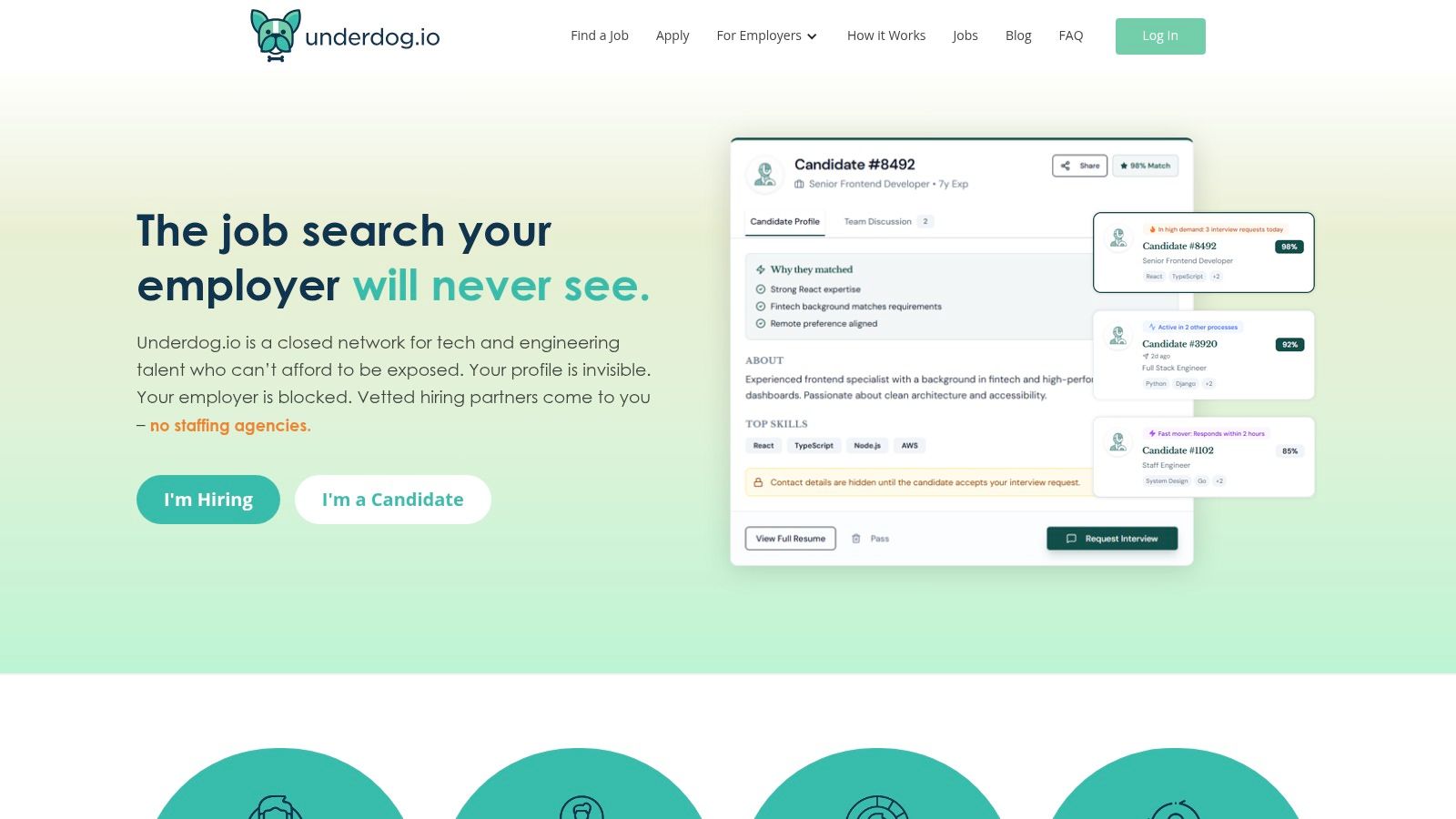
Underdog.io is a strong choice when the hiring problem is startup fit plus candidate intent, rather than maximum database reach. It's a curated, candidate-first marketplace for early-stage and high-growth technology companies, with technical roles spanning software engineering, data, QA, machine learning, AI, and DevOps.
The marketplace reverses the usual job-board dynamic. Candidates submit one application that takes about 60 seconds, then vetted startups can review relevant profiles and reach out. Candidates remain anonymous until interest is mutual, which makes the platform particularly useful for employed engineers who want to explore opportunities discreetly. The service is free for job seekers, while employers use success-based pricing and can access enterprise recruiting support through Hunt by Underdog.io.
Underdog.io's human curation is its main differentiator. The platform says it accepts approximately 5% of candidate applicants and turns away more than half of companies that try to join, according to the publisher's supplied product information. It also reports that about 85% of its talent is employed and that its marketplace produces a 65%+ response rate. Those signals matter because technical recruiters often struggle less with finding profiles than with getting qualified passive candidates to engage.
Use Underdog.io for startup hiring where founders, hiring managers, mission, equity, and adaptability influence the decision. It's particularly relevant to New York City, San Francisco, and remote US roles.
Practical rule: Choose Underdog.io when a smaller, better-matched slate is more valuable than an unfiltered candidate list.
The trade-off is focus. Underdog.io isn't designed for large corporate hiring, broad international coverage, or roles outside the startup and technology ecosystem. Employer pricing is handled privately, so buyers seeking a publicly posted flat fee may find the commercial model less transparent. For a deeper look at how the platform can support startup recruiting, see candidate sourcing tools for startups.
Best for: Curated startup and Series B technical hiring.
Pros: Human-vetted candidates and companies, confidential access, passive technical talent, founder-level conversations, free candidate participation, success-based employer pricing.
Cons: Highly selective, startup-focused, primarily US-oriented, and not publicly priced for employers.
Website: Underdog.io
How do you map a technical talent market and turn that map into relevant conversations? LinkedIn Recruiter combines market mapping, candidate discovery, outreach, and team workflow in one environment. It offers access to more than 1 billion profiles, according to candidate sourcing tool coverage from Pin.
Advanced filters, project-based sourcing, InMail, Recommended Matches, and signals such as Open to Work help recruiters define a search. Teams can connect Recruiter with an ATS through Recruiter System Connect, share projects, coordinate ownership, and review sourcing activity.
A recruiter can identify engineers at competitor companies, compare title patterns, find adjacent skills, and present a realistic target list to a hiring manager. The platform's reach does not guarantee attention. Generic messages still perform poorly, especially when they repeat the job description instead of explaining why the role fits the candidate's work.
Practical rule: Build the target market first, then personalize outreach around a specific technical signal, career move, or relevant team problem.
The commercial model requires a budget check. Recruiter Lite starts at about $1,600 per year, while Corporate is listed at about $10,800 per year. Tiers and access mechanics vary, so confirm current packaging before budgeting because pricing can vary by plan and organization.
Boolean structure still matters for engineering searches. Recruiters can review Boolean strings for sourcing software engineers, then layer in relationship signals and message personalization.
Best for: Broad passive-talent discovery and professional-graph market mapping.
Pros: Extensive reach, mature search, InMail, collaboration, and ATS connectivity.
Cons: Premium pricing, variable response quality, and heavy dependence on recruiter research and message quality.
Website: LinkedIn Recruiter
How do you find strong engineers when their best evidence is missing from the résumé? SeekOut searches technical and professional signals across sources such as GitHub, patents, publications, and other public profiles. Juicebox's candidate sourcing overview describes coverage across 30 platforms and 800 million profiles, with GitHub, patent, and diversity filters among its differentiators.
That coverage supports technical-signal discovery, especially for engineers with generic titles, incomplete résumés, or meaningful work documented in projects and publications. A candidate who lists Python or distributed systems may provide little context on a résumé. Public technical activity can show the problems they have explored and the depth of that work, although it still requires recruiter review.
People Insights and market analytics help recruiters explain talent availability and pipeline composition to hiring managers. Diversity filters can also broaden the search, but they should guide human review rather than determine fit automatically.
SeekOut has more configuration and a steeper learning curve than a basic résumé database. Custom enterprise pricing can also slow an initial evaluation. Start with one difficult role, define the technical signals that matter, and compare the shortlist with results from a conventional professional-graph search. Recruiters can review this guide to candidate sourcing software and tools when deciding how SeekOut fits into a broader sourcing stack.
A staff-level infrastructure search is a strong use case when titles vary and GitHub or publication activity adds useful context. A high-volume role is a weaker fit if the team needs rapid applicant flow and has little time to interpret multiple signals. Use SeekOut for hard-to-classify technical talent, then hand qualified prospects to an outreach or rediscovery tool.
Best for: Engineering discovery through code, patents, publications, and market intelligence.
Pros: Technical depth, diversity analytics, GitHub search, talent-pool analysis, and AI-assisted slate development.
Cons: More complex user experience, custom enterprise pricing, and disciplined signal interpretation required.
Website: SeekOut
hireEZ, formerly Hiretual, is aimed at teams that want to combine open-web sourcing, contact finding, ATS rediscovery, CRM, and outreach. Rather than operating as a narrow discovery database, it presents itself as a stack consolidator for recruiters managing several sourcing motions at once.
Its EZ Agent can interpret a job description or persona and return ranked candidate slates. Recruiters can also search external profiles, rediscover people already stored in the ATS, find contact information, and move prospects into nurture workflows. That combination makes hireEZ particularly useful when a team has a large historical database but lacks an efficient way to reactivate it.
The practical advantage is reduced handoff. A recruiter can move from search to enrichment to outreach without rebuilding the candidate record in another system. Market salary insight dashboards and analytics can also support intake conversations, especially when the hiring manager's requirements are unrealistic for the available talent market.
hireEZ's platform approach creates a different burden. It's not a lightweight per-seat utility, and pricing is custom. The quality of automated recommendations and outreach still depends on the clarity of the recruiter's inputs, the accuracy of records, and the quality of the messaging. Automation can increase activity without improving conversations if the team doesn't review fit before contacting candidates.
Use hireEZ when you want one operating layer for external discovery and warm database work. Don't buy it solely because it can generate a large slate. Define how recruiters will measure qualified candidates, replies, interviews, and hires before evaluating the consolidation case.
Best for: AI-assisted sourcing, ATS rediscovery, contact finding, and high-volume nurture.
Pros: Broad workflow coverage, fast ramp, CRM functionality, rediscovery, analytics, and outreach in one platform.
Cons: Custom pricing, platform complexity, and dependence on strong search inputs and messaging.
Website: hireEZ
Gem is best understood as the workflow and outreach layer of a technical recruiting stack. It captures profiles through a Chrome extension, adds prospects to shared pipelines, supports multistep email sequences, and gives recruiting teams visibility into source performance and funnel health.
That makes Gem valuable after a recruiter has identified the right people. A technical recruiter can save prospects from LinkedIn or another discovery source, assign ownership, build a sequence, and report on how each channel contributes to pipeline movement. Hiring managers can participate in shared projects without relying on scattered spreadsheets or private recruiter notes.
Gem has also expanded into AI sourcing, but its strongest practical value remains coordination and measurement. It's especially useful for teams that already know how to find candidates but struggle to maintain consistent follow-up. The platform can help distinguish a sourcing problem from an outreach problem. If the team has qualified prospects but weak replies, messaging and timing may need work. If replies are healthy but interviews are poor, the search criteria or technical calibration may be wrong.
A CRM can make outreach consistent, but it can't make an irrelevant message persuasive.
Gem is a custom-priced enterprise purchase, and it works best when paired with a strong top-of-funnel source such as LinkedIn Recruiter or SeekOut. Smaller teams may find the platform more extensive than they need if they're filling only occasional roles. Larger technical recruiting teams benefit more when several recruiters, sourcers, and hiring managers need a shared operating picture.
Best for: Outreach sequencing, sourcing collaboration, and channel analytics.
Pros: Strong multistep campaigns, shared pipelines, Chrome capture, reporting, and funnel visibility.
Cons: Custom enterprise pricing and limited value without a reliable discovery source.
Website: Gem
AmazingHiring focuses on developer discovery through digital footprints rather than résumé keywords alone. It aggregates profiles from GitHub, Stack Overflow, Kaggle, Dribbble, Behance, and other networks, then helps recruiters compare candidates through technical and career signals.
The platform's unified profile view is useful when an engineer maintains separate identities across professional and technical communities. Its Chrome extension can show cross-network information while recruiters browse, which reduces the need to search each source independently. Candidate ranking considers more than one dimension, including technical skill, employer context, and seniority.
This is a good fit for searches where contribution evidence matters. A recruiter hiring for a developer tools company, data platform, or machine learning team may learn more from project activity, competition participation, or portfolio work than from a polished but generic résumé. The ranking system helps prioritize research, but it shouldn't be treated as a final assessment of engineering ability.
The free extension has limited credits, while contact details and fuller functionality sit in the paid version. Pricing is sales-led and not listed publicly, so teams should test the workflow against a real role before committing.
AmazingHiring is less useful when the hiring process is primarily applicant-driven or when the target population doesn't maintain visible technical profiles. It's also not a replacement for a CRM. Recruiters still need a controlled place to record contact history, disposition, and hiring-stage progress.
Best for: Finding engineers through contributions, portfolios, and cross-network technical signals.
Pros: Developer-focused aggregation, high-signal discovery, ranking, and market mapping.
Cons: Paid access is needed for fuller contact functionality, and sales-led pricing reduces transparency.
Website: AmazingHiring
Findem addresses a problem many internal recruiting teams overlook: the next strong candidate may already exist somewhere in the company's hiring ecosystem. Its warm-sourcing approach brings together inbound applicants, ATS records, referrals, alumni, and external profiles in a guided search workflow.
Fia, Findem's assistive AI, translates hiring intent into ranked candidate slates and explains the signals behind those recommendations. Continuous enrichment helps maintain current records and adds broader career context, while reporting can separate the performance of ATS, referral, and external channels.
That makes Findem particularly useful for companies with accumulated applicant and employee data. A recruiter opening a new platform engineering role can search past finalists, silver-medalist candidates, former employees, and referred prospects before paying for another external search. The system can also support a more productive intake conversation because attribute-level matching gives recruiters a clearer way to discuss why a candidate appears relevant.
Findem's value depends on data quality. A sparse or inconsistent ATS won't provide the same warm-sourcing opportunity as a mature, well-maintained talent database. Recruiters should confirm how records are deduplicated, enriched, retained, and connected to existing systems.
Custom, sales-led pricing adds another buying consideration. Findem is best for teams that want talent intelligence and sourcing-mix reporting, not for a recruiter seeking a simple standalone search box. Use it when rediscovery and referral activation are meaningful parts of the hiring strategy.
Best for: Warm sourcing, ATS rediscovery, referrals, alumni, and sourcing-mix analysis.
Pros: Transparent match signals, guided AI assistance, continuous enrichment, and stronger use of existing pipeline data.
Cons: Requires data-rich recruiting operations and comes with custom pricing.
Website: Findem
Hired solves the response problem through a curated, opt-in marketplace. Candidates signal interest, provide compensation expectations, and receive support from talent advocates, giving employers access to people who are more prepared to discuss a move than a typical passive prospect.
That intent changes the recruiter's work. Instead of spending most of the first interaction proving that the role is worth considering, the conversation can move more quickly toward technical scope, team context, compensation, and interview expectations. Hired also offers bias-reduction features, visible salary expectations, employer branding, and integrations with major ATS platforms.
Hired is useful for software engineering and related technical positions in covered markets, particularly when a company needs a responsive pipeline and wants to shorten the distance between matching and conversation. It can complement LinkedIn Recruiter when cold outbound is producing profile views but few meaningful replies.
The trade-off is marketplace coverage. Candidate availability can change with market cycles, and the platform doesn't cover every role or geography. Employer pricing and fee models are custom, so procurement teams should ask for a complete cost view that includes the expected hiring motion and any service components.
Choose Hired when an opt-in candidate pool is more important than exhaustive market mapping. Don't use it as the only channel for a rare specialist role if the marketplace lacks enough relevant candidates.
Best for: Responsive, curated technical candidates and faster initial conversations.
Pros: Candidate intent, compensation transparency, talent advocates, and ATS integrations.
Cons: Covered-role and marketplace limitations, market-cycle sensitivity, and custom employer pricing.
Website: Hired
Wellfound is a startup-focused talent marketplace built around the expectations of startup candidates and employers. Recruiters can search for engineers, product managers, designers, and growth talent using startup-oriented filters that include compensation and equity considerations.
Its employer-branding tools and startup-native job posts help smaller companies explain why a candidate should consider them over a larger employer. Wellfound also offers wellfound:ai Autopilot, which can support sourcing, pitching, and scheduling, with a human-assistance option. Public pricing tiers for Recruit and Pro make initial comparison easier than with platforms that disclose only custom quotes.
The platform works best when the hiring story is central to the search. A startup can present its stage, product, ownership opportunity, and working model in the same environment where candidates are already evaluating startup roles. That context can help a recruiter avoid sending a generic enterprise-style pitch to a candidate who cares about autonomy and equity.
Wellfound is less suitable for late-stage enterprise hiring or highly specialized senior individual contributors outside startup-oriented communities. Autopilot is also an extra-cost option, so teams should decide whether they need automation, human assistance, or a recruiter-led workflow.
Use Wellfound when startup identity is a genuine part of the value proposition. If the role is highly specialized and the company's brand isn't strong in the relevant technical community, pair it with a technical-signal discovery tool rather than expecting one marketplace to solve the entire search.
Best for: Startup hiring, employer branding, and startup-ready technical talent.
Pros: Strong startup community, compensation and equity context, public pricing tiers, and optional assisted sourcing.
Cons: Weaker fit for enterprise hiring and niche senior talent outside startup markets.
Website: Wellfound
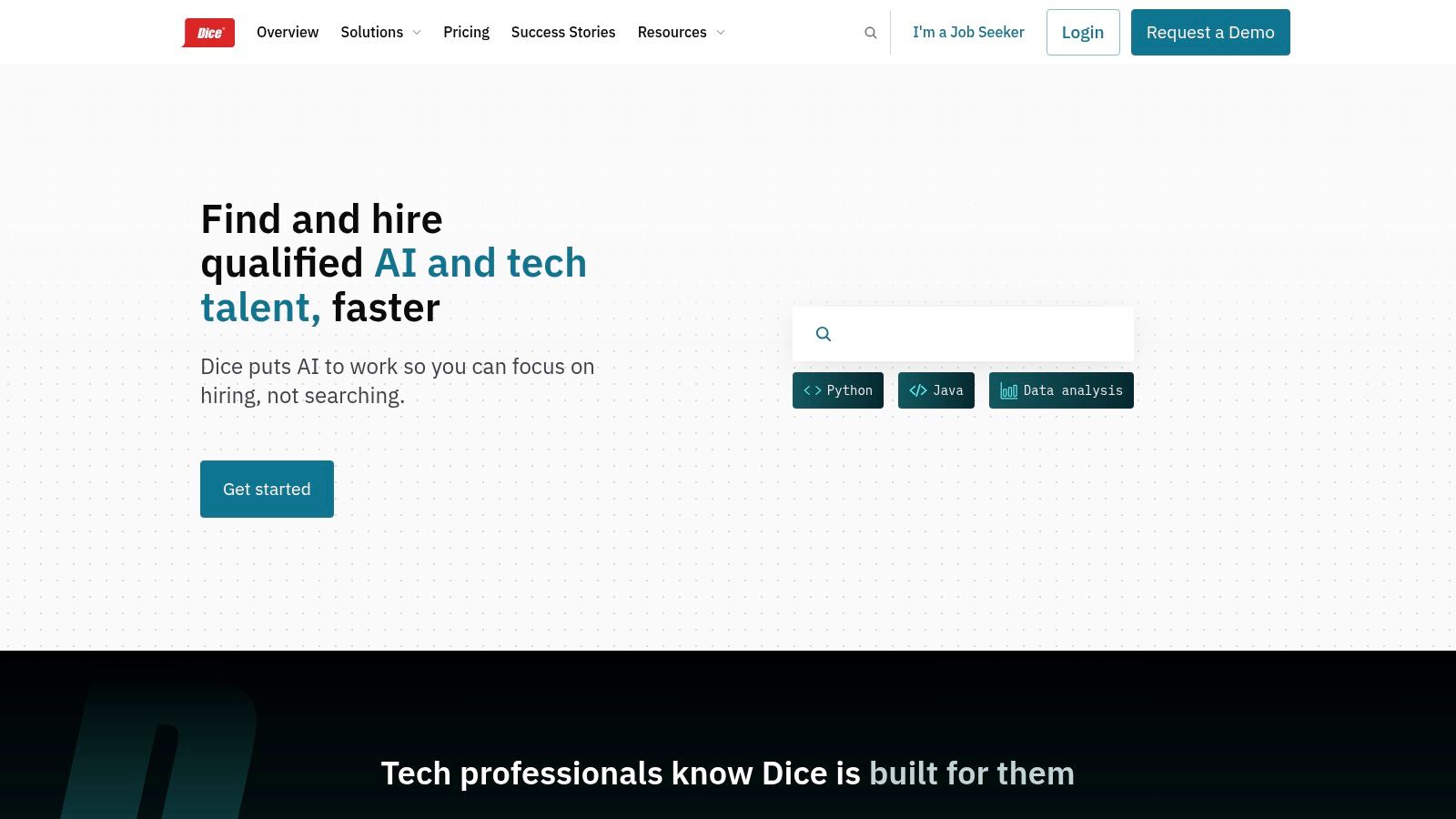
Dice is a technology-focused hiring platform for employers sourcing engineers, data professionals, and cybersecurity talent across US markets. Its résumé database, job postings, skill targeting, Recruiter Hub, instant candidate matching, programmatic distribution, and employer-branding tools make it a practical option for volume hiring.
Dice is most useful when the company needs a steady flow of candidates for common technical stacks and wants a channel dedicated to technology rather than a general job board. Recruiter Hub can match candidates to a job description, while branded jobs and company profiles give employers more room to explain the opportunity.
The main limitation is quality variance. Recruiter sentiment can differ by niche and market cycle, and a large technology audience doesn't guarantee that every returned profile matches the role's actual seniority, architecture experience, or environment. Recruiters should define screening questions and review source quality instead of judging Dice solely by application count.
Dice is a reasonable choice for organizations hiring across familiar technical categories and US locations. It's less compelling for confidential executive searches, unusual research profiles, or roles where open-source contribution is more important than résumé volume. Pricing is often sales-quoted, so buyers should compare expected qualified-candidate output rather than headline access.
Best for: Tech-focused volume hiring across common US technical roles.
Pros: Technology-only audience, skill targeting, job distribution, matching, and employer branding.
Cons: Variable candidate quality and ROI, plus sales-quoted pricing.
Website: Dice for Employers
| Product | Core focus | Matching & vetting | Candidate experience & privacy | Best for / Target audience | Pricing & value |
|---|---|---|---|---|---|
| Underdog.io (Recommended) | Curated early-stage & high-growth startups (product/eng/design/data/marketing) | Human-powered matches; candidate acceptance ≈5%; company screening >50%; high response (~65%+) | 60s application, anonymous until mutual, free for candidates, passive talent (~85%) | Startup-seeking tech talent, founders/hiring-managers, confidential searches | Free to candidates; employers pay success-based fees; enterprise Hunt option |
| LinkedIn Recruiter | Broad professional graph (1B+ members) | Advanced Boolean filters, AI recs, large-scale sourcing | Direct InMail outreach; public profiles; response quality varies | Enterprise sourcers, market mapping, large-scale outreach | Premium seat pricing, custom enterprise quotes |
| SeekOut | Engineering & technical discovery (public contributions) | Aggregates GitHub/papers/patents, diversity analytics, AI agents | Enriched profiles with deep technical signals | Engineering-focused sourcing, diversity hiring, research-led teams | Enterprise/custom pricing |
| hireEZ (Hiretual) | AI-first open-web sourcing + CRM | Agentic AI ranked slates, ATS rediscovery, contact finding | High-volume outreach and nurture, relies on strong messaging | Teams consolidating sourcing stack, high-volume hiring | Platform pricing, sales-led/custom |
| Gem | Recruiting CRM + outreach sequencing | Capture via extension, AI sourcing workflow, pipeline analytics | Multistep email sequences, collaborative pipelines, ROI tracking | TA teams focused on outreach performance & analytics | Custom/enterprise pricing |
| AmazingHiring | Developer footprint aggregation (50+ networks) | Cross-network profiles (GitHub, StackOverflow, Kaggle), candidate ranking | Unified cross-network view; contact info in paid tier | Recruiters hunting engineers with public contributions/portfolios | Paid features with sales-led pricing |
| Findem | AI talent intelligence & warm sourcing | Assistant (Fia) for ranked slates, continuous enrichment, transparent signals | Emphasizes ATS/inbound rediscovery and referrals | Data-rich orgs leveraging historical ATS/CRM pipelines | Custom, sales-led pricing |
| Hired | Opt-in marketplace for tech & sales talent | Candidate intent & salary transparency, talent advocates | High-intent candidates, faster cycles, candidate support | Employers seeking ready-to-talk engineers/sales in US & remote | Marketplace fees via sales; custom pricing |
| Wellfound (AngelList) | Startup-native talent marketplace | Startup-focused search, wellfound:ai Autopilot (paid) | In-platform messaging, employer branding, startup filters | Startups hiring product/eng/design/growth talent | Public tiers (Recruit/Pro) with optional add-ons |
| Dice (for Employers) | Tech-only job board & résumé database | Tech résumé database, instant matching, programmatic distribution | Job postings and employer branding; candidate quality varies by niche | Volume tech hiring (engineering, data, cybersecurity) | Sales-quoted pricing; variable entry points |
The best candidate sourcing tools for technical recruiters don't compete on one universal ranking. They solve different sourcing problems. Underdog.io, Hired, and Wellfound are strongest when candidate intent, startup fit, or curated matching matters. LinkedIn Recruiter, SeekOut, and AmazingHiring support broad or technically specific discovery. Findem and hireEZ recover warm candidates and consolidate sourcing workflows. Gem manages personalized sequences and measures channel performance, while Dice supports tech-focused volume hiring.
A practical stack starts with the recruiting motion, not the vendor demo. For an early-stage startup hiring a small engineering team, begin with Underdog.io or Wellfound to access startup-aligned candidates, then add LinkedIn Recruiter when the search needs broader passive-talent mapping. For a specialized infrastructure or machine learning role, use SeekOut or AmazingHiring to identify technical evidence, then move qualified prospects into Gem or hireEZ for controlled outreach.
Enterprise teams often need a different design. Findem can prioritize previous applicants, referrals, alumni, and ATS records before the team spends more time on external sourcing. hireEZ can combine rediscovery with open-web search and nurture. Gem can provide the shared campaign and reporting layer when several recruiters or hiring managers need consistent follow-up.
Build the smallest stack that can complete the role's actual workflow. Adding another database won't fix weak calibration, poor personalization, or missing follow-up ownership.
Test one discovery source and one workflow or outreach layer against the same role. Track the qualified slate rate, response quality, time to the first viable slate, interviews, and hires. Raw profile counts can make a platform look productive while hiding irrelevant results or weak downstream conversion.
Before purchasing, confirm current pricing, integration scope, geographic coverage, and data-use requirements. Check whether the platform connects to your ATS and CRM, whether recruiters can export or retain records appropriately, and whether the search signals match how your hiring managers evaluate technical ability. Also ask how the vendor handles duplicates, stale profiles, candidate consent, and outreach controls.
The right stack may contain one tool for curated access, another for technical discovery, and a third for relationship management. That combination is often more effective than forcing one broad platform to handle passive sourcing, code-signal research, warm rediscovery, and high-volume execution at the same time.
Underdog.io gives startups curated, confidential access to vetted technical talent through a candidate-first marketplace, with matching designed for early-stage and high-growth technology hiring. If your team needs a focused alternative to broad database searches, visit Underdog.io and explore how its startup-specialized sourcing model can support your next technical hire.