What signal do you need from a software engineer, and are your Boolean strings searching for that signal or merely collecting keywords? A stack, seniority, startup experience, product orientation, domain knowledge, or proof of work each requires a different search design. Stacking every title, language, framework, and cultural phrase into one query often creates noise, hides useful candidates, or excludes engineers who describe equivalent experience differently.
The seven Boolean strings below are organized around distinct sourcing signals. They show how to adapt searches across LinkedIn, GitHub, resume databases, and X, where syntax, indexing, and profile language vary. LinkedIn Recruiter supports AND, OR, NOT, quoted phrases, and parentheses, while structured resume and profile databases use the same operators to refine results, as explained in LinkedIn's Boolean search guidance and SHRM's Boolean search overview.
Use each string as a starting hypothesis. Test broad and narrow versions against real results, then inspect relevance, recall, and false positives before you contact anyone. For broader hiring context, see this guide to hiring software engineers.
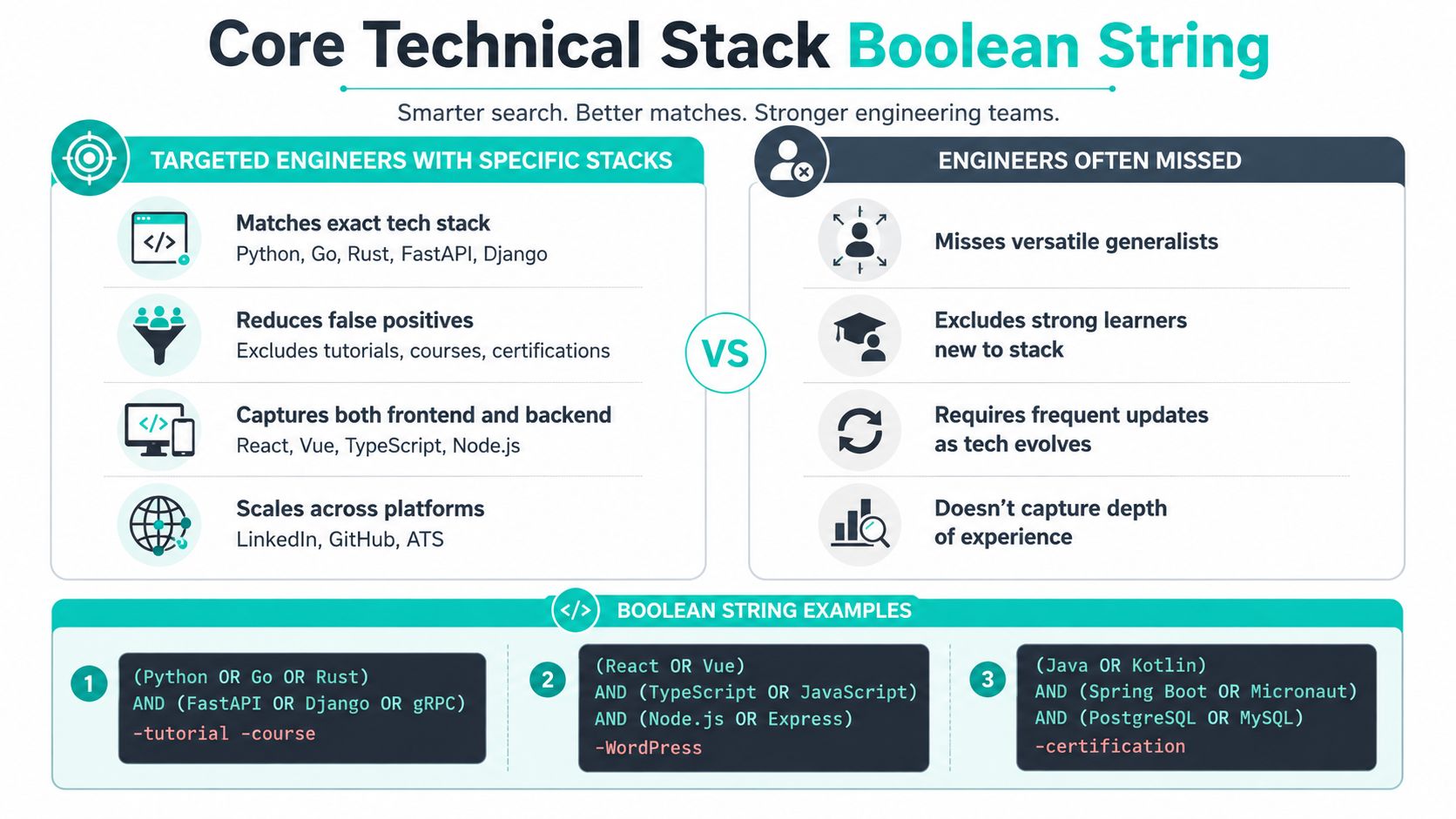
A stack search should reflect what the engineer must be able to do, not every tool your company has ever touched. Start with a title group, add a small set of related technologies, and exclude obvious educational or commercial noise.
("software engineer" OR "software developer" OR "backend engineer" OR "frontend engineer") AND ((Python OR Go OR Rust) AND (FastAPI OR Django OR gRPC)) NOT (intern OR trainee OR tutorial OR course)
That structure finds candidates who mention a relevant language and framework combination. It won't prove production ownership. A profile may list Django because someone completed a tutorial, while an experienced engineer may omit a framework that was central to an older project. Treat the result as an invitation to inspect work history, repository evidence, and technical scope.
For a JavaScript-oriented role, try:
("software engineer" OR "frontend engineer" OR "full-stack engineer") AND (React OR Vue) AND (TypeScript OR JavaScript) AND (Node.js OR Express) NOT (WordPress OR intern OR trainee)
For a JVM backend search, use:
("backend engineer" OR "software developer" OR "software engineer") AND (Java OR Kotlin) AND ("Spring Boot" OR Micronaut) AND (PostgreSQL OR MySQL) NOT (certification OR intern)
LinkedIn handles quoted phrases and uppercase Boolean operators directly. Use its location, current-company, and experience filters separately instead of forcing every constraint into the keyword field. On Google X-ray, prepend site:linkedin.com/in/ and replace LinkedIn-style exclusions with minus terms, such as -intern -trainee -QA. X-ray searches can also use field-targeting examples for software-engineer sourcing, including title: and technical metadata.
GitHub requires a different emphasis. Search repositories, users, languages, locations, and contribution evidence rather than relying on job titles. A query such as language:Python location:"New York" repos:>15 can surface developers whose profiles don't say “software engineer.” Resume databases may index the full document, so add -resume or -jobs only when templates and job postings swamp the results. X often rewards combinations of technology names, project language, and profile links, but it can miss engineers who keep their technical identity off-platform.
Practical rule: Keep the title group focused, rotate primary and secondary technologies, and test every exclusion before making it permanent.
Titles are useful orientation points, but they aren't evidence of scope. A “senior” engineer at one company may have owned a service, while another may have held the title without architectural responsibility. Search for progression language, then validate ownership, complexity, and influence in the profile or resume.
("Senior Software Engineer" OR "Staff Engineer" OR "Lead Engineer" OR "Principal Engineer") NOT (manager OR director OR VP)
A tenure-led variant can widen the search:
("5+ years" OR "7+ years" OR "10+ years") AND (backend OR "full-stack" OR platform) NOT (director OR VP OR executive)
For startup leadership without executive titles, try:
("Tech Lead" OR "Principal Engineer" OR Architect) AND (startup OR "early stage") NOT (executive OR CTO)
These strings work best as starting filters. The tenure expression may be absent from LinkedIn, abbreviated on a CV, or replaced by a sequence of roles. Seniority terms can also create geographic bias because companies use “staff,” “principal,” “lead,” and “architect” differently across regions. Add variants based on the profiles of engineers already succeeding in your environment.
Look for language such as owning a service, designing systems, scaling a team, mentoring engineers, leading incident response, or working directly with product. “Managed” deserves careful reading because it might describe people management, project coordination, or technical ownership. A NOT clause that removes every profile containing “manager” can discard strong candidates who managed projects but never left engineering.
For public sourcing, an X-ray query can combine site:linkedin.com/in/ with seniority and evidence terms. Resume databases may support exact phrases more consistently than social platforms. GitHub rarely exposes seniority directly, so inspect maintainership, project responsibility, documentation, and issue participation instead.
Passive candidates often require a different outreach and validation approach, which makes this passive candidate sourcing guide a useful companion to title-based search.
Seniority is a hypothesis about scope. The profile must supply the proof.
A recognizable employer can help you locate relevant talent quickly, but it shouldn't become a proxy for ability. Combine company background with startup, product, or ownership signals to find engineers who've worked in both structured and ambiguous environments.
(Google OR Facebook OR Amazon OR Microsoft OR Apple) AND (founder OR startup OR seed) AND (engineer OR developer)
For venture-backed experience:
("Series A" OR "Series B" OR "Series C") AND (engineer OR developer) NOT (recruiter OR recruiting)
For exit-related language:
(exit OR acquisition OR IPO OR acqui*) AND engineer AND technology NOT (news OR article)
The last query needs manual review. “Acquisition” might describe a company event, an article about an employer, or a candidate's direct role in integration. Partial matching such as acqui* can capture related forms, but it also increases noise, particularly on general search engines.
A former large-company engineer may bring strong systems discipline but limited experience with incomplete requirements. A startup engineer may have excellent adaptability but less exposure to operational scale. Search combinations such as "YC" OR "Y Combinator" alongside engineering terms when startup pedigree matters, then check what the person built and owned.
Acquisition announcements can identify recently available talent, but searching news alone creates false positives. Use the announcement to identify names, then verify the person's role through LinkedIn, a CV, GitHub, or a personal site. Don't assume that everyone at an acquired company worked on the acquired product.
For candidates in startup-focused marketplaces, Series A or Series B experience may be more relevant than a famous employer alone. The useful signal is not prestige. It's evidence that the engineer shipped under constraints, collaborated closely with product, and adapted as the company changed.
Use employer names to open a door, not to make the hiring decision.
The strongest version of this search pairs background with a concrete technical need, such as (Google OR Amazon) AND (distributed systems OR Kubernetes) AND startup. That keeps the query connected to the role instead of turning it into a prestige filter.
Early-stage teams often need engineers who can move from interface to API, database, deployment, and production support. “Full-stack” can identify that breadth, but the term is also broad enough to describe very different levels of hands-on responsibility.
"full-stack" AND (React OR Vue) AND (Node OR Python OR Java) AND (AWS OR GCP)
A cross-functional version searches for adjacent ownership:
(frontend AND backend) AND (DevOps OR infrastructure) AND (Docker OR Kubernetes)
For engineers who describe themselves as generalists:
("end-to-end" OR generalist OR versatile OR adaptable) AND engineer AND (database OR infrastructure OR deployment)
The first string is narrow and practical. It can produce fewer results, but those results are easier to compare against a role that requires front-end, backend, and cloud experience. The second string is broader and may capture specialists who collaborated with infrastructure teams rather than deploying systems themselves. The third finds candidates who use breadth language, but self-description isn't proof.
A candidate can list React, Python, AWS, Docker, and Kubernetes without having used them together. Ask whether the profile shows a coherent product journey, such as building a feature, exposing an API, storing data, deploying the service, and responding to production issues. Repository history, project descriptions, technical writing, and interview discussion can clarify that sequence.
You can add "multiple programming languages" or "3+ technologies" to search for explicit breadth, but these phrases are uncommon and may exclude capable engineers. Likewise, -specialist can remove useful candidates who describe one area as a specialty while still working across the stack. Use exclusions only after reviewing the noise they remove.
Search for adjacent roles such as site reliability engineer or platform engineer alongside application-development terms. GitHub can be especially valuable here because repository structure, deployment configuration, and documentation may reveal cross-functional work that a job title doesn't mention.
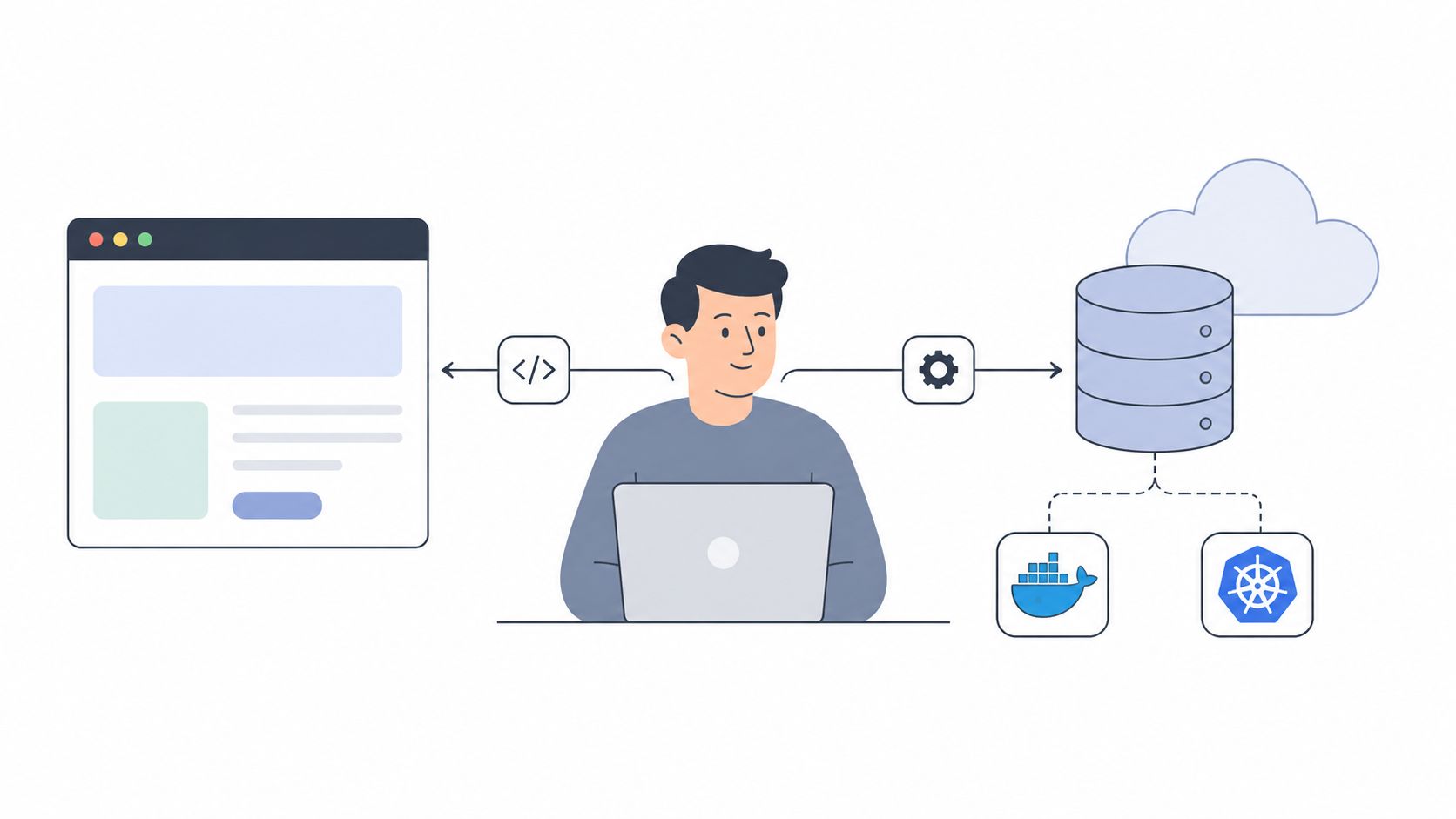
For startup hiring, words such as “versatile” and “adaptable” can help you find relevant profiles, but validate them with examples of changing priorities, incomplete specifications, and direct product delivery. A broad string discovers possibility. Work evidence determines whether the breadth is real.
Product language can surface engineers who connect implementation decisions to users and business outcomes. It can also produce some of the weakest Boolean results because phrases such as “fast-paced,” “impact,” and “dynamic” appear in generic profiles and job descriptions.
Start with a technical anchor:
("product-driven" OR "user impact" OR "metrics-driven") AND engineer
Then tighten it:
("product-driven" OR "user impact" OR "metrics-driven") AND (backend OR "full-stack" OR platform)
For early-stage experience, try:
startup AND ("fast-paced" OR "early stage" OR founder) AND (technical OR engineer)
A shipping-oriented query is useful for product engineers:
(impact OR shipping OR MVP) AND (agile OR fast OR dynamic) AND engineer NOT corporate
The final exclusion can be too aggressive. Large companies contain product-minded engineers, and the word “corporate” may appear in a candidate's description without reflecting their actual working style. Use it only if the results show a clear, recurring noise pattern.
Search for concrete product indicators such as ARR, retention, conversion, experimentation, user feedback, roadmap, or launch. These terms can identify engineers who discuss outcomes, but a metric mention doesn't establish contribution. Ask what the candidate changed, how they measured it, and what technical trade-offs followed.
Founder and advisor experience can point to comfort with ambiguity, although it may also indicate limited time for hands-on engineering. Company names such as Stripe, Figma, and Notion can help locate product-first engineering backgrounds, but don't infer product judgment from the employer alone.
For a startup-specific hiring process, this guide to hiring software engineers can help connect search signals with role definition and evaluation.

X and personal websites may contain richer explanations of shipping decisions than LinkedIn, while resume databases often compress outcomes into short bullets. Search across platforms, but evaluate the same evidence consistently. “Product-minded” should mean the person can explain a user problem, a technical choice, and an observable result, not that they used the phrase in a summary.
Domain searches become valuable when the engineer must understand regulated workflows, specialized data, or operational constraints. They become counterproductive when recruiters add every industry synonym and competitor name before deciding which knowledge is necessary.
For fintech:
(fintech OR payments OR "financial services") AND (backend OR "full-stack") AND (Python OR Go)
For healthcare:
(healthcare OR clinical OR HIPAA) AND engineer AND (compliance OR regulation)
For commerce and logistics:
("e-commerce" OR marketplace OR "supply chain") AND (infrastructure OR DevOps OR backend)
For applied machine learning:
("machine learning" OR AI) AND ("computer vision" OR NLP) AND (startup OR scale)
Add compliance terms when the role needs them:
(fintech OR payments) AND (PCI-DSS OR SOC2 OR compliance) AND engineer
Healthcare searches may use HIPAA, clinical, and compliance vocabulary, while finance searches may benefit from PCI-DSS, SOC2, payments, settlement, or real-time transactions. These terms identify familiarity with a problem space, but they don't establish current regulatory knowledge. Confirm the candidate's direct involvement rather than treating a compliance keyword as a credential.
Review competitor profiles, relevant job descriptions, technical talks, and repository documentation to discover how practitioners describe the work. Include both business terms and technical terms. A fintech engineer may write “payment orchestration” rather than “financial services,” and a healthcare engineer may describe clinical workflows without mentioning HIPAA.
Competitor names can widen discovery, especially when a company has a known engineering pattern. Use them as discovery terms, then remove them if they create prestige bias or make the pool unnecessarily narrow. GitHub and X can reveal domain-specific projects and discussions that resume databases miss, while LinkedIn may provide clearer employment context.
A useful scenario is a compliance-automation startup hiring a backend engineer. Searching only Python and Go finds generalists. Adding payments, audit logs, PCI-DSS, and compliance automation creates a more relevant hypothesis, but the hiring team still needs to test system design, data handling, and judgment under changing requirements.
Don't require domain experience when the role can support learning. Domain fluency is valuable, but an unnecessarily strict AND group can hide engineers with strong technical foundations and adjacent experience.
Keyword matches tell you what someone claims to know. Proof-of-work searches help you find how they explain, build, maintain, or share that knowledge.
(portfolio OR Github OR "side project") AND engineer AND (backend OR "full-stack")
For open-source activity:
("open source" OR OSS OR "contributed to") AND (Python OR Go OR Rust) AND engineer
For technical communication:
(published OR speaker OR "technical blog" OR "wrote about") AND engineer NOT (recruiter OR recruiting)
For a more cautious certification search:
("course completed" OR certification) AND (AWS OR Kubernetes) AND engineer
A profile mention isn't enough. Check whether the GitHub account is the person's, whether repositories contain meaningful code, whether commits show sustained activity, and whether the project matches the role's technical requirements. A polished portfolio can demonstrate presentation skill without demonstrating production engineering, while a quiet repository can still contain valuable implementation work.
GitHub-oriented searches can include "github.com/" AND engineer, then narrow by language, location, repository topics, or project names. Search GitLab and personal websites as well. On resume databases, use portfolio, open source, technical blog, or publication terms because the actual URL may not be indexed consistently.
Look for learning journeys, not just finished projects. Documentation, issue discussions, design notes, tests, release history, and explanations of trade-offs can reveal more than a list of technologies. On X, search technology terms alongside open source, maintainer, demo, or a project name. X can surface current interests, but it can also overrepresent public posting rather than engineering depth.
Use this guide to hiring on GitHub when repository evidence is central to the role. The practical validation sequence is straightforward:
| Boolean String | Primary Focus | Core Features | Ideal for | Value / Pros | Limitations |
|---|---|---|---|---|---|
| Core Technical Stack Boolean String | Find engineers with exact tech stacks | Languages + frameworks, OR/NOT groups, DevOps terms, platform-tailored exclusions | Early-stage → Series A/B startups with defined architecture | Surfaces hands‑on stack matches, reduces false positives, works across LinkedIn/GitHub/ATS | Misses adaptable generalists, needs frequent updates, no depth signal |
| Experience Level and Seniority Boolean String | Target career stage & leadership readiness | Tenure indicators, seniority titles, leadership signals, junior exclusions | Startups building first leadership layer; Series B scaling teams | Shortens hiring time, finds mentors, captures career-transition candidates | Tenure ≠ quality, varying language across platforms, bias risk |
| Company Background and Exit Experience Boolean String | Leverage background at high-growth / exited companies | FAANG / high-growth company names, exit/acquisition keywords, startup labels | Series B / growth-stage startups needing scaling experience | Identifies scaling-proven engineers, signals technical rigor, possible investor mindset | Bias toward big-name pools, may miss strong smaller-company talent, not a guarantee of startup fit |
| Full-Stack and Cross-Functional Capability Boolean String | Find end-to-end builders who span domains | Frontend+backend+infra terms, full‑stack labels, CI/CD, DevOps keywords | Pre-Series A and lean Series A teams needing broad contributors | Reduces coordination, speeds MVP work, fits small teams with varied needs | May lack deep specialization, "full‑stack" term is diluted, risk of shallow expertise |
| Product Mindset and Startup Culture Boolean String | Identify engineers with product thinking & entrepreneurial fit | Product‑oriented language, startup culture keywords, founder/advisor signals | Early-stage product-first startups; Series A prioritizing velocity | Predicts retention, lowers management overhead, aligns engineering with metrics | Language can be performative, may over-weight communication vs. technical depth |
| Specific Problem Domain and Industry Boolean String | Target domain expertise (fintech, healthcare, e‑comm, etc.) | Stack + industry terms, regulatory/compliance vocab, competitor company names | Regulated or vertical startups (fintech, healthcare), Series A/B scaling by domain | Faster ramp, addresses compliance needs, deep customer-context understanding | Smaller, competitive candidate pool; may exclude fast learners without domain history |
| Portfolio and Proof of Work Boolean String | Surface candidates with demonstrable projects & OSS | Portfolio/GitHub indicators, side‑projects, publications, demos, certifications | Teams valuing visible output, remote hiring, non‑traditional backgrounds | Shows real capability, reduces hiring uncertainty, uncovers underemployed talent | Many skilled engineers lack public portfolios; may favor marketing skills over current ability |
A Boolean string should produce a reviewable set of hypotheses, not an automatic shortlist. Start with one signal, such as backend stack or proof of work, and run a broad version before adding seniority, location, domain, or exclusions. Inspect the first results for false positives. If Java appears in unrelated profiles, tighten the technical group. If strong engineers disappear after adding a seniority phrase, restore the broader version and validate progression manually.
Platform comparison matters because the same engineer leaves different traces in different places. LinkedIn may show titles, employers, and scope. GitHub may show languages, repositories, maintainership, and technical documentation. Resume databases may provide fuller project descriptions. X can reveal current interests, public problem-solving, and links to personal work. A string that works on LinkedIn won't automatically transfer to Google, GitHub, or an ATS because search scope and syntax differ.
Document the search that produced each lead. Record the platform, version of the string, date, signal sought, and reason the person appeared relevant. This makes sourcing more reproducible and helps the team identify which terms create unnecessary bias. Remove exclusions that eliminate valid candidates, and avoid using employer prestige, public activity, or exact title as a substitute for technical evaluation.
The labor market makes precision useful. ManpowerGroup's 2026 Global Talent Shortage Survey covered 39,000 employers across 41 countries and found that 72% of employers reported difficulty filling roles. The same verified summary notes that AI skills had overtaken engineering and traditional IT as the hardest capabilities to find globally. In that environment, Boolean search helps recruiters focus scarce attention, but it doesn't solve discovery gaps on its own.
Boolean sourcing has a durable role because LinkedIn Recruiter and structured databases explicitly support operators, while exact titles, alternate titles, and technology combinations remain useful search signals. The historical logic comes from George Boole's work, which recruitment has adapted into a practical sourcing method for decades. Still, the best string isn't the longest one. A recent recruiting guide recommends using 4–6 title variations and 2–3 core languages, a useful reminder that excessive synonyms can create diminishing returns. See this Boolean search guide for technical recruitment for the reasoning behind iterative narrowing.
Validate technical depth through work evidence and conversation. Ask what the engineer owned, what changed because of their work, how they handled trade-offs, and which parts they would build differently. A curated, candidate-centric marketplace such as Underdog.io can also complement keyword sourcing when a startup needs qualified engineering talent beyond profile matching. Its marketplace focuses on startups and high-growth technology companies, and its matching process adds human review to candidate discovery.
The final shortlist should be explainable. Each person should be there because their evidence aligns with the role, not because a long query happened to retrieve their profile.
Underdog.io connects software engineers with curated startup and high-growth tech opportunities across New York City, San Francisco, and the US through a single application. If you want a candidate-centric alternative to relying only on Boolean matches, visit Underdog.io and explore how its human-powered matching can support your engineering search.