Finding the right tech job can feel like sending your resume into a black hole. You spend hours tailoring your application, only to receive an automated rejection or, worse, complete silence. The problem isn't a lack of talent on your part; it's often the platform you're using. Generic, high-volume job boards are built for quantity over quality, leaving talented candidates like software engineers, product managers, and designers lost in the noise. This is especially true when targeting competitive roles at high-growth startups in hubs like NYC, San Francisco, or fully remote positions.
This guide cuts through that noise. We’ve curated a comprehensive list of the best tech job boards specifically designed to connect skilled professionals with innovative companies. Instead of just listing names, we provide a practical, comparative analysis to help you choose the right platform for your specific career goals. For each job board, you’ll find a detailed breakdown, including:
Who it’s for: The ideal candidate profile, from junior engineers to senior product leaders.
Pros and cons: A balanced look at what each platform does well and where it falls short.
Actionable application Tips: Specific strategies to optimize your profile and stand out to hiring managers.
When to use it vs. Underdog.io: A direct comparison to help you decide which platform is better suited for your immediate needs.
Each entry includes screenshots for visual context and direct links, so you can stop scrolling endlessly and start making strategic moves in your job search. This isn't just another list; it's a playbook for finding a tech job that respects your time and values your skills.
1. Underdog.io
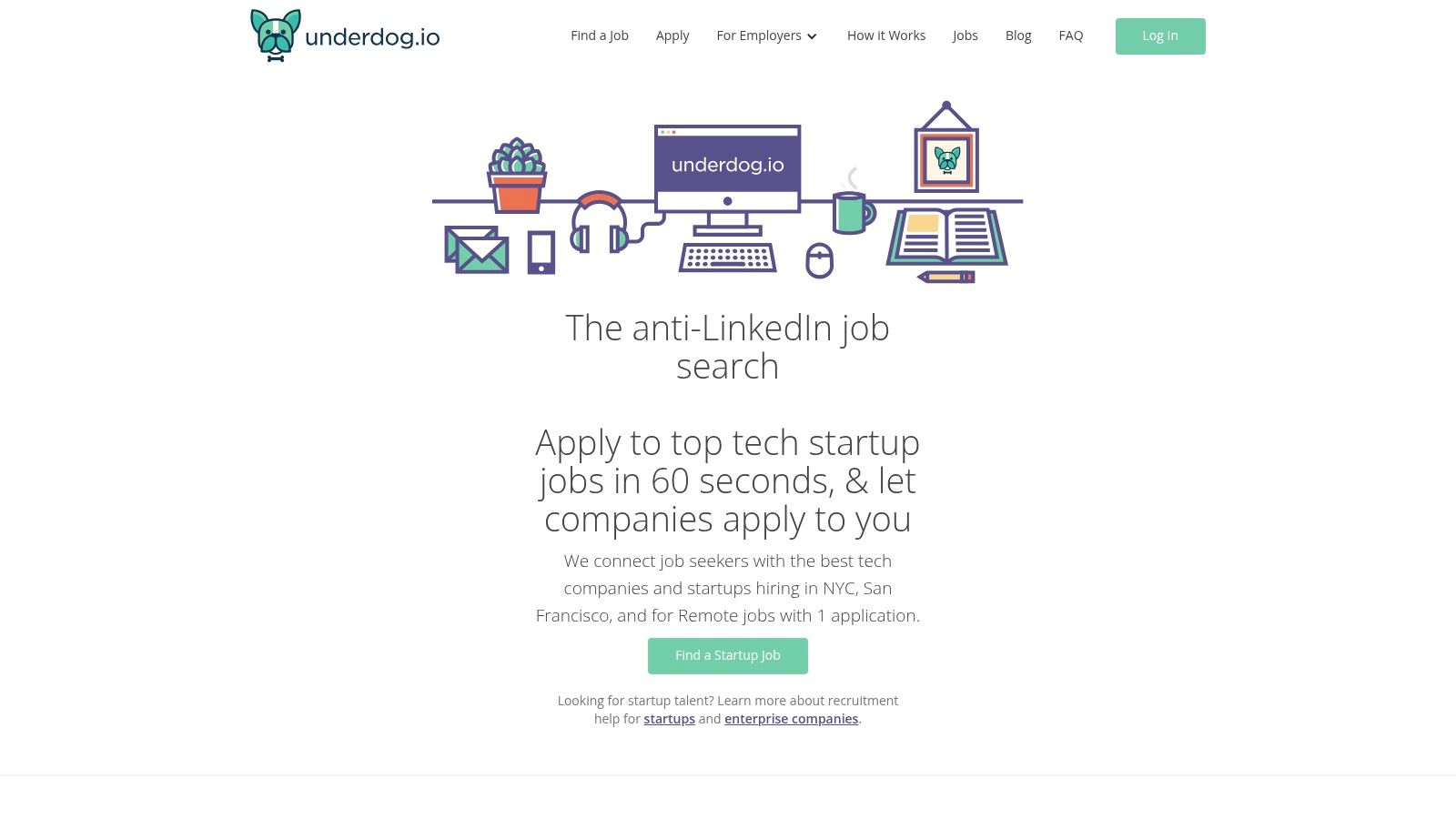
Underdog.io flips the traditional job board model on its head. Instead of having candidates browse and apply to endless public listings, it functions as a curated, invite-only marketplace. Candidates submit a single, 60-second application and, if accepted, are featured in weekly batches sent directly to a vetted network of high-growth startups and tech companies primarily in major U.S. hubs and remote-first environments.
This model is designed for a discreet, high-signal job search, connecting you directly with founders and hiring managers. The human curation on both sides of the marketplace, for candidates and companies, ensures that the introductions are relevant and valuable, saving everyone time.
This "reverse-marketplace" model is built on a foundation of extreme selectivity. Both candidates and companies are manually vetted, ensuring a high signal-to-noise ratio. For candidates, this means a single, confidential 60-second application can lead to direct introductions from founders and hiring managers at compelling early-stage to Series B companies. This approach makes it one of the best tech job boards for those tired of the "resume black hole" and seeking roles with significant equity and impact potential.
Who It’s For
Underdog.io is ideal for experienced tech professionals who are either actively or passively exploring the startup ecosystem. Its core audience includes software engineers, product managers, designers, and data scientists primarily interested in roles in New York City, San Francisco, or remote-first companies. Because roughly 85% of its talent pool is currently employed, it's a prime destination for passive candidates who value privacy and targeted opportunities over broad, public job searches.
Feature Comparison
Underdog.io
Traditional Job Boards (e.g., LinkedIn, Indeed)
Application Process
✓
One 60-second application for all opportunities
•
Apply individually to each job posting
Curation Method
✓
Human-reviewed and manually matched
•
Primarily algorithmic keyword matching
Candidate Anonymity
✓
Profile is anonymous until mutual interest
•
Public profile or visible application history
Primary Company Type
✓
Vetted, high-growth startups (early-stage to B)
•
Broad range, from small businesses to large enterprises
Cost for Job Seeker
✓
Free
•
Free
Signal-to-Noise Ratio
✓
Very High
•
Low to Moderate
Key Features & Advantages
Underdog.io's model provides several strategic benefits that set it apart:
Founder-Level Access: The platform facilitates direct connections to decision-makers, bypassing initial HR screens and getting your profile in front of founders and hiring managers. This is invaluable at the startup stage, where culture fit and direct team dynamics are critical.
Human-Powered Curation: Unlike platforms that rely solely on keyword matching, Underdog uses a human review process for both candidates and companies. This manual vetting (with a reported ~5% candidate acceptance rate) ensures that the matches you receive are relevant, high-quality, and aligned with your skills and career goals.
Confidentiality and Speed: Your profile remains anonymous until you express mutual interest in a company. The entire process is streamlined, with a single application serving for all potential matches, saving you hundreds of hours typically spent on customizing resumes and cover letters.
Aligned Incentives: The platform is completely free for job seekers. Employers pay success-based or recruiting fees, which means Underdog is financially motivated to facilitate successful, long-term hires, not just generate application volume.
How to Get the Most Out of Underdog.io
Lead with Your Impact: In your 60-second application, focus on tangible achievements. Instead of listing job duties like "developed new features," quantify your impact: "Led the development of a new feature that increased user retention by 15% in Q3."
Highlight Your Startup Fit: Emphasize experiences that show you thrive in fast-paced environments. Mention working in small teams, owning projects from end-to-end, or contributing to product strategy. This signals to founders that you understand the startup mindset.
Be Patient and Selective: Don't expect a flood of inquiries. The model is built on quality over quantity, so receiving 1-3 highly curated introductions per month is standard. Carefully review each one, as they have been specifically selected for you.
Human-Curated Batches: Your profile isn't just thrown into a searchable database. It's manually reviewed and included in a curated batch of talent sent to hiring partners, ensuring you get noticed.
Pros and Cons
Pros
Cons
✅
High Signal, Low Noise
Vetted companies and candidates lead to better matches.
❌
Highly Selective
Not all applicants are accepted into the marketplace.
✅
Candidate Privacy
Excellent controls for a discreet job search.
❌
Startup-Heavy
Fewer opportunities at large, established enterprise companies.
✅
Free for Candidates
The platform is entirely free for job seekers.
❌
Less Control
You can't proactively browse or apply to specific jobs.
For more insights into navigating the job market, you can see how Underdog.io's team analyzes the landscape of the best websites for tech jobs and what makes each platform unique. This curated approach provides a distinct advantage for candidates who want to cut through the noise and find their next significant role in the tech world.
2. Wellfound (formerly AngelList Talent)
Wellfound, which built its reputation as AngelList Talent, is one of the original and largest startup-focused job platforms in the world. It provides a massive, searchable database of roles at companies ranging from early-stage ventures to established tech giants. The platform is built on a foundation of transparency, often displaying salary and equity information upfront.
Unlike curated marketplaces, Wellfound gives candidates full control to browse, filter, and apply to over 150,000 active tech jobs. It’s designed to facilitate direct connections, often allowing you to message founders and hiring managers directly, cutting through the red tape of traditional application processes.
Who is Wellfound For?
Wellfound is ideal for tech professionals at all career levels, from recent graduates to senior leaders, who want to actively drive their job search in the startup ecosystem. It's particularly powerful for candidates who value compensation transparency and want to explore a high volume of opportunities in major tech hubs and remote-first companies. If you prefer to be in the driver's seat of your search, Wellfound is an essential tool.
Unique Features & Differentiators
Wellfound’s key differentiator among the best tech job boards is its unparalleled transparency and scale within the startup world.
Upfront Salary & Equity: The platform culture strongly encourages companies to post compensation ranges. When they don't, Wellfound often provides a realistic estimate, empowering you to make informed decisions before you apply.
Massive Startup Inventory: With tens of thousands of startups actively hiring, its volume is nearly unmatched in the niche. You can find roles at companies of every stage, from two-person seed startups to late-stage, pre-IPO unicorns.
Direct Access: Many listings allow you to apply with one click and initiate a direct conversation with the hiring team, bypassing generic HR inboxes and automated screening systems.
Actionable Tips for Success
To stand out in Wellfound's vast marketplace, a proactive and well-crafted approach is key.
Build a Comprehensive Profile: Your Wellfound profile is your resume. Fill out every section, including your projects, skills, and a compelling summary. Link to your GitHub, portfolio, or personal website to provide concrete proof of your work.
Use Filters Strategically: Don't just search for "Software Engineer." Use advanced filters for company size, funding stage, tech stack, and keywords like "Series A" or "FinTech" to narrow down the 150,000+ jobs to the most relevant ones. For example, a search could be: "Senior Backend Engineer" + "Remote (US)" + "Series B" + "Healthcare".
Craft a Personalized Introduction: When you apply, you often have a chance to write a brief note. Use this space. Mention something specific about the company or product that excites you. For example, "I'm a big fan of your new API documentation; my experience building developer tools at [Previous Company] aligns directly with this role."
Pros and Cons
Pros
Cons
✅
Exceptional Transparency
Salary and equity data are a core feature.
❌
Variable Quality
With so many listings, the quality and responsiveness can vary.
✅
Huge Volume of Jobs
Massive inventory of startup and tech roles.
❌
Less Curation
You are responsible for vetting companies and opportunities yourself.
✅
Direct Founder Access
Cuts through layers of recruiters and HR.
❌
High Competition
Popular roles can receive a large volume of applications.
Wellfound is completely free for candidates to use. Companies can post jobs for free or subscribe to premium recruiting tools like RecruiterCloud to source candidates more proactively. This makes it an indispensable, high-value platform for any tech job seeker.
Tired of Endless Scrolling on Job Boards?
Skip the noise of traditional boards. Underdog.io is a curated hiring marketplace where you create one profile, and we match you with opportunities at top tech startups. Get introduced directly to hiring managers.
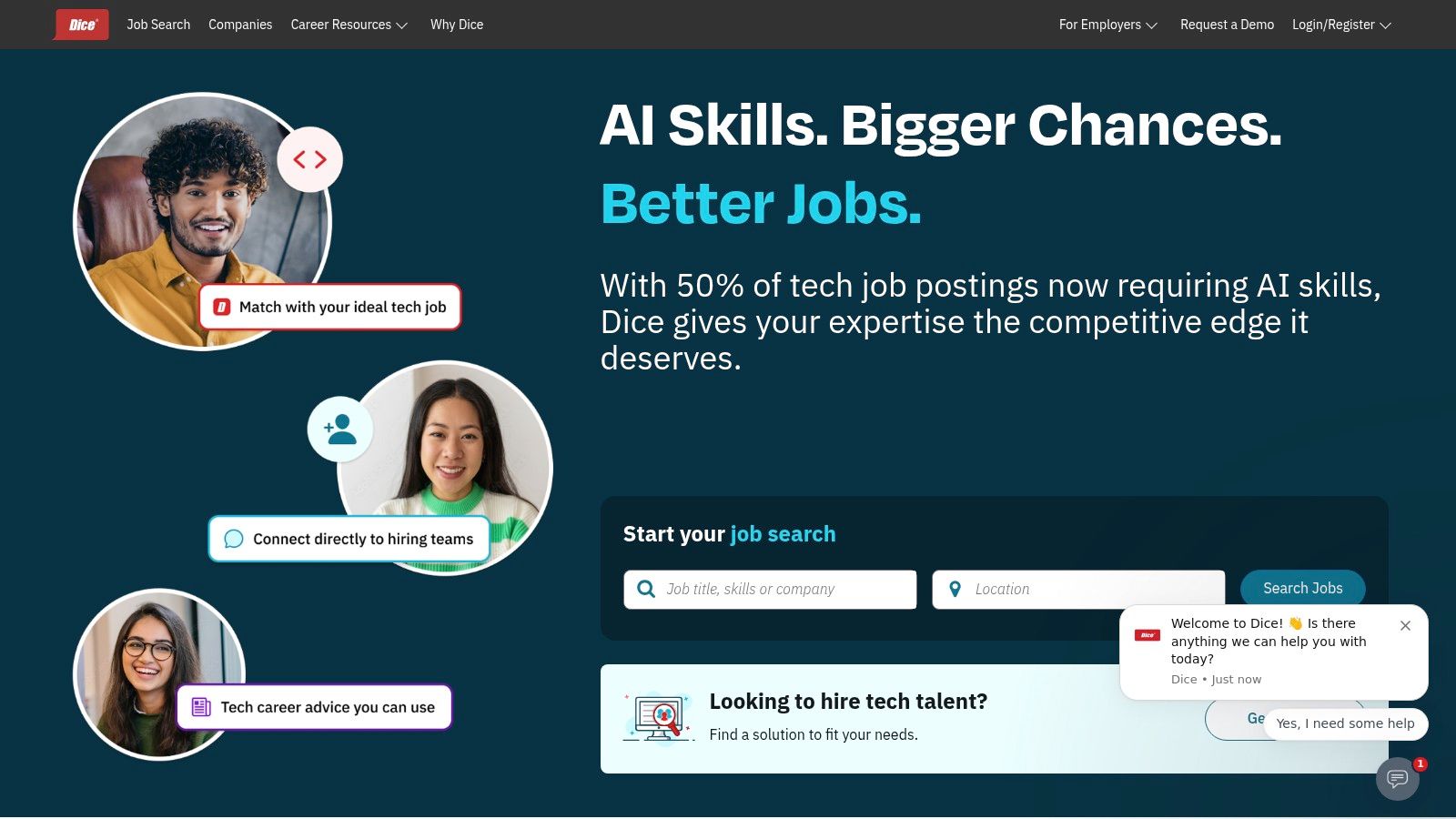
Dice has been a cornerstone of the tech recruiting world for decades, cementing its reputation as a vast and reliable resource specifically for technology professionals. Unlike generalist job boards that list roles across every industry, Dice maintains a singular focus on tech. This specialization means candidates spend less time filtering out irrelevant sales or marketing positions and more time discovering roles in software development, data science, cybersecurity, and IT infrastructure.
The platform functions as a traditional job board, allowing you to search, filter, and apply directly to a massive database of listings from a wide range of companies, from Fortune 500 giants to established tech firms. It has also recently invested heavily in its platform, adding AI-powered tools and features like "Easy Apply" to streamline the application process for candidates.
Who is Dice For?
Dice is ideal for a broad spectrum of U.S.-based tech professionals, from entry-level developers to senior IT managers. Its strength lies in its sheer volume and depth of roles across the entire tech ecosystem. If you are actively looking for a new role and want to cast a wide net across different company sizes and sectors, Dice is an indispensable tool. It's particularly strong for roles requiring specific, established tech stacks (like Java, .NET, or SQL) and for cleared government or contracting positions.
Unique Features & Differentiators
While it operates on a traditional model, Dice's commitment to tech-specific innovation helps it stand out as one of the best tech job boards available.
Tech-Focused Search Filters: The search functionality is built for technologists. You can filter by highly specific skills, security clearance levels, remote work options, and employment types far more effectively than on a generalist site.
AI-Powered Enhancements: Dice has integrated AI to improve the experience for both sides. For recruiters, this includes tools to generate better job descriptions or enhance search strings. For candidates, this translates to more relevant job recommendations and a better chance of being discovered for the right role.
"Easy Apply" Integrations: A growing number of listings feature an "Easy Apply" option, which significantly cuts down on the time it takes to submit applications by pre-filling information from your Dice profile, helping you apply to more relevant jobs faster.
Actionable Tips for Success
To get the most out of Dice, you need to actively manage your profile and search strategy.
Optimize Your Profile with Keywords: Recruiters on Dice live and die by keyword searches. Scour job descriptions for roles you want and ensure those exact skills, programming languages, and certifications are listed in your profile and resume. For instance, if you're a cloud engineer, list AWS, Azure, GCP, Terraform, and Kubernetes explicitly.
Set Up Personalized Job Alerts: Don't just search passively. Create several specific job alerts for different role titles and skill combinations. For example, create one for "Remote Senior Python Developer" and another for "Lead Data Engineer." This ensures you see relevant roles as soon as they are posted.
Keep Your Profile Visible and Updated: Set your profile visibility to "Visible" so recruiters can find you. Refresh your resume upload every few weeks. This activity can sometimes bump your profile higher in recruiter search results, signaling you are an active candidate.
Pros and Cons
Pros
Cons
✅
Huge Volume of Tech Roles
Deep database of U.S. tech jobs, reducing non-tech clutter.
❌
Variable Role Quality
Interface and job quality can differ greatly depending on the employer.
✅
Powerful Search & Filters
Excellent, tech-specific filtering capabilities.
❌
Less Startup-Focused
Not as strong for very early-stage or stealth-mode startups.
✅
Steady Platform Improvements
Ongoing investment in AI tools and the candidate experience.
❌
Recruiter-Centric Features
Some of the best tools are designed for recruiters, not candidates.
Dice is completely free for job seekers. You can create a profile, upload your resume, and apply to an unlimited number of jobs without any cost. Companies and recruiting agencies pay to post jobs and access the resume database.
You can learn more and start searching at dice.com.
4. Built In
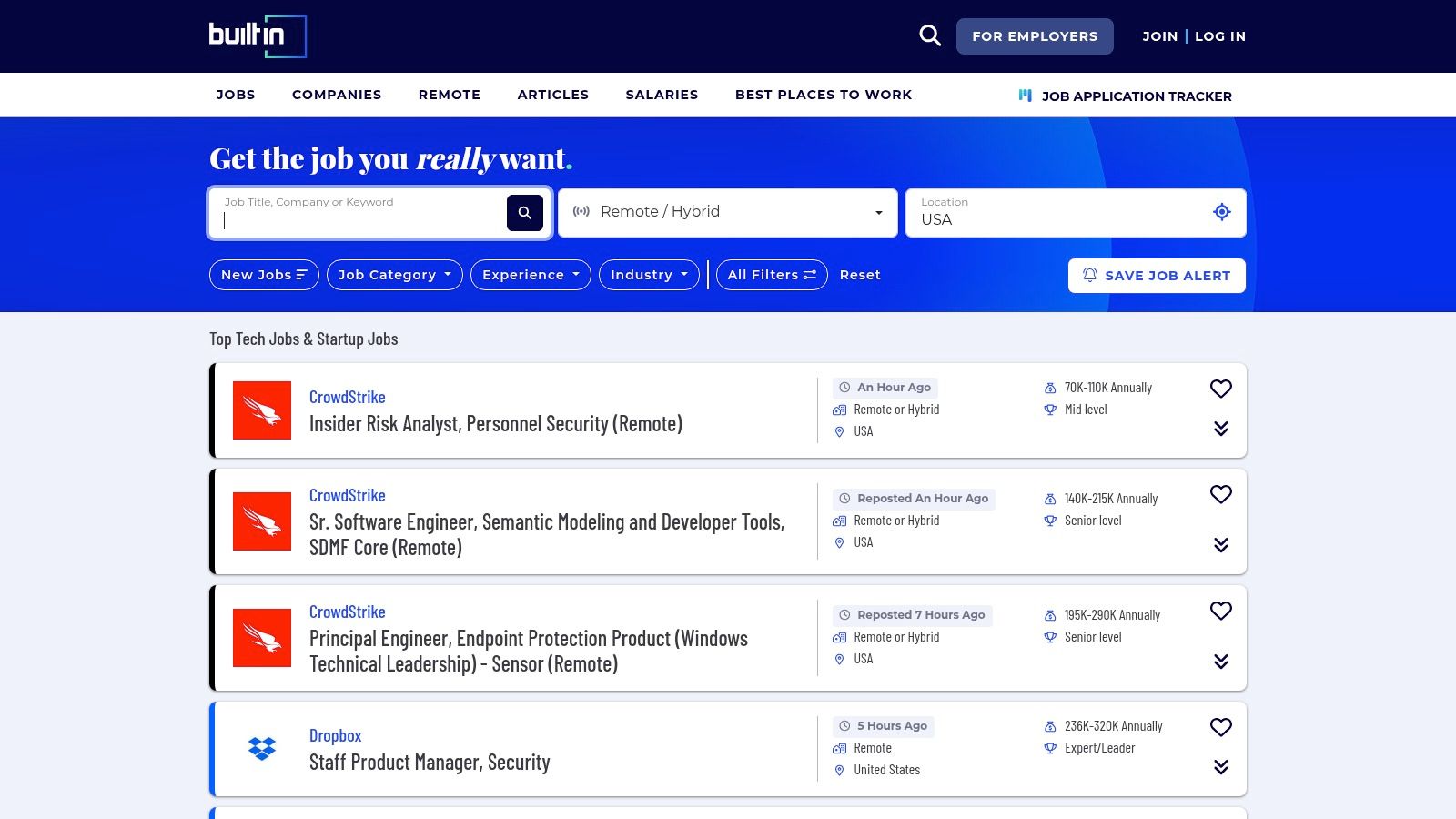
Built In has evolved from a series of city-specific tech blogs into a comprehensive national job board and employer branding platform. It connects tech professionals with companies in major U.S. hubs and remote-first environments, functioning as both a job discovery tool and a research hub for company culture, benefits, and technology stacks.
The platform's strength lies in its rich company profiles and editorial content, which provide a deeper look into what it’s like to work at a particular company. This context makes Built In one of the best tech job boards for candidates who want to understand a company's DNA before they apply, moving beyond simple job descriptions.
Who is Built In For?
Built In is ideal for tech professionals at all levels who are targeting specific U.S. tech ecosystems like Austin, Chicago, NYC, or are looking for fully remote roles. It serves engineers, marketers, salespeople, and product managers who value transparency and want detailed information about potential employers, including their tech stack, benefits, and DEI initiatives. It’s also a great resource for those passively looking, as its content keeps them informed about the local tech scene.
Unique Features & Differentiators
What distinguishes Built In is its combination of a robust job board with rich employer branding content. While other sites list jobs, Built In tells the stories behind the companies.
In-Depth Company Profiles: Go beyond the job post. Learn about a company’s mission, office life, interview process, and even see the technologies they use (e.g., AWS, Python, React) before you apply.
Hyper-Local and Remote Focus: The platform is organized around major tech hubs, providing a localized feel, while also featuring one of the strongest remote job filters available.
Content-Driven Discovery: You might discover a new company not through a job listing, but by reading an article about its engineering culture or a roundup of the best perks it offers.
Actionable Tips for Success
To get the most out of Built In, leverage its dual function as a research tool and a job board.
Filter with Precision: Use the advanced filters to narrow your search not just by role and location, but also by company size, industry, and even specific tech stacks. This helps you find companies that are a perfect technical fit.
Use Company Profiles for Your Cover Letter: When you find a role you like, read the company's Built In profile. Mentioning a specific company value or a recent project highlighted in their profile can make your application stand out. For example, "I was inspired by your recent feature on employee-led innovation and believe my experience in agile project management aligns perfectly with that value."
Set Up Personalized Alerts: Create and save multiple job alerts for different criteria (e.g., "Remote Senior React Engineer," "Product Manager in Boston"). Built In’s alert system is effective at surfacing newly posted roles that match your specific needs.
Pros and Cons
Pros
Cons
✅
Rich Employer Data
Detailed profiles offer deep insights into company culture and tech stacks.
❌
Inconsistent Job Details
Some listings are aggregated and may lack detail unless the employer pays for a premium post.
✅
Strong Geographic and Remote Filters
Excellent for targeting specific U.S. cities or finding fully remote work.
❌
Varying Startup Depth
While it features many startups, it's not as concentrated as platforms dedicated solely to the early-stage ecosystem.
✅
Free for Candidates
Job seekers can browse and apply for free.
❌
U.S. Centric
Primarily focused on the United States, offering limited opportunities for international job seekers.
Built In is completely free for job seekers. Companies pay to post jobs and enhance their employer profiles. For those wanting to compare it against other platforms, you can find helpful information about a top Built In alternative.
LinkedIn Jobs leverages the world's largest professional network, transforming it into a vast and dynamic job marketplace. Unlike niche boards, its strength lies in its sheer scale and integration with your professional identity, making it an indispensable tool for both active and passive job seekers. You can browse millions of listings, receive alerts for saved searches, and directly engage with recruiters who are actively sourcing on the platform.
The platform is a comprehensive ecosystem for career management. Beyond just applying, you can research companies, connect with employees, and showcase your expertise through your profile and content. Recent additions, like AI-powered search for Premium members, allow for more natural and intuitive job discovery, moving beyond simple keyword matching.
Who is LinkedIn Jobs For?
LinkedIn Jobs is universally useful for almost every tech professional, from new graduates to seasoned executives. It is particularly effective for those who want to cast a wide net, explore opportunities across all company sizes (from early-stage startups to FAANG), and leverage their professional network. If you want to be found by recruiters or quickly apply to a high volume of roles, LinkedIn is the go-to platform.
Unique Features & Differentiators
What makes LinkedIn a cornerstone among the best tech job boards is its unmatched network integration and recruiter access.
Network Leverage: You can see how you're connected to a company through 1st, 2nd, and 3rd-degree connections, providing an immediate path for warm introductions or insider information.
Recruiter InMail: LinkedIn is the primary hunting ground for corporate and agency recruiters. Having an optimized profile makes you a searchable target for unadvertised roles.
Easy Apply & Skill Assessments: The "Easy Apply" feature streamlines applications, while LinkedIn Skill Assessments allow you to verify your expertise and earn a badge for your profile, helping you stand out.
Actionable Tips for Success
To get the most out of LinkedIn, you need to treat your profile as a living document and engage strategically.
Optimize for Search: Recruiters use keywords. Ensure your headline and "About" section are rich with the technologies, skills, and job titles you're targeting (e.g., "Senior Software Engineer - Python, AWS, FinTech").
Turn on "Open to Work": Use the feature that discreetly signals to recruiters that you're open to new opportunities. You can control its visibility to prevent your current employer from seeing it. This simple toggle significantly increases the inbound messages you'll receive from recruiters.
Use AI Search Prompts (Premium): Instead of just typing "Product Manager," try a natural language search like "Find remote product manager roles at series B startups under 200 employees that use Figma." This yields highly specific results.
Pros and Cons
Pros
Cons
✅
Unmatched Scale
The largest volume of tech jobs and recruiter activity.
❌
High Noise and Competition
Your application can easily get lost in the crowd.
✅
Powerful Networking Tools
Easily find and connect with insiders at target companies.
❌
"Easy Apply" Black Hole
Many "Easy Apply" jobs receive thousands of applications.
✅
Rich Company Insights
Access to data on company growth, employee trends, and more.
❌
Premium Subscription Needed
Some of the most powerful features are behind a paywall.
LinkedIn Jobs is free for candidates to use. However, a LinkedIn Premium subscription (starting around $29.99/month) unlocks features like InMail credits, advanced job insights, and enhanced AI search capabilities, which can significantly speed up your search.
Your Next Move: Choosing the Right Job Search Strategy
Navigating the crowded landscape of tech job boards can feel overwhelming, but with the right strategy, you can transform your search from a stressful grind into a targeted, efficient journey. We've explored some of the best tech job boards available, from the curated, white-glove experience of Underdog.io and Hired to the startup-centric ecosystem of Wellfound and the expansive, industry-specific databases of Dice, Built In, and LinkedIn. Each platform offers a unique set of tools, community features, and access to different types of opportunities.
The key takeaway is that there is no single "best" platform; the ideal choice depends entirely on your specific career goals, experience level, and what you value most in a job search. Your task now is to move from analysis to action.
Crafting Your Multi-Platform Approach
Relying on a single job board is like fishing with only one type of lure. To maximize your chances of landing the perfect role, a multi-platform strategy is essential. This doesn’t mean creating a profile on every site and blasting out hundreds of generic applications. Instead, it means being intentional about how you use each tool.
Consider this practical approach:
For Curated, High-Intent Opportunities: Start with a platform like Underdog.io. Dedicate time to crafting a standout profile because this is where quality over quantity truly matters. These platforms put you directly in front of hiring managers at top-tier startups and tech companies who are actively looking for candidates with your skillset. This is your "A-list" application strategy.
For Startup Ecosystem Immersion: Simultaneously, build a presence on Wellfound. Use it not just to apply for jobs, but to research early-stage startups, follow founders, and understand market trends. This platform is invaluable for finding ground-floor opportunities where you can make a significant impact.
For Niche and Location-Specific Roles: Use Built In to zero in on specific tech hubs like NYC, SF, or Chicago. If you’re targeting a particular city, Built In’s localized content and company lists provide an unmatched level of detail. It’s the perfect tool for a geographically focused search.
For Broad Market Coverage and Networking: Maintain an updated and active LinkedIn profile. Use its powerful search filters and networking capabilities to supplement your active applications. Treat LinkedIn as your professional home base, a place for passive discovery and connecting with recruiters.
Aligning Your Strategy with Your Goals
To help you decide where to focus your energy first, ask yourself a few critical questions:
What is my primary goal? Am I urgently seeking a new role, or am I casually exploring the market? Platforms like Underdog.io are designed for active, high-intent job seekers, while LinkedIn can be effective for passive browsing.
What kind of company culture am I looking for? If you thrive in fast-paced, high-growth environments, Wellfound and Built In are your go-to resources for startup roles. For more established or enterprise-level positions, Dice and LinkedIn Jobs often have more extensive listings.
How much time can I invest? If your time is limited, focus on curated platforms that bring opportunities to you. This minimizes the time spent searching and maximizes the time spent interviewing.
Understanding the hiring process from the other side can also give you a significant advantage. To truly optimize your job search on tech job boards, it's beneficial to understand the employer's perspective, including their specific challenges and priorities. For those interested in remote work, you can gain valuable insights by reviewing expert tips for hiring remote software developers to see what hiring managers are looking for.
Ultimately, the best tech job boards are the ones that align with your personal and professional needs. By combining the strengths of these different platforms, you create a robust, multi-channel job search strategy that puts you in control. Your next great opportunity is out there; now you have the map to find it.
Ready to skip the endless searching and connect directly with innovative companies? Underdog.io takes the noise out of the job hunt by curating the best tech opportunities and delivering them straight to you. Create your free profile in minutes and let top startups and tech firms apply to you.
FAQ
What makes a tech job board different from a general one like Indeed? Tech-specific job boards are curated for the industry, meaning they attract listings from companies actively seeking technical talent. They often have better filters for specific programming languages, frameworks (like React or Node.js), and role types (e.g., "backend" or "machine learning"), saving you from sifting through irrelevant postings.
Are niche job boards worth using, or should I stick to the big names? Niche boards can be incredibly valuable. While large platforms have volume, niche boards focused on startups, remote work, or specific tech stacks (like Python or blockchain) often have higher-quality, more relevant listings and can connect you directly with hiring managers or founders in that community.
How can I make my application stand out when applying through a job board? Tailor your resume for each application by using keywords from the job description. When possible, use the platform's features to your advantage—some boards allow you to add a video intro or link to your portfolio directly on your profile. A short, personalized note to a recruiter or hiring manager can also make a big difference.
What should I look for in a job board if I want a remote position? Look for boards that specialize in or have strong filters for remote work. Check if they distinguish between "remote anywhere" and "remote within a region." The best remote job boards also vet companies to ensure they have proper remote infrastructure and culture.
Are there any completely free job boards for tech professionals worth using? Yes, many excellent platforms are free for job seekers. Platforms like Wellfound (AngelList Talent) for startups, GitHub Jobs for developers, and specialized community boards often provide free access to high-quality listings. The business model typically charges employers to post, not candidates to apply.
What is the main advantage of using a curated platform like Underdog.io? Curated platforms focus on quality over quantity. They screen both companies and candidates, which reduces noise and spam applications. For job seekers, this often means a more efficient process—like submitting one profile to be matched with multiple vetted companies—and direct access to decision-makers at high-growth startups.
Our biweekly curated tech and recruiting newsletter.
Thank you. You've been added to the Ruff Notes list.
Oops! Something went wrong while submitting the form.
Looking for a startup job?
Our single 60-second job application can connect you with hiring managers at the best startups and tech companies hiring in NYC, San Francisco and remote. They need your talent, and it's totally 100% free.