A typical business intelligence analyst salary in 2026 starts around $65,000 for entry-level roles and can climb to $113,000 and beyond for senior positions. But your total compensation isn't just a single number; it’s a dynamic figure shaped by your years of experience, where you’re located, and the kind of company you join.
Think of a BI analyst's salary as a story with multiple chapters. It starts with your foundational skills and grows as you deliver more strategic value to the business. To really get a handle on your earning potential, you first need to understand the field itself. At its core, Business Intelligence is all about using data to help organizations make smarter decisions, and your pay directly reflects how well you enable that process.
Your career stage is the biggest factor here. An analyst just starting out will likely focus on building reports and dashboards. A senior analyst, on the other hand, is deep in the weeds of high-level business strategy. This natural progression in responsibility creates a clear and rewarding path for salary growth.
As you move through your BI career, you'll see your compensation grow significantly. Entry-level analysts can expect to start somewhere between $63,676 and $90,273 annually, but that number climbs quickly. On average, an analyst with under a year of experience earns about $65,489, which jumps to roughly $84,709 for mid-level professionals. That’s a pretty solid bump, and it shows just how fast hands-on experience becomes valuable.
The real money comes with expertise. Senior BI analysts can expect to earn between $94,917 and $113,295, which represents a potential 79% salary increase from where they started. This growth reflects the premium companies are willing to pay for analysts who can navigate complex data and genuinely drive strategic decisions.
Here's a quick look at how those numbers break down across different career stages.
This table provides a snapshot of average total compensation for BI analysts at different stages of their careers, helping you quickly assess where you stand.
As you can see, the path from an entry-level position to a senior role offers substantial financial growth, rewarding the deep expertise gained over time.
The chart below gives you a clean visual of the average salary progression for a BI analyst at these key milestones.

This visual breakdown shows a clear upward trend, with major pay bumps between the entry, mid-level, and senior stages of a BI career. As you get ready to benchmark your own worth, be sure to check out how other tech roles stack up in our 2025 Tech Salary Guide.
Your salary isn't a static number; it’s a reflection of your evolving value. Think of your career like a video game character—as you gain experience, conquer new challenges, and master new skills, you "level up." For a business intelligence analyst, this means your earning potential grows with every project you nail, every tool you master, and every strategic insight you deliver.
This path is fairly predictable, and that’s a good thing. As you transition from executing basic tasks to driving high-level strategy, your impact on the company’s bottom line becomes undeniable. Your compensation package grows to match that impact. Let's break down exactly how this progression plays out.
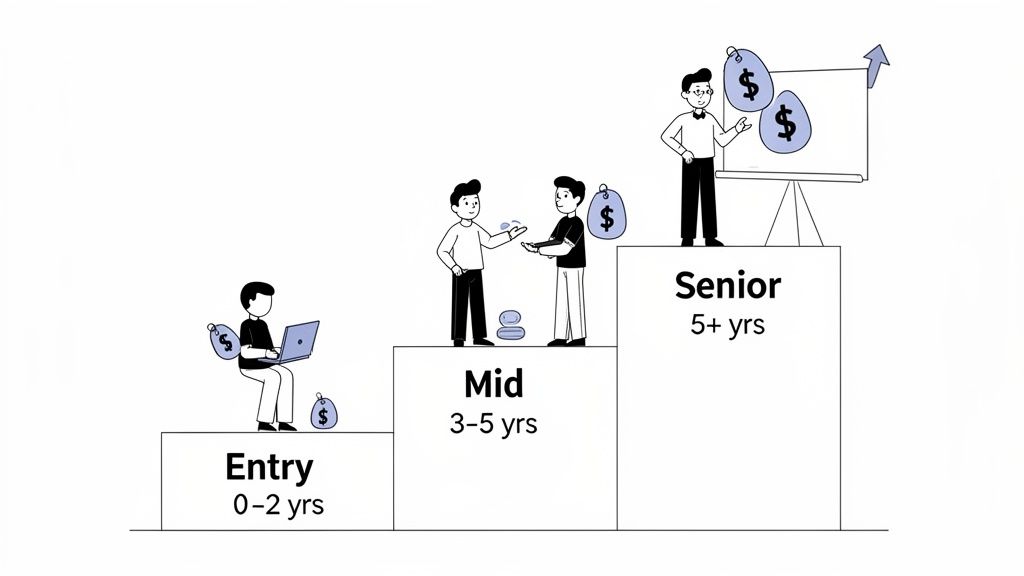
In your first couple of years, you are the foundation builder of the BI world. The job is all about mastering the fundamentals. You’ll spend most of your time deep in the company’s data architecture, building dashboards in tools like Tableau or Power BI, and pulling reports to answer very specific questions from various teams.
For example, a marketing manager might ask, "Can you build a dashboard that tracks our weekly lead generation by channel?" Your job is to translate that request into a functional and accurate report.
Your core responsibilities are centered on execution:
At this stage, your value is measured by your ability to get well-defined tasks done accurately and on time. While the salary is foundational, this period is a critical investment in skills that will pay off for the rest of your career.
With a few years under your belt, you’re no longer just following a checklist. You're starting to see the bigger picture. A mid-level analyst goes beyond just building reports and starts wrestling with more complex, ambiguous business problems. You're not just answering "what happened?" anymore—you're digging deep to figure out why it happened.
This is where you’ll see a significant jump in your business intelligence analyst salary. Your role is becoming more proactive and, frankly, more influential.
Practical Example: The VP of Sales asks why the West Coast region missed its quarterly target. Instead of just pulling sales numbers, you dig into CRM data, marketing campaign results, and even regional economic indicators. You discover that a competitor's recent product launch in that region heavily impacted lead conversion rates. You present this analysis with a recommendation for a targeted counter-promotion.
You'll find yourself taking ownership of projects from start to finish, working closely with different departments, and maybe even helping mentor the new hires. Your ability to turn a vague question into a concrete, data-backed recommendation is what sets you apart—and justifies the bigger paycheck.
After more than five years, a senior or lead BI analyst is playing a different game entirely. You’re operating at a strategic level. You’ve moved on from building individual dashboards to designing entire analytics frameworks that the whole company relies on. Your work now directly informs major business decisions, like which new markets to enter or which product features to build next.
At this point, your technical skills are a given. Your true value comes from your deep understanding of the business and your ability to be a trusted advisor to leadership. You are the storyteller who translates complicated data into a clear, actionable strategy that executives can get behind.
Senior-level responsibilities often include:
This role commands a top-tier salary because your impact is huge—it’s measured in things like revenue growth, cost savings, and staying ahead of the competition. Your experience lets you spot opportunities and risks that others miss, making you an indispensable part of the organization.
Ever wonder why a BI analyst in San Francisco can pull in a salary that seems like it's from another planet compared to someone in a smaller city? It's simple: your zip code plays a massive role in your paycheck. Location is one of the biggest levers affecting compensation, all thanks to a mix of local market demand, cost of living, and how many high-paying companies are packed into one area.
Your physical (or even virtual) location really sets the baseline for what you can expect to earn. A company in a major tech hub like New York City or the Bay Area has to offer more money to attract talent. Why? Because everything from rent to a cup of coffee is way more expensive. It's a basic economic adjustment to make sure their people can actually afford to live there.
But it’s not just about the cost of living. Major cities are also battlegrounds for talent.

In cities dense with tech companies, the demand for skilled BI analysts is off the charts. This creates a "talent premium" where businesses have to constantly outbid each other to hire and keep the best people on their teams. Think of it like a classic supply and demand problem—top-tier analysts are the scarce resource, and everyone wants a piece.
This concentration of opportunity means salaries in these hubs are often way higher than the national average, even after you factor in the higher living costs. When you're trying to get a handle on how much location matters, it's useful to look at broader data, like the recent Data Science Salary Trends across big markets like the USA and India.
The numbers don't lie. Location is a huge deal.
On average, where you live can swing your annual salary by more than $35,000 as a business intelligence analyst in the United States.
Recent data paints a clear picture of this gap. New Hampshire is currently leading the pack with an average BI analyst salary of $94,092, with California close behind at $91,673. On the other end of the spectrum, you have a state like Hawaii, where the average is $59,510.
That gap gets even wider in major tech hubs. In San Francisco, it's not uncommon for BI analysts to see base salaries of $170,000, and that's before stock and bonuses kick in, pushing total compensation well over $213,000.
The explosion of remote work has thrown a fascinating wrench into the salary conversation. If you work remotely for a San Francisco company but live in a city with a much lower cost of living, do you get an SF-level salary? The short answer is: it depends.
Companies are still sorting this out, but a few models have emerged:
It's absolutely critical to understand a company’s philosophy on remote pay when you're looking at an offer. If you live in a lower-cost area but are interviewing with a company based in a major hub, don't be afraid to ask how they determine compensation for remote employees. Knowing their approach is key to setting the right expectations and making a smart career move.
When you’re weighing BI analyst job offers, the type of company you join matters just as much as your years of experience or where you live. The choice between a scrappy, high-growth startup and a stable, large enterprise isn’t just about culture—it’s a financial decision rooted in two completely different compensation philosophies.
A steady paycheck from a corporate giant versus a stake in a fast-growing startup—which one is right for you? It all comes down to your financial goals and your appetite for risk.
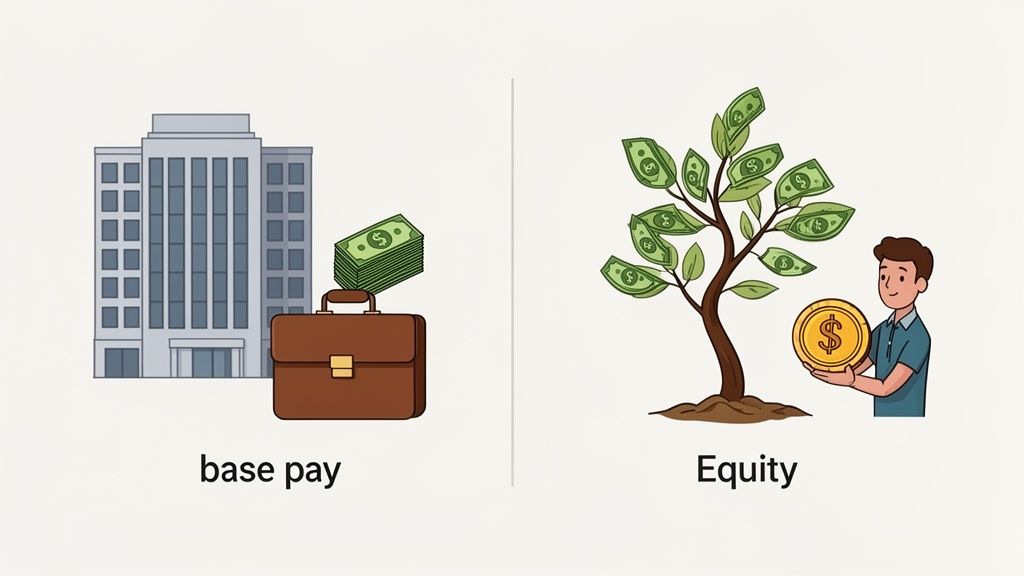
At a big, publicly traded company, compensation is all about predictability. These organizations have meticulously defined salary bands, structured bonus programs, and rock-solid benefits packages. For a BI analyst, this almost always means a higher base salary right off the bat.
An enterprise offer typically includes:
This model is built to minimize your financial risk. Your paycheck is consistent, the benefits are solid, and there are very few surprises. It’s a great fit if your top priority is immediate, stable cash compensation.
Startups are playing a completely different game. They're often cash-constrained but rich in a different kind of asset: equity. To land top talent without breaking the bank, they build compensation packages that blend a more modest base salary with a potentially life-changing stake in the company's future.
Think of it this way: an enterprise pays you for the value you create today, while a startup pays you with a mix of cash for today and ownership in the value you'll help create tomorrow. This ownership comes in the form of stock options or restricted stock units (RSUs).
Joining a startup is like getting a small piece of a sapling. If the company grows into a giant tree, your small piece could become incredibly valuable. If it doesn't, it might be worth nothing.
This trade-off is the heart of the startup compensation model. You accept a lower immediate salary in exchange for the chance of a massive long-term payout if the company has a successful exit, like an IPO or acquisition.
To see how these packages stack up, let’s break down the key differences.
As you can see, the value proposition is completely different. One path offers immediate security, while the other offers a high-risk, high-reward bet on the future.
Because startup offers are so much more complex, you can't just glance at the base salary. You need to put on your detective hat and figure out the potential value of your equity. For a deeper dive into the terminology, check out our guide on the fundamentals of startup equity basics for job seekers.
When a startup makes an offer, ask these critical questions to gauge the real value:
Answering these questions helps you look past the base number and see the bigger picture. Your goal is to assess the company's momentum and make an educated guess about the future value of your equity. It’s a bet on growth—and a well-placed one can pay off far more than a traditional enterprise salary ever could.
What separates a good BI analyst from a great one—especially when it comes to their paycheck? While experience and location set the baseline, your specific skills and tool mastery are what give you real leverage in salary negotiations.
Think of your skillset like a contractor's toolbox. A basic hammer and screwdriver get the job done, sure. But it’s the power drill and laser level that let you build bigger, better, and faster. In the world of business intelligence, certain technical and soft skills are your power tools, making you far more valuable to an employer.
The foundation of any high-earning BI analyst role is technical excellence. These are the non-negotiables that companies are willing to pay a premium for because they directly impact the quality and speed of insights.
SELECT statements is crucial. To justify a top salary, you need to be fluent in complex joins, window functions, and common table expressions (CTEs) to untangle messy data from multiple sources. An analyst who writes efficient, optimized queries saves the company serious time and engineering resources.Having these skills on your resume proves you can handle the entire analytics workflow from raw data to final recommendation.
A BI analyst who can independently query a database with SQL, clean the data using Python, and visualize the findings in a Tableau dashboard is a self-sufficient powerhouse. This end-to-end capability is what justifies a top-tier business intelligence analyst salary.
Technical chops get you in the door, but it’s the soft skills that determine how high you climb. The best-paid analysts aren’t just number crunchers; they are communicators, consultants, and storytellers who bridge the critical gap between raw data and smart business decisions.
Simply put: technical skills help you find the what, but soft skills help you explain the so what.
By developing this blend of technical expertise and polished soft skills, you shift from being a service provider to a strategic partner. This transition is the most reliable path to not just a better title, but a significantly higher compensation package.
Salary negotiation can feel like a high-stakes game, but it’s really just a business discussion about your market value. With the right prep work, you can turn this often-dreaded conversation into a confident, professional exchange that ensures you’re paid what you're worth.
Forget generic advice. Success in the tech world demands a strategy grounded in data, not just guts.
Your negotiation power comes from knowing the numbers cold. Simply put, you can't ask for what you're worth if you don't actually know what that is. This research phase isn't just a good idea—it's non-negotiable and should happen long before a recruiter ever asks for your salary expectations.
Start gathering data points from a few different places:
Once you have this data, you can build a realistic range. For a more detailed walkthrough, check out our guide on how to calculate your target salary range and walk into the conversation fully prepared.
When you get an offer, the worst thing you can do is just throw out a higher number without any justification. Instead, you need to frame your counteroffer around the specific value you’ll bring to their company. It’s about connecting your skills directly to their needs.
For example, instead of saying, "I was hoping for something closer to $110,000," try an approach like this:
"Thank you so much for the offer. I'm very excited about the opportunity to build out your self-service analytics dashboards. Based on my experience driving a 15% reduction in reporting requests at my previous role by implementing a similar Tableau project, and considering the market rate for senior analysts with Python skills in this area, I would be more comfortable with a base salary of $115,000."
See the difference? This reframes the negotiation from a simple ask for more money to a clear reminder of the return on investment the company gets by hiring you.
A great offer is more than just the base salary. Especially in tech, your total compensation has several moving parts. Don't get so hyper-focused on the base number that you leave other valuable perks sitting on the table.
Consider these other components when you negotiate:
By looking at the offer holistically, you can find creative ways to build a total compensation package that truly reflects your value and sets you up for success in your new role.
Even with all this data, you probably still have a few specific questions floating around. Let's tackle some of the most common ones we hear from BI analysts navigating their careers.
If you're going the freelance route, you can typically charge between $60 to $150 per hour. Where you land in that range really depends on the project's complexity, your own expertise, and the client's industry.
For instance, an analyst with deep experience in a niche like financial modeling or complex supply chain analytics can easily command rates at the higher end of that spectrum. Just remember to account for things like self-employment taxes and your own insurance when you're setting your final rate.
Think of the BI analyst role as a launchpad. The skills you build—blending data analysis with strategic business thinking—open up a ton of doors for what comes next.
Some common next steps we see are:
Yes, certifications can definitely give your salary a nudge in the right direction and make your resume stand out. When you get a credential from a major player like Microsoft (for Power BI), Tableau, or AWS, you're validating your technical skills in a way that hiring managers immediately recognize and trust.
While a certification isn't a magic ticket to a specific raise, it massively strengthens your negotiating position. It's concrete proof that you've mastered a toolset, making you a more valuable and competitive asset—especially for roles that need deep expertise in one particular platform.
It’s like adding another verified, in-demand skill to your professional toolkit. That gives you more leverage when it's time to talk compensation and shows a real commitment to your craft, which almost always translates to a higher business intelligence analyst salary over the long run.
The average business intelligence analyst salary in 2026 ranges from about $65,000 at the entry level up to $113,000 or more for senior professionals. Factors like location, industry, and company stage can push total compensation significantly higher — senior analysts in San Francisco, for example, can see base salaries around $170,000.
Experience is the single biggest driver of pay. Analysts with under two years of experience typically earn between $65,000 and $90,000, while mid-level professionals with two to five years on the job can expect $85,000 to $110,000. Senior analysts with five or more years of experience commonly earn $113,000 to $145,000 or beyond, representing a potential 79% increase from where they started.
New Hampshire currently leads with an average business intelligence analyst salary of around $94,092, followed closely by California at approximately $91,673. Major tech hubs like San Francisco can push compensation well above those state averages when bonuses and equity are included.
Yes, significantly. Large enterprises typically offer higher base salaries, structured bonuses, and comprehensive benefits. Startups often come in with a lower base but compensate with equity — stock options or RSUs — that can be worth considerably more if the company grows. The right choice depends on your financial goals and tolerance for risk.
Advanced SQL, Python (especially with Pandas and Matplotlib), and expert-level proficiency in platforms like Tableau or Power BI are the technical skills that most consistently command higher pay. Soft skills like data storytelling and stakeholder management also play a major role in moving analysts into higher-paying, more strategic positions.
Certifications from recognized providers like Microsoft (Power BI), Tableau, and AWS don't guarantee a set raise, but they do strengthen your negotiating position. They serve as verified proof of skill mastery, which hiring managers recognize and which can give you more leverage during compensation discussions.
Freelance rates typically range from $60 to $150 per hour, depending on project complexity, industry specialization, and the analyst's experience level. Those with niche expertise — financial modeling or supply chain analytics, for instance — tend to command rates toward the higher end of that range.
Common next steps include moving into senior or lead analyst positions, transitioning into data science or data engineering, or stepping into management as a BI Manager or Director of Analytics. Some analysts also pivot into product management, where data-driven decision-making is a direct asset.
Ready to find a BI analyst role where your skills are truly valued? At Underdog.io, we connect top tech talent with innovative startups and high-growth companies. Stop searching and let the best opportunities find you. Sign up for free today.