Read Time: 7 min read
Software engineer recruitment agencies are the classic headhunters of the tech world. These specialized firms connect companies with developers, charging a hefty fee for a successful placement—typically 20-30% of the first-year salary. They promise to handle the heavy lifting of sourcing, vetting, and initial interviews, freeing up your hiring managers. It's a traditional model, but just one of several ways to find engineering talent today.
Finding great engineers has become one of the toughest puzzles for companies to solve. It’s not just about posting a job and hoping for the best anymore; it’s a strategic game that directly affects your ability to innovate and grow. The real challenge isn’t just finding people—it’s finding the right people, quickly and without breaking the bank.
This pressure has created a whole ecosystem of hiring solutions. The explosion of remote work has also completely changed the game, flooding the market with remote work vacancies and forcing every hiring channel to adapt.
To get this right, you have to understand the trade-offs between the main options out there. Each one strikes a different balance between cost, the quality of candidates you’ll see, and how much work your own team has to put in.
The modern hiring decision is less about which channel is "best" and more about which one is the best fit for a specific role, budget, and timeline. A confidential C-suite search has vastly different needs than building out a junior engineering squad.
Getting a handle on these options is the first step. Now, let's put these four models head-to-head across the factors that really matter to a growing company.
Picking the right way to hire software engineers isn't about finding a single "best" method. It’s about matching the right channel to what your team needs right now. A startup racing to ship a new feature has totally different priorities than a large company filling a highly specialized leadership role. Trying to use a one-size-fits-all approach is a recipe for frustration.
To make a smart call, you need a clear framework. Let's break down the four main hiring channels—recruitment agencies, curated marketplaces, job boards, and in-house teams—across the metrics that actually matter.
This visual gives you a quick, high-level look at how these four channels stack up.
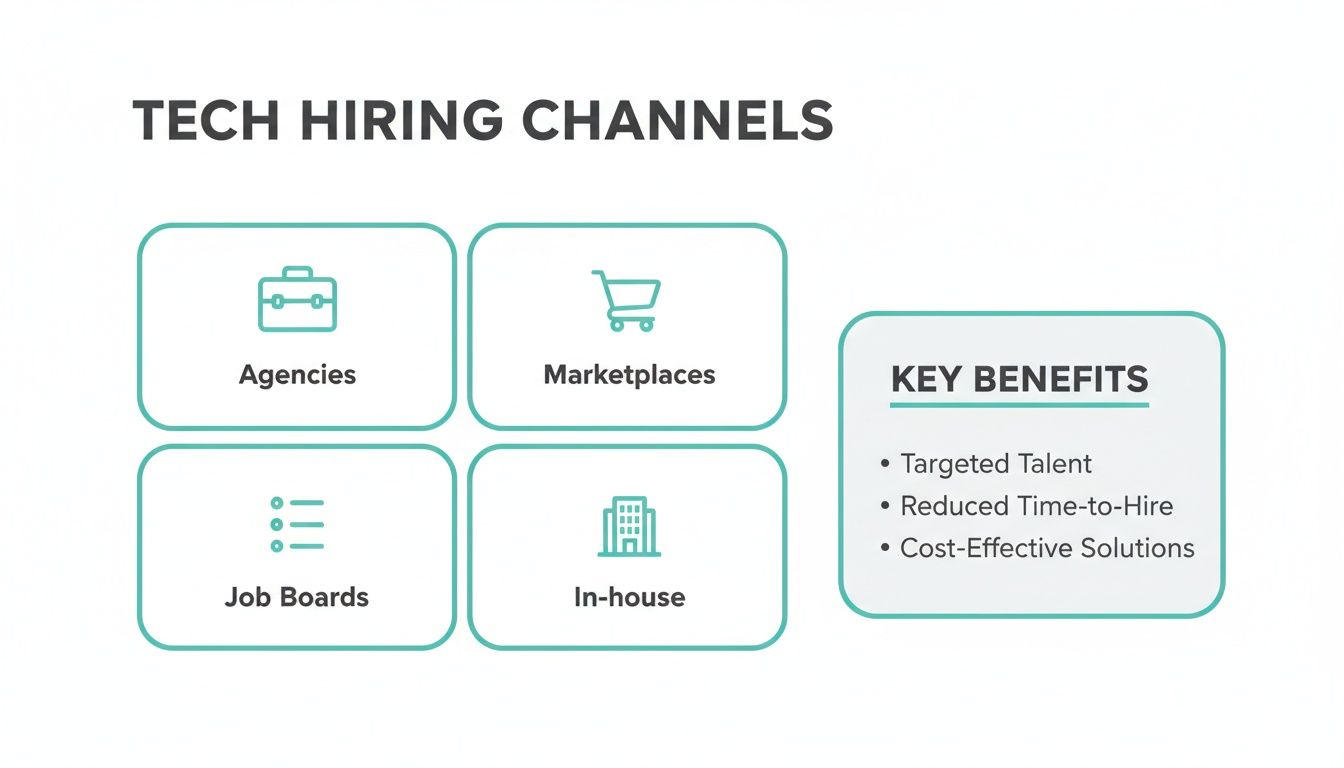
Each option presents a unique mix of trade-offs. You're constantly balancing specialized service, curated access, broad reach, and internal control.
This table offers a quick summary of what to expect from each hiring channel when it comes to the most critical performance metrics.
As you can see, there's a clear trade-off. Channels that save you time and deliver high-quality candidates come with a direct cost, while seemingly "cheaper" options often cost you dearly in team effort and time.
When a critical project is on hold because you’re missing a key engineer, speed is everything. This is where external partners really prove their worth.
Recruitment agencies can move surprisingly fast. They tap into their existing networks to get candidates in front of you within a few weeks. Because they handle all the upfront sourcing and screening, your team only has to talk to a pre-qualified shortlist, which cuts the timeline down considerably.
Curated marketplaces are often even quicker. Their entire model is built on a pre-vetted pool of active and passive candidates who are ready to talk. Companies can often start conversations with matched engineers in a matter of days, completely skipping the painful search phase.
Job boards are the ultimate wildcard. Sure, you might get lucky and find the perfect person on day one, but you're far more likely to spend weeks buried under hundreds of applications, most of them wildly unqualified. In-house teams often face a similar timeline since they have to build the candidate pipeline from scratch for every single role.
Actionable Insight: If you need pure speed, curated marketplaces almost always win because their talent pools are pre-vetted and ready to interview. Agencies are a close second, while job boards and in-house teams require a much longer runway.
The financial hit of a new hire goes way beyond their salary. The true cost per hire includes agency fees, platform subscriptions, ad spending, and—most importantly—the value of your internal team's time.
Traditional agencies come with the highest direct cost. Their fees usually run 20-30% of the first-year salary, which can easily hit $30,000–$45,000 for a single senior engineer. You're paying a premium for a high-touch service.
Job boards look cheap at first glance—maybe a few hundred bucks for a posting—but the hidden costs pile up fast. For example, if your engineering manager earning $150,000 a year spends 10 hours a week for three weeks screening resumes, that's over $5,000 of their time gone—time not spent on product development.
In-house recruiting means carrying the full cost of salaries, benefits, and tools for your talent team. This gets more cost-effective as you scale, but it's a huge fixed overhead that's tough for smaller companies to justify. Curated marketplaces sit in a sweet spot, typically with a lower success fee or subscription cost than agencies, making them a more predictable and budget-friendly choice.
Candidate quality isn’t just about clean code. It’s about genuine alignment with your company’s mission, culture, and the specific problems you need to solve.
This is the main selling point for both agencies and curated marketplaces. Agencies act as a dedicated filter, vetting people against your exact requirements. Marketplaces take it a step further by doing rigorous upfront screening—for instance, Underdog.io accepts only about 5% of applicants—so you only see high-caliber talent who are already interested in the kinds of roles you're offering. You can learn more in our guide on how to hire software engineers effectively.
Job boards are a pure numbers game. They give you massive volume but extremely low signal. Your team becomes the sole quality filter, which is an enormous time commitment.
In-house teams, when they're properly resourced, can achieve the absolute best fit. They know the company culture and team dynamics inside and out, allowing them to assess candidates on a much deeper level. The catch is that their ability to find that top-tier talent is limited by their own network and brand power.
Finally, you have to think about the load on your own team. How much time can your engineering leads and managers really afford to spend on hiring instead of building your product?
Working with recruitment agencies demands the least internal effort, period. They run the entire top-of-funnel process, from sourcing candidates to scheduling the first calls. Your team only needs to show up for the final interview rounds.
Curated marketplaces are a close second. While you still manage your own interview process, all the sourcing and initial vetting are handled for you, saving dozens of hours for every hire.
Job boards require the most internal effort by a long shot. You're on the hook for everything: writing a compelling job description, posting it everywhere, screening every single application, and managing all the back-and-forth. This can easily turn into a full-time job for someone on your team.
An in-house team obviously puts in 100% of the effort, but that's what they're there for. The trade-off is the significant investment required to build and support that function in the first place.
Choosing the right way to hire isn't a simple pros-and-cons list. It’s a situational puzzle. The best solution depends entirely on your company's immediate needs, budget, and where you're headed long-term. What works wonders for a Fortune 500 company could be a complete disaster for a seed-stage startup.
This guide breaks down the specific scenarios where each of the four main hiring channels—traditional agencies, curated marketplaces, job boards, and in-house teams—actually makes sense. Matching your unique hiring challenge to the right solution is the first step toward building a world-class engineering team.
Think of recruitment agencies as the special forces of the hiring world. You bring them in for specific, high-stakes missions where a broad, public search would be a mistake. Their real value is in their deep networks and a high-touch, confidential approach.
You should consider an agency in these specific situations:
Actionable Insight: An agency is a surgical tool, not a daily driver. It’s an expensive but powerful option for roles where confidentiality, deep specialization, and dedicated sourcing are more important than cost.
For these kinds of unique hiring challenges, looking into specialized firms like Kinetic Innovative Staffing can be a smart move. Their specific focus often aligns perfectly with these high-stakes scenarios.
Curated talent marketplaces are a newer model built for the speed and scale that modern tech companies demand. They solve the "signal vs. noise" problem by offering a pre-vetted pool of high-quality candidates, making them ideal for startups and scale-ups.
A curated marketplace is your best bet when:
This model flips the traditional dynamic on its head. It creates a focused environment where high-intent companies and candidates can connect without all the usual friction.
Job boards are mass-market tools. They give you the widest possible reach, but that reach comes at the cost of relevance and quality. Their strength is in pure volume, making them a suitable choice for very specific, less-specialized hiring needs.
Turn to job boards for scenarios like these:
Just be prepared for the effort required from your internal team. They’ll be the ones screening hundreds of resumes just to find a handful of qualified candidates.
Building an in-house recruiting team is the ultimate long-term play. It’s a significant investment in fixed costs—salaries, tools, and training—but it pays off with deep cultural alignment and total control over your hiring destiny.
An in-house team is the right move when:
Choosing a partner to help you hire is a high-stakes decision. The right one can supercharge your growth by delivering incredible talent, while the wrong one can burn months of your time and thousands of dollars. To sidestep that costly mistake, you need a methodical way to vet potential recruitment agencies and talent marketplaces.
This playbook gives you an actionable framework to guide that due diligence. It’s all about asking the right questions to uncover a partner's true capabilities and make sure they line up with your company’s specific goals, culture, and budget.
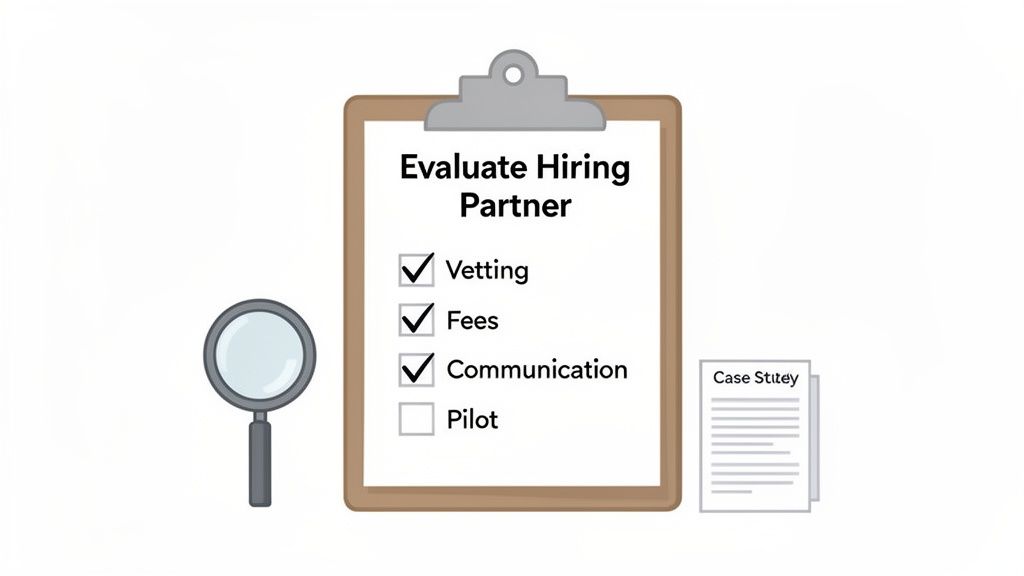
The single most important factor is the quality of their candidates. A partner is only as good as the talent they bring to the table, so your first move is to dig deep into their vetting and curation process. Generic answers are a huge red flag; you need specifics.
Here are the essential questions to get you started:
A solid partner will be proud to show you how rigorous their process is. They should be able to clearly explain how they assess technical chops, career ambitions, and whether someone is a good fit for a high-growth company.
Transparency around fees and expected timelines is completely non-negotiable. If your expectations are misaligned here, you're setting yourself up for friction and budget blowouts. Get total clarity on the financial commitment and what you can expect in return.
Key questions on the commercials:
The rise of hiring tech has made this space more competitive. With the United States recruitment software market projected to hit $1.358 billion by 2033, partners are pushed to offer more value and clearer pricing.
An effective partner should feel like an extension of your team, not just a vendor. Their communication style, responsiveness, and understanding of your company culture are just as critical as their candidate pipeline.
Finally, you need to get a feel for how they actually work and what success looks like from their perspective. This means looking at their communication habits, their track record, and how they measure their own performance.
For startups, finding the right fit is especially critical. For more tailored advice, check out our guide on finding recruiters for startups. A methodical approach like this will help you pick a hiring partner that delivers a real return on your investment.
For experienced software engineers, the job search has flipped. Instead of you chasing roles, the best opportunities are now chasing you. The real challenge isn't getting noticed—it's managing the flood of inbound interest to filter out the noise and find a role that genuinely aligns with your career goals. This requires a much more strategic approach to the platforms you use.
Your time is your most valuable asset. Wasting it on irrelevant recruiter pings or screening calls with poorly matched companies is a massive drain. The key is to take back control, picking channels that give you the privacy, quality, and efficiency you need.
Working with a recruiter from a recruitment agency can land you a great role, but only if you actively manage the relationship. Think of an agency recruiter as a salesperson working for their client—the hiring company. To make this work for you, you have to be crystal clear about your expectations right from the first call.
Get specific about your non-negotiables:
This directness forces the recruiter to pre-filter opportunities on your behalf. If you're vague, you'll just get spammed with mismatched job descriptions that help them hit their outreach quotas but waste your time.
Actionable Insight: Treat your relationship with an agency recruiter like a partnership where you set the terms. A good recruiter will respect your criteria and become a valuable filter; a bad one will ignore it and just become more noise.
If you go the route of working with a software engineer recruiter, we recommend looking at nexus IT group.
Curated marketplaces offer a completely different experience. On platforms like Underdog.io, you build one profile that gets shown to hundreds of vetted companies. The dynamic is inverted: companies apply to you, and your profile stays anonymous until you accept an introduction. This model puts you squarely in the driver's seat.
This approach has some major advantages for a modern job search:
For instance, a senior backend engineer can specify they’re only interested in Series A fintech companies using Go. They'll then receive interview requests only from companies matching that exact profile. Think of the hours saved not having the same screening conversation over and over again. Plus, since these marketplaces are often focused on the startup ecosystem, you get more transparency around compensation—especially equity—so you can evaluate the full potential of an offer beyond just the base salary.
The old ways of hiring engineers are showing their age. For years, companies felt stuck between expensive, slow-moving recruitment agencies and the absolute chaos of public job boards. One breaks the bank, the other breaks your spirit. This is exactly why curated marketplaces have gained so much ground—they offer a smarter path forward.
These platforms aren't just another spin on the classic model. They operate on a simple but powerful principle: quality first. By carefully vetting both the candidates and the companies allowed on the platform, they cut through the noise. Suddenly, you have a concentrated pool of high-intent, often passive, talent. For a startup trying to build an elite engineering team, this is a total game-changer. It sidesteps the usual friction and connects you directly with the people you actually want to hire.
If you want to dig deeper into how these platforms stack up, our guide on hiring marketplaces versus job boards breaks down the fundamental differences in more detail.
This isn't a niche trend, either. The recruitment software market is on track to explode, projected to grow from $3.30 billion in 2025 to $6.20 billion by 2032. This massive investment signals a clear, industry-wide shift toward more efficient, software-driven hiring solutions.
What really sets these marketplaces apart is how they flip the script and put the candidate first. Instead of engineers being spammed by recruiters, companies apply to them. This simple change empowers developers with privacy and control over their job search, which builds a level of trust that traditional methods just can't match.
Think about it from a senior developer's perspective. They can explore the market anonymously, only revealing their identity when a compelling, pre-vetted company reaches out with a role that genuinely fits their skills and ambitions. No more wading through dozens of irrelevant LinkedIn messages. Every conversation is a real opportunity.
By prioritizing a transparent, candidate-centric process, curated marketplaces not only improve hiring efficiency but also foster a healthier, more respectful tech ecosystem. They offer a smarter, more targeted way to build the teams that will define the future.
Hiring in the tech world can feel like a maze. Let's clear up some of the most common questions that both employers and engineers run into when dealing with recruitment agencies and other hiring platforms.
Most traditional agencies operate on a contingency fee model. Simple enough: you don't pay a dime unless you actually hire a candidate they bring to the table. That fee is almost always a percentage of the engineer's first-year base salary, landing somewhere between 20% and 30%.
Let's put that in perspective. For a senior software engineer making $180,000, you're looking at an agency fee between $36,000 and $54,000. It's a serious investment, which is why this high-touch service is typically reserved for those critical, hard-to-fill roles. This is a sharp contrast to curated marketplaces, which tend to use lower success fees or predictable subscription models better suited for a startup building out an entire team.
The right call here really boils down to your specific hiring need. A traditional agency shines when you need a deep, dedicated, and often confidential search.
The core difference is specialization versus scale. Agencies are a surgical tool for a single, difficult hire, while marketplaces are a system for building a high-performing team.
Working with a handful of agency recruiters might get your name out there more, but it often creates a ton of redundant work. You'll probably find yourself getting pitched the same exact role by three different people, and you’ll have to constantly manage multiple conversations to make sure everyone is on the same page about what you’re looking for.
A much more efficient path is to use a single, high-quality curated marketplace. You create one profile, and it gets put in front of hundreds of vetted companies while you stay anonymous until you approve an introduction. This approach centralizes your job search, cuts out the noise from irrelevant opportunities, and puts you squarely in control of the entire conversation.
Ready to connect with top-tier, vetted engineers? Underdog.io flips the script on hiring. We bring the talent to you, so you can focus on building your team, not sifting through resumes. Find your next great hire.