
The search for high-quality remote work is more competitive than ever. Finding the right role isn’t just about scrolling through endless job boards; it's about connecting with legitimate, high-growth companies that value and invest in remote talent. This guide moves beyond generic lists to give you a detailed breakdown of the best platforms and curated marketplaces where top startups and tech companies that hire remotely are actively sourcing candidates. We provide a tactical playbook for navigating your job search and landing a role where you can make a significant impact, from anywhere.
This roundup is designed to be actionable. Instead of surface-level descriptions, we offer a strategic overview of each platform, including who it’s best for, what to expect, and how to optimize your profile for maximum visibility. For example, we'll show you how to transform a generic resume bullet point into a powerful, data-backed achievement that gets you noticed by hiring managers.
We also go a step further by providing a framework for evaluating potential remote employers. A great remote job is about more than just location flexibility; it’s about a company's culture, communication protocols, and support systems. Successfully landing a high-impact remote role often depends on a smooth transition, so understanding remote onboarding best practices is crucial for both employees and employers. This guide will equip you with the insights needed to ask the right questions during an interview, such as, "What does a typical asynchronous collaboration look like for your engineering team?"
Underdog.io revolutionizes the job search for tech professionals seeking opportunities with high-growth startups and innovative tech companies that hire remotely. Instead of the traditional "apply and wait" model, this curated marketplace flips the script entirely. Candidates create a single, confidential profile in about 60 seconds, and Underdog.io’s team presents them directly to vetted, actively hiring companies.
This model is especially effective for passive job seekers (around 85% of their talent pool) who want to explore the market without broadcasting their search. Your profile remains anonymous until a company you approve expresses interest, ensuring complete confidentiality. The platform is entirely free for candidates, as Underdog.io’s revenue comes from success-based fees paid by employers.
What truly sets Underdog.io apart is its human-powered, quality-first curation. Both candidates and companies undergo a rigorous vetting process. The platform accepts only about 5% of candidate applications and rejects over half of the companies that try to join. This dual-sided selectivity ensures that the opportunities are genuine, the companies are well-funded and mission-driven, and the introductions are highly relevant.
Instead of relying on keyword-matching algorithms that often lead to irrelevant outreach, a real person reviews your profile and matches you with roles where you’d be a strong fit. This significantly reduces the noise and frustration of the typical job hunt, replacing application black holes with meaningful conversations, often directly with founders and hiring managers.
Actionable Insight: When crafting your Underdog.io profile, transform responsibilities into quantifiable achievements. Since a human reviews your profile, a compelling story wins. Instead of "Responsible for API development," write "Architected and shipped a new public API in Node.js, reducing latency by 40% and supporting a 3x increase in partner integrations." This shows impact, not just activity.
While its selectivity is a major strength, it can also be a drawback if your profile isn't accepted. The platform is also hyper-focused on the startup ecosystem, so it’s less ideal for those seeking roles at large, established corporations. However, for tech professionals looking for impactful remote roles at the next wave of breakout companies, Underdog.io provides an unparalleled, efficient, and confidential path forward.
The process is designed for discretion and efficiency. You create a single, comprehensive profile in about 60 seconds, which remains anonymous. The Underdog.io team reviews your application and, if accepted, your profile becomes visible to a vetted selection of US-based startups and tech companies.
Companies then send you interview requests for specific roles. You only receive a handful of high-signal introductions (typically 1–3 per month), eliminating the noise common on other platforms. Your identity is only revealed once you accept an interview request, ensuring a confidential search.
Underdog.io excels for candidates in specific tech verticals looking for roles at early-stage to Series C startups.
For a deeper dive into their remote offerings, you can explore the curated list of remote startup jobs on Underdog.io.
Website: https://underdog.io
Wellfound, widely known by its former name AngelList Talent, is a cornerstone of the startup job market. It's a massive platform where tens of thousands of startups list their open roles, making it a primary destination for anyone looking to join an innovative tech company. Its extensive database and powerful search filters allow job seekers to specifically target companies that hire remotely, from early-stage ventures to well-funded, high-growth businesses.
Unlike curated platforms, Wellfound operates as a more traditional (but startup-focused) job board. You create a detailed profile that functions as your resume, showcasing your experience, skills, and preferences. From there, you can browse and apply directly to an enormous volume of jobs.
The platform provides transparency with features like salary ranges, equity information, and detailed company profiles. Employers can post jobs for free or pay for premium features like Recruit Pro to get better visibility and access to sourcing tools. This means you’ll see a mix of companies, from those casually hiring to those actively and aggressively recruiting.
Wellfound is a versatile platform that serves a broad range of tech professionals, especially those interested in the startup ecosystem.
To get noticed in a sea of applicants, you need to optimize your profile and application strategy.
For job seekers who want to cast a wide net and have direct control over their application process, Wellfound is an essential resource for finding companies that hire remotely in the tech and startup world.
As one of the pioneers in the space, We Work Remotely (WWR) is the largest and arguably most recognized remote-only job board. Its long-standing presence and exclusive focus on remote work have made it a go-to destination for professionals seeking opportunities outside the traditional office. WWR’s extensive catalog spans beyond just tech, making it a comprehensive resource for anyone looking for companies that hire remotely across various industries and roles.
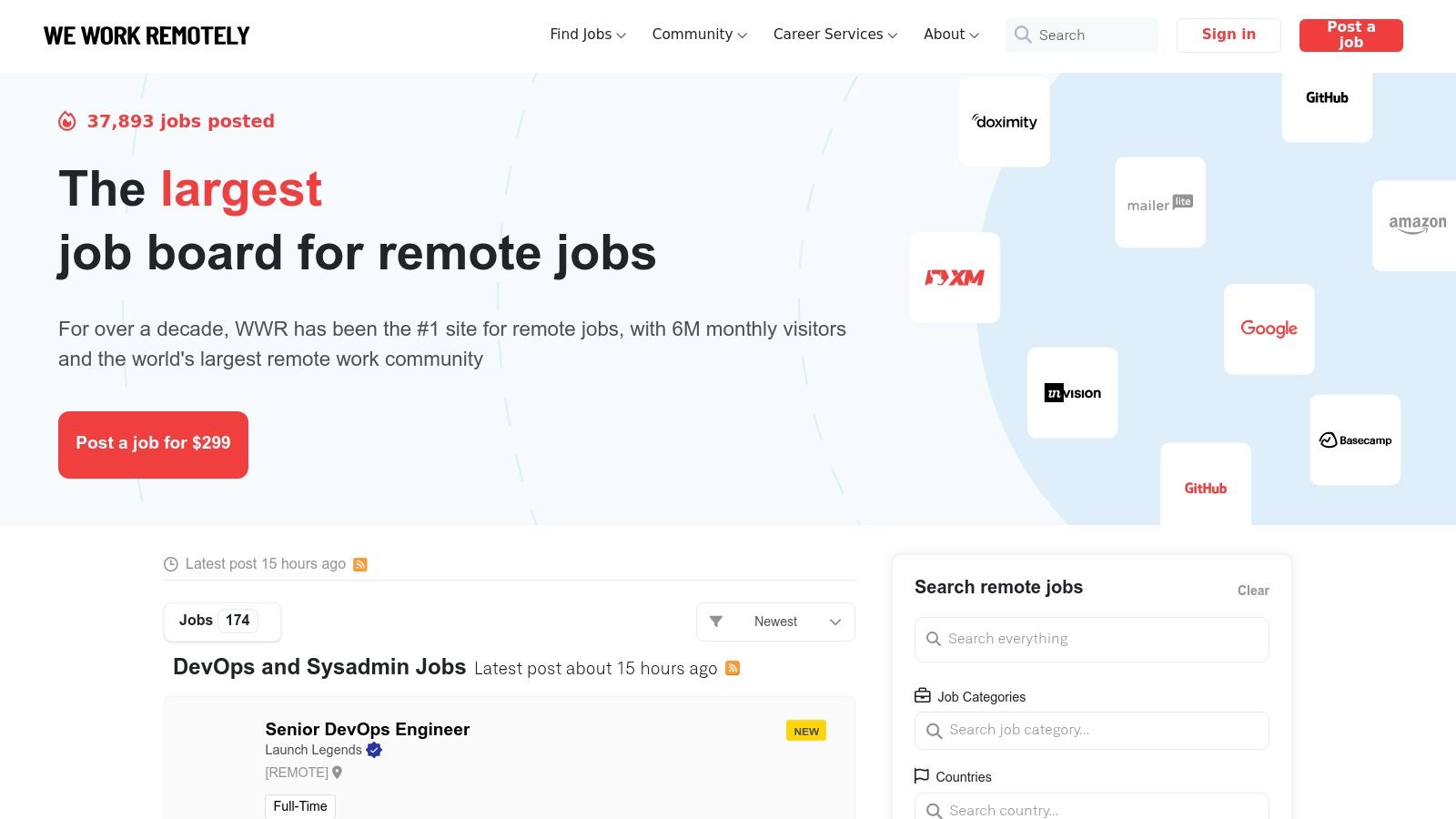
WWR operates on a traditional job board model but with a crucial filter: every single listing is for a remote position. Employers pay a premium to post their jobs, which helps reduce the volume of low-quality or spammy listings often found on free platforms. Job seekers can browse listings by categories like programming, design, marketing, and customer support, or search for specific keywords.
The platform also provides editorial content and resources, including guidance on how to spot and avoid potential job scams, adding a layer of security for users. Once you have an account, you can also tailor the job seeker view by region and time zone, making the search more relevant.
We Work Remotely’s broad scope makes it suitable for a wide range of remote job seekers, not just those in the core tech ecosystem.
To get the most out of this high-volume platform, a strategic approach is essential.
We Work Remotely remains a foundational tool for any remote job search due to its unwavering focus, extensive role diversity, and commitment to quality listings.
Remote OK is one of the most established and high-traffic job boards dedicated exclusively to remote work. Founded by Pieter Levels, a prominent figure in the indie hacker and digital nomad communities, the platform has a strong reputation for aggregating a high volume of legitimate opportunities. It serves as a go-to resource for professionals across the globe searching for companies that hire remotely, with a significant emphasis on roles in technology and startups.
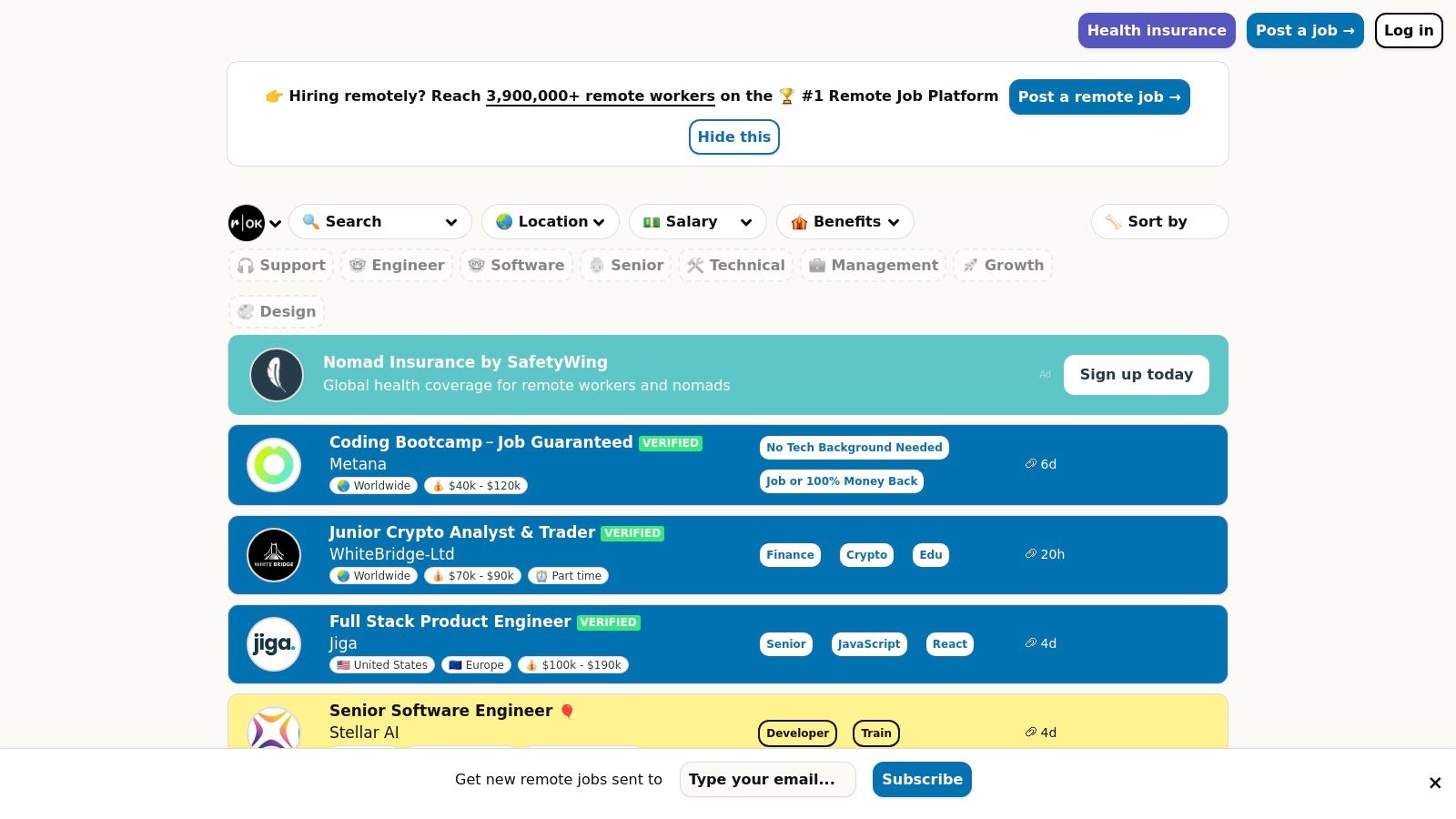
Remote OK functions as a traditional job board but is supercharged with robust filtering and tagging capabilities. Employers pay to post listings, which are then categorized and made searchable. Job seekers can browse for free, filtering results by keywords, specific tags like "JavaScript" or "Marketing," and crucial location-based requirements such as "Worldwide" or "US-Only."
The platform's strength lies in its volume and discoverability. Thanks to strong SEO, many of its listings also surface directly in Google Jobs searches, increasing the visibility of opportunities. You can apply directly through links provided in the posts, which usually lead to the company's application tracking system (ATS).
Remote OK is an excellent starting point for a broad range of remote job seekers, though it has a clear sweet spot.
To cut through the noise on a high-volume board, a strategic approach is essential.
[typescript] [react] [senior] [us-only] and another for [golang] [api] [staff]. This precision ensures you only see highly relevant roles in your inbox.With its massive selection and user-friendly interface, Remote OK remains a cornerstone for anyone looking to find companies that hire remotely. For more options, explore this list of the best websites for tech jobs on underdog.io to broaden your search.
FlexJobs is one of the most established and trusted platforms dedicated to flexible and remote work. Unlike general job boards that simply have a "remote" filter, FlexJobs' entire model is built on curating and hand-screening every single listing to ensure it's legitimate, professional, and offers some form of remote, hybrid, or flexible arrangement. This meticulous vetting process makes it a go-to resource for professionals seeking companies that hire remotely across a vast array of industries, not just tech.
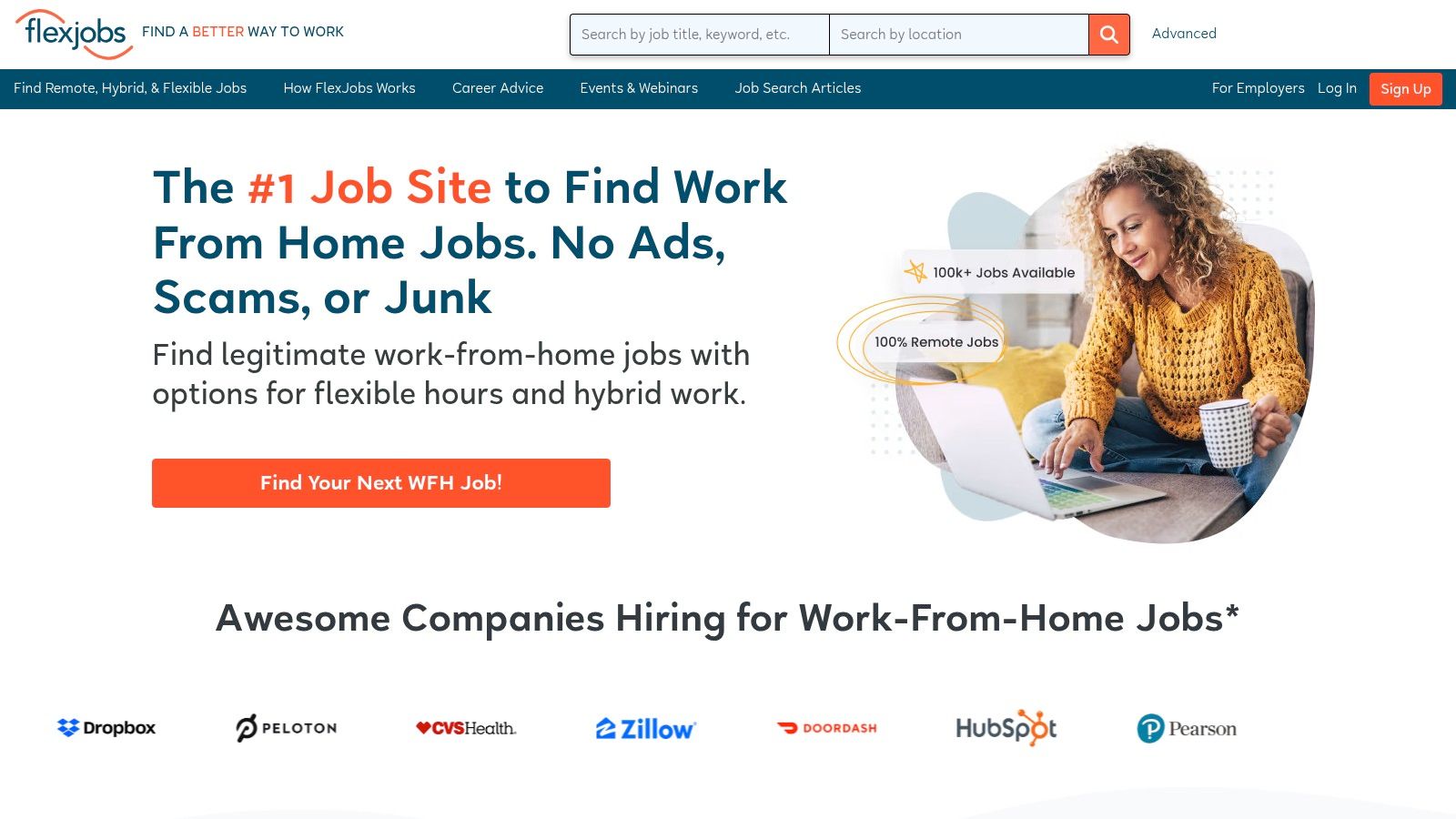
FlexJobs operates on a subscription model for job seekers, which funds its team of researchers who manually verify every role. This paywall acts as a powerful filter, eliminating scams, commission-only gigs, and ads that often clutter free job sites. The platform allows users to search with highly specific filters, including level of remote work (100% remote, hybrid, optional), job type (employee, freelance), and career level.
This focus on quality over quantity means you spend less time sifting through junk and more time applying to high-caliber, relevant positions. The platform also provides valuable resources like skills tests, career coaching, and webinars to support your search.
FlexJobs' strength is its breadth, making it ideal for a wide range of professionals beyond the startup tech scene.
To get the most out of your subscription, leverage the platform's powerful tools.
FlexJobs’ commitment to quality and security makes it an invaluable tool for anyone serious about finding legitimate remote work, particularly for those looking for companies that hire remotely outside of the traditional tech startup bubble.
Remotive has established itself as a cornerstone in the remote work community, offering more than just a job board. It's a comprehensive resource that combines curated job listings with a supportive community, making it a go-to platform for professionals actively seeking companies that hire remotely. By focusing exclusively on remote roles, Remotive cuts through the noise of traditional job sites and delivers relevant opportunities directly to a dedicated audience.
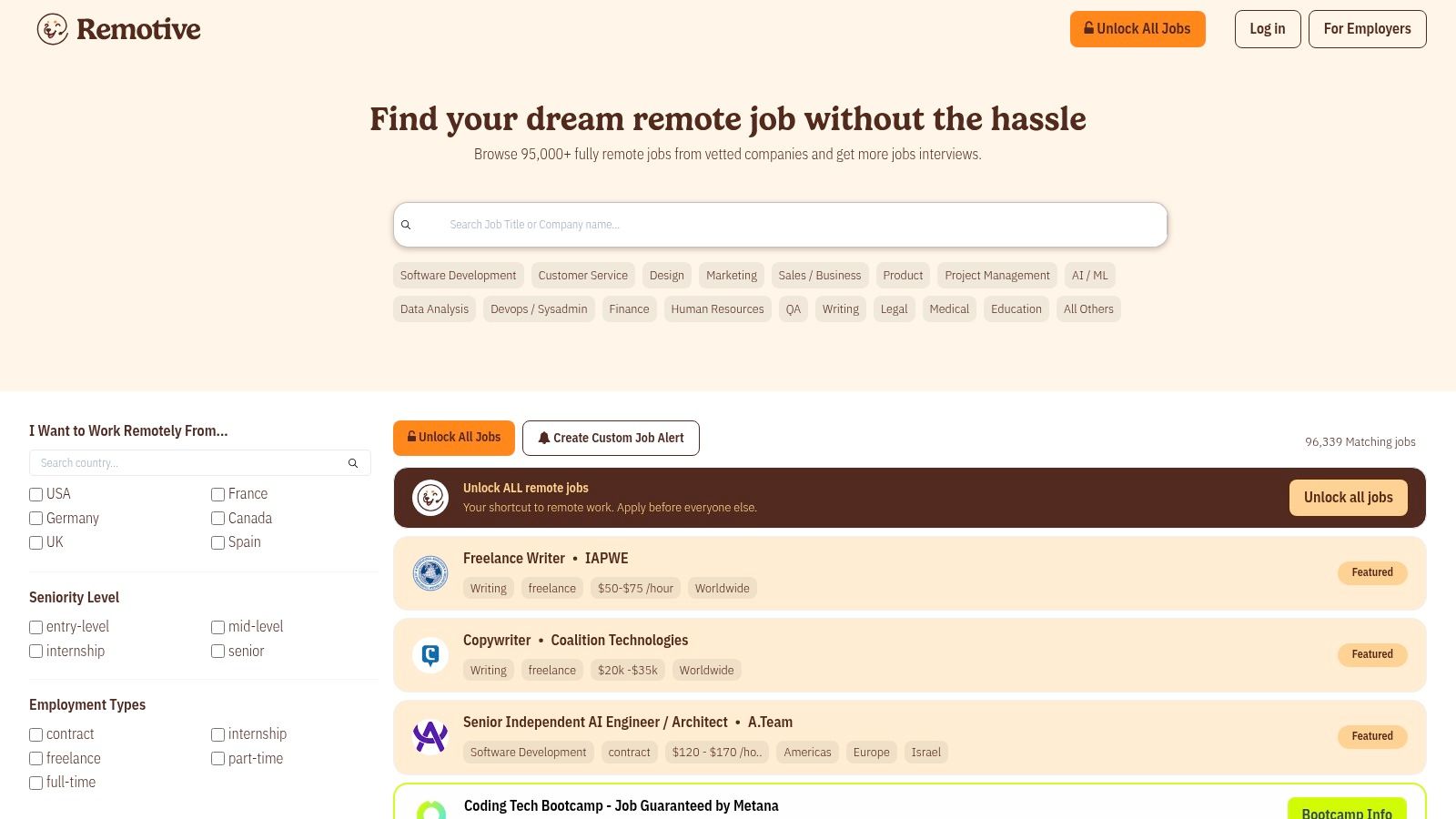
Remotive operates primarily as a high-quality job board where companies pay to post their remote openings. This paid model serves as a quality filter, as it indicates that employers are serious about investing in remote talent. Job listings are distributed across multiple channels, including a popular email newsletter, social media, and Google Jobs, maximizing visibility.
For job seekers, the experience is straightforward. You can browse and filter jobs by category (e.g., Software Development, Marketing, Sales) and apply directly on the company's official website. This direct application process is a key feature, as it reduces the risk of scams and ensures you are entering the employer's official hiring pipeline.
Remotive's strength lies in its broad appeal to remote professionals across both technical and non-technical fields.
To make the most of Remotive, leverage its community features and be strategic with your applications.
Remotive's dedicated focus on remote work and its active community make it an indispensable resource for anyone looking to build a career outside the traditional office environment.
Navigating the landscape of remote work can feel like searching for a signal in a sea of noise. As we've explored, the world is filled with incredible companies that hire remotely, but connecting with the right one requires more than just a resume and a prayer. It demands a strategic, focused approach that leverages the right tools to cut through the clutter and position you for success.
This guide was designed to be your roadmap. We’ve moved beyond a simple list of job boards and provided a curated look at platforms that serve distinct purposes in your remote job search. From the high-volume, diverse listings on sites like We Work Remotely and Remote OK to the carefully vetted opportunities on FlexJobs, each platform offers a unique value proposition. The core takeaway is this: your job search strategy should be as specialized as the roles you’re pursuing.
The most effective remote job seekers don't just apply everywhere. They intentionally select their channels based on their career goals, experience level, and desired company culture. Think of it as building a job-search toolkit.
However, the ultimate goal is to move from a high-effort, low-signal process to a low-effort, high-signal one. The most significant shift in a modern job search is moving from seeking opportunities to having opportunities find you. This is where a curated marketplace model completely changes the game.
The most significant challenge in finding top-tier remote roles isn't a lack of openings; it's the intense competition and the automated systems that filter out qualified candidates. Sending your application into a generic portal can feel like a black hole, with little to no feedback.
Key Insight: The best way to stand out is to bypass the front door. A platform that directly introduces your profile to hiring managers at vetted companies that hire remotely is your single greatest advantage. It shifts the dynamic from you chasing companies to companies competing for you.
This is the fundamental difference offered by a platform like Underdog.io. Instead of you spending hours sifting through job descriptions and tailoring countless applications, you create one high-quality profile. That profile is then put directly in front of decision-makers at rapidly growing tech companies and startups that are actively and often urgently hiring for roles that match your skills. This model prioritizes quality over quantity, ensuring your time is spent in meaningful conversations, not filling out redundant application forms. It’s the most direct path from talented candidate to compelling offer.
As you embark on the next phase of your career, remember that the remote work landscape is vast and full of possibility. Armed with the right strategy and the right tools, you can navigate it with confidence and land a role that doesn't just offer flexibility, but also aligns perfectly with your professional ambitions.
Ready to stop scrolling through endless job boards and start connecting with the best companies that hire remotely? Create your free profile on Underdog.io in under 60 seconds. We'll put your profile directly in front of decision-makers at top startups, so you can skip the noise and focus on landing your dream remote job.
What is the difference between "remote-friendly" and "remote-first" companies?
This is a crucial distinction. A "remote-friendly" company has a central office and allows some employees to work from elsewhere, but processes often favor in-office staff. A "remote-first" company is designed for distributed work from the ground up. All communication, documentation, and processes are built to include everyone equally, no matter their location. For true flexibility and equity, remote-first companies are often the better choice.
Where is the best place to find legitimate remote job listings?
Avoid generic search terms on large boards. Instead, use job platforms that specialize in or have strong filters for remote work. Many tech-focused and startup job boards allow you to filter for "remote anywhere" or "remote within a region." Dedicated remote-work websites and community job boards are also excellent sources, as they often curate and vet their listings.
How can I tell if a company has a strong remote culture during the interview process?
Ask specific questions. Inquire about their communication tools (e.g., Slack, Notion), how they run meetings across time zones, and what they do to build team cohesion remotely. Pay attention to how the interview is conducted—is it smooth and organized digitally? Also, ask about onboarding: "How do you integrate a new remote employee in their first month?" A well-defined process is a good sign.
Are salaries for remote jobs location-based?
It depends entirely on the company's policy. Many larger tech companies and "remote-friendly" firms use location-based pay scales. However, a growing number of "remote-first" companies advertise roles with salary bands that are the same regardless of where you live, often tied to competitive national or international market rates. The job description or initial screening should clarify this policy.
What tools and setup do I typically need to work remotely?
At a minimum, you'll need a reliable, high-speed internet connection, a functional laptop/computer, and a quiet workspace. Most remote companies provide a stipend to help you set up your home office. Beyond hardware, you'll need to be proficient with collaboration software like video conferencing (Zoom, Google Meet), instant messaging (Slack), project management tools (Asana, Jira), and document sharing (Google Workspace, Notion).
What are the biggest challenges of working remotely, and how do successful companies address them?
Common challenges include communication gaps, feeling isolated, and work-life balance. Successful remote companies address these by over-communicating, documenting everything, using asynchronous communication effectively, scheduling regular virtual social events, and strongly encouraging employees to set and respect clear boundaries between work and personal time.
How can a platform like Underdog.io help me find a remote role?
Curated platforms can streamline your search for high-quality remote opportunities. By submitting one profile, you can get matched with vetted startups and tech companies that are actively hiring for distributed roles. This saves you from sifting through countless listings and helps you find companies with established remote practices, often connecting you directly with the hiring managers.


