Let's be honest—the best people are almost always busy doing great work, not scrolling through job boards. This is the simple truth behind passive candidate sourcing: you have to proactively find and engage high-performing professionals who aren't actively looking for a new job. For a startup, this isn't just another recruiting tactic; it's a core strategy for building an elite team from the ground up.
If your entire hiring strategy hangs on inbound applications from job postings, you're fishing in a very small, very crowded pond. The most talented engineers, product managers, and designers are typically content, challenged, and well-paid where they are. They aren't polishing resumes or setting up job alerts. They're busy shipping products and solving tough problems for their current company.
Relying only on active job seekers creates a massive blind spot. While you might land some great people, you're completely missing the overwhelming majority of the talent market. For tech startups, especially in competitive hubs like New York City and San Francisco, this has become a make-or-break reality. A staggering 73% of professionals are considered passive candidates—not actively hunting for a new role, but open to the right opportunity if it finds them.

A reactive hiring model—just posting a job and waiting for people to apply—immediately puts you on the back foot. You're left competing with hundreds of other companies for the exact same, limited pool of active candidates.
Passive sourcing flips this whole dynamic on its head. It’s an offensive strategy. You get to identify your ideal hire and start a conversation on your own terms.
Think about it from their perspective. An active job seeker is just one of hundreds applying, stuck in a high-volume, low-personalization meat grinder. But a passive candidate? They get a thoughtful, personalized message about a specific opportunity that acknowledges their expertise. This targeted approach instantly makes your startup stand out.
By focusing on passive talent, you shift from being just another 'job advertiser' to becoming a 'talent magnet.' You're not just filling an open role; you're building a powerful network of top-tier professionals who see your company as a premier destination.
This change in mindset is absolutely critical for high-growth tech companies that need specialized skills. You can't afford to wait for the perfect Senior AI Engineer or Lead UX Designer to stumble upon your job ad. You need to know who they are and start building a relationship long before you even have a formal job opening. This proactive approach is a core reason why relying on inbound alone could hurt your recruiting efforts.
The table below breaks down the clear benefits of integrating this strategy into your hiring process.
This table summarizes the core benefits you'll see when you prioritize passive candidate sourcing in your recruitment strategy.
Ultimately, focusing on passive candidates isn't just about finding better people; it's about building your company more strategically. You gain control over who you talk to, improve the quality of your hires, and build a long-term competitive advantage.
A solid passive sourcing strategy starts with a simple truth: you have to go where the best talent actually spends their time. Just posting on LinkedIn is like fishing in the open ocean with a single net—sure, you'll catch something, but you’ll miss the high-value talent hiding in specific, protected coves.
To find great tech professionals, you need to think less about "where do people look for jobs?" and more about "where do talented people hang out online?" For developers, that’s not job boards. It’s the platforms where they build, collaborate, and solve tough problems.
Technical platforms like GitHub and Stack Overflow are goldmines for finding proven developers. On GitHub, a developer's profile is essentially a living, breathing resume. You can see their actual code, the projects they contribute to, and their real interests through their repositories. You’re not just looking at a list of skills; you're seeing the work itself.
Stack Overflow is just as valuable, giving you a window into a developer’s problem-solving and communication skills. A high reputation score and a history of clear, well-written answers to complex questions are huge indicators of genuine expertise.
Don’t just look for profiles; look for activity. A developer who consistently contributes to open-source projects or provides detailed answers on Stack Overflow is demonstrating passion and expertise beyond their day job. That's the sign of a fantastic passive candidate.
You can use Boolean search strings right on Google to zero in on the exact people you're looking for. For instance, if you wanted to find a Python developer in Boston on GitHub, you could try something like this:
site:github.com ("python" OR "django") AND "boston" AND ("hire" OR "contact" OR "email")
This simple search helps cut through the noise and surface developers who are not only skilled but might also be open to hearing from you.
For designers, the portfolio is everything. Platforms like Dribbble and Behance are where the best UX/UI designers, illustrators, and graphic artists show off their work. Sourcing here is less about keywords and more about finding a visual and functional style that clicks with your brand.
When you’re browsing these sites, pay attention to:
Searching for "UX designer" is a decent start, but you'll get much better results by adding terms like "SaaS," "fintech," or "mobile app" to find designers with experience in your specific industry.
Your current team has one of the most valuable and trusted networks you can possibly tap into. But a passive, "let us know if you know anyone" approach almost never works. To really get this channel humming, you need to formalize the process and make it incredibly easy and rewarding for your team.
Modern tools can turn a basic referral program into a powerful sourcing machine. A platform like vouchedin.co, for instance, adds structure by making it simple for employees to track their referrals and see the rewards. When you remove the friction and ambiguity, you get way more participation, and every employee becomes a proactive sourcer for your team.
Sometimes, the smartest move is to just call in an expert. While building your own sourcing muscle is a great long-term goal, a specialized recruitment agency can give you a huge, immediate advantage. For a complete rundown of options, check out our guide on the best candidate sourcing software and tools for recruiters.
This is especially true for those highly specialized, senior, or impossible-to-fill roles. If you've been searching for a Principal Engineer with a niche skillset for 3 months with no luck, it's probably time for reinforcements.
A good technical recruitment staffing agency, like nexusitgroup.com, doesn’t just post jobs. They have deep networks and established relationships with passive candidates that they've built over years. They know the market, they know the key players, and they can make introductions that would be impossible for an internal team to get. Think of it as a tactical investment to land a critical hire and get top-tier talent in the door right when you need it.
So you’ve done the hard work and found a handful of incredible passive candidates. This is the moment of truth, and honestly, it’s where most sourcing efforts fall flat. A generic, copy-pasted message is the fastest way to get your email deleted or, worse, marked as spam.
Getting a response from someone who isn't looking for a job is all about starting a genuine conversation. Your initial email response rates will likely fall somewhere between 30% and 50%. Hitting the high end of that range comes down to one thing: a personalized, value-driven approach from the very first word.
A great outreach email has a few moving parts that all work together to spark curiosity. It’s got to respect their time, show you recognize their expertise, and give them a compelling reason to even consider hitting "reply."
Your subject line is the first gatekeeper. It has to cut through the noise without sounding like cheap clickbait. Forget the generic "Job Opportunity" and show you've actually done some research.
The second version is a world away from the first. It’s specific, flattering, and makes them wonder what you have to say. It instantly proves you’re not just blasting out a template.
Personalization is, without a doubt, the most critical part of this process. A truly standout message proves you invested time in understanding who they are and what they’ve accomplished. Reference a specific project, an article they wrote, or a talk they gave.
Let's say you're reaching out to a Head of Product.
Before: "Hi [Name], I saw your profile and thought you'd be a great fit for our Head of Product role. We're an exciting startup in the fintech space. Are you open to a chat?"
This is lazy and gives them zero reason to care. It's all about you and your needs.
After: "Hi [Name], I just finished reading your blog post on building product roadmaps for B2B SaaS companies—your point about prioritizing customer feedback loops over internal feature requests really resonated. At [Your Company], we're tackling a similar challenge, and I was hoping to get your perspective on it."
See the difference? The "after" example shows you're genuinely interested in their ideas. You've found common ground and made a soft ask. You're not demanding an interview; you're asking for their expert opinion. That’s a much easier "yes."
This outreach step is the critical final piece of the sourcing puzzle, whether you've found talent through niche channels, referrals, or agencies.
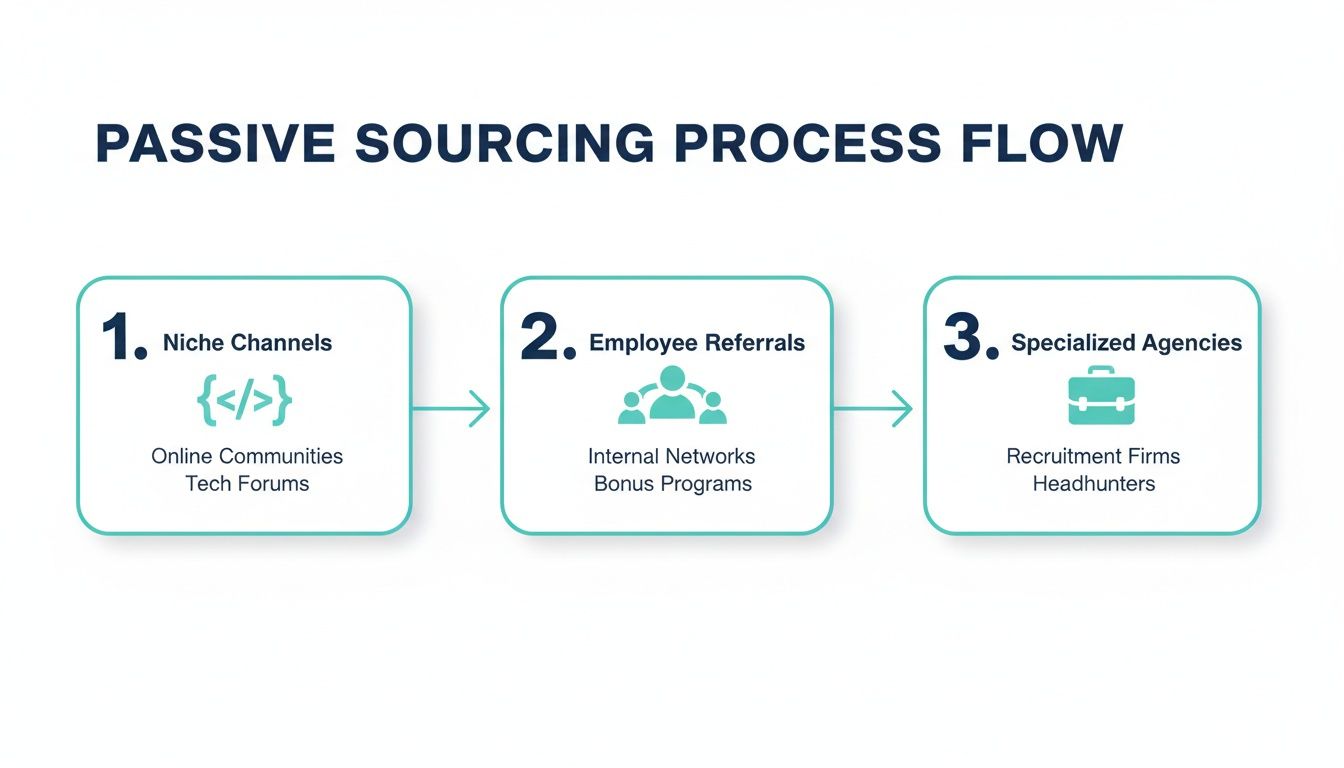
Ultimately, every path leads to this crucial moment where personalized communication makes or breaks your success.
Even a perfectly written email can land at a bad time. That’s why a single message is almost never enough. A thoughtful, multi-touch follow-up sequence is your best bet for increasing responses without coming across as a pest.
The trick is to add value with every single touchpoint. Don't just send a dozen emails saying, "Just bubbling this up." Instead, mix up your channels and share different bits of interesting information.
A Practical Follow-Up Cadence:
This sequence builds rapport over time and gives the candidate multiple, low-friction ways to engage when it works for them. For more inspiration, it's worth checking out some proven cold email example templates that get replies. You can adapt these frameworks with your own research to create something truly compelling.
So, you got a reply. That first response from a passive candidate is a huge win, but let’s be clear: the real work is just beginning. Most people who are great at their jobs aren't looking to jump ship tomorrow. The true art of passive sourcing lies in patiently nurturing that initial spark of interest over the long haul.
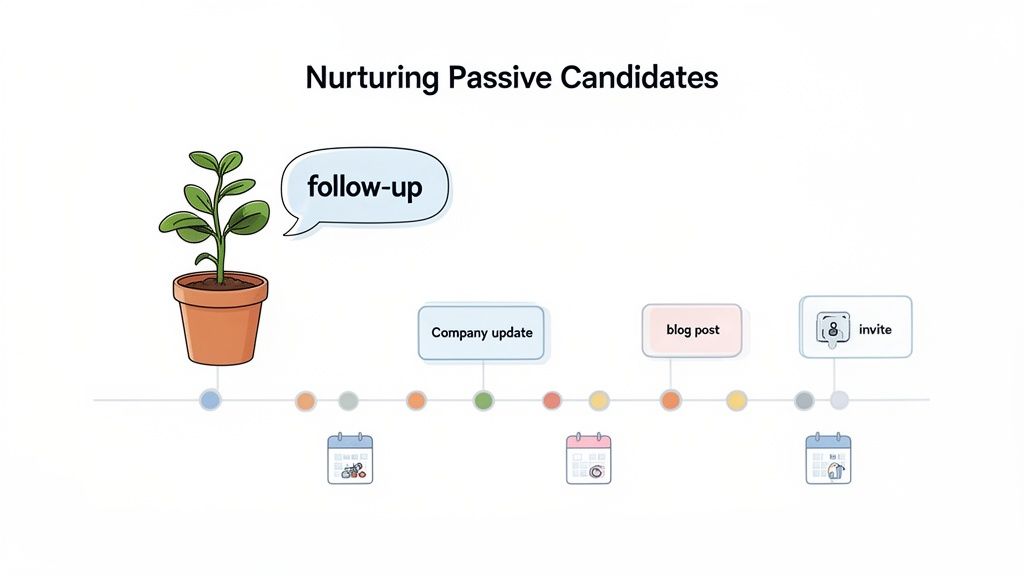
This is where you shift from a transactional mindset ("Are you ready for an interview?") to a relational one ("Let's stay connected."). Your goal is simple: keep your startup top-of-mind. When they are finally ready for a change, you want to be the first person they think of. It's a long game, but it’s how you build a pipeline of incredible talent that your competitors can't touch.
You can't nurture a relationship you forgot you had. While a full-blown Candidate Relationship Management (CRM) system is fantastic, you don't need one to get started. Honestly, a simple spreadsheet or a Trello board works just fine when you're in the early stages.
Create a few columns to track the basic stages of your pipeline:
For each person, track their name, LinkedIn profile, the date of your last contact, and a "next step" date. This basic setup is enough to make sure no one falls through the cracks and helps you time your follow-ups like a pro.
The secret to nurturing is providing value, not being a pest. Your follow-ups should feel less like a sales pitch and more like a friendly, professional update from someone in their network. You’re sharing information that’s genuinely interesting and subtly reinforces why your company is an exciting place to be.
Instead of sending those empty "just checking in" emails, share content that keeps the conversation alive and adds something to their day.
Here are a few things that have worked for me:
These touchpoints are designed to be low-pressure and high-value. You're not asking for a thing. You’re simply sharing information that positions your startup as innovative, growing, and a magnet for top talent.
This approach builds a positive association with your brand. Every valuable piece of content you share strengthens the relationship. It makes the eventual transition to a formal interview feel like a natural next step, not a sudden, awkward pivot. Just remember, consistency is everything. A simple follow-up sequence every few months can be all it takes to stay on their radar.
After a few months of nurturing, a candidate might start sending signals that they're ready for something more. They might ask a direct question about open roles, "like" one of your job postings on LinkedIn, or casually mention that they're starting to explore new opportunities. This is your green light.
When you spot these buying signals, it's time to gracefully pivot the conversation.
You can make the transition with a message like this:
"That's great to hear you're starting to think about what's next. Based on our past conversations, I have a feeling you'd make a huge impact on our [Specific Team]. Would you be open to a more formal, confidential chat next week to explore what that could look like?"
This script works because it’s both direct and respectful. It acknowledges the relationship you've built ("Based on our past conversations") while clearly defining the next step. By proposing a "formal, confidential chat," you signal a shift in intent without creating pressure, making it an easy and comfortable "yes" for the candidate.
Sourcing the best passive talent feels like an art, but the real wins come from treating it like a science. If you’re not measuring what works, you’re flying blind. You end up wasting time on the wrong channels and sending messages that fall flat, all while your perfect candidate gets snapped up by someone else.
Building a sourcing engine that actually works means tracking your efforts, understanding the results, and using that data to sharpen your approach. It’s about moving past generic metrics like “time to fill” and zeroing in on the KPIs that show how well you’re engaging people who aren’t even looking for a job.
Your goal is to see exactly how each stage of your sourcing funnel is performing, from that first cold outreach to a signed offer. Start by tracking a few critical data points that will give you a clear, actionable picture.
The whole point is to create a feedback loop. Data from these metrics should directly inform your strategy, telling you what to amplify and what to cut.
For instance, if one of your outreach templates consistently gets a high response rate, break it down. Analyze its structure, tone, and call-to-action, then use that formula to improve your other messages. To see how other companies have put this into practice, you can explore customer success stories on sourcing.
It’s easy to get your metrics mixed up, but it's vital to distinguish between what measures passive sourcing success and the broader KPIs for general recruiting. They tell very different stories. Sourcing metrics are about influence and engagement, while standard KPIs often focus on speed and volume.
So, what should you really be looking at? Here’s a quick comparison of standard recruitment metrics with the KPIs that truly measure the impact of your sourcing.
By tracking these specific data points, you’ll leave the "spray and pray" method behind for good. You'll start making smarter, data-informed decisions every step of the way, building a predictable sourcing function that consistently delivers incredible talent.
Even the best sourcing plan will run into a few tricky situations. Let's tackle some of the most common questions that pop up when you start engaging with passive talent.
This is all about smart time management. Time-blocking is your best friend here. Set aside a few dedicated hours each week to focus only on sourcing—that’s how you build a solid pipeline over time without feeling overwhelmed.
Think of it as running two different plays at once. Your Applicant Tracking System (ATS) is perfect for handling the high volume of active applicants. For your hand-picked list of passive candidates, a simple spreadsheet or a lightweight CRM is all you need. Active applicants solve today's hiring needs, while your passive sourcing efforts build a strategic bench of talent for tomorrow, saving you a ton of stress when a critical role suddenly opens up.
Discretion is everything. You absolutely never use a candidate’s work email or work phone. Stick to personal contact info you can find on professional networks like LinkedIn, personal portfolios, or public GitHub profiles.
Your first message should always be respectful of their current role.
Try opening with something like, "I imagine you're happy in your current role, but I was so impressed with..." This shows you’ve done your homework and respect their position. The whole point is to start a confidential conversation, not to put their job at risk.
Not at all. While it’s a must-have for senior roles where the talent pool is small, this strategy works wonders for any hard-to-fill position. For a startup, finding a high-potential mid-level engineer with a specific niche skill can be just as tough as finding a new VP of Engineering.
Remember, top performers at every level are usually happy and excelling where they are—they aren't scrolling through job boards. Proactive sourcing lets you find these rising stars before your competitors even know they exist. This gives you a massive advantage in building a truly high-performing team from the ground up.
Think of passive sourcing as a long-term investment, not a quick win. You might get lucky and find someone who’s ready to move right away, but the real payoff comes from building relationships over weeks and months. You should start seeing consistent replies and a few initial chats within your first month of dedicated effort.
The true ROI—a pipeline of warm, high-quality candidates that dramatically shortens your time-to-hire—usually becomes clear after 3-6 months of consistent work. It's a long game, but one that creates a predictable and reliable flow of amazing talent.
Passive candidate sourcing is the practice of proactively identifying and engaging high-performing professionals who are not actively looking for a new job. Rather than waiting for candidates to apply to a job posting, a recruiter or hiring team goes out and finds the people they want — on platforms like GitHub, LinkedIn, Stack Overflow, or Dribbble — and initiates a conversation. The core premise is that the best performers in any field are typically employed, challenged, and well-compensated, which means they rarely show up in an active job seeker pool. Passive sourcing is used to access the 73 percent of professionals who are not browsing job boards but would consider the right opportunity if it was presented to them thoughtfully and personally.
For startups, passive sourcing is not just a recruiting tactic — it is a competitive necessity. The most specialized technical talent — senior engineers, experienced product managers, niche designers — almost never applies to job postings. Startups that rely solely on inbound applications are fishing from a small and highly competitive pool, competing with every other company for the same limited set of active candidates. Passive sourcing shifts that dynamic entirely. It lets hiring teams identify the exact profiles they need, engage those people before competitors do, and build relationships over time rather than scrambling to fill a role when urgency is highest. A healthy pipeline of passive candidates also reduces time-to-hire significantly when a critical role opens, because relationships with potential hires have already been established.
The most effective platforms for sourcing passive tech talent depend on the role. For software engineers and developers, GitHub is the most signal-rich source available — a candidate's profile reveals their actual code, the projects they contribute to, and the depth of their engagement with the open-source community. Stack Overflow shows problem-solving quality and communication skills through a history of answered questions. For UX and UI designers, Dribbble and Behance are the primary platforms, where portfolio depth, consistency across projects, and peer recognition from other respected designers all serve as quality signals. LinkedIn remains useful for initial discovery and contact across all roles. Technical community spaces — Discord servers, GitHub Discussions, and Slack groups attached to major newsletters or frameworks — are where early conversations happen organically, often before a candidate would ever consider themselves "looking."
The single most important factor in passive outreach is genuine, specific personalization. A generic "I came across your profile and think you'd be a great fit" message will be ignored or deleted. Effective outreach references something specific the candidate has actually done — a project they shipped, a blog post they wrote, a contribution to an open-source library, a talk they gave — and draws a concrete connection between that work and why you reached out. The subject line should reflect this specificity rather than announcing a job opportunity. The call to action should be low-pressure and conversational, asking for their perspective or a brief chat rather than immediately proposing an interview. Response rates for personalized outreach in this style typically fall between 30 and 50 percent; a generic templated approach will fall far short of that range.
A multi-touch follow-up sequence is a structured cadence of outreach across multiple channels and over multiple days, designed to increase response rates without being intrusive. A well-constructed sequence typically includes an initial personalized email on day one, a LinkedIn connection request with a brief contextual note on day three, a follow-up email on day seven that shares a new and genuinely interesting piece of information (a company milestone, a relevant article, or a recent product launch), and a final "break-up" email on day fourteen that gracefully closes the loop without burning the relationship. The key principle is that every touchpoint should add value rather than simply following up for its own sake. This approach respects the candidate's time, gives them multiple low-friction ways to engage, and avoids the impression of desperation that single-channel or high-frequency outreach creates.
Nurturing passive candidates is a relational, long-term process that requires a shift from a transactional mindset to a genuine network-building approach. Once a candidate has responded, the goal is to keep the relationship warm through periodic, value-adding touchpoints rather than persistent asks. Effective nurturing messages share company milestones that signal growth and momentum, link to engineering blog posts or product launches that reinforce technical credibility, or pass along industry news relevant to the candidate's expertise. These interactions should require nothing from the candidate — they are meant to build a positive association with your company over time so that when the candidate is ready for a change, your startup is the first one they think of. This pipeline typically matures into consistent, high-quality hiring after three to six months of steady effort.
The metrics that matter for passive sourcing are distinct from general recruiting KPIs and focus on engagement quality rather than volume. Response rate per channel tells you whether your targeting and personalization are resonating and which platforms are worth your continued investment. Conversation-to-interview rate shows how effectively your nurturing sequences are moving initial replies into genuine hiring conversations. Offer acceptance rate for sourced candidates validates whether the relationships built during the sourcing process are translating into successful hires. Sourced hire retention rate is the longest-horizon metric and the most powerful proof of ROI — passive candidates who were thoughtfully engaged before accepting a role tend to be more aligned with the company's mission and more likely to stay. Tracking these metrics creates a feedback loop that lets you improve your messaging, refocus your sourcing channels, and build a more predictable hiring function over time.
The most practical approach is time-blocking — dedicating specific, protected hours each week to sourcing rather than letting active applicant volume crowd it out. Using an applicant tracking system to manage active candidates and a separate lightweight CRM or spreadsheet to track passive outreach keeps the two pipelines from interfering with each other. Conceptually, it helps to think of them as solving different problems: active applicants address immediate hiring needs, while passive sourcing builds a strategic talent bench that reduces urgency and cost in future hiring cycles. The organizations that handle this balance best treat passive sourcing as an ongoing business function rather than a reactive activity they turn to only when a role is hard to fill.
The core ethical principle is discretion. Passive candidates should never be contacted through their work email, work phone, or any channel associated with their current employer — this risks exposing them to professional consequences they have not consented to. Contact should be made exclusively through personal channels they have made public: a LinkedIn profile, a personal portfolio, or a GitHub account. The initial outreach message should acknowledge their current employment respectfully and make clear that the conversation is confidential. Framing such as "I imagine you're happy where you are, but I was so impressed by your work on..." reflects the right tone — it shows awareness of their situation, respects their current role, and removes any pressure to respond immediately. The goal is to start a low-stakes professional conversation, not to poach or pressure.
Passive sourcing is a compounding investment rather than an immediate return. Early results — initial replies and exploratory conversations — typically begin appearing within the first month of dedicated outreach effort. But the real payoff, a pipeline of warm, pre-qualified candidates that consistently shortens time-to-hire and improves quality of hire, generally becomes measurable after three to six months of consistent work. Startups that treat passive sourcing as a continuous function — not something to activate only when urgently hiring — see the greatest benefits over time. The strategic advantage compounds because relationships are already established when a role opens, which means hiring decisions can happen faster and with higher confidence on both sides.
Ready to connect with top-tier tech talent who are open to new opportunities? At Underdog.io, we curate a marketplace of the best engineers, product managers, and designers actively and passively seeking their next role at innovative startups. Stop just posting jobs and start getting introductions to vetted candidates. Explore our pool of talent today.