You've got the same hiring problem in a different costume. The inbox is full of resumes, the board is full of applicants, and yet the shortlist still feels thin because most of what lands in front of you isn't useful signal. That's where a curated marketplace changes the game, not by adding more noise, but by controlling who gets through and how trust gets established.
If you've ever run an open job board campaign for an early-stage startup, you've probably seen the pattern. Good people apply late, average applicants flood the funnel early, and the hiring team ends up spending its energy proving what to ignore instead of deciding who to move forward. A curated marketplace is a structural answer to that mess, and it exists because open platforms can't solve two problems at once, signal-to-noise and trust delegation.
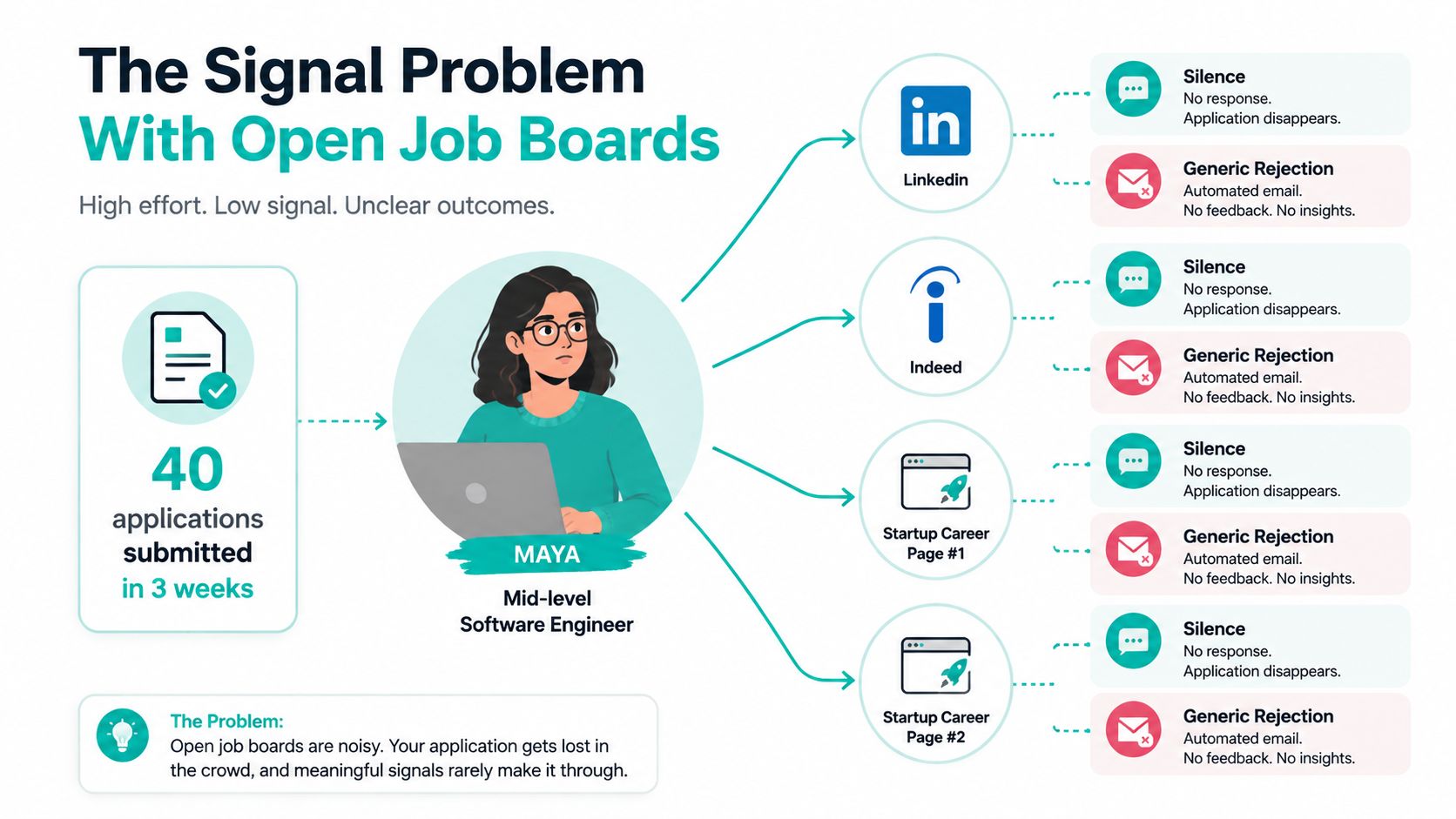
Maya is a mid-level software engineer, and her last three weeks have been the same loop on repeat. She's submitted 40 applications in 3 weeks across LinkedIn, Indeed, and three startup career pages, then watched the day-by-day outcome settle into silence or an automatic rejection. That experience feels personal when you're in it, but the failure is structural.
The hiring side is dealing with the same breakdown from the other direction. Employers post a role, then get a flood of unvetted resumes, many of them loosely relevant at best, and they respond by leaning harder on keywords, brand names, and whatever proxy signal is easiest to filter. The result is a dead-air marketplace where candidates keep applying and recruiters keep sorting, but neither side gets a meaningful match.
Open boards reward the side that can generate the most activity, not the side that can surface the best fit. That pushes candidates to spray applications and pushes employers to automate the first pass, which is exactly where strong talent gets missed. The marketplace economy has also shifted toward control and trust, not just openness, with one report estimating about 60% of e-commerce spend globally now flowing through marketplaces and another putting the share at 67% of all B2C online retail spending in 2024 Cobbleweb's marketplace curation analysis.
For software roles, the mismatch gets sharper because many engineers aren't actively shopping in public. One source in the brief describes 85% of engineers as passive candidates, which explains why a public apply-to-all funnel so often feels empty from both sides. If the best people aren't flooding the board, then the board can't be the whole strategy.
Practical rule: if your funnel depends on volume alone, you'll keep mistaking activity for quality.
The bottleneck isn't applicant effort. It's signal quality, and open job boards are built to collect volume first, then ask hiring teams to manufacture signal afterward.
A curated marketplace is a gated supply system, not just a prettier directory. The platform decides who gets in, what gets shown, and when both sides are allowed to see each other, which is why it behaves more like a controlled matching layer than an open posting board.
The first mechanism is screening. Someone reads the submission, instead of trusting a parser to rank profiles by keyword overlap. That sounds basic, but it changes the shape of the funnel because every later step is built on a cleaner intake.
The second is vetting. A platform may review portfolios, references, technical depth, domain fit, or brand fit before an employer ever sees the profile. In a startup hiring context, that's the difference between sending a founder twenty “maybe” candidates and giving them three people who already clear a meaningful bar.
The third is selective introductions. The marketplace controls who gets introduced to whom, so neither side is spammed. Research on curation and matching shows that how the platform reveals information affects match quality and communication load, which is why the intake form and taxonomy are part of the infrastructure, not an afterthought Management Science on matching design.
The fourth is discreet matching. Passive candidates can explore without making their job search public, and that matters when current employment needs to stay private. In some anonymous hiring workflows, candidate details stay hidden until there's mutual interest, which changes the emotional cost of looking.
A good example is a vetted backend engineer getting three hand-picked intros a week instead of forty cold applications, while a hiring manager sees a dashboard of pre-screened finalists instead of a resume pile. That's not just a better user experience, it's a different supply discipline. A curated marketplace doesn't promise more people, it promises better control over who reaches the next step.
The fastest way to understand the difference is to compare the operating model, not the marketing language. Open boards maximize access, while a curated marketplace maximizes control over who enters the process and how much trust gets attached to each introduction.
| Dimension | Open Job Board | Curated Marketplace |
|---|---|---|
| Access model | Apply-to-all, open posting | Gated submission, review before exposure |
| Screening depth | Keyword filters and inbound sorting | Human review plus vetting before intros |
| Candidate anonymity | Public profile or open resume visibility | Blinded profiles, disclosure after mutual interest |
| Cost structure | Free posting or pay-per-click style spend | Success-based fees or intro-based pricing |
| Best-fit scenario | High-volume junior hiring and active seekers | Niche roles, senior talent, confidential searches |
The row that matters most depends on your pain point. If you need raw volume for a broad role, the open board is still useful because it gives you reach quickly. If the problem is that half the applicants shouldn't have made it into the pipeline at all, then the screening and anonymity rows matter more than reach.
Employers usually feel the cost structure first, because curated partners often charge for outcomes instead of clicks. Candidates feel the access model first, because they stop dumping resumes into a void and start waiting for selective outreach.
That's why the right comparison isn't “which one is better,” it's “which one breaks less under my hiring conditions.” Broad hiring needs breadth. Scarce talent needs control.
The strongest case for curation is simple, it cuts garbage out of the process before people waste time on it. That usually means fewer low-fit submissions, cleaner shortlists, and a candidate experience that feels more intentional because every intro signals real interest on both sides.
The trust piece matters just as much. Buyers of hiring platforms want to know who is doing the verifying, because the verification step itself has become part of the product.
Research on algorithmic assortment curation in online marketplaces found that featured curation can increase orders and visits, especially where search friction is higher, and it can raise average product quality when competition is strong ScienceDirect study on assortment curation. Hiring isn't shopping, but the mechanism carries over. When the platform filters supply before the buyer sees it, the buyer spends less time rejecting noise.
Curated marketplaces also create a better emotional experience for passive candidates. They don't have to explain themselves to every recruiter on the internet, and they don't have to surface a full identity until there's actual mutual interest. That's especially useful when discretion matters.
Hiring teams don't pay for curation because they love fewer options. They pay because fewer wrong options save more time than more raw volume ever will.
The trade-offs are real. Smaller candidate pools can mean slower fill times, and employers may pay more for access or outcomes. Vetting can also introduce bias if the platform's idea of “quality” is too narrow, too pedigree-heavy, or too dependent on a single reviewer's judgment.
That verification gap is the most overlooked issue in curated marketplace coverage. A 2026 trust report in the brief says 92% of consumers say background checks influence their decision, 90% would wait for a fully vetted worker, and 76% think platforms should take significant responsibility for vetting CBR Exchange trust report. Those numbers point to a simple question buyers keep asking, who is verifying the person on the other side?
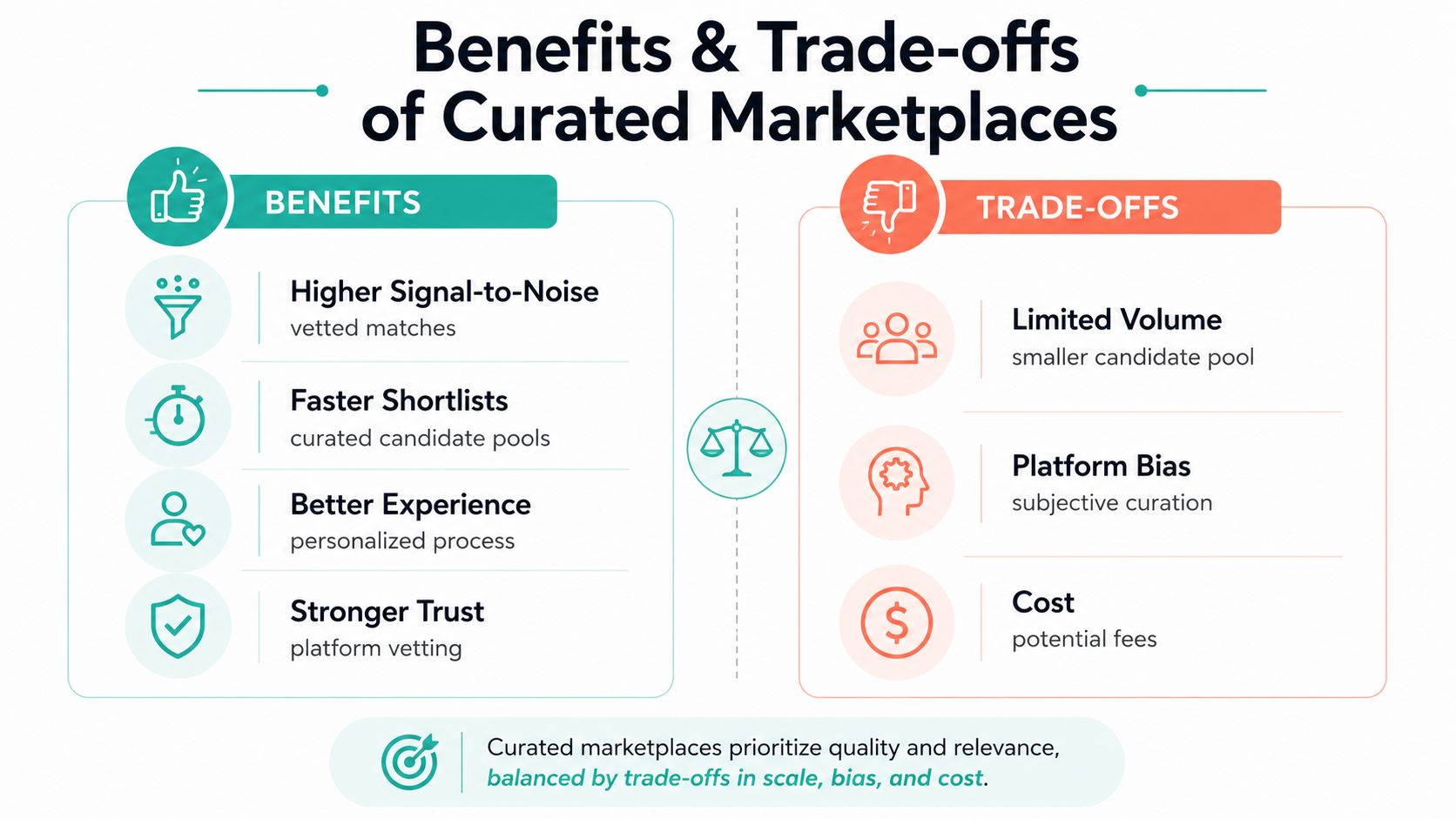
Curated supply also breaks down when the market needs brute-force volume, like hourly staffing or very junior pipelines. It's less effective when geography is scattered, roles are commodity-like, or the hiring team wants maximum reach at minimal cost. In those cases, curation can become a bottleneck instead of an upgrade.
Underdog.io is a useful concrete model because it shows how curation works when the product is talent, not merchandise. The flow is designed around a short application, selective matching, and privacy first, which keeps the experience focused on fit rather than public exposure. The platform's own explanation of the model is laid out in how Underdog works.
A candidate starts with a 60-second application, then the profile is manually reviewed for relevant experience and startup fit. That review matters because the marketplace is trying to screen for people who are already close to the target profile, not to create a giant open funnel that founders have to sort through later.
Once accepted, the candidate gets an anonymous profile shared only with hiring startups after mutual interest. That protects passive candidates, especially people who want to explore while still employed. The matching process is selective, not self-serve, which is why it cuts down wasted outreach.
Companies on the platform are screened too. The marketplace doesn't just accept every employer that wants attention, it checks the startup side for basic quality signals before putting candidates in front of them. That's the part many job seekers miss, because the platform is vetting both directions of the marketplace at once.
For candidates who are also comparing other sourcing channels, visa-sponsored job listings can be a useful parallel resource when immigration support is part of the search criteria. It's a different filter, but the logic is similar, reduce noise before asking candidates to spend time on the wrong openings.
Candidates feel less spam because intros are selective and the visibility is controlled. Employers feel less friction because the marketplace has already filtered out people who don't clear the platform's technical or culture screen.
This isn't the same as an agency, because the marketplace experience is productized and the matching is still narrow enough to preserve candidate control. It also isn't an open board with a prettier front end. It's a curated pipeline that keeps supply tight by design.
A curated platform rewards clarity, speed, and honesty. If you treat it like an open board and blast everything in sight, you'll weaken your own signal because the whole point of the system is that the platform is already doing the filtering for you.
Lead with the role you want, the stack you know, and the kind of impact you've had. A clean summary beats a full resume dump because the reviewer needs to understand fit fast, and the employer needs to understand fit even faster once the intro lands.
Keep salary expectations visible if the platform asks for them. Curated intros collapse fast when comp assumptions stay hidden, because selective matching only works when both sides know whether the conversation is realistic.
Practical rule: respond in hours, not days. Curated marketplaces reward candidates who move quickly because the whole system is designed around intent, not passive browsing.
If you're a startup engineer trying to improve your odds, the guide on how to get recruited by startups lines up with this approach, especially the part about making your project scope and impact legible. The platform can only curate what you make readable.
A curated marketplace works best for candidates who are deliberate. If you're clear about what you want, the marketplace can do the noisy part for you.
Hiring teams often judge curated platforms too quickly, usually by how nice the candidate feed looks in week one. That's the wrong test. The question is whether the platform produces better decisions with less wasted time than your current mix of inbound, referrals, and open posting.
Use this checklist to separate a real curated marketplace from a dressed-up sourcing tool.
| Criterion | What to Look For | Red Flag |
|---|---|---|
| Vetting rigor and methodology | Clear screening steps and documented review standards | Vague “quality” language with no process detail |
| Who does the screening | Named human reviewers or a defined assessment team | Fully opaque or outsourced black box |
| Pricing model | Success-based fees, trial terms, or clear pilot pricing | Lock-in subscription with weak accountability |
| Geographic and specialty coverage | Real density in the roles and regions you hire for | Broad claims with thin local supply |
| Exclusivity clauses | Flexible terms that don't trap you | Long lock-in tied to limited candidate flow |
| Placement transparency | Visibility into past outcomes and fit patterns | No evidence of how prior searches performed |
| Candidate experience metrics | Fast response times and clear intro flow | Slow turnaround and candidate drop-off |
| Ease of pilot or trial | A low-friction way to test the channel | Heavy contract before any proof of value |
A lot of platforms fail on the middle rows. They market curation as if it were outsourcing, then hide the actual review process, which leaves you paying for confidence without seeing the evidence. That's a problem, because curation only works if the buyer trusts the screener as much as the screened.
One helpful benchmark is to compare the curated channel against one open channel for the same role. Use the internal guide for finding software developers as a practical reminder that role definition and sourcing channel should be evaluated together, not separately.
Run two platforms in parallel for thirty days. Measure shortlist quality, response speed, and how often hiring managers say “yes” without extra cleanup against one open channel, then keep the partner that produces the strongest signal-to-hire ratio.
Practical rule: if the platform can't explain who screens, what they screen for, and how fast candidates move, it's not really curation. It's just a slower intake form.
The best partners make the screening logic legible, the pilot easy, and the outcomes measurable. Everything else is branding.
Curation makes the most sense when the cost of a bad hire is high and the candidate pool is narrow. That usually means senior engineers, designers, product leaders, and specialized GTM roles where false positives burn a lot of team time and where passive candidates are more common than active applicants.
It also fits confidential searches. If a founder needs discretion, or a company wants to test a role without broadcasting the search, the anonymous and selective structure is more useful than an open board ever will be. The same is true when employer branding is weak and you need trust to come from the platform rather than the company page.
High-volume hourly hiring is a poor fit because the supply problem there is scale, not precision. Early founder hiring with no budget is another poor fit, since the cost model of a curated partner may not align with the cash reality.
Junior pipelines can also suffer if the platform over-filters too early. If the role benefits from broad exposure and basic screening can be handled cheaply in-house, open channels may still be the smarter first layer.
The clean mental model is this. Choose curation when trust, discretion, and fit are worth more than raw reach, and when you're willing to pay for a partner that reduces noise at the source. Use layered open channels when you need breadth, speed, or low-cost volume and can afford to sort later.
If you're hiring for a startup role and open channels keep drowning you in noise, Underdog.io gives you a curated way to surface vetted tech talent without forcing candidates into a public application pile. Visit Underdog.io to see how a selective marketplace can change the quality of the hiring conversation.