You've probably seen this pattern already. You apply to data analyst roles, get a recruiter screen or two, maybe a take-home, then silence. Or worse, you land interviews for jobs that say “analytics” but turn out to be dashboard maintenance with no real ownership.
That's why a lot of smart candidates stall on startup hiring. They search harder when they should be positioning differently.
For data analyst startup jobs, the winning move usually isn't sending more applications. It's showing that you can walk into a messy environment, define the problem, make reasonable assumptions, and turn data into a decision someone will act on. Startups don't need another person who can pull a clean SQL query from a clean warehouse. They need someone who can handle half-defined metrics, shifting priorities, and leaders who ask better business questions than analytical ones.
If you change your portfolio, your search process, and your interview posture around that reality, your odds improve fast.
A lot of analysts leave larger companies for one simple reason. They're tired of being the person who updates the weekly deck while product, growth, and leadership make the actual calls.
At a startup, that distance between analysis and action is usually much smaller. The same analyst who investigates a drop in activation might also sit in the meeting where the onboarding flow gets changed. The person who notices a sales funnel issue might help decide what the team tests next. That kind of proximity changes the job.

Corporate analyst roles often come with clean ownership boundaries. One team owns finance reporting. Another owns product dashboards. Another handles experimentation. That structure can be useful, but it also narrows your range.
Startup analyst roles often do the opposite. You might touch product analytics in the morning, debug a data-quality issue after lunch, and help a founder frame board-facing metrics by the end of the day. Some people hate that. The right candidates love it because they build judgment faster.
That's also why startup experience tends to compound. You're not just learning SQL, Looker, Tableau, Metabase, Excel, or Python in isolation. You're learning when a quick directional answer is enough, when a metric definition is broken, and when a stakeholder is asking for a chart instead of the decision they need.
Startup analysts get valued for reducing uncertainty, not for producing more output.
This isn't just about preferring a faster environment. The labor market supports the move. The U.S. Bureau of Labor Statistics projects 23% growth in the broader data science and analytics labor market from 2024 to 2034, with about 23,400 openings per year over that decade for data scientists, according to the BLS occupational outlook for data scientists.
For startup hiring, that matters because these companies often recruit from the same quantitative talent pool used for analytics, experimentation, SQL-heavy product work, and business intelligence. In practice, analyst roles are getting treated less like support functions and more like strategic hires.
The biggest misconception is that startup roles are only for extroverted generalists who don't care about rigor. That's backwards.
Strong startup analysts are usually rigorous people who know how to operate without perfect inputs. They don't wait for pristine tracking, perfect documentation, or a polished request ticket. They ask sharper questions sooner.
A startup is often the best place to become the kind of analyst companies remember. Not because the title is fancier, but because the scope is.
You open LinkedIn, search "data analyst startup," and get 400 results. Half are mislabeled BI roles at large companies. A quarter are "remote" jobs with location restrictions buried at the bottom. The rest give you no clear sense of whether the company needs product analytics, growth support, or someone to clean CRM exports all day.
That search pattern creates busy work, not better odds.
High-signal startup roles usually show up closer to the company, the investors behind it, or the operators talking about the problem the company is trying to solve. If your goal is to break into startup analytics, stop treating job search like a volume game. Treat it like research.
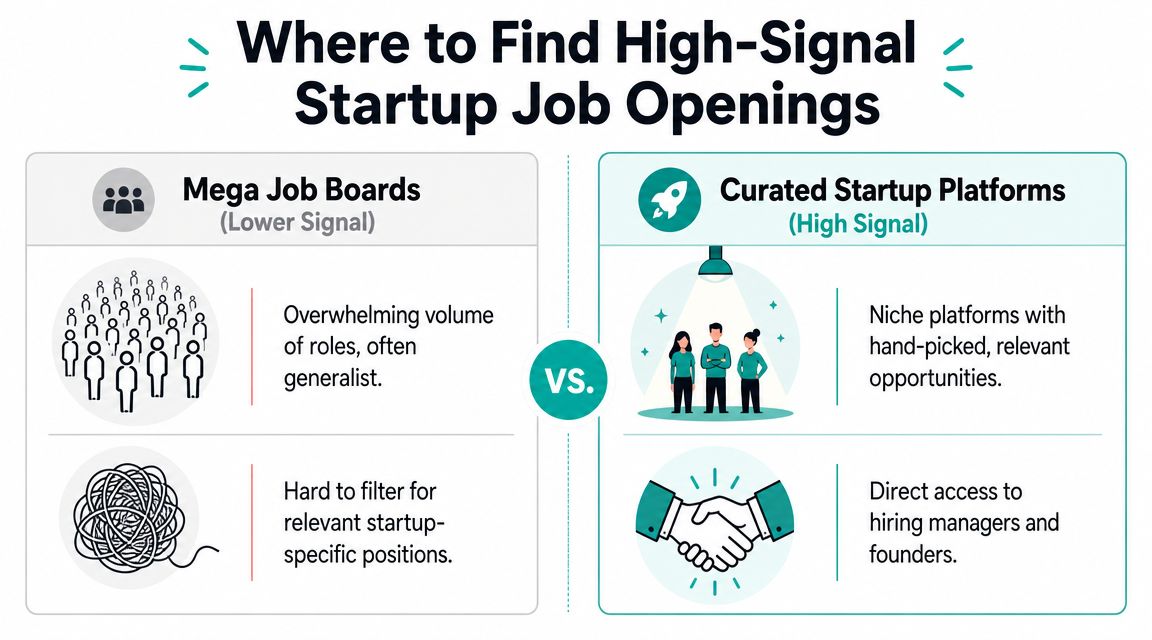
The best sources tell you more than "company hiring analyst."
They tell you stage, business model, recent momentum, team shape, and whether the role sits near product, growth, finance, or operations. That context matters because startup analyst titles are messy. Two companies can post "data analyst" jobs that have almost nothing in common.
The channels I trust most are:
Use broad job boards as a backstop, not your main engine.
A lot of weak applications come from candidates who never pressure-test the posting.
"Remote" can mean remote within one state, remote within the U.S., remote with quarterly travel, or remote but close enough to come onsite twice a month. Startup listings also hide constraints around work authorization, time zone overlap, and team cadence.
A quick screen saves hours:
| Check | What to look for |
|---|---|
| Location language | "Remote" versus "remote in" a specific state, region, or metro |
| Eligibility | Citizenship, work authorization, clearance, or country restrictions |
| Team cadence | Office expectations, travel cadence, or hybrid requirements |
| Role scope | Whether "analyst" means product, growth, operations, or support |
If a company is vague on these points, ask early or move on.
A startup role is only high-signal if you can tell where you can work, who can take it, and what the job is.
Candidates who get traction in startups rarely search one title and spray applications. They search for the business function behind the role.
That means combinations like:
Then check the company before you read the full JD. Look for signs that analytics will influence decisions. Is there a self-serve product? A pricing model with room for experimentation? A growth team? Evidence that the company measures user behavior in a structured way? Those clues tell you more than a generic requirements list.
I also recommend a simple tracker in Notion, Airtable, or Google Sheets. Keep fields for company stage, business model, hiring manager, analyst type, location limits, and whether the role looks strategic or reactive. After 20 to 30 companies, patterns show up fast. You start seeing which startups want impact under ambiguity and which ones just want reporting coverage.
One overlooked move. Make your work easy to inspect before anyone asks for it. A clean LinkedIn profile, pinned portfolio links, and a short project summary can help founders and hiring managers qualify you faster. This guide for founders to showcase work is aimed at visibility, but the same principle applies to analyst candidates. Reduce friction for the person deciding whether to talk to you.
Most analyst portfolios fail for one reason. They prove tool usage, not business usefulness.
A founder doesn't care that you imported a Kaggle dataset, cleaned nulls, wrote window functions, and built a dashboard with nice filters. They care whether you can identify a business problem, choose the right analysis, and explain what should happen next.
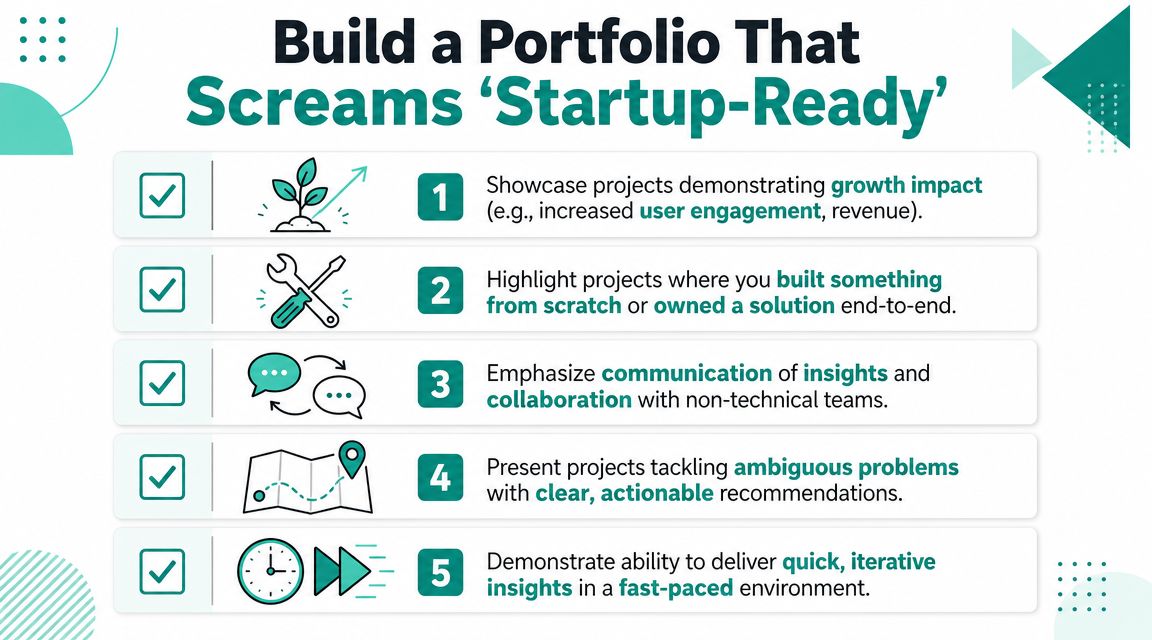
The strongest startup portfolio projects begin with a business question. That's the right frame because a startup almost never hires an analyst to “analyze available data.” It hires one to help answer questions tied to growth, efficiency, risk, or product performance.
That approach lines up with practical analyst training guidance. A high-signal startup portfolio should start with a business problem and produce deliverables in two formats: an interactive dashboard and a consulting-style slide deck, as described in this analyst portfolio guidance video.
Good project prompts look like this:
Those questions sound more like startup work because they are startup work.
Many candidates separate themselves here.
Build:
The dashboard shows that you can build something people can use. The deck shows that you can lead a decision.
A clean portfolio entry might include:
That last point matters. Startups trust analysts who can say, “Here's the likely answer, here's what would change my confidence, and here's what I'd test next.”
Practical rule: If your project can't answer “so what?” in one sentence, it isn't portfolio-ready.
A strong portfolio hidden in a PDF folder won't help much. Put your best work where recruiters and hiring managers already evaluate credibility.
That's why candidates should think beyond GitHub alone. If you want a practical walkthrough on presenting project work in a way hiring teams can find and assess quickly, this guide for founders to showcase work is worth reviewing because the same visibility principles help analyst candidates too.
For startup roles, I'd keep the portfolio tight. Three strong projects beat eight generic ones.
A useful structure is:
| Project type | What it proves |
|---|---|
| Product funnel analysis | Product sense and metric design |
| Churn or retention work | Business judgment and prioritization |
| Marketing or ops project | Cross-functional thinking and recommendation quality |
If you want more startup-specific positioning advice around how teams evaluate candidates, this startup recruiting guide is a good companion to the portfolio work itself.
Startup interviews are often less polished than corporate ones, but they're usually more revealing. The process may look simple on the surface, yet every round is testing for something different: judgment, speed, ownership, communication, and your ability to work without complete information.

Many startup analyst job descriptions collapse multiple functions into one role. They blend dashboards, KPI tracking, experimentation, reporting, user behavior, and even data-quality support. That ambiguity shows up clearly in startup-focused data analyst listings on Indeed.
Don't treat that as sloppy writing alone. Treat it as signal.
It often means one of three things:
None of those are automatically bad. But you need to figure out which one you're interviewing for.
A startup interview loop usually has fewer formal steps, but more hidden questions.
| Interview stage | What they say they're testing | What they're actually testing |
|---|---|---|
| Recruiter screen | Background and fit | Can you tell a coherent story and sound startup-compatible |
| Hiring manager round | Skills and experience | Can you frame messy work and make trade-offs |
| Take-home or case | Technical ability | Can you structure ambiguity and communicate clearly |
| Founder or cross-functional round | Team fit | Will people trust your judgment under pressure |
A lot of candidates overprepare for the technical portion and underprepare for the business conversation. That's backwards for startup analytics.
If you get a case with missing context, don't panic and don't fill in assumptions as if they were facts. State them. Show the branches. Explain what you'd ask for if this were live.
For example: “I'd want cohort-level retention before recommending a channel shift, but with the information here, I'd prioritize onboarding friction over acquisition volume because the drop-off appears closer to activation.”
That answer shows more maturity than a perfect query with no point of view.
Most candidates ask weak closing questions. They ask about culture, team size, and what success looks like in broad terms. That's fine, but it won't help you decode the work.
Ask sharper questions:
Their answers will tell you whether the role is product analytics, growth analytics, operations support, or a hybrid with a lot of unglamorous cleanup.
The interview is not just a performance. It's your only clean chance to find out whether the company wants a strategist, a service desk, or both.
Startup offers confuse candidates because the headline number rarely tells the whole story. A base salary can look solid, then the equity is unclear, the vesting terms are buried, and nobody explains what happens if the company exits, stalls, or you leave.
Start with base pay, but don't stop there.
A 2026 job-posting analysis reported an average U.S. data analyst salary of $111,000, with entry-level pay around $90,000 and senior compensation at $119,000+. The same analysis found that roles advertising over $100K made up only about 30% of postings, and that New York accounted for 26% of listings. That concentration matters when you benchmark an offer for startup roles. See the full breakdown in this data analyst salary and job outlook analysis.
A startup offer usually includes some combination of the following:
The salary needs to make sense for your market and your risk tolerance. If the company wants startup flexibility from you, you should be equally clear-eyed about what you're taking on.
A lot of candidates nod through the equity section because they don't want to sound inexperienced. That's a mistake.
Ask:
You don't need to turn the offer call into a finance seminar. You do need enough clarity to understand whether the equity is meaningful, speculative, or mostly symbolic.
A practical habit is to model a few scenarios on paper. What if the company grows well? What if it raises again and dilutes? What if you stay long enough to vest a meaningful amount? For a quick framework, a startup equity calculator can help you translate abstract option numbers into something easier to reason about.
Early-stage companies often have less flexibility on salary than big companies. That doesn't mean you have no negotiating power.
What usually works:
What doesn't work:
Good startup offers are understandable. If you need three follow-up calls just to decode the basics, slow down.
Getting hired is the easy part compared with becoming useful fast. In a startup, nobody wants an analyst who spends months “getting ramped.” They want someone who builds trust, learns the business, and delivers something concrete before patience runs out.
The first ninety days set your reputation.
Your job at the start is diagnosis, not heroics.
Learn the business model, the product, the core metrics, and the key decision-makers. Figure out where definitions break, where dashboards disagree, and which teams are waiting on data but haven't phrased the problem well yet.
You should also map the data flow end to end. If pipelines are messy or source systems don't line up, your first win may come from fixing confusion before you build anything new. A practical explainer on understanding data integration challenges can be particularly helpful, especially if you're inheriting startup systems that were stitched together quickly.
Now you need one visible win.
Not a giant re-architecture project. Not a perfect semantic layer rebuild. One useful piece of work that makes someone's week easier or makes a decision faster.
That might be:
Pick something small enough to finish and important enough that people notice.
The fastest way to earn trust is to solve a problem people already complain about.
By this point, you should know where the company is reactive and where it needs more structure.
That's when you shift from responsive analyst to analytical partner. Propose a short roadmap. Show which questions deserve deeper work, which reporting should be automated, and which metrics need owner-level clarity.
Don't present it like a grand strategy memo. Present it like someone who understands startup reality: here's what matters now, here's what can wait, and here's how analytics can support the next stretch of growth.
If you do that well, you won't just survive your first quarter. You'll define the role around your strengths instead of inheriting it exactly as you found it.
If you're targeting startup roles and want a more focused path than mass-applying, Underdog.io is one way to get in front of vetted startups through a single application. For candidates pursuing data analyst startup jobs, that kind of curated exposure can save time and surface roles that are easier to evaluate for fit.