One in three new hires leaves within the first 90 days (onboarding research summary). That number should change how every startup thinks about onboarding an employee. It's not a welcome ritual, a laptop handoff, or a benefits packet. It's a 90-day retention system that decides whether a person gets clarity fast enough to stay, contribute, and build momentum.
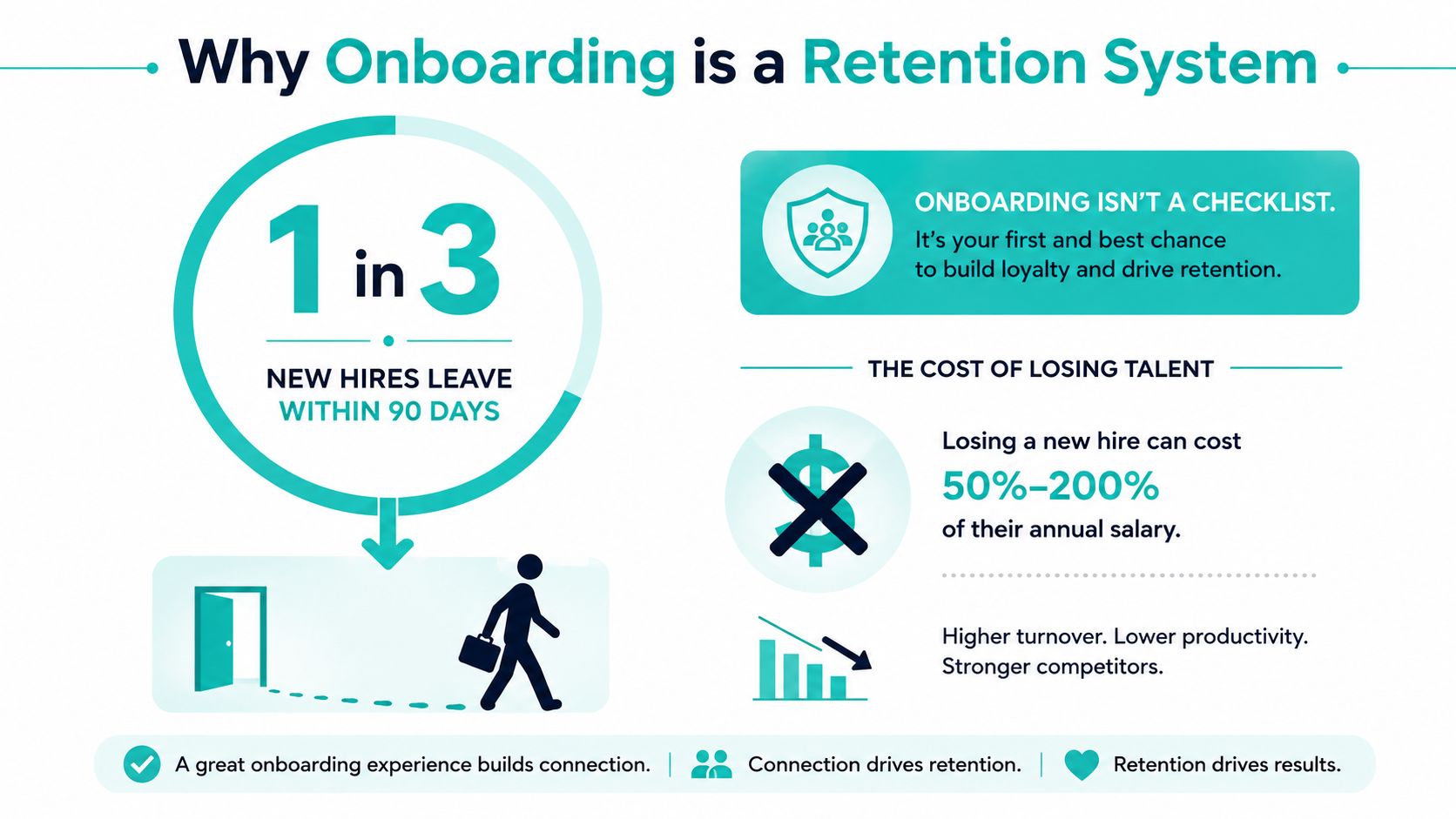
The problem starts early. 70% of new hires decide whether a job is the right fit within the first month, and 29% decide within the first week (same onboarding research stream). Yet only 12% of employees say their organization has a good onboarding process (BambooHR benchmarking guide). In plain startup terms, most companies are leaving the most fragile part of the employee journey to chance.
That's why structured onboarding keeps showing up as a retention and productivity lever. Better programs are associated with stronger retention, and effective onboarding can lift productivity by up to 60% (Yomly onboarding statistics). The practical takeaway is simple. The first six weeks matter far more than the first six hours, because that's when people decide whether they understand the job, trust the manager, and can ship.
If you want the short version, the playbook is this, preboarding, a tight first-week checklist, role-specific ramp plans, manager cadence, remote-friendly adjustments, compliance handled on time, and measurement that goes beyond “How was your first week?” Teams also do well to borrow ideas from resources on onboarding swag programs, but swag only helps when the system behind it is real.
A startup can lose a promising hire before that person ever becomes useful. The usual culprit is fog, weak manager cadence, and too much administrative noise in the opening stretch.
The strongest onboarding an employee program is measured by whether a new hire can ship meaningful work by week six. It has to clear the path for real output, not just a good first impression. On a typical startup, the first two weeks can disappear into IT access, scattered docs, and waiting for answers, which is exactly when doubt starts to set in.
The clearest way to frame onboarding is as a retention system with a clock attached. Early on, new hires are deciding whether the role matches what recruiting sold them, whether the team is organized, and whether the manager can run the job. Structured onboarding gives those judgments somewhere to land before frustration turns into a resignation.
A lot of founders over-index on day one polish and underinvest in weeks two through twelve. That is backwards. The evidence points to the earliest stage as the place where employees form lasting judgments about fit, clarity, and stay-or-go decisions, which is why a one-day orientation cannot carry the load (onboarding research summary).
Structured programs reduce ambiguity. They make the manager accountable, they create a social path into the team, and they turn “figure it out” into a sequence of visible milestones. That is also why onboarding should be run as a business process, not an HR event.
Practical rule: If a new hire cannot explain their first mission in plain language by the end of week one, onboarding is already behind.
The startup trade-off is real. You do not need an enterprise program, but you do need a system that covers preboarding, first-week logistics, role ramp, and regular check-ins. The rest of this playbook is built for scrappy teams that cannot afford to let early confusion snowball. Teams can also borrow ideas from onboarding swag programs, but swag only helps when the system behind it is real.
Good onboarding feels calm, coordinated, and specific. The manager knows what success looks like. The buddy knows where to point the new hire for context. People Ops knows what paperwork cannot slip. The new hire gets a small, visible win early enough to build confidence.
The strongest versions of onboarding also match the role. An engineer does not need the same first month as a designer, and a PM does not need the same setup as an analyst. Once you accept that, the whole process gets easier to design.
A bad first week usually starts before day one. The laptop is late, access is missing, the calendar is empty, and the new hire spends the morning waiting on other people's mistakes. The U.S. Office of Personnel Management checklist helps because it turns the first week into concrete actions, and a practical employee checklist gives startups the same discipline without turning onboarding into bureaucracy.
The goal is to clear friction before the hire shows up. Ship the equipment early, provision accounts, and send a short welcome note from the manager. In a small team, one missed setup item can turn into three people chasing the same fix, which wastes time and sets the wrong tone.
A sane preboarding flow looks like this:
New hires notice whether the company was ready for them. That memory lasts longer than a polished welcome email.
Teams that are still tightening their People Ops habits can also use build a world-class onboarding experience as a reference point, especially if they need a simple way to standardize the basics.
The first day should be practical. The hire completes orientation, meets the manager, gets into the system, and ends with a short debrief. The rest of the week should add a buddy or mentor, a first assignment, review of the role description and work plan, required training, and payroll and benefits paperwork. The same OPM checklist keeps that sequence tidy without making the process feel heavy.
In startup terms, compress the admin into one short block and use the rest of the week for context plus one visible output. When the first week is mostly paperwork, new hires feel like administrators, not team members. If they ship a small artifact by Friday, they start to feel momentum.
The compliance timing sits beside all of this. Form I-9 Section 1 must be completed no later than the first day of work, and Section 2 must be completed within 3 business days of the hire date (I-9 timeline reference). That deadline belongs in the same onboarding tracker as the rest of the setup, not buried in someone's inbox.
Generic onboarding wastes talent fast. Engineers get access but no meaningful ticket, PMs get meetings without customer signal, and designers get context without a path to production. A better ramp plan gives each role a narrow first mission, clear ownership, and a measurable output at each stage.
An engineer's first week should answer three questions, where is the code, what breaks when I touch it, and what can I ship without risk. Repo access, local setup, and a short list of well-scoped issues do more for confidence than a stack of process docs. A “good first issue” works because it reveals the repo shape without asking the hire to bet the roadmap.
By day 30, a strong engineering ramp should include a small shipping project. That project doesn't need to be glamorous, but it should be real enough that the team can review it in production terms. If the new hire is on-call, shadowing before solo responsibility is usually the right trade-off.
Product managers usually stall when they can't get close to customers quickly. Their ramp should include interview exposure, a small surface area they can own, and a written memo by around day 60 that shows judgment on a real problem. That memo is useful because it forces the PM to move from note-taking to prioritization.
Designers need a different path. They usually ramp best when they're grounded in the design system, paired closely with a senior designer, and pushed toward a contained flow that reaches production by day 60. The goal is to prove the hire can ship within existing product constraints.
A simple comparison helps managers keep the plans honest.
| Role | Early focus | Milestone signal |
|---|---|---|
| Engineering | Repo access, setup, one small issue | Ships a small project by day 30 |
| Product | Customer access, surface ownership, problem framing | Writes a useful 60-day memo |
| Design | System fluency, pairing, production flow | Ships a contained flow by day 60 |
Keep the milestone small enough to finish and meaningful enough that the team cares. That gives the hire a real target without turning the ramp into a vague stretch assignment.
Location changes the onboarding plan more than many teams admit. A hire in another timezone needs different logistics, different touchpoints, and a more deliberate path into the team. If you keep one process for office, hybrid, and fully remote employees, the remote hire gets less context and more delay.
Start with equipment and access. A fully remote hire needs gear shipped on time, not promised later, and the setup has to work across borders if that is where they live. Some teams choose a company-issued laptop and peripherals. Others use a stipend. The right choice depends on control, tax handling, and how much variation your team can tolerate.
For policy design, teams usually keep a written remote work policy close by, and a practical reference is remote work policies. The goal is to cut ambiguity before the new hire becomes someone else's blocker.
Remote employees need structured social exposure because they will not pick up context in the hallway. A written first-week guide, a recorded welcome, and a planned rotation of introductions all help. The manager should also set a timezone-aware check-in cadence so the new hire is not waiting half the week for replies.
A few remote-specific additions make a real difference:
Hybrid hires need less handholding than fully remote hires, but they still need clear expectations about when in-person time is for connection and when it is for heads-down work. In-office hires can rely more on informal context, so some of the structured introduction work can be lighter. The mistake is assuming office proximity replaces onboarding structure. It covers only part of it.
Onboarding falls apart when ownership is fuzzy. The manager assumes People Ops owns it, People Ops assumes the manager owns it, and the new hire assumes nobody does. Clarity about who owns what at each stage matters before the offer is extended, because that is where mismatch risk is lowest.
The manager owns goal setting, ramp plan quality, and feedback. That means the manager has to define what “good” looks like, not just ask how things are going. The buddy or peer owns cultural translation, the small unspoken questions, and the practical unblocker role. The new hire owns the small artifacts, early communication, and saying when something is unclear.
That division keeps onboarding active. New hires should not wait around for the company to teach them how to work. They should be shipping something small while they learn the rest.
Practical rule: If the buddy is doing all the emotional labor and the manager is doing all the planning, the system is brittle.
SHRM recommends structured follow-ups at 30, 60, 90, and 120 days, with onboarding lasting months rather than days (SHRM onboarding guidance, SHRM effective onboarding guidance). That cadence works because each meeting should answer a different question. At 30 days, check role confidence and blockers. At 60 days, look at whether the first meaningful work shipped. At 90 days, check whether performance is steady. At 120 days, ask whether growth is visible.
A one-pager is enough for a small team. Keep the owner, the artifact, and the success signal in the same place so nobody has to guess.
A structured manager interview process helps here too, and a practical guide is hiring manager interview training. The point is simple. The manager, buddy, and new hire each need a clear job in the ramp, and the cadence should make that visible instead of assumed.
A strong onboarding plan still falls apart if the compliance pieces wait until the end of the week. The risk shows up fast when payroll, benefits, and start-date paperwork are handled as an afterthought.
Form I-9 is the one many teams miss under pressure. The employee completes Section 1 no later than the first day of work, and the employer completes Section 2 within 3 business days of the hire date (I-9 timeline reference). The same I-9 timeline reference also says employers must retain the form for 3 years after hire or 1 year after employment ends, whichever is later (same I-9 timeline reference).
W-4 collection usually happens at the same time as payroll setup, because waiting creates messy first checks. State new-hire reporting also matters, but the process varies by state, so this is one of those tasks the payroll system should carry. Direct deposit, benefits enrollment windows, and workers' comp classification should all sit in the same intake flow.
Harassment training is easy to forget until a state requires it. If your startup hires in multiple states, write the checklist by location, not just by role. Teams using systems like Gusto, Rippling, or Deel can automate many compliance steps, but they can't interpret local exceptions for every state.
Visa hires add another layer. Timing and documentation can shift quickly, so founders should keep a dedicated reference like hiring visa candidates as a startup in the same operating folder as onboarding materials. That keeps the team from scrambling after the offer is accepted and the start date is close.
A single “How was onboarding?” survey is too blunt to be useful. It comes late, people answer politely, and it misses the failure modes that show up before someone starts looking around. A better scorecard uses signals that show whether the employee is ramping.
The first signal is time-to-productivity, which is when the new hire ships a real artifact. For an engineer, that might be a code change. For a PM, it could be a memo or decision doc. For a designer, it might be a production flow. Track the first visible output, not the moment orientation ends.
The second signal is manager touchpoint quality. A calendar 1:1 that does not surface blockers is noise, not signal. The question is whether the conversation clarified priorities, changed what happened next, and helped the new hire move faster. If manager meetings do not change behavior, they are just recurring meetings.
The third signal is role confidence. Ask the new hire to rate confidence at 30 and 90 days on a simple 1 to 5 scale. This is a direct proxy for whether they understand expectations and can operate without constant rescue. It also gives the manager something concrete to compare over time.
The fourth signal is 90-day retention itself, because retention is still the cleanest proof that the system held. That matters even more for remote and hybrid hires, where hidden friction can go unnoticed for weeks.
A good onboarding scorecard catches problems before the exit conversation exists.
A simple table works well, with Day 30, Day 60, and Day 90 columns, then rows for the four signals above. Keep it in the HRIS or a shared doc on day one. For low-volume teams, a manual tracker is fine. For fast-growing startups, consistency matters more than sophistication.
Do not turn this into a sprawling questionnaire. Keep each check-in focused, use the same few signals every time, and make the manager responsible for acting on what they learn. The right question at the wrong time is still a bad system.
A lightweight startup checklist usually includes three artifacts, a preboarding checklist, a role-specific 30-60-90 plan, and a manager cadence doc. That trio keeps the process from drifting. If you want to keep improving it, start with the first 30 days, because that is where most onboarding failures become visible before they harden.