Navigating the startup interview process requires more than just knowing algorithms; it demands a deep understanding of problem-solving, collaboration, and pragmatism. While LeetCode grinds have their place, the real signal comes from how you articulate your experience and approach complex, real-world challenges. Many candidates can solve a theoretical puzzle on a whiteboard, but far fewer can clearly explain how they debugged a production crisis or negotiated a technical tradeoff with a product manager. This distinction is what separates a good candidate from a great hire, especially at the fast-paced startups featured on platforms like Underdog.io.
This guide provides a comprehensive breakdown of the most impactful engineer interview questions that probe beyond pure coding ability. We are moving past abstract theory to focus on the practical, behavioral, and system-design questions that truly reveal your engineering mindset. For each question, we provide a clear framework for constructing a compelling answer, complete with practical examples and specific tips for demonstrating your skills.
You will learn not just what to say, but how to frame your experiences to showcase your technical depth, problem-solving skills, and collaborative spirit. This curated list is your roadmap to mastering the conversations that lead to compelling offers. We will cover everything from detailing your most significant projects and explaining your debugging process to discussing architectural decisions and your philosophy on managing technical debt. This is about preparing you for the questions that matter most.
1. Tell Me About a Technical Problem You Solved and Your Approach
This classic behavioral question is a staple in engineer interview questions because it’s a powerful diagnostic tool. Hiring managers use it to evaluate your problem-solving methodology, technical depth, and communication skills all at once. It reveals how you deconstruct an ambiguous challenge, apply your expertise, and articulate complex concepts to others. For startups, this is especially critical; they need engineers who can tackle novel problems autonomously and share knowledge effectively within a small, fast-moving team.
How to Structure Your Answer
The STAR method (Situation, Task, Action, Result) is your best friend here. It provides a clear, compelling narrative that guides the interviewer through your thought process and highlights your impact.
Situation: Briefly set the scene. "Our e-commerce platform's checkout API response time was degrading, exceeding 3 seconds during peak traffic."
Task: Define your responsibility. "My task was to diagnose the performance bottleneck and reduce latency to under 500ms to prevent cart abandonment."
Action: Detail the steps you took with technical specifics. "I used a profiler which revealed N+1 query patterns in our order processing service. Specifically, the code was looping through cart items and fetching product details one by one. I refactored this to use a single IN clause to batch-load all product details at once. For session data, I implemented a Redis cache with a 15-minute TTL, which eliminated another 400ms of database lookups per request."
Result: Quantify your success with metrics. "These changes reduced the average API response time from 3.2 seconds to 150ms, supported a 20% increase in peak traffic, and contributed to a 5% uplift in conversion rates in the following quarter."
Actionable Tips for Success
Choose a Problem with Nuance: Select a problem that wasn't just a simple bug fix. A great example involves a trade-off, a performance puzzle, or an integration challenge that required you to learn something new.
Quantify the 'Before' and 'After': Use metrics to create a clear picture of your impact. Instead of "I made it faster," say "I reduced p99 latency from 1200ms to 250ms."
Show Humility and Collaboration: Mention what you didn’t know initially. "At first, I suspected a network issue, but after collaborating with the SRE team and reviewing our monitoring dashboards, the data pointed clearly to an application-level problem."
2. Walk Me Through Your Most Significant Project From Start to Finish
This question moves beyond a single problem to assess your understanding of the entire project lifecycle. Interviewers use it to gauge your sense of ownership, strategic thinking, and ability to navigate a project from ideation to delivery. For startups, this is crucial; they need engineers who can manage features end-to-end, considering not just the code but also the product requirements, stakeholder communication, and post-launch impact. It’s one of the most revealing engineer interview questions for evaluating big-picture thinking.
How to Structure Your Answer
A chronological narrative works best. Guide the interviewer through the project’s journey, highlighting your specific contributions and decision-making process at each stage.
Situation: Describe the project's goal and business context. "Our company needed to build a real-time notification system to increase user engagement and serve over 50,000 daily active users."
Task: Explain your role and responsibilities. "As the lead engineer on a team of three, I was responsible for the technical design, core backend implementation, and coordinating the deployment strategy."
Action: Detail the project's progression and key decisions. "I began by prototyping two solutions: one with long-polling and another with WebSockets. I presented a one-page document to the team showing that while long-polling was simpler, WebSockets would reduce our server load by 70% at scale. We chose WebSockets. A key challenge was handling connection drops on mobile clients, which I solved by implementing an exponential backoff-with-jitter reconnection strategy on the client side."
Result: Quantify the project's success. "The system launched and now handles over 1 million concurrent connections at peak. It directly contributed to a 15% increase in daily user engagement. Post-launch, I created a runbook for the on-call team and documented the architecture to help onboard new engineers."
Actionable Tips for Success
Focus on the 'Why': Don't just list what you did; explain why you made key technical decisions. "We chose PostgreSQL over a NoSQL solution because the relationship between users and notifications was highly relational, and we wanted to leverage its transactional integrity."
Acknowledge Challenges and Trade-offs: Discussing things you would do differently shows self-awareness. "In retrospect, we should have load-tested the connection manager earlier, as it revealed a bottleneck that delayed our launch by a week."
Connect to Business Impact: Frame the project's outcome in terms of business metrics. "This system unlocked our ability to launch time-sensitive promotions, which became a new revenue stream."
3. Describe Your Experience With [Specific Technology Stack] and How You'd Approach Learning a New One
This question serves a dual purpose for hiring managers. It gauges your current expertise with their stack while simultaneously testing your adaptability and learning agility. For startups, where technology choices can pivot quickly, this is invaluable. They need engineers who are not only proficient today but can also grow with the company, quickly mastering new tools to solve emerging business problems. It's a key question to see if you can make sound technical judgments.
How to Structure Your Answer
A strong answer demonstrates both current depth and future potential. It combines a confident summary of your skills with a clear, repeatable process for acquiring new ones. This shows you are both a reliable expert and a proactive learner.
Current Expertise: Be specific and quantify your knowledge. "I have over four years of production experience with a React and Node.js stack. In my last role, I was responsible for a service that handled 10,000 requests per minute. I focused heavily on performance optimization using React.memo and useCallback, and designed RESTful APIs in Node following OpenAPI specifications."
Learning Process: Transition to explaining your method for learning. "When my last team adopted GraphQL, my first step was to build a small personal project—a simple to-do app—to understand the core concepts of schemas and resolvers. I then read the official docs, focusing on best practices for things like the N+1 problem. I solidified my learning by preparing and leading a lunch-and-learn for my team."
Technology Philosophy: Conclude by showing strategic thinking. "I believe in being pragmatic. While I stay current on trends via newsletters like ByteByteGo, I evaluate new tools based on their ability to solve a specific problem. Understanding how to choose a tech stack for growth is more important than just adopting the newest framework."
Actionable Tips for Success
Be Honest and Specific: Clearly distinguish between "I've used it in production for years" and "I've built a few side projects with it." It’s better to be honest than to overstate your skills.
Provide an Actionable Plan: Instead of a vague "I'd read the docs," give a step-by-step plan: 1) Build a toy project, 2) Read official documentation for best practices, 3) Find and study a well-regarded open-source project using the tech, 4) Apply it to a small, non-critical feature at work.
Show Enthusiasm: Frame learning new technologies as an exciting opportunity, not a chore. This highlights a growth mindset, which is highly valued in fast-paced environments.
Ready to Ace Your Startup Interview?
You've studied the questions—now find the right stage. Underdog.io connects talented engineers directly with hiring managers at top, innovative startups.
4. How Do You Approach Writing Testable Code and What's Your Testing Philosophy?
This question probes your engineering maturity and commitment to long-term code quality. Hiring managers use it to see if you think beyond just making code work; they want to know if you consider maintainability, reliability, and the impact of your code on future developers. For a scaling startup, this is vital. They need engineers who build robust systems, not fragile ones that break with every change, and your testing philosophy is a strong indicator of your engineering judgment.
How to Structure Your Answer
A great answer balances principles with pragmatism, demonstrating you understand both the "why" and the "how" of testing. Structure your response to cover your principles, practices, and a concrete example.
State Your Philosophy: Start with your core belief. "My philosophy is that tests should provide confidence and serve as living documentation. I write testable code from the start by using dependency injection to mock external services and keeping functions focused on a single responsibility."
Describe Your Process: Explain the different types of tests you use and when. "I follow the testing pyramid: a strong base of fast unit tests using Jest, fewer integration tests to verify database interactions, and a small number of end-to-end tests using Cypress for critical user flows like checkout. I'm pragmatic about coverage; I aim for 90%+ on complex business logic, but I don't chase 100% on simple data models."
Provide a Specific Example: Ground your philosophy in a real-world scenario. "On a recent project, I used Test-Driven Development (TDD) for a complex payment processing module. Writing a failing test for each edge case (like expired cards or insufficient funds) forced me to design a clear and robust API before writing the implementation. This caught several issues that would have been painful to debug in production."
Acknowledge Trade-offs: Show you understand the startup environment. "While I advocate for a strong testing culture, I know that sometimes a feature needs to ship fast. In those cases, I prioritize testing the most critical paths and create a tech debt ticket to add more comprehensive tests in a subsequent sprint."
Actionable Tips for Success
Name Drop Frameworks: Mentioning specific tools (e.g., Jest, Pytest, RSpec, Cypress, Playwright) adds credibility and shows practical experience.
Connect to CI/CD: Explain how your testing strategy integrates with a CI pipeline (e.g., GitHub Actions) to automate quality checks and block merges on test failures. This shows you think about the entire development lifecycle.
Be Pragmatic, Not Dogmatic: Avoid rigid statements like "I always write tests first." Instead, say, "I find TDD most valuable for complex, mission-critical logic, but for simpler UI components, I might write tests after the implementation."
5. Tell Me About a Time You Failed and What You Learned From It
This behavioral question is less about your failure and more about your response to it. Hiring managers use this prompt to evaluate your humility, self-awareness, and capacity for growth. It reveals how you handle adversity, take ownership of mistakes, and transform setbacks into valuable lessons. For a startup, where navigating ambiguity and learning from frequent missteps is part of the job, this is a non-negotiable trait. They need to see that you can fail, recover, and become a stronger engineer because of it.
How to Structure Your Answer
The STAR method is again an excellent framework, but with a slight twist to emphasize the learning aspect. Let's call it STAR+L (Situation, Task, Action, Result + Learning).
Situation: Describe the context of the failure. "Early in my career, I was tasked with a database migration for our users table under a tight deadline."
Task: Clearly state your role and the specific mistake. "My task was to add a new is_active column. In my haste, I wrote a migration script that locked the entire table while it updated millions of rows, not realizing the performance impact."
Action: Detail the immediate negative outcome and your response. "The deployment caused a 15-minute outage as all user-related requests timed out. I immediately worked with the on-call engineer to roll back the change. I then owned the communication in our incident channel, explaining what happened and when we expected service to be restored."
Result & Learning: Quantify the impact and articulate what you learned and how you changed. "The incident impacted thousands of users. The key lesson was the danger of long-running transactions in a live environment. Since then, I’ve become a vocal advocate for using tools that allow for non-locking migrations and always test migration scripts on a production-sized data staging environment. It fundamentally changed my approach to database changes."
Actionable Tips for Success
Own It Completely: Do not blame teammates or external factors. Use "I" statements: "I made the mistake of..." or "I overlooked..." to show full accountability.
Focus on the Lesson: Spend 20% of your answer on the failure and 80% on your analysis, corrective actions, and the long-term changes you made. The "learning" part is the most critical.
Choose a Real, Technical Failure: Avoid a "humblebrag" like "I cared too much about code quality." Pick a genuine technical error with tangible consequences. It shows you're authentic and not afraid to be vulnerable.
6. How Do You Approach Code Reviews and Architectural Decisions in a Team?
This question moves beyond individual coding ability to assess your impact as a team member and potential leader. Interviewers use it to gauge your collaboration style, technical judgment, and communication skills. For a startup, hiring managers want to see if you can contribute to a culture of quality and make sound collective decisions in an environment of high uncertainty, balancing speed with long-term code health.
How to Structure Your Answer
Frame your answer to highlight your collaborative and constructive approach. Show that you view these activities as opportunities for team growth, not just gatekeeping.
Code Review Philosophy: Start with your core belief. "I see code reviews as a collaborative tool for improving the codebase and sharing knowledge. My goal is to be constructive, not critical. I follow a principle of 'praise in public, suggest in private,' leaving positive comments on the PR but discussing major changes in a quick Slack huddle."
Architectural Decision Process: Detail how you facilitate group decisions. "For architectural choices, I advocate for a lightweight RFC (Request for Comments) process. I'll write a short document outlining the problem, at least two potential solutions with their pros and cons (e.g., cost, complexity, performance), and my recommendation. For example, when deciding on a new database, I compared PostgreSQL and DynamoDB across axes of consistency, scalability, and operational overhead."
Handling Disagreements: Explain your method for reaching consensus. "The RFC is then shared with the team for comments. The goal is to reach a consensus, but if we can't, we 'disagree and commit.' The most important part is documenting the why behind the final decision so future engineers have context."
Actionable Tips for Success
Provide Specific Examples of Feedback: Instead of saying "I give good feedback," describe it. "In a recent review, I noticed a teammate was manually constructing a complex string. I suggested using a template literal for readability and left a link to the MDN docs explaining the benefits. It was a small thing, but it improved our code and helped them learn."
Emphasize Psychological Safety: Mention that you always start reviews with a positive comment and frame suggestions as questions (e.g., "Have you considered what might happen if this input is null?"). This shows you care about creating a supportive environment.
Discuss Documentation: Highlighting that you document architectural decisions in a shared space like Confluence or Notion shows foresight and a commitment to the long-term health of the team.
7. How Do You Balance Shipping Speed With Technical Debt?
This question probes your strategic thinking and pragmatism, especially in a startup environment where speed is a competitive advantage. Hiring managers want to see that you understand the business implications of engineering decisions. They’re assessing your ability to make conscious, calculated trade-offs between rapid delivery and long-term code health, rather than blindly pursuing architectural perfection or accumulating unmanageable debt. This is one of the more telling engineer interview questions for senior roles.
How to Structure Your Answer
Frame your response around a philosophy of strategic debt management. Show that you view technical debt not as a failure, but as a tool that can be used deliberately and responsibly. Use a clear framework to explain your approach.
Acknowledge the Trade-Off: Start by validating the premise. "In a startup, speed is a feature. I view technical debt as a loan taken out to ship faster and get market feedback, but like any loan, it must be managed with clear terms and a repayment plan."
Explain Your Process: Detail your system for managing debt. "My approach is to make debt explicit. When we take a shortcut, we create a tech debt ticket in Jira with a standard format: what the shortcut was, why we took it, the risk of not fixing it, and the estimated effort to fix. We then review these tickets quarterly during our planning sessions."
Provide a Specific Example: Use a real-world scenario. "For a new marketing feature, we needed to launch in two weeks. I proposed hardcoding some configuration values instead of building a full admin UI. This was logged as tech debt. We hit the deadline, and three months later, when the marketing team needed to change the config frequently, we prioritized the ticket to build the proper UI."
Connect to Business Goals: Show how you align technical decisions with business needs. "I always communicate the trade-offs to product. For a critical payment module, I'll argue for zero debt due to the high cost of failure. But for a v1 internal tool, taking on debt is a smart trade-off to validate its usefulness quickly."
Actionable Tips for Success
Show Proactive Management: Talk about allocating a fixed capacity (e.g., 15-20% of each sprint) to address tech debt. This shows you're disciplined, not just reactive.
Use a Prioritization Framework: Explain how you decide which debt to fix first. "I prioritize debt that slows down new feature development the most, as that has the highest compounding cost."
Discuss Communication: Emphasize how you frame debt to non-technical stakeholders. "I don't say 'the code is bad.' I say, 'Fixing this will let us build the next three features 50% faster.'"
Be Balanced: Avoid extreme positions. Stating you never incur tech debt can signal a lack of pragmatism in a startup environment.
Candidates should also be prepared to discuss strategies for managing long-term codebase health, such as by actively engaging in discussions about reducing technical debt.
8. Describe Your Debugging Process and How You'd Handle an Obscure, Hard-to-Reproduce Bug
This question tests your persistence, logical reasoning, and ability to handle ambiguity. Hiring managers want to see if you have a systematic approach or if you resort to guessing. For startups, where systems can be new and undocumented, a methodical debugging process is a crucial skill. It reveals your engineering maturity and how you operate under pressure when the answer isn't obvious.
How to Structure Your Answer
Frame your response as a systematic investigation. Avoid saying you’d just “start looking at the code.” Instead, describe a structured, multi-step process that shows you’re driven by evidence, not intuition.
Gather Data & Reproduce: "First, I’d gather all context from logs, monitoring dashboards like Datadog, and user reports. My immediate goal is to reproduce it reliably in a local or staging environment. If I can't, I'll add more granular logging around the suspected code paths and deploy it to capture state the next time it occurs in production."
Form a Hypothesis: "Based on the data, I’d form a specific, testable hypothesis. For example, 'The bug only occurs for users in a specific timezone, suggesting an issue with date serialization/deserialization across services.'"
Isolate and Test: "Next, I'd design an experiment to test my hypothesis. This could involve writing a targeted integration test that simulates the condition or using a debugger to step through the code execution line by line. I use a 'binary search' approach—bisecting the problem space until I've isolated the faulty component."
Fix and Verify: "Once confirmed, I'd implement the fix. Crucially, I'd also write a regression test that codifies the exact failure case. This ensures we never re-introduce the same bug. Before deploying, I'd verify the fix in the staging environment where I first reproduced the issue."
Actionable Tips for Success
Emphasize Systematic Thinking: Show you’re methodical. Mention specific tools (debuggers, profilers, logging platforms like Splunk or Datadog) but focus on your logical process.
Discuss Collaboration: Mention when you'd ask for help. "If I'm stuck for more than an hour after gathering initial data, I'll grab a teammate to rubber-duck the problem. A fresh perspective is often the fastest way to a solution."
Focus on Prevention: Conclude by talking about the post-mortem. "After the fix is deployed, I'd lead a brief post-mortem to understand the root cause and identify process improvements, like better static analysis or more robust monitoring, to prevent the entire class of bug from recurring."
9. How Do You Stay Current With Technology and Improve Your Engineering Skills?
This question probes your dedication to professional growth, revealing if you're a passive consumer of technology or an active, lifelong learner. For fast-paced startups, an engineer's ability to adapt and acquire new skills is just as valuable as their current knowledge. Hiring managers use this to gauge your curiosity, learning agility, and long-term potential to contribute to the team's evolving needs.
How to Structure Your Answer
A strong answer demonstrates a consistent, multi-faceted learning habit rather than sporadic efforts. Show that your learning is a structured part of your professional life, not an afterthought.
Routine & Sources: Detail your regular learning activities. "I follow a 'T-shaped' learning model. For breadth, I spend 30 minutes each morning scanning Hacker News and a few key newsletters like TLDR and DevOps Weekly to stay aware of industry trends."
Deeper Learning: Explain how you go beyond surface-level reading. "For depth, I pick one topic per quarter. Last quarter, it was distributed systems, so I worked through 'Designing Data-Intensive Applications' and built a small project using a Raft consensus library. This quarter, I'm focusing on Kubernetes by taking a CKA certification course."
Practical Application: Connect learning to your work. "This proactive learning helps me make better technical decisions. My recent deep dive into Kubernetes helped my team design a more resilient and cost-effective deployment strategy for a new microservice, which cut our cloud spend for that service by 30%."
Community & Teaching: Mention collaborative learning. "I also find that teaching is the best way to learn. I regularly do lunch-and-learns for my team on topics I'm exploring, and I'm an active contributor to an open-source library in the Python ecosystem."
Actionable Tips for Success
Be Specific: Instead of "I read blogs," name them (e.g., Martin Fowler's blog, Netflix TechBlog). Instead of "I do side projects," describe one and what you learned from it.
Show, Don't Just Tell: Connect your learning to a tangible outcome—a problem you solved, a process you improved, or a technical decision you influenced at work.
Balance Breadth and Depth: Show you’re aware of broad trends but also intentionally deepening your expertise in areas relevant to your role. This demonstrates strategic personal development, not just chasing shiny new tech.
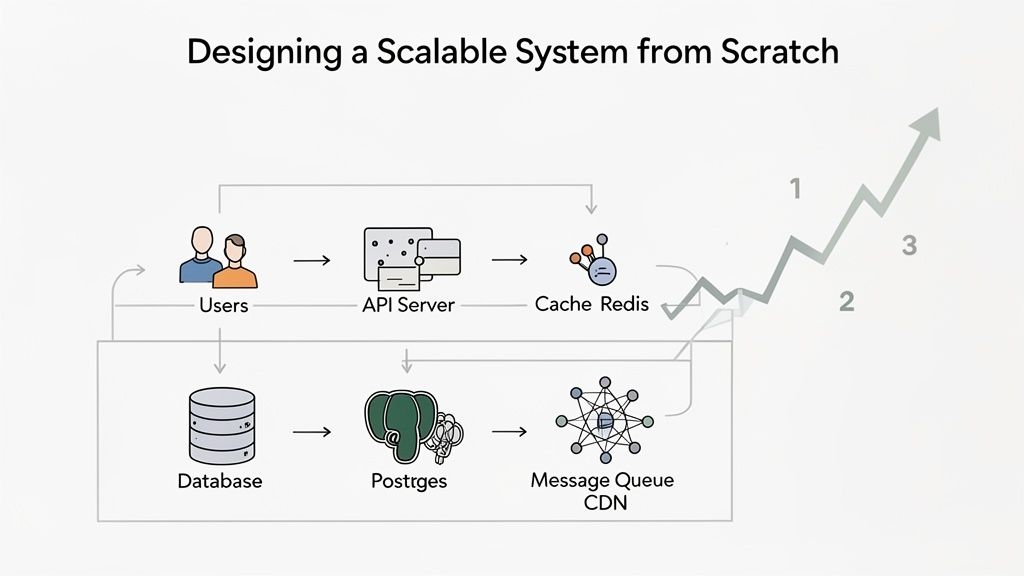
10. Walk Through How You'd Approach Building a System From Scratch That Needs to Scale to Millions of Users
System design questions are a cornerstone of senior-level engineer interview questions, designed to evaluate your architectural thinking, foresight, and ability to manage trade-offs. Interviewers want to see how you reason about scalability, reliability, and cost. For a startup, this is a proxy for your ability to build a robust platform that won't crumble under the weight of its own success, ensuring long-term technical viability.
How to Structure Your Answer
Start by gathering requirements, then propose a simple initial design and explain how you would evolve it iteratively as scale increases. This shows practicality and an understanding of engineering priorities.
Clarify Requirements (The 5 Ws): First, ask clarifying questions. "To design a Twitter-like service, I need to know: What are the functional requirements (e.g., post tweet, view timeline)? What is the expected read/write ratio (likely very read-heavy)? What's the latency target (e.g., p99 latency for timeline load under 200ms)? What's our user scale (e.g., 1 million DAU)?"
Start Simple (V1 for 10k Users): Propose an initial architecture. "For the first 10,000 users, I'd build a single monolithic application with a PostgreSQL database and a Redis cache for hot timelines. This is fast to build, simple to operate, and lets us iterate quickly."
Identify Bottlenecks: Explain where this design will break. "As we scale, the two main bottlenecks will be the single database handling all writes and the 'fan-out' logic for generating user timelines, which will become too slow to do on-the-fly."
Evolve the Design (V2 for 1M+ Users): Detail your scaling strategy step-by-step. "First, I'd introduce read replicas for the database to handle the high read load. Next, I'd decouple timeline generation into an asynchronous service using a message queue like Kafka. When a user tweets, we publish an event, and worker services pre-compute the timelines for all their followers and write them to a Redis cache. This makes timeline loads instant. Finally, I'd shard the database by user_id to distribute the write load horizontally."
Actionable Tips for Success
Think Incrementally: Don't jump straight to a complex microservices architecture. Show you can build what's needed for today while planning for tomorrow. This demonstrates pragmatism and cost-consciousness.
Talk About Trade-offs: Explicitly state the pros and cons. "Moving to asynchronous timeline generation increases system complexity and introduces eventual consistency, but it's a necessary trade-off for achieving the required low-latency reads at scale."
Mention Observability: A mature design includes monitoring. "From day one, I would implement structured logging, metrics for latency and error rates using Prometheus, and dashboards in Grafana to ensure we can see bottlenecks before our users feel them."
Be Specific with Tech and Justify It: Naming specific technologies (PostgreSQL, Redis, Kafka, CDN) and explaining why you chose them for the task (e.g., "I chose Kafka for its durability and replayability") demonstrates practical experience.
11. How Do You Handle Working With Product and Non-Technical Stakeholders?
This behavioral question assesses your collaboration and communication skills, which are paramount in modern engineering teams. Hiring managers want to see if you can bridge the gap between technical implementation and business objectives. In a startup environment, where engineers frequently interact with founders, product managers, and marketing, this ability is non-negotiable. It proves you can advocate for technical needs while understanding and respecting business constraints.
How to Structure Your Answer
Frame your response as a partnership, not a conflict. Show how you align technical work with business goals by translating complex ideas and presenting trade-offs clearly.
Situation: Describe a scenario requiring negotiation. "Our product manager wanted to add a complex, real-time activity feed to our app, but the engineering team knew our existing infrastructure couldn't support it without a major overhaul that would take a full quarter."
Task: State your objective. "My goal was to understand the core business need driving the request and propose a phased approach that delivered immediate value while creating a path to the full vision."
Action: Explain your collaborative approach. "Instead of saying 'no,' I worked with the PM to identify the 'minimum viable' version. We learned the most critical need was to show the most recent activity. I proposed we could ship a simpler, polling-based version in two weeks. I then created a one-page tech spec outlining the work for a full real-time solution, framing it not as 'tech debt' but as 'Phase 2,' which we could prioritize based on the success of Phase 1."
Result: Quantify the outcome. "This approach got a valuable feature into users' hands in weeks instead of months, allowing us to gather real data on its impact. The initial version was so successful that the business happily greenlit the 'Phase 2' investment in the following quarter."
Actionable Tips for Success
Translate, Don't Trivialize: Explain technical concepts in terms of business impact. Instead of "We need to refactor our service," say "By improving this service, we can reduce our infrastructure costs by 20% and ship new features 30% faster."
Offer Options, Not Obstacles: Always come with solutions. Frame discussions around choices and trade-offs. "We can build this quickly with some known scalability limits, or we can build it robustly, which will take longer. Which is more important for this feature's goals?"
Show Proactive Engagement: Mention how you participate in product planning meetings or user feedback sessions to gain context early. This shows you want to be a partner in building the product, not just a code implementer.
Build Trust: Emphasize your goal is to be a reliable partner who delivers on commitments. Trust is the foundation that makes difficult trade-off conversations possible.
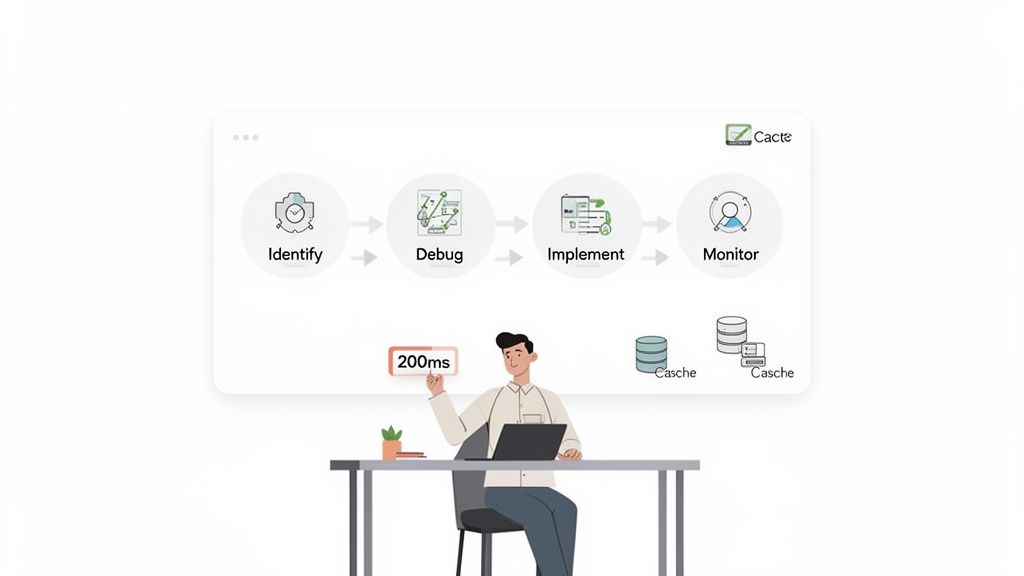
12. Describe Your Experience With Performance Optimization and How You Approach Optimization Problems
This is one of the more telling engineer interview questions because it assesses your ability to think systematically and make data-driven decisions. Hiring managers want to see if you can diagnose and resolve bottlenecks that directly affect user experience and operational costs. For a startup, where resources are lean and performance can make or break user retention, an engineer who measures before acting is invaluable. This question separates those who optimize based on hunches from those who use data to pinpoint the most impactful issues.
How to Structure Your Answer
A narrative approach that showcases a methodical, evidence-based process is most effective. Explain how you identify, diagnose, and solve performance issues, highlighting your reliance on data over assumptions.
Situation: Start with a specific, user-facing problem. "Our main search results page was taking over 4 seconds to load for queries with many results, leading to a high bounce rate."
Task: Define your objective with a clear, measurable goal. "My task was to diagnose the bottleneck and reduce the p99 load time for this page to under 1 second."
Action: Detail your diagnostic and implementation process. "My first step was to refuse to guess. I used our APM tool, Datadog, to trace the requests. The data showed that 90% of the time was spent in a single database query with multiple complex joins. Instead of trying to optimize the query directly, I proposed a denormalization strategy. We created a separate, optimized search index using Elasticsearch, which was updated asynchronously. This moved the expensive join work from request time to ingestion time."
Result: Quantify the outcome with hard numbers. "This change reduced the p99 search latency from 4.2 seconds to 300ms, a 92% improvement. It also reduced the load on our primary database by 40%, and we saw a 10% decrease in user bounce rate from that page."
Actionable Tips for Success
Emphasize a "Measure First" Mentality: Always start your story with how you measured and identified the problem. Mention specific tools like profilers (e.g., cProfile for Python), APM software (New Relic, Datadog), or browser DevTools (Lighthouse, Performance tab).
Discuss Trade-offs: Show you understand that optimization has costs. "The trade-off for using Elasticsearch was increased infrastructure complexity and cost, but given the business impact of slow search, it was a clear win."
Avoid Premature Optimization: Acknowledge the principle that you should focus on actual, measured bottlenecks, not theoretical ones. "My philosophy is to make it work, make it right, then make it fast—and only if measurement proves it's necessary."
Comparison of 12 Engineer Interview Questions
Question
Implementation complexity
Resource requirements
Expected outcomes
Ideal use cases
Key advantages
Tell Me About a Technical Problem You Solved and Your Approach
Low–Medium — single example review
Moderate interview time; ask for metrics/artifacts
Performance-sensitive products and cost-conscious scaling
Demonstrates data-driven optimization and verification practices
Turn Your Preparation Into an Offer
You've navigated the landscape of critical engineer interview questions, from deep technical dives into system design to nuanced discussions about collaboration and failure. The journey through these questions reveals a fundamental truth: a successful engineering interview is rarely about finding a single "correct" answer. Instead, it’s a demonstration of your thought process, your problem-solving methodology, and your ability to articulate complex ideas clearly.
Mastering your responses isn't about memorizing scripts; it’s about building a framework for storytelling. Each question is an invitation to share a narrative that showcases your skills in action. The STAR method isn't just a gimmick; it's a structure that transforms a simple anecdote into a compelling case study of your impact. By grounding your answers in specific projects and tangible outcomes, you move beyond claiming you have a skill and start proving it.
Key Takeaways: From Theory to Interview-Ready
To consolidate your preparation, focus on these core principles that underpin almost all of the engineer interview questions we've covered:
Structure is Your Ally: Whether you're using STAR for behavioral questions or a step-by-step framework for system design, a clear structure prevents you from rambling. It shows the interviewer that you think in an organized, logical manner, which is exactly how you'd approach a complex engineering problem.
Emphasize Impact, Not Just Activity: Don't just state what you did; explain why it mattered. Did your code review process catch a critical bug before it hit production? Did your approach to technical debt improve developer velocity by 15%? Quantify your contributions whenever possible to demonstrate your business acumen.
Honesty and Self-Awareness Are Superpowers: When asked about failures, weaknesses, or disagreements, your ability to reflect honestly is a sign of maturity. An interviewer learns more from how you deconstruct a past mistake than they would from a flawless, unrelatable success story. This is especially true in startup environments where learning from rapid iteration is essential.
Your Actionable Next Steps
Interview preparation is an active process. Don’t just read; engage with the material.
Create Your "Story Bank": Go through the 12 questions in this article. For each one, write down bullet points from your own experience that could form the basis of an answer. Revisit your resume and identify 3-5 key projects. For each project, outline the problem, the actions you took, the technologies used, and the measurable results.
Practice Articulation Out Loud: The gap between thinking an answer and saying it is significant. Record yourself answering a question like, "Walk me through your most significant project." Listen back and ask yourself: Was it clear? Was it concise? Did I focus on the impact?
Conduct a Mock Interview: Find a peer, a mentor, or use an interview practice platform. The real-time feedback you receive from a live mock interview is invaluable for refining your delivery and handling unexpected follow-up questions.
Ultimately, your preparation for these engineer interview questions is an investment in your career narrative. You are not just a collection of technical skills; you are a problem-solver, a collaborator, and a strategic thinker. By learning to communicate that holistic value, you transform the interview from a stressful interrogation into a collaborative conversation about what you can build together. You're showing a potential employer that you aren't just looking for a job; you're looking for a place to make a tangible impact.
Ready to put your preparation to the test with companies that value thoughtful, skilled engineers? Underdog.io connects you directly with top-tier startups and tech companies actively hiring for roles that match your expertise. Stop searching and start interviewing by creating your free profile on Underdog.io today.
FAQs for Top Engineer Interview Questions
What are the most important types of questions in a startup engineering interview?
Beyond coding puzzles, startups focus heavily on behavioral and practical questions. They want to understand your real-world problem-solving process, how you handle a project from start to finish, your approach to writing reliable code, and how you learn from mistakes. These questions reveal your engineering mindset and how you'll perform in a fast-paced, collaborative environment.
How should I answer a question about a technical problem I solved?
Use the STAR method (Situation, Task, Action, Result). Choose a problem with nuance, like a performance bottleneck or integration challenge. Clearly describe the situation, your task, the specific technical actions you took (mention tools used), and most importantly, quantify the result with metrics (e.g., "reduced latency from 3.2 seconds to 150ms").
What if they ask me to walk through a project from start to finish?
Structure a chronological narrative that shows ownership. Explain the project's goal, your specific role, the key technical decisions you made (and why), challenges you faced, and the final business impact. Don't just list what you did; focus on the 'why' behind your choices and connect the outcome to metrics like user engagement or revenue.
How do I demonstrate my skills with a specific technology stack I don't know well?
Interviewers often ask this to gauge your learning agility. Be honest about your current experience level. Then, outline a clear, actionable learning plan: start with a small personal project, study the official documentation and best practices, examine a reputable open-source project, and explain how you'd apply it to a real task.
Why do interviewers ask about failure, and how should I answer?
This question tests humility, self-awareness, and growth. Choose a professional, technical failure. Use the STAR framework but add a strong emphasis on the Learning (STAR+L). Clearly state the mistake, its impact, how you fixed it, and the specific, actionable lesson you learned that changed your future approach to similar problems.
Our biweekly curated tech and recruiting newsletter.
Thank you. You've been added to the Ruff Notes list.
Oops! Something went wrong while submitting the form.
Looking for a startup job?
Our single 60-second job application can connect you with hiring managers at the best startups and tech companies hiring in NYC, San Francisco and remote. They need your talent, and it's totally 100% free.