A single NYC engineering offer can look $30K apart in base pay and still leave you with nearly the same take-home reality once bonus, equity, taxes, and rent enter the picture. That's why an engineering salary NYC search is usually the wrong first question. The better question is which combination of base, variable cash, and equity matches the level and company you're evaluating.
In New York, the compensation spread is wide enough that two engineers can sit in the same city, at the same title, and still be in very different labor markets. Indeed reported an average base salary of $144,757 for an engineer in New York, NY from 444 salaries collected over 36 months, updated October 6, 2025. ZipRecruiter's July 2026 estimate put engineering pay in New York at $160,678, with a typical range of $127,500 to $189,300. That gap is not noise, it's a warning that role definition matters more than any citywide average. Indeed's New York engineer salary page
A mid-level engineer comparing two NYC startup offers can get pulled toward the cleaner base salary and miss the rest of the package. Offer A may show the higher salary upfront, while Offer B can pair a slightly lower salary with stronger bonus participation and equity that becomes meaningful if the company grows. On paper, those offers can look close. In practice, one can be safer, and the other can be more valuable, depending on where you are in your career and how much risk you can tolerate.
That is the lens to use for engineering salary NYC data. The market is not one number, it is a spread shaped by specialization, seniority, and employer type. SalaryEngineer's May 2024 analysis reported a New York blended engineering median of $141,848, described as 18% above the national average, and identified New York City as the state's highest-paying metro at $148,991. The U.S. Bureau of Labor Statistics also gives a useful anchor, since engineers had a U.S. median annual wage of $91,420 in May 2023 compared with $48,060 for all occupations. SalaryEngineer's New York engineering salary analysis
The practical mistake is chasing a single “average” and treating it like a negotiation target. In NYC, that number can hide large differences between software, data, structural, and licensed professional engineering roles. It can also hide the fact that startups often pay in a different mix than banks or mature tech firms.
A search for the right public profile matters too. If you are preparing for interviews or updating your online presence before a job search, a step by step social media audit tutorial can help you clean up the parts of your profile that recruiters see.
Practical rule: if a salary number does not tell you the role, seniority, and whether it includes variable pay, it is not a useful number for negotiation.
A better way to read the market is to treat the headline as a screen, then move straight to level, cash mix, and equity quality. A citywide average can tell you whether an offer is broadly in range. It cannot tell you whether the offer fits the role you are being hired to do, or whether the equity is likely to matter.
If you are interviewing in NYC, the right question is not “What does an engineer make here?” It is “What does this exact engineer, at this exact company, at this exact level, really take home?”
Different salary pages answer different questions, so the gap between them is expected. Indeed's $144,757 base average reflects a local New York, NY sample. ZipRecruiter's engineering estimate comes in higher at $160,678, with a range of $127,500 to $189,300. Salary.com's Professional Engineer figure for New York, NY averages $130,942, with typical pay from $120,295 to $143,044 and most professionals earning between $110,602 and $154,063. Salary.com's New York Professional Engineer salary page
The spread is a signal that the job title changes the answer as much as the geography does. A licensed Professional Engineer sits in a different labor market from a broad software engineer title, and neither one matches a generic “engineering” search result exactly.
SalaryEngineer's New York blended median of $141,848 and its New York City metro figure of $148,991 land in the same general zone, which reinforces the point that title and sample shape the output. SalaryEngineer's New York engineering salary analysis
| Source | Average Pay | Typical Range | What It Measures |
|---|---|---|---|
| Indeed | $144,757 base | Not specified in the provided data | Engineer in New York, NY, base salary |
| ZipRecruiter | $160,678 | $127,500 to $189,300 | Engineering pay in New York |
| Salary.com | $130,942 | $120,295 to $143,044 | Professional Engineer in New York, NY |
| U.S. Bureau of Labor Statistics | $91,420 median annual wage | Not specified in the provided data | U.S. engineers, national benchmark |
The simplest filter is a four-part check.
That is why a salary article can be accurate and still be poor guidance for an offer. If the source does not match your role and level, the number is just décor.
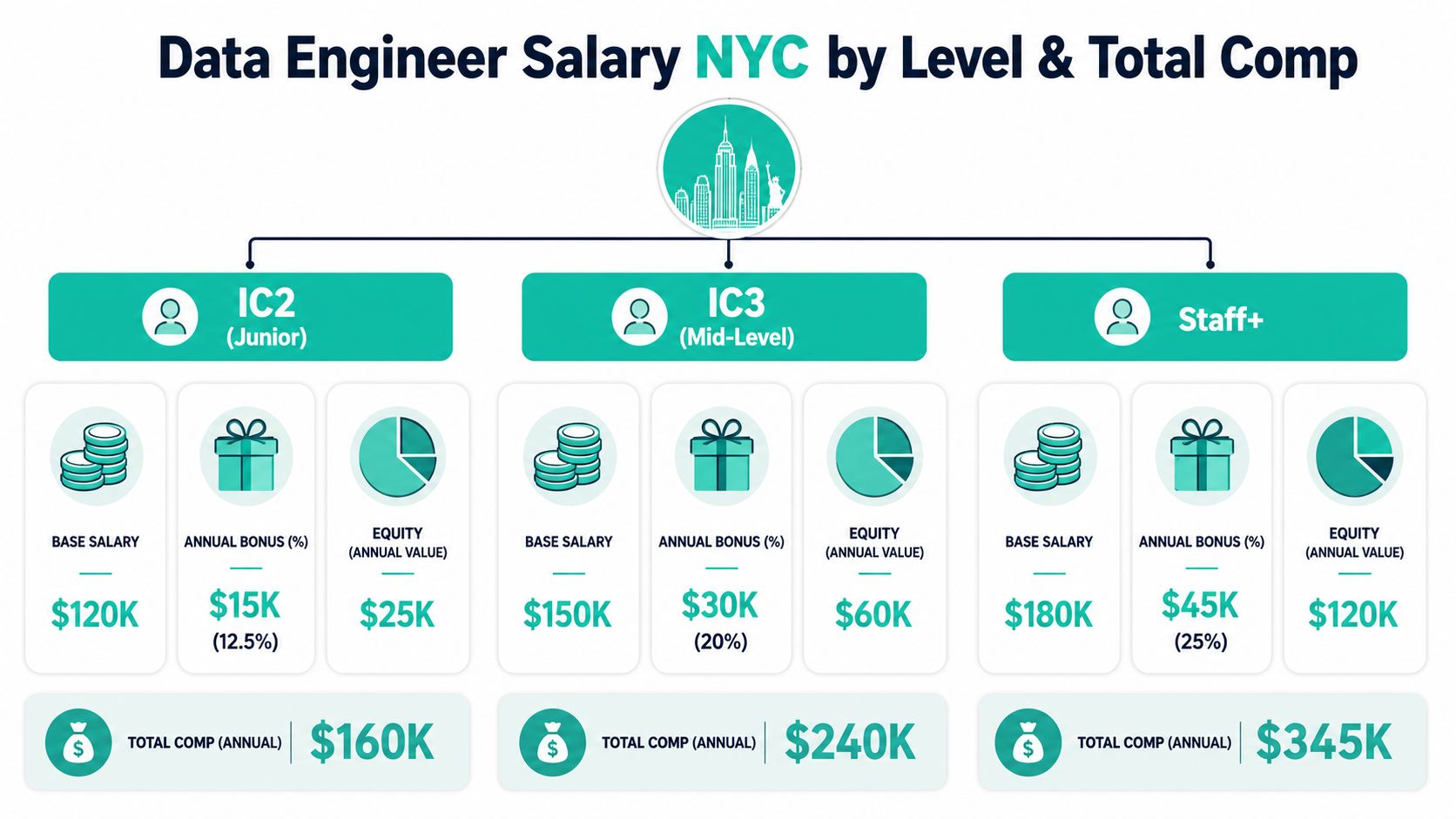
Data engineering is the cleanest worked example because the published ranges make the level jump obvious. CareerCheck's 2026 NYC benchmark puts junior IC2 roles at roughly $90K to $115K base and $105K to $140K total comp, while staff IC5+ roles reach about $175K to $230K base and $280K to $400K total comp. That's not a small progression. It's a different compensation model as you move up the ladder. CareerCheck's NYC data engineer salary guide
Built In shows how cash comp changes the picture in a way base alone can't capture. For NYC data engineers, it reports $121,628 average base, $12,100 additional cash, and $133,728 total comp. Salary.com's estimate is higher at $142,607 average pay, with a $131,847 to $156,038 range. The lesson isn't that one source is right and the other is wrong. It's that you need to compare both base and variable pay before you decide whether an offer is competitive. Built In's NYC data engineer salary page
For a startup, I'd separate the offer into base salary, annual cash, and equity value. A role with a slightly lower base can still win if the bonus structure is reliable and the equity is meaningful. That becomes especially true at senior levels, where published 2026 benchmarks show total compensation expanding much faster than base alone.
The move is to test the offer the same way a finance person would test a waterfall. Ask what's guaranteed, what's performance-linked, and what only pays off if the company exits well. Then compare that to your actual stage, not your ego. A junior engineer needs cash stability. A senior engineer with startup experience can afford more upside exposure.
“Engineering” in NYC is too broad to be a salary category by itself. Built In reports an average NYC software engineer salary of $160,109, plus $24,390 in additional cash compensation for $184,499 total compensation. It also shows a strong experience premium, with engineers under 1 year averaging $120,750 and those with 7+ years averaging $195,688. Built In's NYC software engineer salary page
Salary.com's Professional Engineer benchmark in New York, NY averaged $130,942, and its typical range of $120,295 to $143,044 sits in a different band from the software numbers above. Salary.com also shows that entry-level structural engineers in New York City sit at $87,401, which is another reminder that structural, licensed, and software roles don't converge on the same market price just because they share the word “engineer.” Salary.com's Professional Engineer salary page
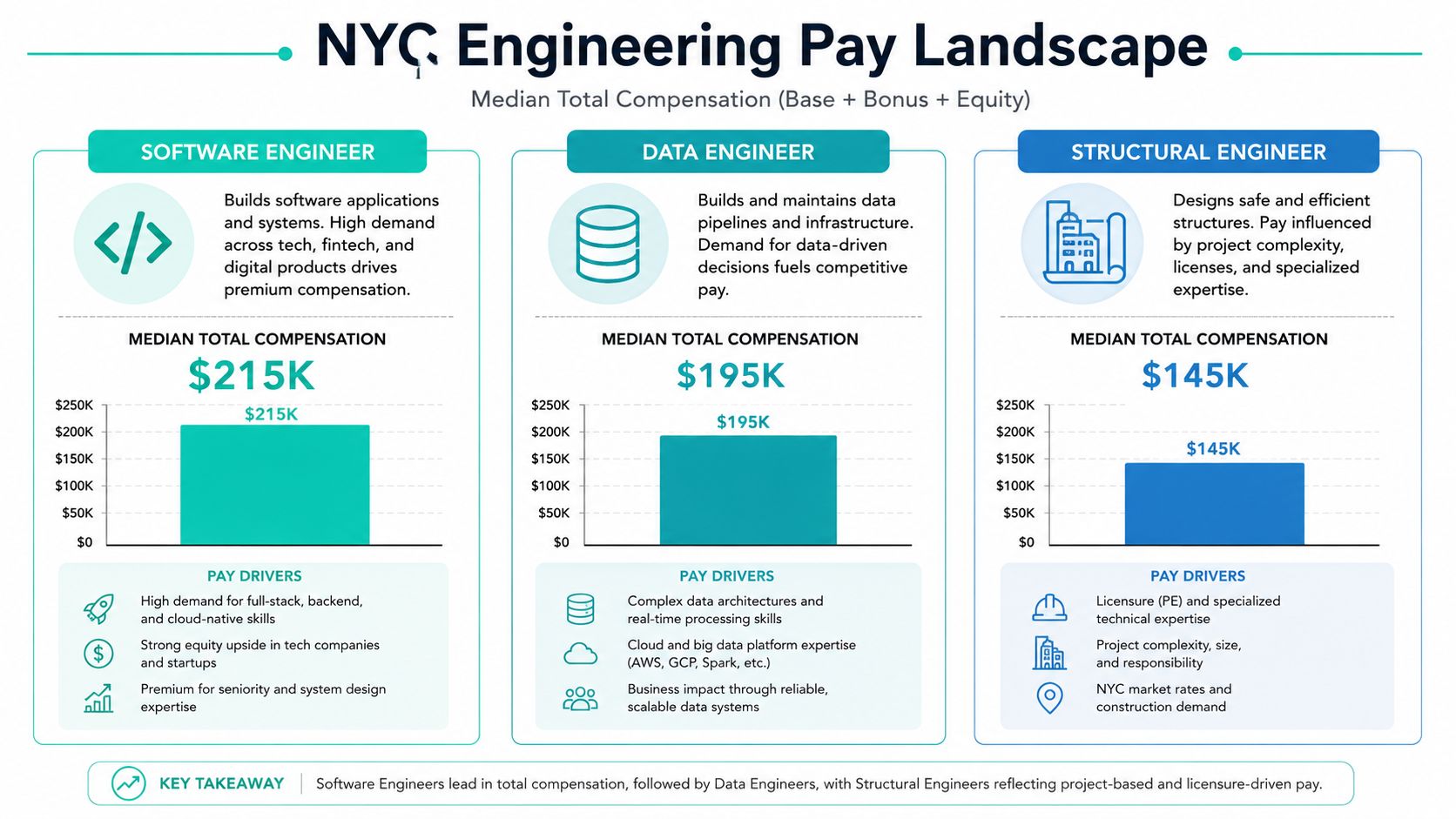
The comparison that matters is not “which engineering job pays the most in theory.” It's which labor market you're in. Software engineers at startups often get a larger equity component. Data engineers see comp move sharply with seniority and bonus participation. Structural engineers usually sit inside a different client, licensure, and project-delivery ecosystem.
A title that sounds similar can still point to a completely different negotiation range.
That's why generic salary guides frustrate people. They collapse separate markets into one bucket and then act surprised when the number feels wrong. If you're a software engineer, benchmark software. If you're a data engineer, benchmark data. If you hold a licensure-heavy or project-heavy role, benchmark against that labor market instead of the citywide average.
Gross salary in NYC tells you less than people think. Rent, taxes, commuting, and day-to-day spending all eat into the number before you ever get to the fun part of using it. A compensation package that looks strong on a spreadsheet can feel ordinary once you're paying Manhattan-level housing costs and a city tax bill.
The basic adjustment is mental, not mathematical. Don't compare two NYC offers by base alone, compare them by what's left after housing and taxes. If one role includes more remote flexibility or a shorter commute, that has real economic value even if it never appears in the offer letter. The city makes you pay for convenience, and a lot of engineers discover that the hard way after they sign.
The fastest way to misunderstand an NYC offer is to ignore the neighborhood you'll live in. A salary that looks generous can get swallowed by rent if you insist on a specific zip code. If you're comparing New York to other cities, a practical external reference is the broader cost-of-living lens used in articles like this city comparison guide, because it helps you see why a nominal bump doesn't always translate into better purchasing power.
Once you add taxes, the gap between gross and usable income widens again. That's why I tell candidates to think in terms of monthly disposable income after housing, not annual compensation in isolation. A lower-burn package can beat a higher headline salary if the role saves you on commute time, rent, and surprise costs.
The best candidates I've worked with don't ask “Can I afford this city?” They ask, “What standard of living does this offer buy me here?” That framing keeps the conversation honest.
Startup offers in NYC need to be negotiated as a package, not as a single salary number. A founder can often move on equity, signing cash, or flexibility even when base is tight. If you anchor only on salary, you leave the most movable parts untouched.
Use the right comparison set first. Compare the startup offer against a similar role at a Series A or Series B company in NYC, not against a giant public tech company with a very different pay structure. Then ask what's fixed, what's negotiable, and what can be improved without changing your title. The biggest mistake is asking for “more money” in the abstract. You'll get a vague answer back.
For startup equity, don't let the conversation stop at the number of shares. Ask about vesting, cliff timing, strike price, and whether there are refreshers later if the role evolves. If the employer can't or won't explain the economics clearly, that's information too.
Use the offer letter itself as the negotiation surface. The compensation terms that end up written down matter more than a verbal promise. This offer negotiation guide is useful because it keeps the focus on the paper you'll sign, not on vague recruiting reassurance.
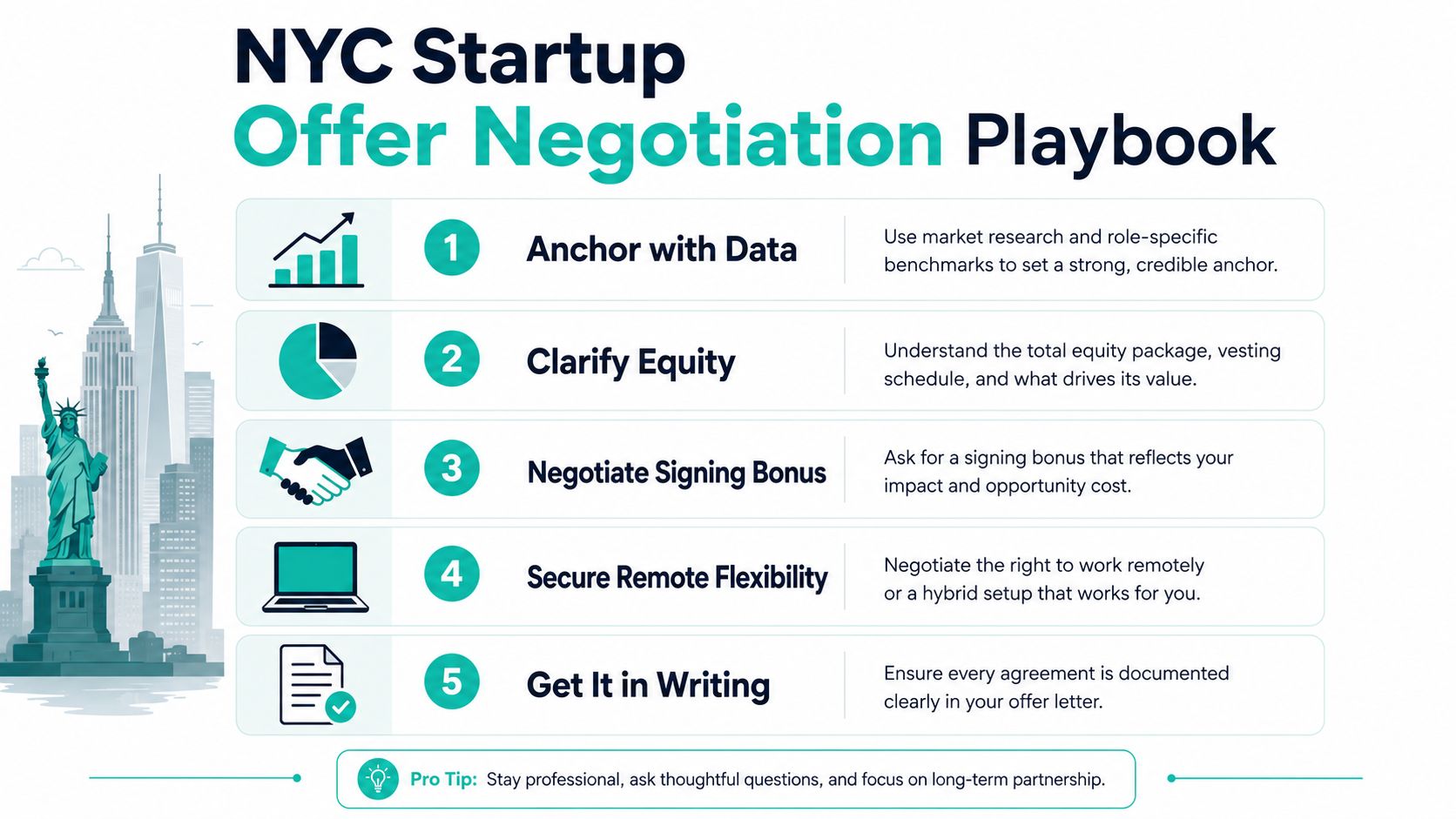
A practical negotiation sequence looks like this:
The cleanest negotiation is the one where you know what matters before you start talking. If you can't explain the offer to yourself in base, variable cash, and equity, you're not ready to sign it.
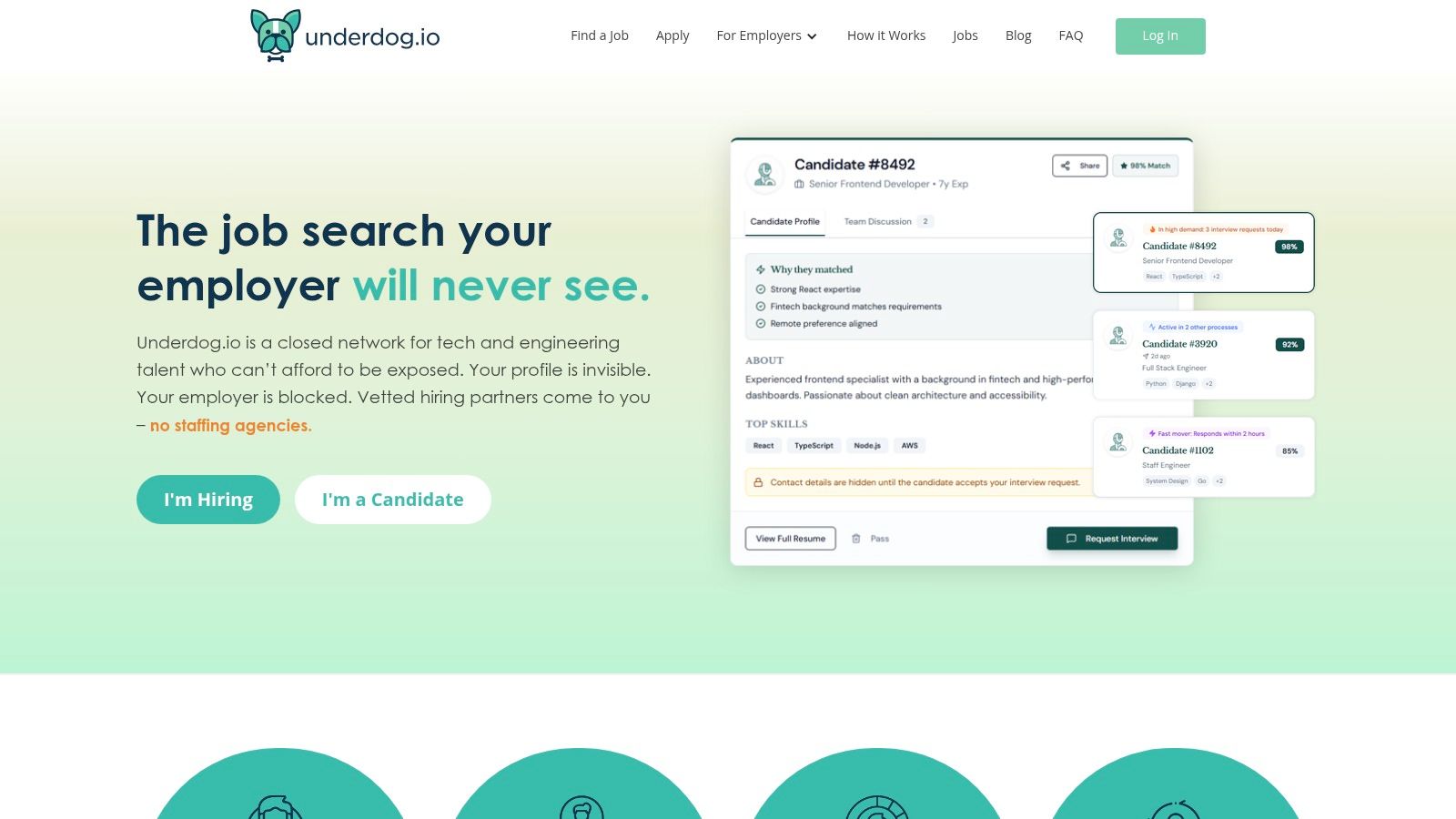
For engineers who want startup options without firing off dozens of cold applications, a curated marketplace changes the search mechanics. Underdog.io uses a single, short application, then matches candidates with vetted startups and high-growth tech firms through human review instead of a broad job-board feed. Its model also keeps profiles anonymous until interest is mutual, which matters if you're currently employed and don't want to broadcast your search.
The point isn't volume. It's relevance. If you're comparing NYC offers by total comp, you want introductions to companies that already fit your level, role, and stage preference. A platform built around curated matching helps reduce the amount of time you spend sorting through misaligned roles, and it keeps the conversation focused on actual fit instead of spray-and-pray recruiting. Underdog.io's NYC startup jobs page
The other advantage is selective exposure. Instead of a pile of irrelevant applications, you get a smaller number of introductions that are more likely to map to your compensation target and your risk tolerance. That's useful if you're trying to evaluate startup equity with any seriousness. You need real conversations, not generic inbound noise.
If you're already comparing offers, a curated marketplace can function as a benchmark generator. Even one or two targeted conversations can tell you whether your current package is under market for your level in NYC. That's often more valuable than another salary calculator.
Before any offer call, write down base salary, variable cash, and your own conservative estimate of equity value. Then compare the offer to the same role at a comparable Series A or Series B startup in NYC, not to a generic engineer average. The goal is to find the package that fits your level, not the one that looks biggest in isolation.
The two questions that usually surface the most useful information are simple. Ask, “How does compensation change at the next level?” and “What happens to equity if the company grows more slowly than planned?” Those answers tell you more than a polished recruiter pitch.
NYC compensation will keep shifting as hiring priorities change, so treat any salary number as a snapshot, not a permanent truth. Revisit the framework when you're interviewing again, because the right comparison set is what keeps you from overpaying for prestige or underpricing your value.
A CTA for Underdog.io.