With dozens of startup job platforms available, which ones produce interviews rather than resume black holes? The difference usually isn't how many openings you can browse. It's whether the platform gets your background in front of someone who understands it and has an approved role to fill.
A useful comparison starts with curation, confidentiality, and hiring-funnel fit. Does someone assess candidates and companies, or does the platform mainly organize listings? Can you explore while employed without broadcasting your interest? Does it help an early-stage founder identify a potential hire, or collect more applications?
The distinction matters across functions. A founder looking to Hire SDRs needs a different candidate pool from a technical leader recruiting a founding infrastructure engineer. Likewise, a designer casually exploring opportunities shouldn't use the same search routine as an unemployed engineer who needs interviews immediately.
The options below include Underdog.io, Wellfound, Y Combinator, Welcome to the Jungle, Built In, Startup.jobs, Techstars, Index Ventures, VentureLoop, and Climatebase. Some are broad discovery tools, others organize investor networks or specific industries, and a curated marketplace can help turn relevant profiles into conversations.
Don't create accounts everywhere and repeat the same application. Combine a selective introduction channel with a broad discovery board and, where useful, a specialist network. Judge each by qualified conversations, not saved jobs.
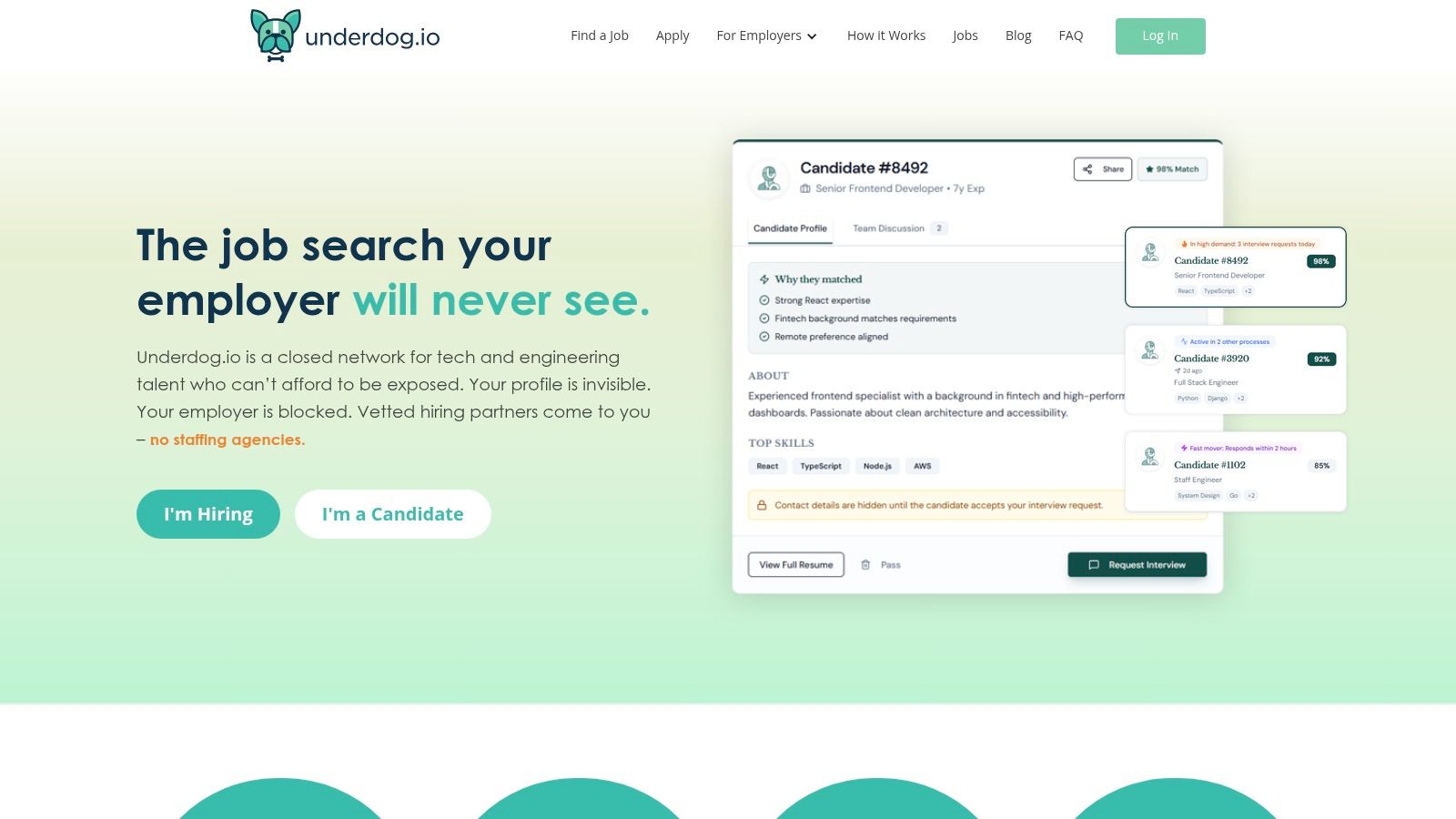
Would a curated introduction be more useful than another application queue? Underdog.io connects people seeking startup jobs or contract opportunities with companies looking to hire or engage them. Its team reviews candidate profiles for fit with startups, and candidates can connect directly with founders, hiring managers, and other decision-makers.
The curation works on both sides: candidates are reviewed for relevant experience and fit, while startups are screened for funding status, team quality, and product viability. That focus can reduce irrelevant introductions, but acceptance is selective and the flow is less predictable than browsing a job board.
Designers create one profile rather than applying to individual postings. Accepted designers are introduced to hiring managers at vetted NYC startups that fit their background and preferences, then decide which conversations are worth their time. For other candidates, a curated introduction channel can suit employed professionals exploring a move discreetly. Keep confidential company information out of portfolios.
Underdog.io lists startup roles in New York City, San Francisco, and remotely. Its network spans engineering, product, design, data, marketing, and business roles, and it shares a new curated cohort of active job seekers with growing technology companies each week.
For founders, the marketplace offers a focused way to review candidates. Define the role clearly, including ownership, technical scope, compensation, and working arrangements. Curation cannot make an unclear hiring brief easier to assess.
For candidates, be explicit about your constraints. Full-time seekers with relevant experience who do not require visa sponsorship are generally the strongest fit; some companies also hire for contract and remote roles, and consider bootcamp and visa candidates.
Wellfound is a strong starting point when you want breadth across startup stages, industries, and functions. A reusable profile supports applications and discovery by founders or hiring teams, while filters help narrow the catalog by role, location, remote policy, stage, and industry.
Its strength is search control rather than tightly managed introductions. Salary and equity information on many listings can help eliminate unsuitable roles, but distinguish employer-provided ranges from estimates. Don't treat every compensation figure as a confirmed budget.
Say you're a backend engineer targeting fintech startups. Filter for the relevant stage and location, then explain how your experience with payments reliability or distributed systems fits the company's product. A specific introduction is more useful than a paragraph listing every language you've used.
Wellfound is free for candidates and covers engineering, product, design, and business roles. The trade-off is that catalog size doesn't guarantee a response.
Founders should publish the actual problem the hire will own. A clear scope and credible compensation range do more to qualify interest than a long list of aspirational requirements.
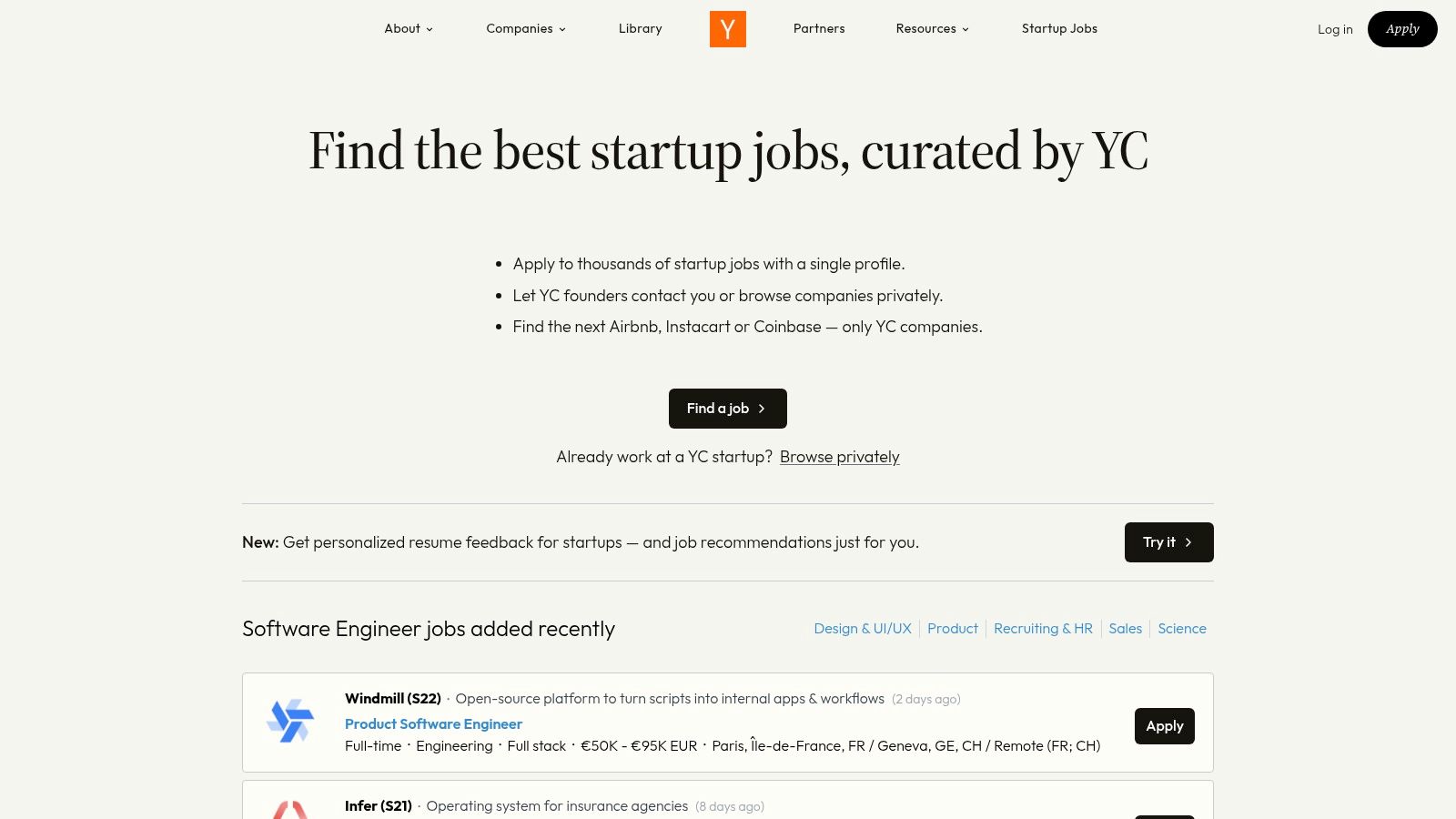
Y Combinator Work at a Startup makes sense when your target is an early-stage team and you want a defined company network. Candidates can use a shared profile across applications, browse privately, or become visible to YC founders.
The curation boundary is company affiliation, not a personalized assessment that every opening suits you. YC membership doesn't answer whether a founder manages well, whether the position has a realistic scope, or whether the company's working arrangements match yours.
Accelerator membership is a useful search boundary, not a substitute for employer diligence.
For a founding-engineer search, emphasize product ownership: what you built, how you chose trade-offs, and how you handled deployment and maintenance. Founders need to understand whether you can operate without a large supporting organization.
Use it for targeted applications and founder discovery across engineering, product, design, recruiting, sales, and other functions. Listings can include location, remote eligibility, and salary ranges.
Private browsing and founder visibility are different choices. Check the current signup flow and access requirements before making your profile discoverable, especially if you're employed.
The main limitation is straightforward: startups outside the YC network won't appear. Pair it with a broader board rather than assuming it represents the whole seed-stage hiring market.

A product manager who knows the work they want but not the companies to target should consider Welcome to the Jungle, formerly known as Otta. Its recommendations incorporate preferences and experience, while company information helps candidates investigate unfamiliar employers.
This is personalized discovery, not the same thing as a recruiter qualifying both parties before an introduction. Recommendations can reduce scanning time, but an apparently suitable match doesn't establish employer interest.
Use role, experience, location, and work-arrangement preferences deliberately. If you're seeking a hands-on product role, examine whether the description emphasizes customer discovery and shipping or mainly stakeholder coordination.
Its U.S. coverage includes particular major cities and remote opportunities, and the catalog also contains larger technology employers. Check company size and stage rather than equating a modern company profile with an early-stage startup.
For remote roles, establish hiring geography, required overlap hours, office attendance, and travel before investing in interviews. A remote label alone doesn't tell you whether the employer can hire you where you live.
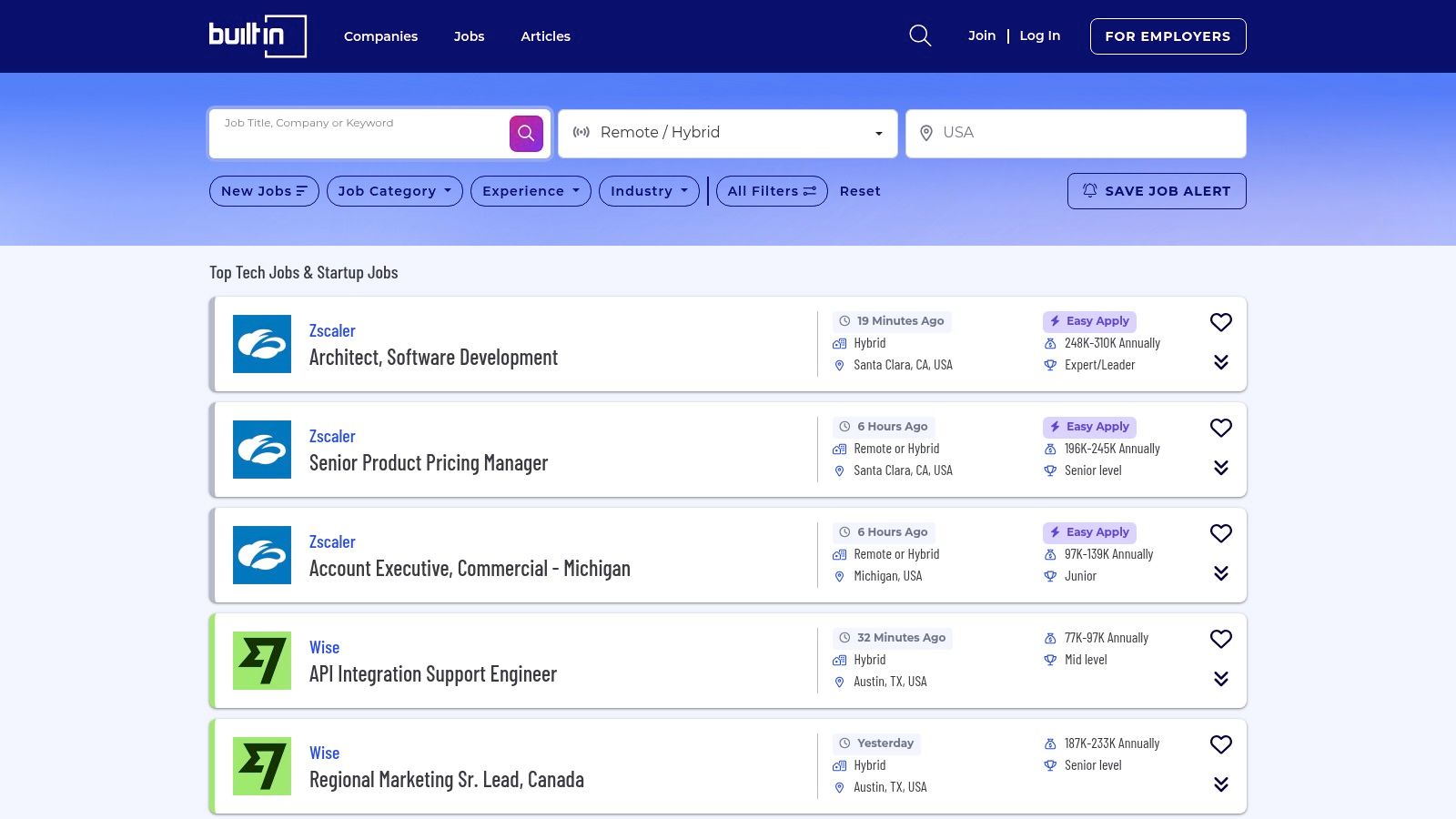
Built In is particularly useful when geography shapes your search. Its mix of job listings, employer profiles, salary content, and local technology coverage helps candidates explore markets such as New York, San Francisco, Austin, and Chicago.
Use it to build an employer shortlist, not just an application queue. A designer relocating to Chicago can compare local teams, inspect their products, and investigate which roles offer meaningful design ownership before applying.
Built In's advantage is context. Its limitation is that company profiles and listing detail vary, and the catalog includes established employers alongside startups.
Company descriptions are a starting point for interview questions, not proof of daily working conditions. If an employer emphasizes autonomy, ask who approves roadmap changes and how engineers handle production incidents.
Candidates deciding between browsing and selective introductions can compare the workflow differences in this Built In alternative comparison. The decision is whether you need more companies to investigate or more relevant conversations with hiring teams.
Startup.jobs is a straightforward option when you already know your target function and want startup-focused listings. It covers engineering, design, marketing, operations, finance, and sales, with location browsing, remote opportunities, and job alerts.
Don't mistake a startup-specific catalog for a curated matching service. You still review the employer, decide whether the opening fits, and apply directly.
Create alerts around both your preferred title and the work itself. An operations candidate might search business operations alongside implementation or customer operations, then compare responsibilities rather than relying on titles alone.
Some job-seeker features require an optional paid subscription, while browsing is available on the site. Employers can pay to promote and distribute postings, so visibility shouldn't be treated as a quality ranking.
Before paying for additional features, identify the actual gap in your workflow. If you're finding suitable roles but receiving no replies, improve positioning and application relevance first. More alerts won't repair a resume that doesn't show the work an early-stage team needs done.
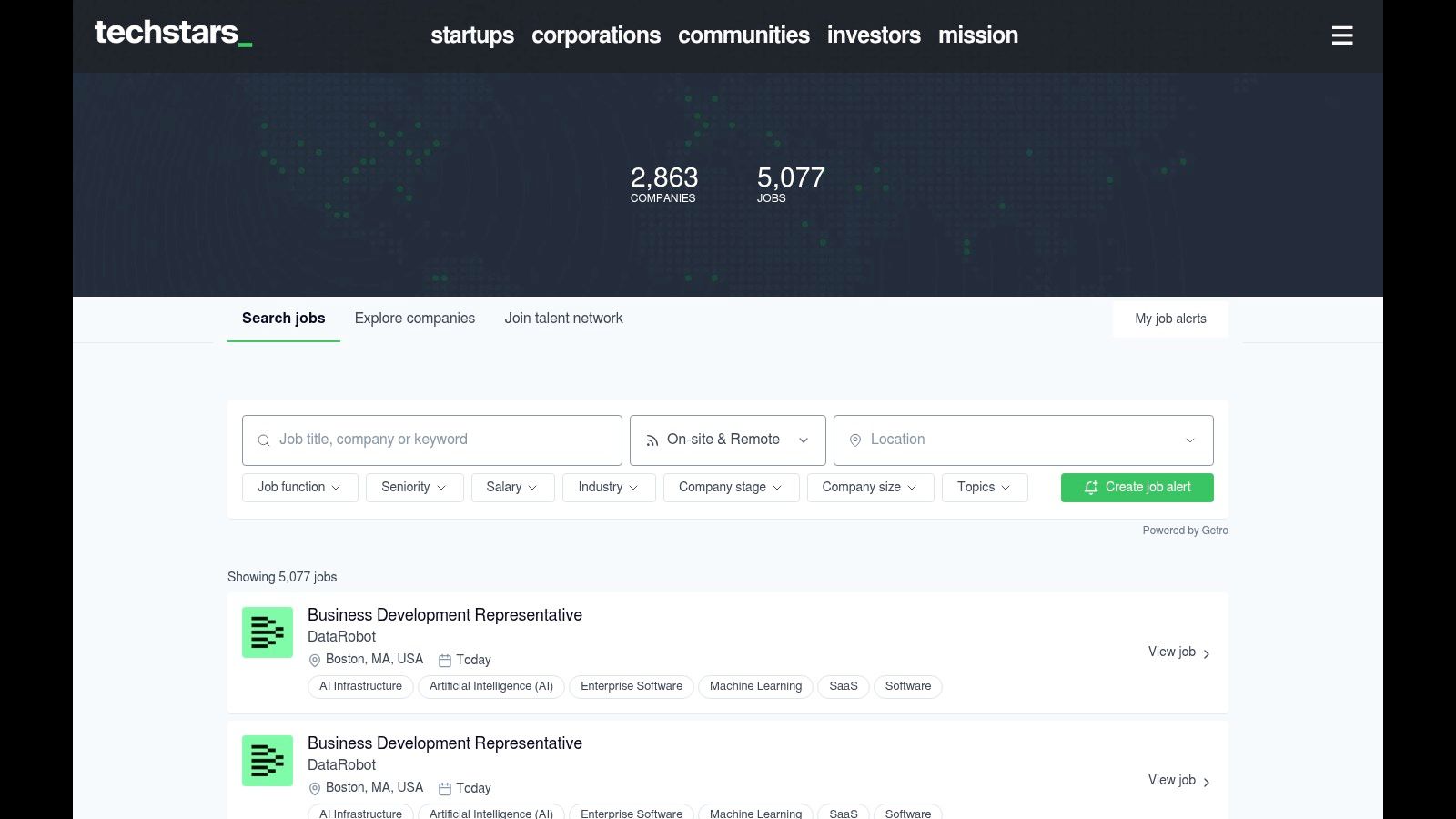
Techstars Jobs is useful for exploring companies connected to an accelerator network without restricting yourself to software businesses. Listings include portfolio companies and Techstars itself, across industries and geographies.
A candidate interested in operationally complex businesses can use function and location filters to find roles that general technology searches may overlook. Applications go to individual employers, so hiring processes and response quality will vary.
A network board helps you choose where to look. The hiring manager still needs to explain why the role exists and what success requires.
International coverage is useful only when the employment arrangement works for you. Establish work authorization, payroll location, relocation expectations, and whether the role requires physical access to customers or equipment.
Curation comes from network membership, not a guarantee of candidate-role fit. Confidentiality depends on the application destination and any profile settings; don't assume private browsing creates an anonymous application.
Its best funnel position is targeted discovery followed by employer-specific diligence. Ask about reporting lines, available support, and which responsibilities belong to the hire rather than the founder.
The broad industry mix is a genuine advantage for non-engineering candidates. The limitation is that accelerator affiliation doesn't standardize company maturity, management quality, compensation, or interview structure. Treat each opening as a separate hiring process.
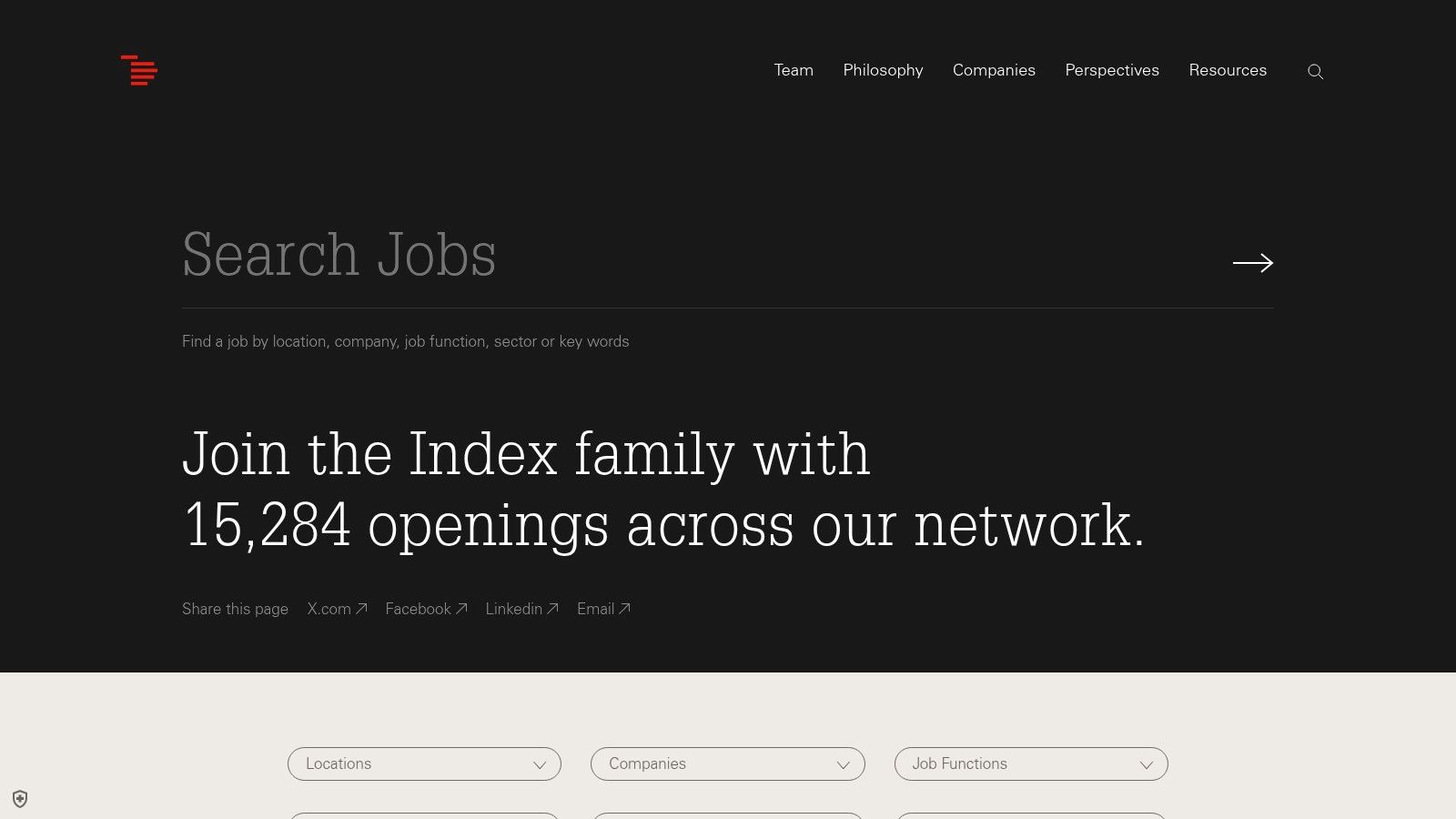
Index Ventures Startup Jobs is especially useful when company stage and size matter as much as title. Filters include location, function, sector, company stage, and employee count, helping distinguish a small product team from a larger portfolio employer.
That distinction changes the job. A product manager joining a small team may own discovery and execution directly; at a later-stage business, the same title may involve a narrower product area and more coordination.
Venture backing isn't proof of broad expansion. CNBC's reporting on Revelio Labs data found that median U.S. Series A headcount fell 17.5%, from 57 employees to 47, between the comparison periods discussed in its 2025 report.
Use this explanation of venture capital funding stages to sharpen your questions about hiring plans and milestones. Ask what the new hire must accomplish before the next financing decision.
The catalog also includes later-stage and public companies. Use the stage and employee filters rather than assuming every result offers a startup-sized team.
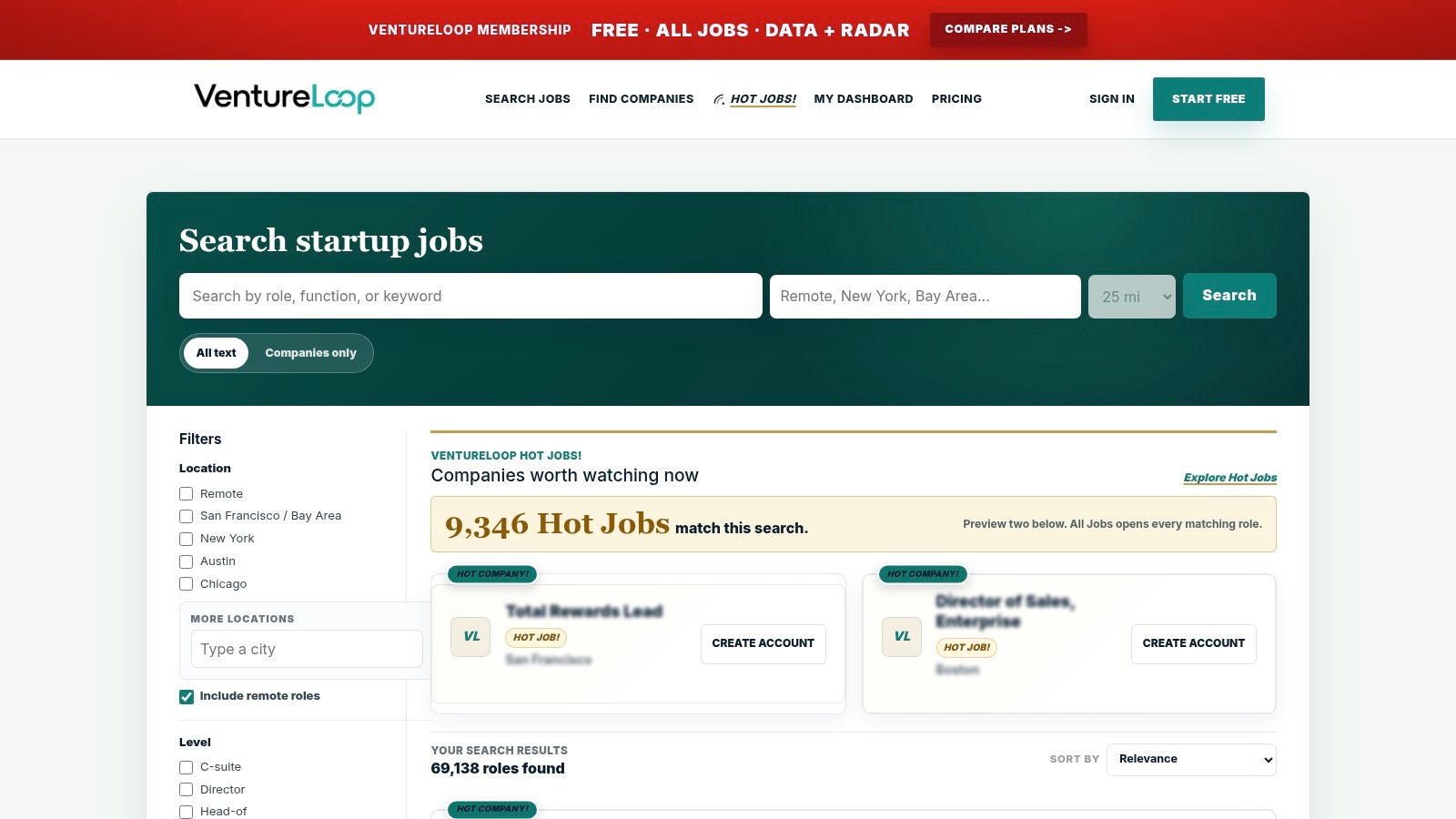
VentureLoop suits candidates who specifically want venture-backed employers, including those searching outside engineering. Search by title, keyword, and location, then narrow by company stage and remote, hybrid, or onsite arrangements.
Its value is a financing-focused employer pool. That can be useful for finance, marketing, sales, and operations candidates who find general startup searches dominated by software engineering openings.
Some listings or features may require registration or paid membership, and the site indicates membership is needed to access all eligible jobs. Check what you can access before building your entire search around the platform.
For a finance role, search beyond the obvious title. Responsibilities such as forecasting, fundraising support, and revenue operations can sit under different titles at different stages.
The practical limitation is overlap with other boards. Track the employer and role in a spreadsheet so you don't submit duplicate applications through multiple channels. If the same opening appears elsewhere, choose the clearest employer-approved route and keep a record of where you applied.
Climatebase is the strongest specialist choice here when climate work is a genuine career requirement. Its listings cover software, product, operations, marketing, finance, and climate-specific work, with sector filters including energy, transportation, buildings, and carbon removal.
Mission alignment is its main advantage, but mission doesn't determine company stage or role quality. The catalog includes startups, established organizations, and nonprofits, so confirm the organizational environment as carefully as the climate focus.
A software engineer moving into energy should explain relevant experience with reliability, data pipelines, optimization, or device integration rather than claiming climate expertise they haven't developed. A product manager should investigate who buys the product and whether deployment depends on hardware, regulation, or long procurement cycles.
Climatebase also includes community resources and a climate-career fellowship, with separate application requirements. Don't confuse fellowship participation with access to a particular job.
For a more focused shortlist, explore these clean energy companies, then compare actual responsibilities and working arrangements. Choose the role where your skills solve a concrete problem, not just the company with the most appealing mission statement.
The main difference is where each platform fits: curated introductions, network-specific listings, or broad job-board browsing. Candidate pricing is included where the section provides a pricing model.
| Platform | Best For | Curation Level | Startup Focus | Pricing for Candidates |
|---|---|---|---|---|
| Underdog.io | Discreet, curated startup introductions | High; candidates and companies are screened | Startups and high-growth tech firms | Free |
| Wellfound | Broad startup and tech job searches | Low; candidates assess listings themselves | Startups from early to later stage | Free |
| Y Combinator Work at a Startup | Jobs at YC-backed companies | Network-limited; candidates review individual roles | YC companies, especially early-stage | Free |
| Welcome to the Jungle | Personalized job discovery and company research | Personalized recommendations; listings vary | Startups and larger tech firms | Free |
| Built In | Local tech-hub job searches and company research | Listings are not tightly curated | Startups and broader tech employers | Free |
| Startup.jobs | Browsing startup roles across job functions | Job board; direct applications | Startup-focused | Browsing available; some features paid |
| Techstars Jobs | Roles at Techstars network companies | Network-based job board | Techstars portfolio and accelerator roles | Free |
| Index Ventures Startup Jobs | Searching venture-backed companies by stage and role | Portfolio-limited job board | Index portfolio companies, including later-stage firms | Free |
| VentureLoop | Jobs at venture-backed companies | Filterable job board | Venture-backed companies | Some access may require paid membership |
| Climatebase | Climate and sustainability careers | Specialist job board and community | Climate-focused startups and organizations | Free |
Use a curated marketplace when fit and direct access matter more than browsing volume. A job board gives candidates more control over which listings to pursue; curated introductions can reduce irrelevant applications, while offering fewer opportunities and less control over timing. For employed candidates, check how each platform handles profile visibility before sharing details.
Choose platforms by the missing step in your search. If you don't know which companies to target, use broad boards and company profiles. If you know your target but can't reach relevant decision-makers, prioritize selective introductions and focused outreach.
For employed candidates, our 60-second application creates a single profile for curated introductions, with anonymity until mutual interest. Underdog.io is free for candidates; employers use pay-per-hire or subscription pricing, and our network includes pre-seed, seed, Series A-C, and high-growth technology companies. Pair that approach with a broad board rather than waiting on selective matching alone.
Track companies, application routes, responses, interviews, and next actions in Google Sheets or Airtable. Candidates should measure qualified conversations rather than applications sent. Founders should separate time to a qualified introduction, interview conversion, offer conversion, and acceptance.
Those distinctions matter because technical hiring isn't instant. An analysis of more than 109 million applications, summarized by The Cognitive, found a median application-to-accepted-offer time of approximately 40 days for technical roles. That's a benchmark for interpreting a funnel, not a promise about any platform.
A curated marketplace is usually the better next step when the problem is relevance: too many unsuitable applicants, limited founder review time, or experienced candidates who won't browse listings regularly. A job board works better when you need broad reach and have the capacity to screen.
For hard-to-fill technical roles, founders can supplement platform sourcing with a specialized staffing partner such as nexusITgroup.com. Define the technical scope and ownership gap first; adding a recruiter to an unresolved hiring brief only spreads the ambiguity.
If you're exploring hiring remote talent with AI, keep human review for technical scope, location eligibility, and candidate motivation. Start your own search with our candidate application or browse our New York City and San Francisco startup listings, then add another platform only when it fills a specific gap.
Underdog.io connects tech professionals with vetted startups through curated introductions and direct access to hiring decision-makers. Visit Underdog.io to create your candidate profile or explore New York City, San Francisco, and remote startup opportunities that match the work you want next.