The usual advice says the best sourcing tool is the one with the largest database. That advice treats every product as interchangeable, and it falls apart the moment you need a reply from someone who already has a job.
A 2025 talent-leader study published by Recruit CRM found that 68% of respondents named LinkedIn Recruiter as their primary tool, nearly twice the next option, while 84% said it generated fewer than 40% of their hires. Roughly one in five of those same respondents still directed 61–80% of their talent-technology budget into it. High adoption and low conversion sat side by side.
I rank a sourcing tool by one test: whether the right person writes back and shows up to a screen worth booking. Profile count comes second.
Raw search still earns its cost when you are mapping a market or building a long list for a new category. Curated, fact-based matching earns its cost when the role is narrow, the company is early, and a bad intro wastes a founder's week. The ten options below split across those two models. Underdog.io leads for startup hiring because a vetted pool and fact-based matching address the reply problem that a searchable database alone has not solved.
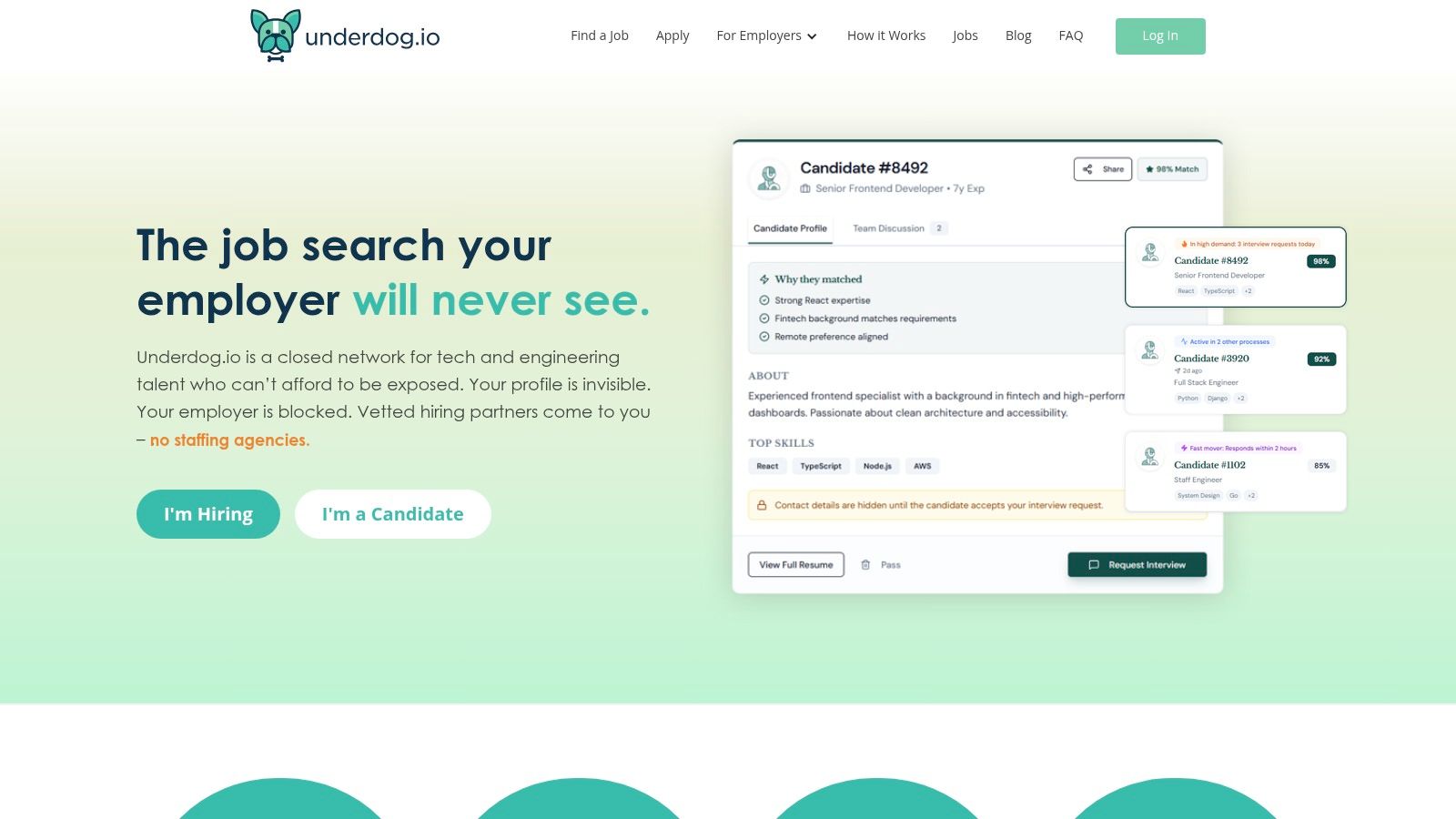
This is the tool I reach for when a startup needs engineers, product managers, designers, or business hires and the founder has no time to blast InMails. We run a curated marketplace for people exploring roles at high-growth tech companies in New York City, San Francisco, and remotely across the U.S. One application, built to take about 60 seconds, puts a candidate in front of hundreds of vetted companies. Employers reach out to them.
The focus is early-stage through Series B, though companies from pre-seed through Series C and high-growth stages hire here too. Matching combines human review with stack-specific questions and Boolean logic, so a founder sees a short list rather than a flood of keyword alerts. We screen companies that apply to join for funding status, team quality, and product viability, and we accept about 5% of candidate applicants. Profiles stay hidden from a current employer until interest is mutual.
Passive-candidate guidance on our blog cites LinkedIn research of 18,000 fully employed professionals across 26 countries, where roughly 75% identified as passive and about 45% said they'd consider a role if a recruiter approached them. Reply rates in that guidance run around 5%–12% for generic outreach and 15%–35% for more personal notes. A selective introduction is the point of the model.
Practical rule: Judge a curated marketplace on qualified replies and interviews, not on how many names the search box returns.
Roundups of sourcing tools rarely cover privacy. A HackerEarth sourcing roundup is typical: automation and reply analytics, almost nothing on anonymous search or how a passive candidate explores without tipping off their company. Confidential profiles are why this model fits employed talent, and conversations run through an email relay inside the platform until both sides opt in. If you need a million-row database for a generalist req in a non-tech function, look further down the list.
LinkedIn Recruiter is the default search-and-outreach seat, and for a reason. If the person keeps a detailed profile, you can filter, save a project, and send InMail outside your network. Individual recruiters and large teams both live here, across almost every function.
LinkedIn's 2015 Global Recruiting Trends already separated quantity from quality. Social professional networks had grown 73% over four years as a source of quality hires, the fastest-growing quality channel in that study of 4,125 global respondents. Internet job boards still produced the most hires by count. That split hasn't gone away. Recruiter is excellent at exposure and weak at telling you who will engage with a seed-stage team.
Pricing is quote-based and gets expensive for a small startup. Coverage is uneven in niche technical markets. For software roles I still write tight Boolean, and this guide to Boolean strings for sourcing software engineers is the worksheet I use before I pay for another seat. Use Recruiter to map the market. Don't pretend the map is a shortlist.
Say you need a staff backend engineer who has shipped in a regulated industry and barely touches LinkedIn. SeekOut is built for that search. You can start from a job description or a profile, rank results, and on the right plan search people already sitting in your ATS.
The startup mix makes that rediscovery matter. The Pragmatic Engineer startup market note for 2025 put 50% of startup hires in backend, 25% in full-stack, 10–15% in AI/ML, and only 5% in frontend. New-graduate hires at startups were down 11% from 2023 and more than 30% from pre-pandemic levels. A volume tool aimed at "software engineer" will waste your week.
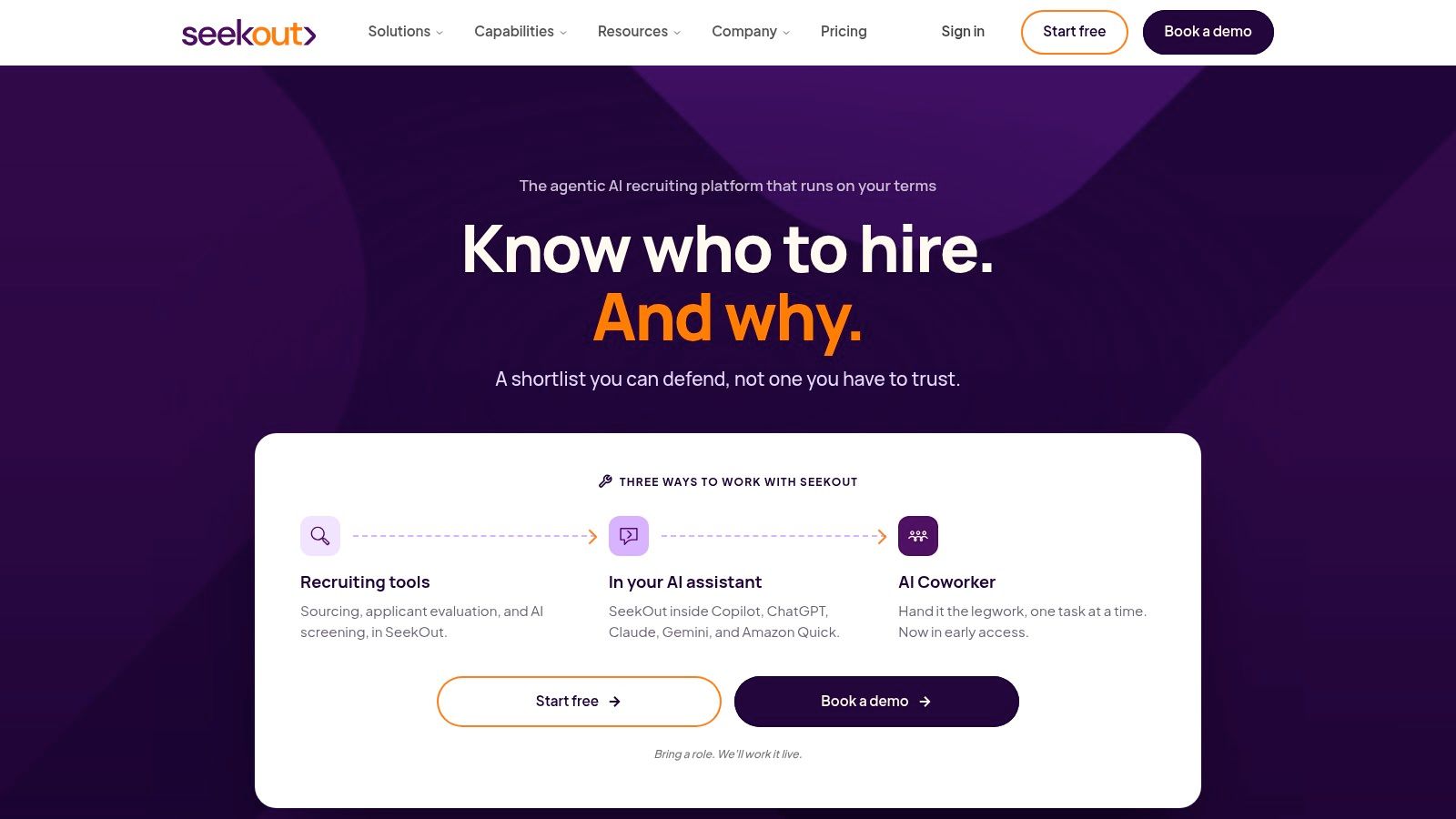
There's a self-serve entry plan and a free trial, which is more than most enterprise databases offer. Advanced team features often need a custom plan, and public profiles go stale. I still verify GitHub and other public work before I trust a match. If that's your motion, start with how to hire on GitHub rather than assuming the AI rank is current.
Juicebox is the small-team test. You describe the person in plain language, refine the list, and skip a Boolean string you don't have time to maintain. Paid plans include email and phone credits, projects, exports, and outreach. A free plan lets you feel the search before you buy.
That's a fair way to see if natural-language search fits your reqs. It is not a reason to celebrate application volume. Gem's 2025 benchmarks, as summarized by Darwinbox, show job boards delivering 49% of applications and only 24.6% of hires. A pretty search box can recreate that gap if you export everyone who loosely matches the sentence you typed.
For passive talent, read passive candidate sourcing before you burn credits on people who never asked to be contacted. Juicebox is a discovery aid. It won't tell you who wants a startup.
Gem is what I look at when sourcing, outreach, scheduling, and reporting have splintered across four logins. You can keep your ATS or move onto Gem's all-in-one system. Startup pricing exists, but the number is custom, so get the quote against your actual seat count.
The cost of a sloppy top of funnel shows up later. Gem's 2025 recruiting benchmarks put interviews per hire up 42% versus 2021, from 14 to 20, while average time to hire rose 24%, from 33 days to 41. Pin.com, Metaview, NoonAI, and Wrangle can help with outreach sequences, interview notes, or workflow automation. They don't replace an upstream match. Juicebox-style database search has the same limit. If the intro is wrong, a cleaner transcript doesn't fix the hire.
Confirm the ATS connection before you sign. If you only needed search, this platform is more product than you will use.
hireEZ suits a team running several reqs at once and trying to keep sourcing, CRM, and engagement in one place. AI search sits next to applicant matching, analytics, and workflow automation. That's useful when a coordinator owns a living pipeline, not a single hard search.
Standard self-serve pricing isn't clearly published, so you're in a sales cycle before you know the bill. For a founder hiring two people this quarter, the extra modules are noise. I've seen teams buy the suite, then still export names into the tool they already liked.
Ask which integrations and service levels are in the order form. "AI sourcing" on a slide is not a committed feature list. Use it when you need candidate management plus discovery. Skip it when discovery is the only job.
Fetcher is easier to compare on paper than most of this list, because the tiers are public. Plans change how many leads you get and whether CRM, email outreach, a LinkedIn plugin, ATS integration, and inbound review are included.
That transparency helps a first conversation. It doesn't pick the tier for you. A small team can start lower and hit a lead cap mid-search. Higher volume and enterprise support need a sales conversation, and support inclusions change by plan.
Check the lead allowance against last quarter's sourced hires, not against the biggest number on the pricing page.
I'd trial the plugin on one live req and count how many leads are already in your ATS. If half the batch is duplicate, the cheaper tier just got expensive.
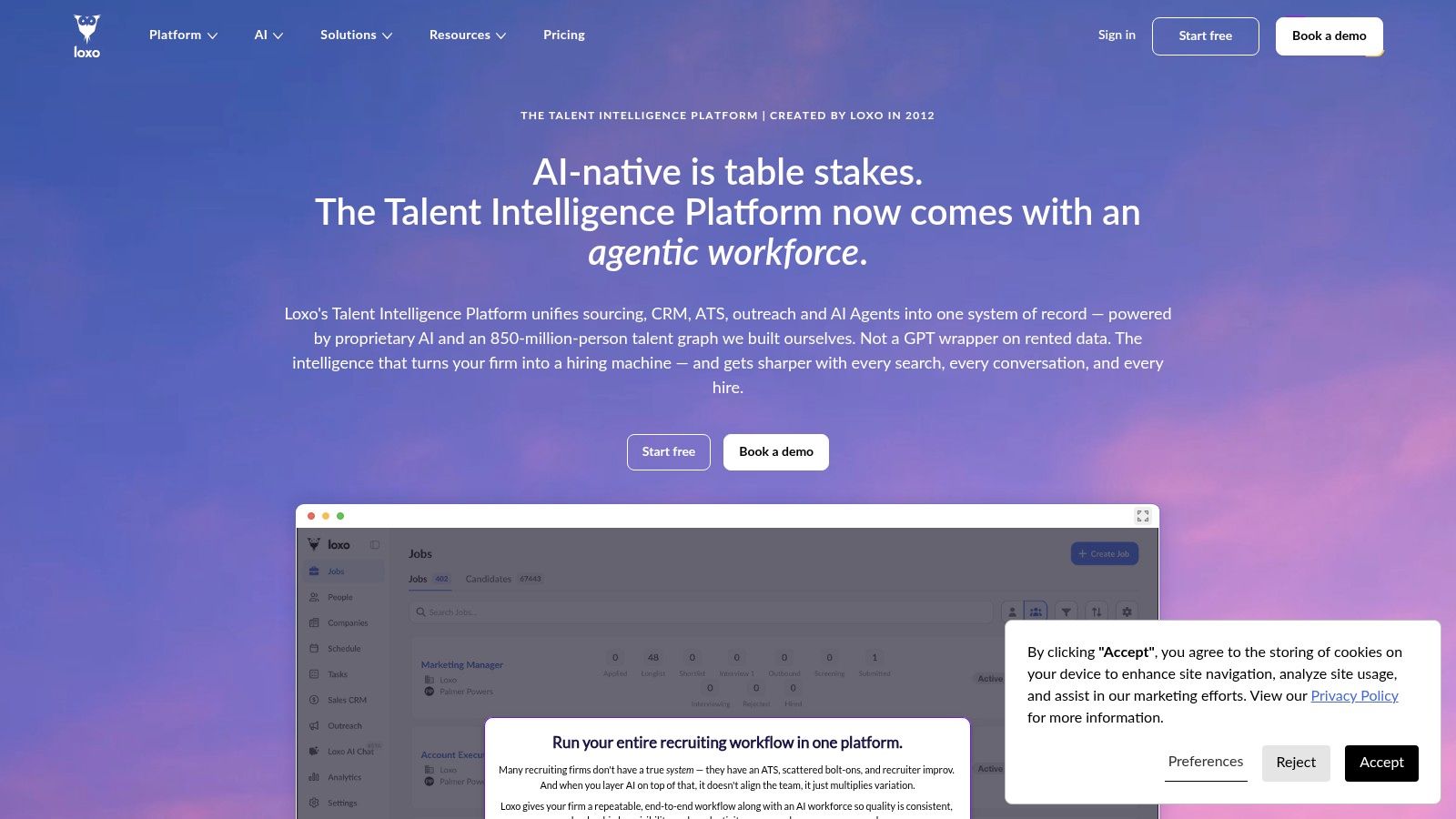
Loxo is the consolidation bet. ATS, CRM, natural-language search, contact data, and outreach automation live in one platform. Agencies and in-house teams that are tired of stitching tools together are the target audience. The vendor offers a free trial of the Professional platform and publishes Core pricing as a starting point, which is more honest than a pure "contact us" wall.
Sourcing and the more agent-like features sit on higher tiers. If your ATS and CRM already work, switching for search alone is a long project. Run ten real profiles through the trial and check whether titles, locations, and emails are current before you migrate a pipeline. Relevance you didn't test is how teams end up paying twice, once for the new system and again for the old one they couldn't turn off.
Findem is talent data for people planning several pipelines, not a recruiter who needs five names by Friday. Sourcing, CRM, analytics, and market insight sit in an enterprise sales motion. There is no standard self-serve price.
That orientation matches how most stacks are bought. HR.com's 2025–26 research, published with Eightfold, puts applicant-tracking systems at 78% adoption and employment hiring platforms at 67%, while recruitment analytics is at 35% and candidate-relationship management at 21%. Only 43% of organizations rate their talent-acquisition stack as good or excellent. Buying another intelligence layer won't close that gap if nobody owns the report.
For a small startup, Findem is usually too much process. For an enterprise team segmenting skills across regions, the analytics can earn the implementation time. Confirm coverage and integrations before you book the kickoff.
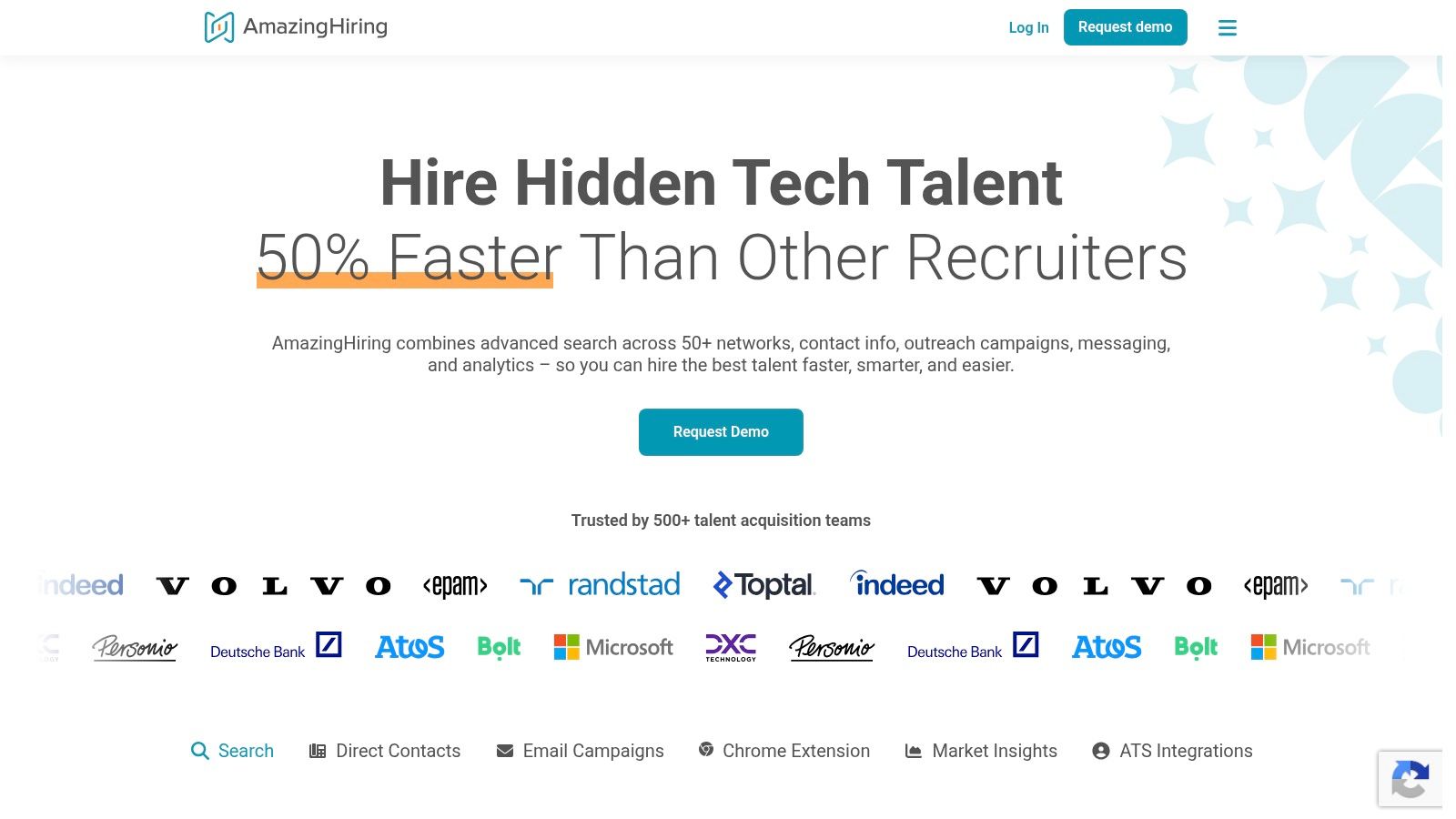
AmazingHiring is a browser-based sourcing tool aimed at technical people, pulling role, location, and whatever contact detail the public profile has. It complements a system you already run. It is a poor primary tool for marketing, sales, or generalist hiring.
Tech employers feel that niche pressure. ManpowerGroup's Experis Tech Talent Outlook reported that in 2025, 41% of U.S. technology employers named attracting qualified talent as a top challenge, and 37% named improving candidate experience. A specialist index helps the first problem. Spamming stale emails makes the second one worse.
Public pricing is hard to find, and you should spot-check contacts before a sequence. I use it when the search is engineering or IT and the main database has gone quiet. I don't use it as the system of record.
Read these tools by failure mode. If searches die from low-fit introductions, start with a curated marketplace. If they die from thin coverage, use a search database. If they die from scattered workflow, consolidate.
| Tool | Best hiring scenario | Pricing signal | Standout capability | Candidate vetting |
|---|---|---|---|---|
| Underdog.io | Startup volume hiring where quality still has to stay high | Free for candidates; employers choose pay-per-hire or subscription pricing, with unlimited seats and a full year of unlimited hires on subscription | Weekly curated batch of active, high-intent candidates and direct access to founders, hiring managers, and decision makers | Manual review; accepts about 5% of applicants for startup-aligned experience |
| LinkedIn Recruiter | Market mapping and broad outreach across job functions | Sales-led pricing rather than a simple self-serve tier | Large professional network with advanced search and InMail | Profile depth depends on member upkeep; verify current role, location, and contact path |
| SeekOut | Technical and hard-to-fill niche sourcing | Self-serve entry plan and free trial; advanced plans can move to custom terms | AI-assisted search across external profiles and ATS data | External profile data can lag; confirm skills, seniority, and availability |
| Juicebox | Small teams testing whether a brief can become a list | Published self-serve plans and a free plan | Plain-language candidate search for teams without a sourcer | Contact and profile details need spot checks before outreach |
| Gem | Teams connecting sourcing, outreach, scheduling, and analytics | Custom pricing, with startup pricing available | Unified recruiting workflow with an optional built-in ATS | Fit is assessed in your process; build the screen into the first touch |
| hireEZ | Teams managing multiple searches and ongoing pipelines | Standard self-serve pricing is not clearly published | AI sourcing combined with CRM and candidate management | Validate relevance before sequencing; volume can hide weak matches |
| Fetcher | Teams wanting sourcing assistance plus follow-up tools | Public tier comparison, with limits varying by plan | Candidate sourcing paired with CRM and outreach | Review suggested matches closely; automation still needs a hiring bar |
| Loxo | Teams consolidating ATS, CRM, sourcing, and outreach | Published core starting price; higher-tier features vary | All-in-one recruiting platform with AI search | Test relevance and data completeness before it becomes the system of record |
| Findem | Enterprise pipeline planning across roles or segments | Standard self-serve pricing is not published | Sourcing combined with talent analytics for planning | Define the quality bar internally; analytics will not set it for you |
| AmazingHiring | Engineering and IT recruiting when the main database goes quiet | Public pricing is hard to find | Technical-profile discovery across online sources | Spot-check contacts before a sequence; keep it beside the core system, not as it |
The pricing column is a buying signal. Published tiers favor fast pilots; sales-led pricing means legal, security, and budget review enter earlier.
Match the tool to the hiring problem, not to a feature grid.
A curated marketplace fits startup volume where quality still has to stay high. We send a weekly curated batch, you can choose pay-per-hire or subscription pricing, and the subscription includes unlimited seats and a full year of unlimited hires. The pool is 300,000+ pre-vetted candidates, with ATS integrations, a personalized employer page, and diversity sourcing on the pricing inclusions. When you want recruiters in the seat, Hunt is contingent support from vetted tech recruiters. Natural-language search, Juicebox being the clearest self-serve example here, fits a small team testing whether a brief can become a list. All-in-one platforms such as Gem or Loxo fit when you are ready to consolidate ATS and CRM. Findem fits enterprise pipeline planning. AmazingHiring and SeekOut fit technical niche discovery. LinkedIn Recruiter still fits market mapping.
Pin.com, Metaview, NoonAI, and Wrangle belong later, or beside the search, as outreach and interview workflow. They don't fix a low-fit intro. Pin's recruitment process guide reports SHRM findings that 36% of candidates who withdrew blamed an unreasonable interview process, and it cites NACE's 2025 benchmarks at 27.3 days on average between first interview and offer for college candidates. A strong match still dies in a slow process. If a tool isn't the right shape at all, a staffing firm such as nexusITgroup.com is the alternative, a dedicated partner instead of another login.
Before you sign, ask every vendor the same four things:
If two tools tie on those answers, pick the one that shortens the path from intro to a real conversation. You can build outreach around hiring trends after the match is real. You can't automate your way out of the wrong pool.
We match startups with a vetted pool of tech candidates through fact-based, human-informed introductions, so you spend time on people who reply. If a searchable database has been giving you names without conversations, start with a curated pipeline instead. Visit Underdog.io to see how employers source startup talent.