The old entry-level playbook has broken. Aura's labor-market analysis reports an 11.2% drop in entry-level job postings from Q1 2021 to Q2 2024, plus a 7 to 10% decrease in roles requiring no prior experience. The same analysis says postings that required AI skills rose 30%, and entry-level postings fell 38% in 2023 alone, with many of the remaining roles asking for more experience or AI-related capability than junior candidates used to face (Aura's entry-level hiring trends analysis).
That sounds discouraging if you define entry level as “someone a startup can train from scratch.”
It becomes more manageable when you define entry level the way startups now do. Someone who can show proof of work, learn fast, and contribute without a long runway. In practice, that means a strong project beats a vague statement about being passionate. A GitHub repo beats a course certificate. A sharp teardown, dashboard, prototype, or writing sample beats a resume full of class names.
I've seen too many candidates miss this shift. They apply to entry level startup jobs as if the label means low expectations. It doesn't. At a startup, entry level usually means junior in title, not low impact in execution.
Most candidates still search for entry level startup jobs with an outdated assumption. They think “entry level” means the company expects limited output and broad potential. Startups usually don't hire that way anymore. Small teams need people who can pick up a real task, use the actual tools, and ship something useful.
That doesn't mean you need years of formal experience. It means you need evidence. If a founder can't see how you work, they'll default to someone else who already looks less risky.
The hardest part of this market isn't just fewer junior openings. It's that the surviving openings often expect applied skill from day one. You're competing against candidates with internships, freelance work, open-source contributions, or unusually strong personal projects.
That's why your digital trail matters more than many applicants realize. Before interviews, recruiters often scan LinkedIn, GitHub, portfolio sites, personal websites, and public social profiles to understand how you present yourself. If you haven't reviewed that lately, this online reputation guide for professionals is a useful checklist.
Practical rule: If a recruiter clicks your name and can't quickly tell what you build, write, analyze, or design, you're making them do extra work. Most won't.
You don't beat the market by sending more generic applications. You beat it by looking more specific.
Focus on three things:
Candidates who understand this shift still land interviews. Not because the market is easy. Because they stop presenting themselves like blank slates.

At a large company, entry level can still mean structured onboarding, narrower tasks, and time to ramp. At a startup, entry level usually means something else. You'll get support, but you're still expected to operate close to production work.
That shift is visible in hiring behavior. SignalFire's 2025 talent report says AI tools are taking over more routine entry-level tasks, pushing companies toward roles with more impactful technical output. A separate 2025 tech-career discussion also cites a survey finding that over 94% of tech hiring managers expect prior related work even for entry-level roles (discussion summarizing the hiring shift).
The wrong mental model is this: “I'm junior, so I'm supposed to be trained before I contribute.”
The startup model is closer to this: “I'm junior, but I already have a toolkit and can use it on real problems.”
Here's the difference:
| Mindset | What candidates assume | What startups actually want |
|---|---|---|
| Corporate ladder | Title comes first, responsibility later | Responsibility starts earlier |
| Blank slate | Potential is enough | Proof matters more |
| Task follower | Wait for direction | Move with partial context |
| Resume-first | Credentials carry weight | Output carries weight |
A startup founder doesn't care that your experience was unpaid, self-directed, or done in school if the work is credible and relevant. They care whether you can solve a problem their team has.
For junior candidates, demonstrable output usually means one of these:
Startups don't need you to know everything. They need to see that you can already do something useful.
That's why many applicants get stuck. They talk about being eager, adaptable, and hardworking. Fine qualities. Not hiring signals. Hiring signals are artifacts. Repos. Screens. Analyses. Memos. Loom walkthroughs. Public writing. Volunteer work that looks like real work.
If you're pursuing entry level startup jobs, stop asking, “How do I prove I deserve a chance?” Ask, “What can I put in front of a hiring manager that lowers the perceived risk of hiring me?” That question leads to better decisions.
The phrase “startup job” is too broad to be useful. Early-career candidates do better when they aim at a specific operating lane. Most junior hires I've seen break in through five recurring functions.
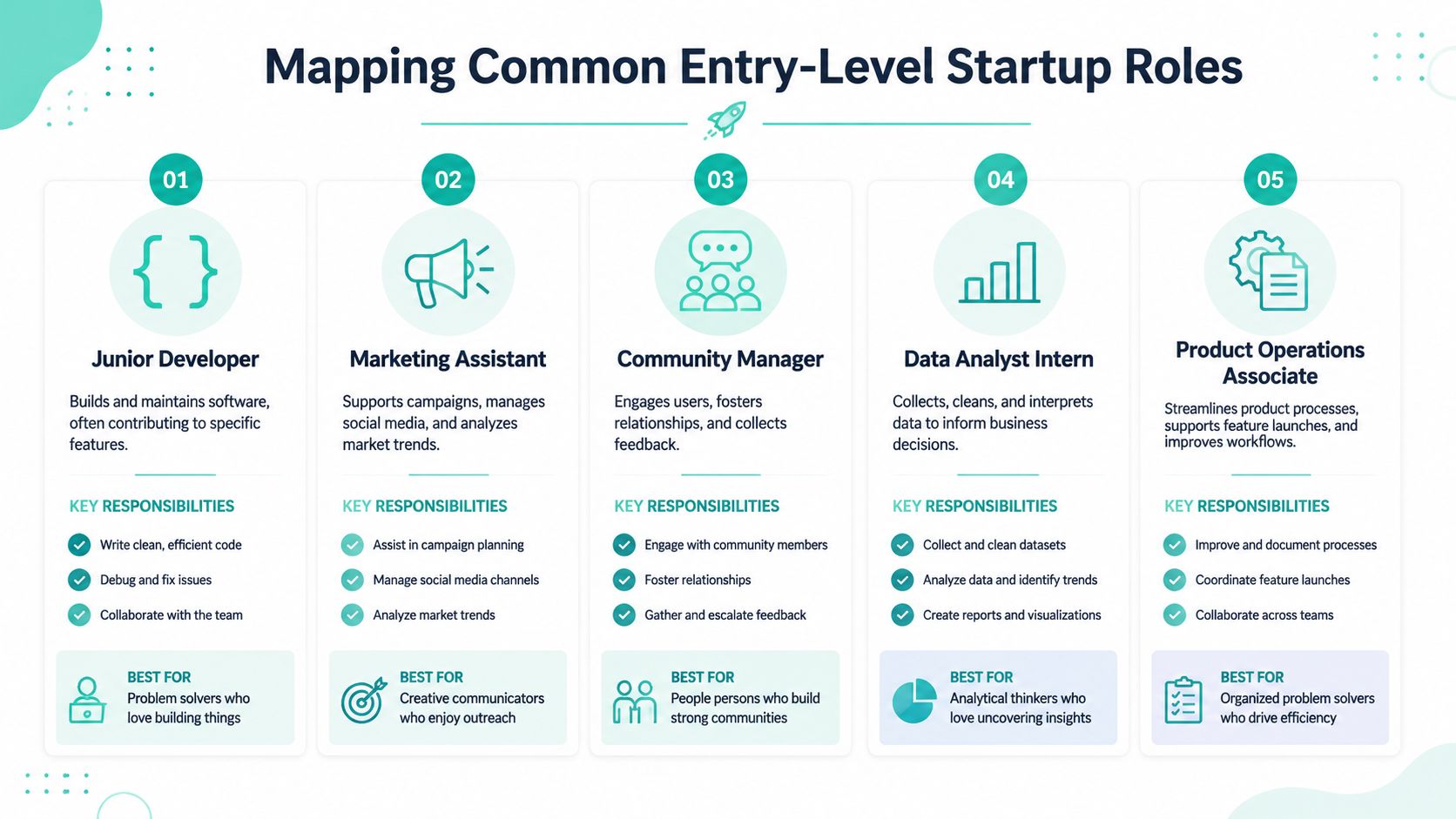
A junior developer at a startup rarely spends months on training tickets. More often, they fix bugs, own a scoped feature, write internal tools, or support integrations. The team wants someone who can read an existing codebase without panicking.
The signal that gets this person hired is not brilliance. It's reliability under ambiguity. Can you take a vague ticket, ask good questions, and ship something clean enough that a senior engineer doesn't need to rewrite it?
Common proof points include:
Startups often hire junior product operations associates or product-adjacent coordinators before they hire a true associate product manager. These roles sit in the messy middle. Documentation, launch support, QA coordination, customer feedback loops, and internal process cleanup.
A strong junior candidate here shows they can reduce friction. If you've ever organized a chaotic workflow, created a better handoff doc, or built a simple system that saved a team time, that's relevant.
The KPI isn't “had product instincts.” It's “made the team run more smoothly.”
Junior product designers don't get hired because their dribbble shots look polished. They get hired because they can solve interface problems in a way that engineers and product managers can practically build.
Hiring managers usually look for:
A startup-ready junior designer can show how a product flow improved, not just how it looked.
If your portfolio is all aesthetics and no product thinking, startups will pass.
This category is broader than candidates think. Startups may hire early-career people into growth marketing, content, lifecycle, partnerships support, or community. The work tends to be hands-on. Writing emails, managing content calendars, supporting webinars, researching competitors, pulling performance snapshots, talking to users.
The hiring signal is traction thinking. Not necessarily large-scale results. Just evidence that you understand how attention turns into action.
Good examples include:
Data remains one of the clearest examples of startup expectations for junior talent. In current startup-focused Indeed listings, employers ask junior data candidates to help with exploratory data analysis, data preparation, cleaning and transformation, reporting, dashboards, and basic statistical techniques. Those listings commonly ask for 0 to 2 years of experience, proficiency in Python, R, or similar, exposure to Tableau or Power BI, and familiarity with cloud platforms such as AWS, Azure, or GCP (startup-oriented entry-level data analyst listings on Indeed).
The key trait here is end-to-end usefulness. A junior analyst who can pull messy data, clean it, structure it, and explain it clearly is much more valuable than someone who only knows theory.
The portfolio isn't optional anymore for most entry level startup jobs. If you're applying to startups without proof of work, you're asking a small team to take a leap of faith they usually won't take.

That pressure is especially high in technical hiring. In a 2025 survey, 80% of startups building AI as their core product expected job growth, and machine learning and backend engineers were among the top openings, which tells you where startup demand concentrates (survey summary on AI-native startup hiring). Even if you're not targeting AI roles, the broader lesson is the same. Hiring teams are rewarding visible technical depth and practical execution.
Most junior portfolios fail because they contain too much unfinished work. Five half-built projects create more doubt than one finished one.
A startup-ready project usually needs these parts:
A real problem
Solve something a company or user might care about. Internal tools, onboarding friction, reporting confusion, broken signup flows, weak email copy, or poor support categorization all work.
A visible artifact
Engineers need live demos or repos. Designers need polished case studies with reasoning. Marketers need assets, campaign breakdowns, or messaging systems. Product candidates need specs, prioritization logic, and decision memos.
A short explanation
Add a concise write-up with the problem, your approach, the tools used, and what you'd improve if you had more time.
The biggest mistake is copying someone else's portfolio structure without thinking about how hiring managers review work in that function.
| Role | Best portfolio format | What reviewers want to see |
|---|---|---|
| Engineering | GitHub, live app, README, Loom demo | code quality, structure, trade-offs |
| Design | Portfolio site, Figma, case study | product thinking, iteration, clarity |
| Marketing | Notion, slides, writing samples | messaging judgment, channel logic |
| Product | Case studies, PRDs, launch docs | prioritization, user reasoning |
| Data | Notebook, dashboard, write-up | analysis quality, interpretation |
For product design, it helps to study actual portfolios that explain process rather than just final screens. These product design portfolio examples are useful because they show how candidates frame decisions, not just visuals.
Recruiters don't spend long on first review. They scan for whether your project sounds like work that could transfer into a startup team.
Use this structure when describing projects:
The portfolio should make a hiring manager think, “This person has already practiced the kind of judgment we need.”
One more candid point. Don't hide behind “I need permission” to build a portfolio. You can redesign a clunky flow from a public app, analyze an open dataset, write a teardown of a startup onboarding sequence, or build a small internal tool for a club, nonprofit, or friend's business. The point isn't prestige. The point is proof.
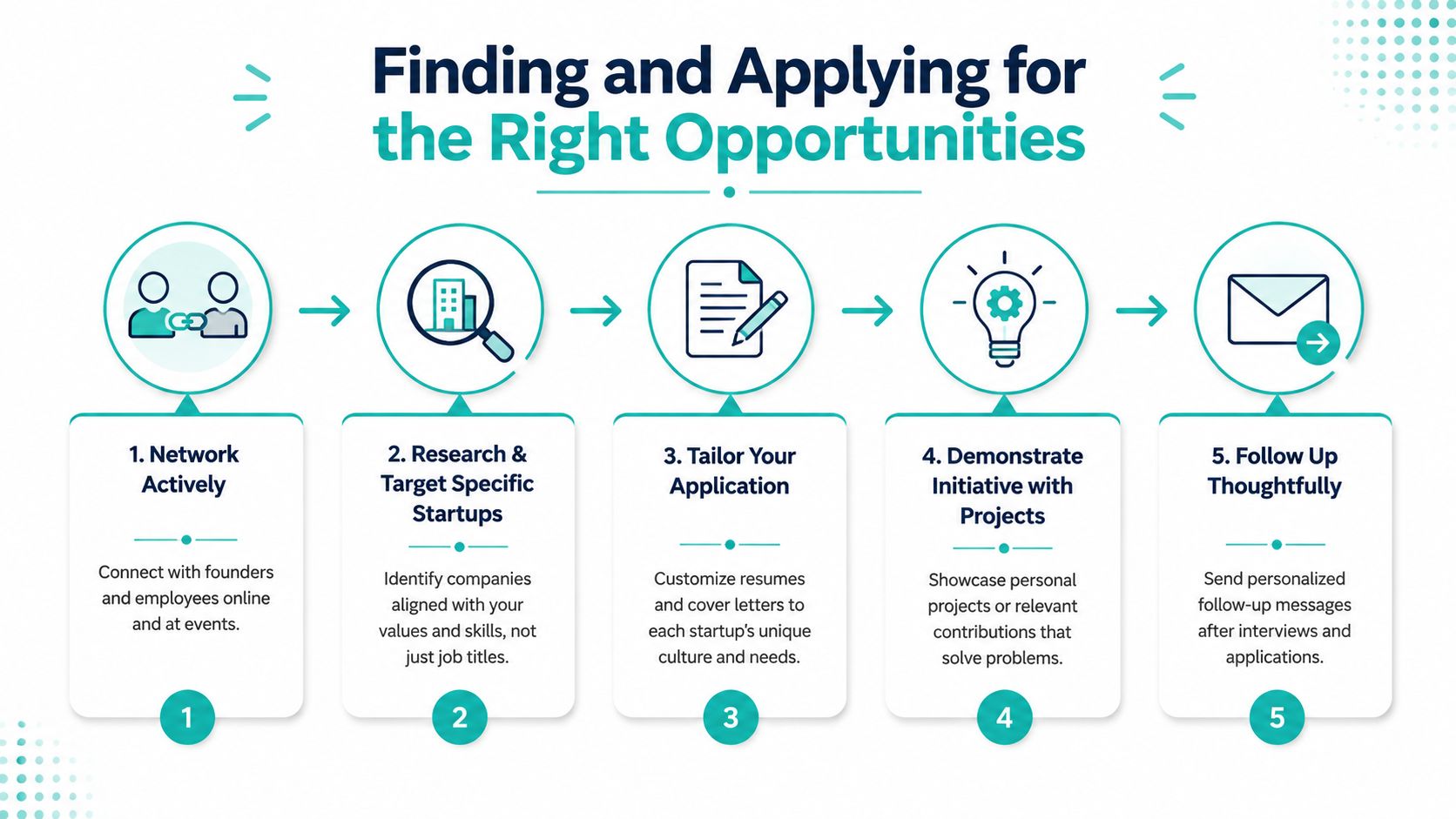
A weak search strategy can waste months. Most candidates put too much time into broad job boards, too little into targeted outreach, and almost none into adjacent markets where competition may be less rigid.
Wellfound highlights 130,000+ remote and startup jobs, and broader startup-job platforms create real surface area for search. But raw listing volume doesn't tell you how many roles are junior-friendly. The same market also includes adjacent options on niche boards such as social-impact tech, which many early-career candidates ignore (overview of startup job availability on Wellfound). That's the useful search question now. Not “Where are the most jobs?” but “Where is my profile most likely to convert into interviews?”
A practical search stack looks like this:
Major hubs still attract attention because that's where many startup teams cluster. Remote roles widen the field but also widen competition. Adjacent sectors such as social-impact tech can be easier entry points for candidates with mission alignment, volunteer experience, or cross-functional range.
Use a simple filter:
| Target | Upside | Risk |
|---|---|---|
| NYC or SF startups | more density, more startup specialization | more competition |
| Remote startups | wider access | harder differentiation |
| Adjacent sectors | mission fit, broader pathways | smaller role volume by category |
The worst approach is mass applying with one resume. A better approach is narrower and sharper.
Before applying, answer these questions:
Candidates who do this get fewer total applications out. They usually get better responses.
Junior startup roles attract heavy competition, and the interview bar is higher than the title suggests. Fewer true entry-level openings means companies use the process to test whether you can already do useful work with limited oversight. In practice, "entry-level" often means early-career candidates who can point to real projects, explain their decisions, and ramp fast.
Expect three to five steps. The exact labels change, but the sequence is familiar: an initial screen, a practical assessment, then conversations with the hiring manager and future teammates.
This round is basic filtering, but candidates lose traction here all the time. Recruiters are listening for focus. They want to hear that you understand the role, can explain your background clearly, and have a credible reason for applying beyond "I want to break into startups."
A strong answer is short and specific: what you've built, where you've done your best work, and why this role matches that evidence.
For searches that include distributed teams, it helps to track startup-specific and remote jobs sources because remote interview loops often put more weight on written communication, responsiveness, and self-direction. Teams cannot watch how you work in person, so they look for signs that you can manage ambiguity without constant prompting.
This is the step that separates candidates with project proof from candidates with only classwork summaries or resume claims. Engineers may get a code screen or take-home. Designers usually walk through portfolio work. Marketing candidates may get a messaging or content prompt. Product, operations, and customer candidates often get a case or scenario discussion.
Interviewers are not looking for polished theater. They are looking for judgment.
Use a simple pattern:
That last part matters. Early-career candidates sometimes think they need to defend every decision. Stronger candidates show they can evaluate their own work. That reads as coachable, which matters a lot in smaller teams.
For interview basics before these rounds, this guide to job interview do and don't habits is a useful refresher.
Startups rarely reject junior candidates because they lack polish. They reject candidates when the team cannot see how they think, prioritize, or recover from a weak first pass.
These interviews test whether you can operate inside a real startup environment. Expect questions about prioritization, speed of learning, handling vague instructions, and responding to feedback. Hiring managers are trying to answer a practical question: if they hand you a small but messy problem next month, will you make progress or stall?
Project-based examples beat generic enthusiasm here. A candidate who can explain how they shipped a class project, fixed a broken workflow for a student group, improved a volunteer onboarding doc, or rebuilt a freelance client's landing page usually performs better than a candidate who talks in broad terms about being motivated and adaptable.
Culture questions often hide execution questions. If someone asks how you work with change, they usually want to know how you handle shifting priorities, missing information, or conflicting feedback.
Answer with specifics. Name the situation, the constraint, your decision, and the result. Then mention what you learned. That is much closer to how startup teams evaluate junior talent than a polished personality answer.
Your first startup offer needs more than a salary glance. Junior candidates often focus on the headline number and ignore the parts that shape the actual experience. Team quality, manager quality, scope, learning curve, and whether the role matches the work you want to do in two years all matter.
Use a short checklist:
Early-career candidates often avoid negotiation because they think it signals ingratitude. It doesn't. What hurts is negotiating badly.
Keep it simple and calm. Try language like this:
I'm excited about the role and the team. If there's flexibility, I'd love to discuss whether the compensation package can move a bit, especially given the scope and expectations of the role.
If salary won't move, ask about other terms. Start date flexibility, equipment support, title clarity, or a scheduled compensation review can all matter.
After you accept, send a thoughtful thank-you note. If you want a model that sounds warm without sounding stiff, these templates for client appreciation adapt well for post-offer communication too.
The first 90 days matter more than the negotiation win. Learn the product fast. Ship something small early. Ask focused questions. Build trust by being dependable before trying to be impressive.
If you want a more targeted path into startup hiring, Underdog.io is worth considering. It's a curated marketplace where tech candidates submit one application and can be matched with startups and high-growth companies across product, engineering, design, data, and related roles. For candidates who fit the market, it can be a more efficient alternative to spraying resumes into general job boards.