Finding a job at a startup isn’t about just listing past duties on a resume. It’s about proving you can make an impact and adapt on the fly. You need a strategy: pinpoint the right stage of company for your goals, build a resume that screams measurable results, and get ready for an interview process that values gritty problem-solving over a perfect pedigree.
Let’s be clear: landing a role in the fast-paced startup world isn’t about luck. It’s about having a solid game plan. If you’re just looking for surface-level perks, you might be missing the point. A startup job is a unique shot at putting your career on an accelerator.
While big corporations offer stability, startups hand you a chance to wear multiple hats, learn new skills at a breakneck pace, and see the direct impact of your work on the company's bottom line. Yes, more than 90% of startups may fail, but the experience you gain from being in the trenches is absolutely priceless.
This guide is your roadmap. We'll break down how to find the right opportunities, create an application that a busy founder will actually read, and navigate an interview process that's often less formal but way more demanding than its corporate counterpart.
Think of this as your inside track on what startup hiring managers are really looking for. We’re giving you an actionable plan to go from applicant to new hire, focusing on the practical stuff that works.
Here’s what you’ll learn:
To get a feel for the landscape, you can start exploring some of the best websites for startup jobs to see what’s out there.
Alright, let’s get into it.
Jumping into the startup world is exciting, but just saying you want to "work at a startup" is a bit like saying you want to "drive a car." Are you picturing a scrappy two-person go-kart, or a polished, high-performance race car on the verge of its biggest race? The experience is wildly different. Nailing the startup job search means figuring out which kind of ride is right for you.
The journey from a garage idea to a public company is marked by funding rounds. Each stage—from Angel and Seed to Series A, B, C, and beyond—tells you a lot about a company's maturity, risk, and the kind of opportunity waiting for you inside.
An Angel or Seed stage startup is as raw as it gets. We're talking fewer than 15 employees, and everyone wears multiple hats. A software engineer isn't just an engineer; they're probably also the QA tester, the customer support rep, and the occasional IT person. The risk is highest here, no doubt, but the potential for meaningful equity and having a direct say in the company’s future is off the charts.
Once a startup hits Series A, it has found its footing. With a proven product-market fit and a fresh injection of cash, these companies are laser-focused on building out their core teams and scaling up. Your role will be more defined than at a seed-stage company, but there’s still plenty of room to shape processes and culture.
By Series B and C, a startup is in a full-blown growth phase. The team could be in the hundreds, and things are much more structured. You’ll likely join a specific team—like platform engineering or product marketing—with clear goals and established leadership. The risk is lower, and while your equity slice is smaller, it's tied to a more proven valuation.
As you look at companies, getting a sense of their product maturity is key. Understanding things like MVP development for startups can give you great insight into where they are in their lifecycle.
To make it even clearer, let's break down what you can expect at each stage. This isn't an exact science, but it's a solid guide for setting your expectations.
Choosing the right stage really boils down to your personal risk tolerance and career goals. There's no single "best" option.
So, how do you choose? Start with your personal risk tolerance. Are you in a position to take a lower cash salary for a potentially massive equity payout down the line? Or do you need the stability and higher base that a later-stage, well-funded company can offer? There's no right answer—only what's right for you.
Let's imagine a real-world scenario:
A Senior Product Manager is weighing two offers. One is from a 10-person, seed-funded FinTech company where she'd be the first PM. The other is from a 300-person, Series C HealthTech firm where she'd join an existing team of five. The seed-stage role offers huge autonomy and a significant equity stake but a lower salary. The Series C role provides a much higher salary, more stability, and a chance to specialize, but with less influence over the big-picture product vision.
Neither role is inherently better. The decision comes down to whether she values creative control and high-risk/high-reward potential over stability and specialized growth.
The flowchart below breaks down the core phases of a smart startup job search. Notice how much of the work happens before you even start applying.
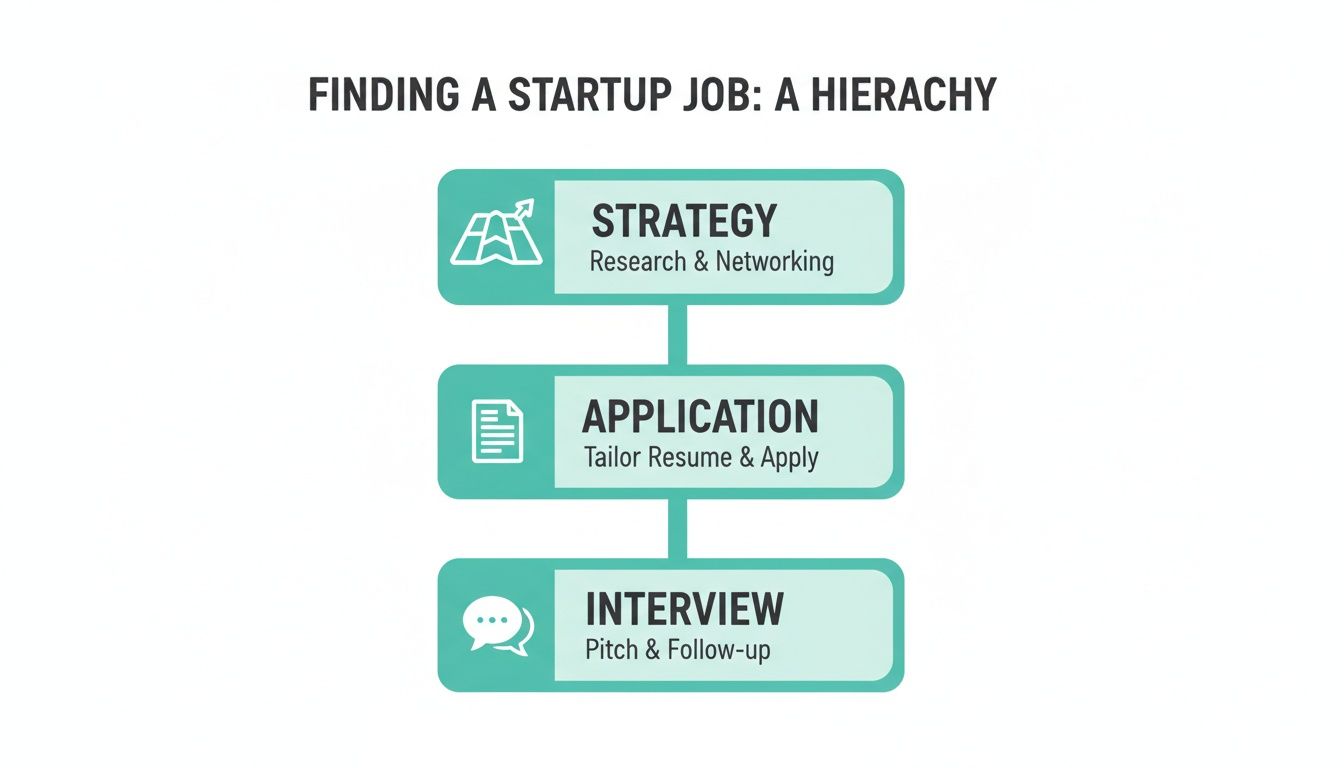
This shows that a successful search is built on a foundation of solid strategy. Choosing your target stage is a massive part of that.
Interestingly, it's the most mature startups that often have the most aggressive hiring goals. In fact, pre-IPO stage companies are expanding at a massive scale, posting a staggering 435,943 job openings in a recent three-month period alone. This hiring blitz far outpaces earlier stages, showing how these giants are ramping up to fuel hyper-growth and satisfy investor expectations.
Ultimately, finding a startup job you'll love requires some honest introspection. By lining up your career ambitions and financial needs with the distinct profiles of different startup stages, you can focus your search on the opportunities where you won't just work, but truly thrive.
When you're trying to land a job at a startup, your resume needs to do more than just list your past duties—it’s your highlight reel. It has to scream impact.
Unlike big corporations with siloed roles, startups need problem-solvers who drive results, plain and simple. They don't have time to decipher vague job descriptions; they want to see numbers, growth, and measurable wins.
A hiring manager at a fast-moving startup might give your resume less than 10 seconds. That's your window. You have to grab their attention immediately by showcasing what you’ve built, fixed, or improved. So, let's ditch the traditional format that focuses on responsibilities and shift our focus to outcomes.

The best way to reframe your experience is by using a simple framework for every bullet point: Problem-Action-Result (PAR). What was the business challenge? What specific action did you take? And what was the quantifiable outcome?
Let's see this in action. A typical, boring resume might say something like, "Managed the company's social media accounts." This tells a hiring manager absolutely nothing about what you actually accomplished.
Now, let’s give it the PAR treatment and turn it into something powerful:
See the difference? This version tells a compelling story of your effectiveness. If you want to go deeper, our guide on how to create a resume for startup jobs is packed with more strategies for tailoring your experience.
Let's be real: your online presence is just as important as your resume. Founders and recruiters will look you up online, so your goal is to make sure what they find backs up the story you’re telling.
Your LinkedIn profile is your digital headquarters. Your headline needs to be more than just your current job title—pack it with keywords that describe your skills and what you actually do.
For instance, instead of "Software Engineer at Acme Corp," try something like: "Software Engineer | Building Scalable FinTech Platforms with Python & AWS | Passionate about Early-Stage Startups."
Your online profiles, side projects, and blog posts are your way of demonstrating how awesome you are before you ever sit down for an interview. Show them what you’re into and how much work you’re willing to put into something you care about, even when you’re not getting paid for it.
Startups want to hire people who are genuinely passionate about their craft, and your online presence is the perfect place to prove it.
Platforms like Underdog.io are designed to connect you with top-tier startups, but you still need to put your best foot forward. Since your profile is what curated companies see, a few small tweaks can make a massive difference.
By treating your resume and online profiles as dynamic showcases of your impact, you shift from being just another applicant to being an in-demand candidate. This is a critical step in landing a job at a startup where every single hire is expected to move the needle.
Firing your resume into the black hole of an online application portal is a low-percentage play. This is especially true in the startup world. The real way in? It's through people.
Forget awkward, transactional handshakes at stale corporate events. Real networking is about building genuine connections. For startups, every single hire is a massive decision impacting culture and performance. A warm introduction from someone they trust can make all the difference.
Think about this: they say over 80% of jobs are filled through networking. That number feels even higher in the tight-knit startup ecosystem. Founders and hiring managers trust referrals from their own team infinitely more than a cold application from a stranger. Your goal isn't just to get your resume seen—it's to have someone vouch for you before it even lands in their inbox.
This requires a mental shift. Stop thinking, "What can you do for me?" and start thinking, "What can I offer?" It's a simple, systematic process of providing value first, which lays the groundwork for a real professional relationship. This approach turns a scary, daunting task into a manageable—and dare I say, enjoyable—part of your job search.
The secret to outreach that actually gets a response is to be specific, personal, and valuable. A generic "I'd like to connect" request on LinkedIn is the digital equivalent of junk mail—it’s getting ignored. A thoughtful message that proves you’ve done your homework? That’s much harder to dismiss.
The key is to give before you ask. Instead of immediately launching into your pitch, offer something relevant. This could mean sharing an insightful article about their industry, giving brief but specific feedback on a new product feature, or just congratulating them on a recent funding announcement.
Here’s a LinkedIn outreach message that works:
Subject: Quick thought on [Company Name]'s recent launch
"Hi [Name], I've been following [Company Name]'s journey for a while and was really impressed by the recent launch of [Product/Feature]. The [specific detail] is a clever solution to [problem it solves].
It reminded me of this article on [relevant topic] that you might find interesting. I’m a [Your Role, e.g., Senior Software Engineer] passionate about this space and would love to connect and follow your work."
This approach feels human. It's not transactional, and it respects their time, making them far more likely to accept your request and remember who you are.
Some of the best networking you'll ever do happens where tech pros hang out to talk shop. Niche Slack groups, Discord servers, and online forums are absolute goldmines for building authentic connections with people at the companies you admire.
But these aren't job boards. They're spaces for real discussion and knowledge sharing. To make an impact, you have to show up and participate authentically.
For instance, joining a Slack community for React developers and actively helping others debug their code is a ridiculously powerful way to get noticed by senior engineers and hiring managers from top startups. You're demonstrating your skills in real-time.
When you decide to reach out to a founder or executive directly, your email needs to be two things: concise and immediately valuable. These people are drowning in emails, so your message has to stand out. The goal is to start a conversation, not to ask for a job in the first email.
Your cold outreach should be a testament to your resourcefulness and respect for the recipient's time. Show you've done the work, understand their challenges, and have a specific, valuable insight to share. That's how you earn a reply.
Let's look at a practical example. Say you're a product manager targeting an early-stage company.
Subject: A quick thought on your onboarding flow
"Hi [Founder's Name],
Huge fan of what you're building at [Company Name]. I just went through your new user onboarding and loved the clean UI.
I noticed one small point of friction at the [specific step] step. Have you considered [offering a one-sentence, actionable suggestion]? At my last role, a similar tweak increased our activation rate by 15%.
No need to reply, just a thought from someone who's passionate about great product experiences.
Best,
[Your Name]"
This email is perfect. It's short, it's specific, and it offers a concrete idea without asking for a single thing in return. This value-first approach is how you turn a cold outreach into a warm conversation, paving the way to land a job at a startup you truly admire.
If you're coming from a corporate background, get ready for a totally different interview experience. The startup interview is designed to figure out how you think, not just what you know from a textbook. Forget the scripted, HR-led screenings. Here, you'll find a mix of practical challenges, deep technical dives, and very direct conversations, often with the founders themselves.
Your mission is two-fold: prove you have the skills to do the job right now, and show you're the right person to help them build their vision from the ground up.
These interviews move fast. Founders and CTOs don't have time to waste, so you need to make a strong impression from the first conversation. They’re looking for people who can hit the ground running, who are genuinely excited about the product, and who will fit into their small, tight-knit team.
Startups use a few key formats to see your skills in action—it's rarely just a series of Q&A sessions. Getting comfortable with these practical assessments is non-negotiable if you’re serious about landing a great startup role.
A pro tip for any take-home project: always aim to slightly exceed expectations. Add clear documentation to your code. Write a brief summary explaining your strategic choices. Present your findings in a clean, professional format. It shows you care.
In a startup interview, the questions you ask are just as important as the answers you give. This is where you prove you’ve done your homework and are thinking like a potential partner, not just another employee. It's also your single best opportunity to vet them.
Ditch the generic questions like, "What does a typical day look like?" Instead, dig into the business and the real challenges they’re wrestling with.
Your questions reveal your priorities and how you think about business. Asking about funding runway shows you're practical. Asking about the biggest product challenge shows you're a problem-solver. Use this opportunity to demonstrate your strategic thinking.
Here are a few questions that will not only impress the hiring team but also give you the intel you need to make a smart decision:
The answers—or lack thereof—can reveal serious red flags. Vague responses about funding, a fuzzy picture of key metrics, or a founder who can’t articulate their long-term vision should give you pause. Remember, finding a job at a startup is a two-way street. You need to be just as confident in their plan as they are in your ability to execute it.
Getting a startup offer is a huge milestone, but don't pop the champagne just yet. The real work is about to begin. Startup compensation is a totally different ballgame compared to what you'd see at a large corporation. The base salary might look a little lighter than you expected, but it's often paired with a hefty chunk of equity—your piece of the company's future upside.
Getting this right is all about understanding the classic risk-reward trade-off. Your salary is the guaranteed cash in your pocket. Equity, on the other hand, is your potential lottery ticket. The key is to cut through the jargon so you can properly weigh that potential against the immediate value of a higher salary.
When a startup gives you equity, it's almost always in the form of stock options. These aren't actual shares—not yet, anyway. They're the right to buy a set number of shares at a fixed price, which is called the strike price. That price is locked in on the day you're granted the options and stays the same, even if the company's valuation goes to the moon.
Of course, you don’t get access to all your options on day one. They're tied to a vesting schedule, which is just a timeline for earning them. The industry standard is a four-year schedule with a one-year "cliff."
This whole structure is designed to keep employees invested in the long-term success of the company. If you're new to this world, our guide on startup equity basics for job seekers is required reading before you even think about negotiating.
Once the offer is in your hands, it’s time to talk numbers. Remember, the first offer is just that—a first offer. It's a starting point for a conversation. Your job is to have a professional, data-backed discussion about what you bring to the table. Don't just ask for more money; build a case for it.
Instead of a weak, "Can you do better on the salary?" try something with more conviction:
"Thank you so much for the offer. I'm incredibly excited about the opportunity to join the team. Based on my experience scaling backend systems—which led to a 30% improvement in performance at my last company—and looking at the market rate for this level of role, I was targeting a base salary closer to [Your Target Number]. Is there any flexibility on the compensation?"
This approach just works better. It's polite but confident, and it ties your request directly to the value you’ve already proven you can deliver.
You can apply the same thinking to the entire package. If they can’t budge on salary, pivot. Ask for a signing bonus to cover the gap or see if they're willing to increase the equity grant. For instance: "I understand the salary is firm. Given how much I believe in the company's vision, would it be possible to discuss a larger equity grant?" This frames the ask as a sign of your commitment to their success, which is a much more powerful way to negotiate.
Look, navigating the startup job search isn't always a straight line. Sometimes the trickiest questions are the ones that don't fit neatly into a step-by-step guide. Let’s tackle a couple of the big ones I hear all the time.
This is a deeply personal calculation, and anyone who gives you a one-size-fits-all answer isn’t giving you the full picture. It comes down to your financial safety net and what you’re trying to achieve in your career right now.
A good rule of thumb? Aim to have at least 3-6 months of living expenses saved up before you even consider joining a seed-stage company. You also need to do your homework—look into the startup's funding runway and, just as importantly, the track record of the founding team. While the risk is absolutely at its highest, so is the potential for making a massive impact and seeing that equity turn into something meaningful.
Ah, the classic startup dilemma. This is all about the strategic trade-off. If the cash salary they’re offering is enough to meet your needs without putting you under financial stress, then accepting a lower base pay for a significant equity stake can be a very smart long-term bet.
But you have to be honest with yourself.
Remember, equity is a high-risk asset, not guaranteed cash. Never accept a salary so low it jeopardizes your financial stability, regardless of the potential payout.
The key is to weigh the realistic potential of that equity against your immediate, real-world financial needs. If you believe in the company's vision and the numbers work for your life, it could be a move that pays off handsomely.
Ready to skip the endless applications and connect directly with top startups? Underdog.io curates opportunities and brings the best roles straight to you. Create your free profile in 60 seconds.