Finding the right role in the Bay Area’s competitive tech scene can feel overwhelming. With countless startups and established firms all vying for talent, it’s difficult to know where to begin your search, much less identify the companies that truly align with your career goals and values. This curated guide cuts through the noise, offering a direct look at some of the most compelling San Francisco based companies hiring now.
This is not just another generic list. We provide a focused roundup of high-growth tech firms, from burgeoning startups to established industry leaders like Notion, Rippling, and Anthropic. For each company, you'll get a clear, actionable overview designed to help you make an informed decision.
Here’s what you can expect for each profile:
We’ve structured this resource to give you the specific details you need to move forward. Whether you are a software engineer, product manager, or designer, this guide will help you pinpoint your next opportunity among top companies in San Francisco.
Notion offers a flexible, all-in-one workspace designed to consolidate documents, databases, wikis, and basic project management. For many teams, especially in the startup ecosystem, it replaces the need for separate subscriptions to tools like Google Docs, Confluence, and Trello. This consolidation is a key part of its appeal among San Francisco based companies aiming for operational efficiency. Notion's core strength is its block-based editor, which allows users to build custom workflows from scratch or adapt pre-made templates for engineering, product, and design.
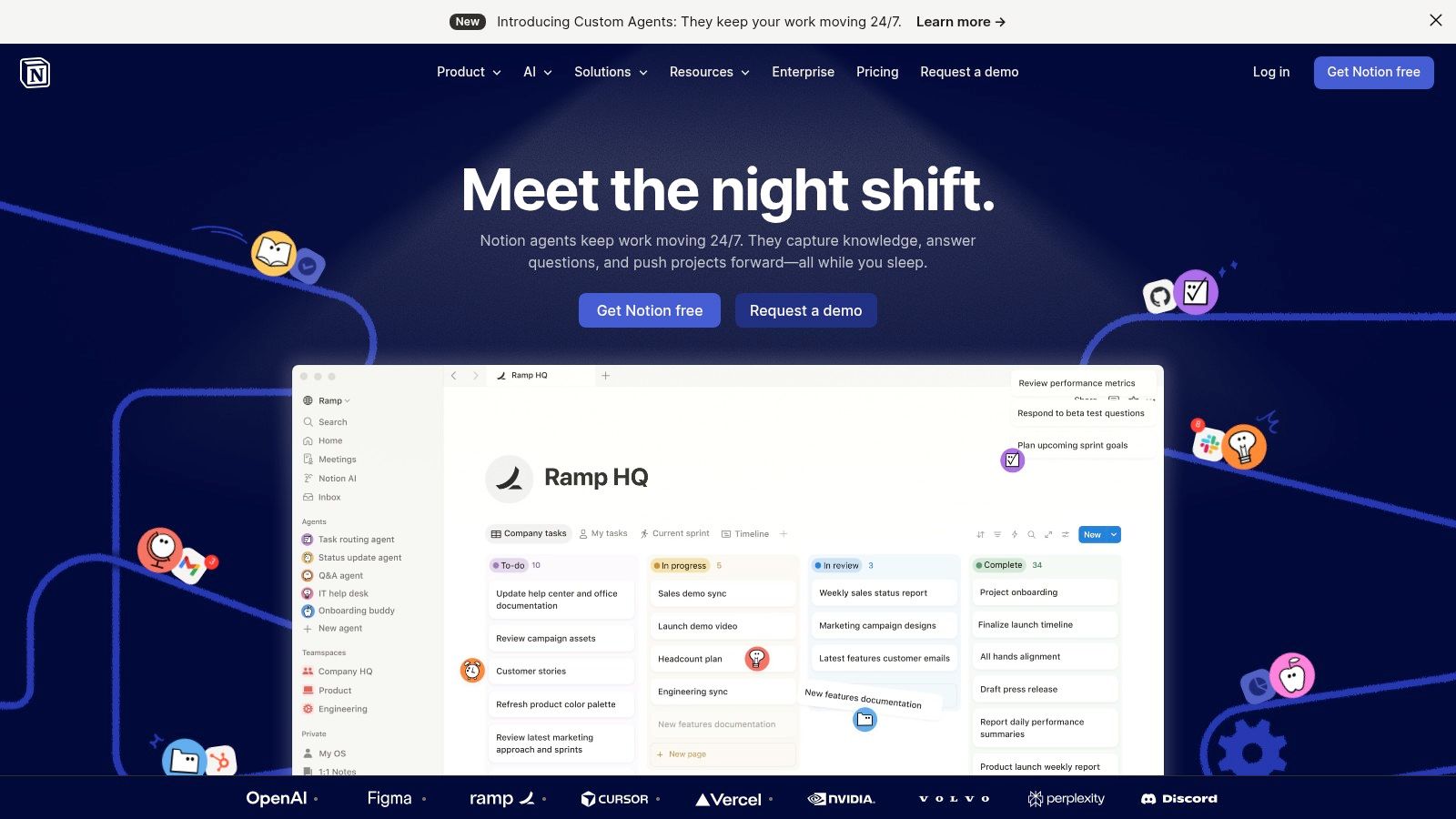
What makes Notion unique is its adaptability. A single page can contain text, a to-do list, a relational database tracking user feedback, and an embedded Figma file. This modularity gives teams a central source of truth for entire projects. The user experience is clean and minimalist, which helps with onboarding, though its extensive features can present a learning curve for creating complex systems.
For job seekers, a practical way to showcase your skills is by creating a Notion portfolio. Instead of a simple PDF resume, you can build an interactive site with project deep-dives, embedded videos, and personal wikis that demonstrate your organizational abilities directly. Exploring opportunities at companies like Notion can be a great next step, and you can find many openings for similar roles on a dedicated job board for tech jobs in San Francisco.
Notion operates on a freemium model.
While the AI features are a significant draw, they are reserved for higher-tier plans, which may be a consideration for smaller teams. A practical tip for teams at scale is to establish clear governance and templating guidelines early on to prevent workspace clutter.
Website: notion.so
Rippling offers a unified platform that combines HR, IT, payroll, and finance, designed specifically for companies scaling their headcount. For many fast-growing startups, it eliminates the "Frankenstack" of disconnected tools for payroll, device management, and benefits administration. This integrated approach is a major asset for companies that need to manage a global workforce efficiently. Rippling’s core is its employee graph, which serves as a single source of truth for all employee data, automating downstream tasks across every module.

What makes Rippling distinct is its deep automation that spans departments. For instance, when a new hire is onboarded, Rippling can automatically run their background check, set up payroll, enroll them in benefits, order their laptop, and grant access to apps like Slack and a Google Workspace account. This cross-functional automation is a massive time-saver for lean operations teams. The system is also highly modular, allowing a company to start with core HR and payroll and add IT and finance modules as its needs grow.
For job seekers in HR or operations, experience with Rippling is a valuable skill, as it signals proficiency in modern, automated workforce management. Its downtown San Francisco headquarters makes it a prime target for local talent. Learning more about what makes certain companies attractive to job seekers can provide valuable context, and you can explore more details on the best startups to work for. For a deeper dive into HR software solutions, including Rippling, explore this guide on the best HR software for startups.
Rippling uses a modular pricing model that starts with its core platform.
While its all-in-one approach is powerful, the costs can add up as you activate more modules, making it a more significant investment than single-point solutions. An actionable insight for administrators is that the initial setup can be complex; plan for a dedicated implementation period.
Website: rippling.com
Retool provides a platform for engineers to build internal tools remarkably fast. It allows developers to create custom applications like CRUD dashboards, operational tooling, and administrative panels by connecting directly to databases and APIs. For many engineering teams, this means they can stop rebuilding the same UIs and focus on core product work, dramatically reducing the time it takes to ship internal solutions from weeks to hours. Retool’s model combines a drag-and-drop interface for UI components with the ability to write JavaScript anywhere, giving developers speed without sacrificing control.
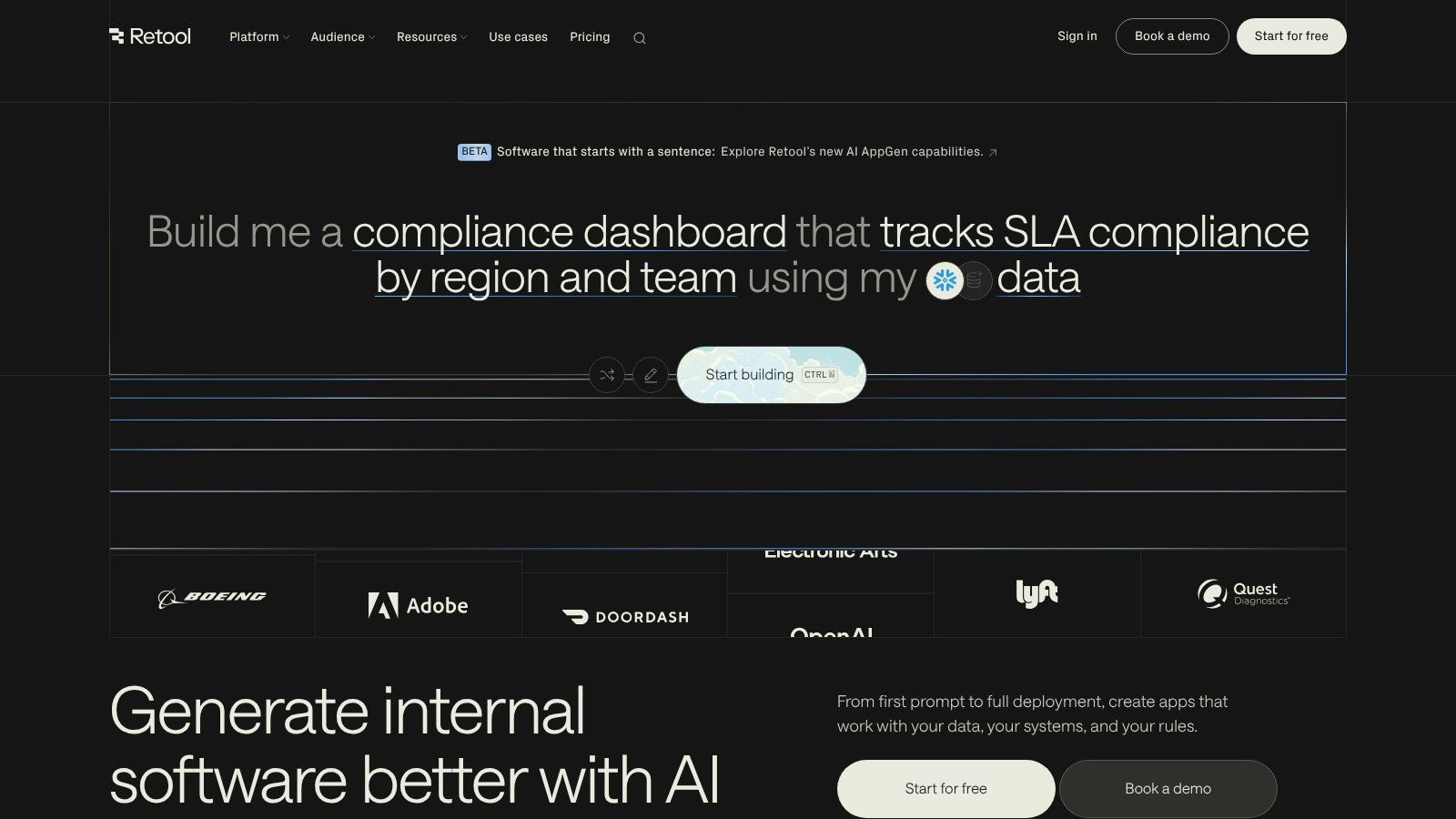
What makes Retool distinct is its engineer-first approach to low-code. While other builders abstract away the code, Retool embraces it. A developer can connect to a SQL database, pull data with a query, and display it in a pre-built table component in minutes. From there, they can write custom JavaScript to transform data or trigger API calls. This "code where you need it" philosophy is a major draw for technical teams who need to build robust, secure, and custom-fit tools without starting from scratch.
For engineering candidates, experience with Retool is becoming a valuable skill, as it signals an ability to deliver business value quickly. A practical way to demonstrate this is by building a small project on the platform for your portfolio. This focus on efficiency is also reflected in hiring practices; you can learn more about what companies look for by exploring resources on how to hire software engineers. For those interested in exploring different options in this space, you might also find insights into a Retool alternative.
Retool offers several pricing tiers tailored to different team sizes and security needs.
One consideration is that costs can scale with the number of end-users or editors, which may be a factor for larger organizations. However, a practical benefit is the platform's generous programs for startups and nonprofits, making it accessible for early-stage ventures.
Website: retool.com
Vercel is the developer platform behind Next.js, one of the most popular React frameworks. It provides the tooling for teams to build, deploy, and scale frontend web and AI experiences with a focus on exceptional developer experience and performance. For many engineering teams, Vercel offers a seamless workflow from local development to global production deployment on its Edge network. The platform handles infrastructure complexities, allowing developers to concentrate on creating user-facing features.
What makes Vercel unique is its tight integration with the Next.js ecosystem and its preview deployment system. As a practical example, for every git push, Vercel automatically generates a unique, shareable URL with a complete preview of the changes. This allows product managers, designers, and QA engineers to provide feedback directly within the development cycle, long before code reaches production. This rapid feedback loop is a key advantage for fast-moving teams.
The platform’s mature Edge network and performance tools, such as integrated observability and image optimization, are built-in. This means applications are fast by default, with assets cached close to users globally. For job seekers, familiarity with Vercel and Next.js is a significant plus, as a growing number of Bay Area startups and enterprise firms build their entire web presence on this stack.
Vercel offers a tiered pricing structure that scales with team and project needs.
While the Pro plan is powerful, cost management is important. Pricing can increase with add-ons for analytics or heavy usage of serverless functions and regional data processing. An actionable insight is for teams to monitor their usage dashboards closely to avoid unexpected bills.
Website: vercel.com
Anthropic is an AI research and product company building reliable, steerable AI systems. Its primary products are the Claude family of large language models, which are designed with a "safety-first" approach. For businesses, Anthropic offers enterprise-grade tooling for chat, coding, and productivity workflows, positioning itself as a key player in the adoption of generative AI. The company’s core focus is on creating models that are not only powerful but also aligned with human values through techniques like Constitutional AI.
What makes Anthropic different is its explicit commitment to AI safety and governance. While other models focus purely on performance, Anthropic builds safety guardrails directly into the model's architecture. Its Claude 3 family, particularly the Opus model, has demonstrated competitive reasoning and long-context performance, making it suitable for complex enterprise tasks like legal document analysis and financial modeling. A practical example is using its long-context window to analyze an entire quarterly earnings report in a single prompt.
For professionals in AI ethics, machine learning, and policy, working at Anthropic offers a chance to contribute to foundational safety research. The company's deep presence in the Bay Area provides strong connections to the local talent pool and opportunities for partnership. Exploring a career here means being at the center of the AI safety conversation, a field of growing importance for the entire tech industry.
Anthropic offers its models through its own platform and major cloud providers.
While the models are powerful, a practical consideration is that pricing and availability can differ depending on the access channel. Some recent public scrutiny regarding federal contracting could be a point of consideration for organizations in the public sector.
Website: www.anthropic.com
Databricks provides a unified data and AI platform known as the "lakehouse," which combines the storage capabilities of data lakes with the performance and governance of data warehouses. For data engineering, analytics, and machine learning teams, it serves as a central hub for processing massive datasets, training models, and deploying them into production. As one of the most prominent data companies, its platform is built around Apache Spark, offering a collaborative environment for large-scale data work.
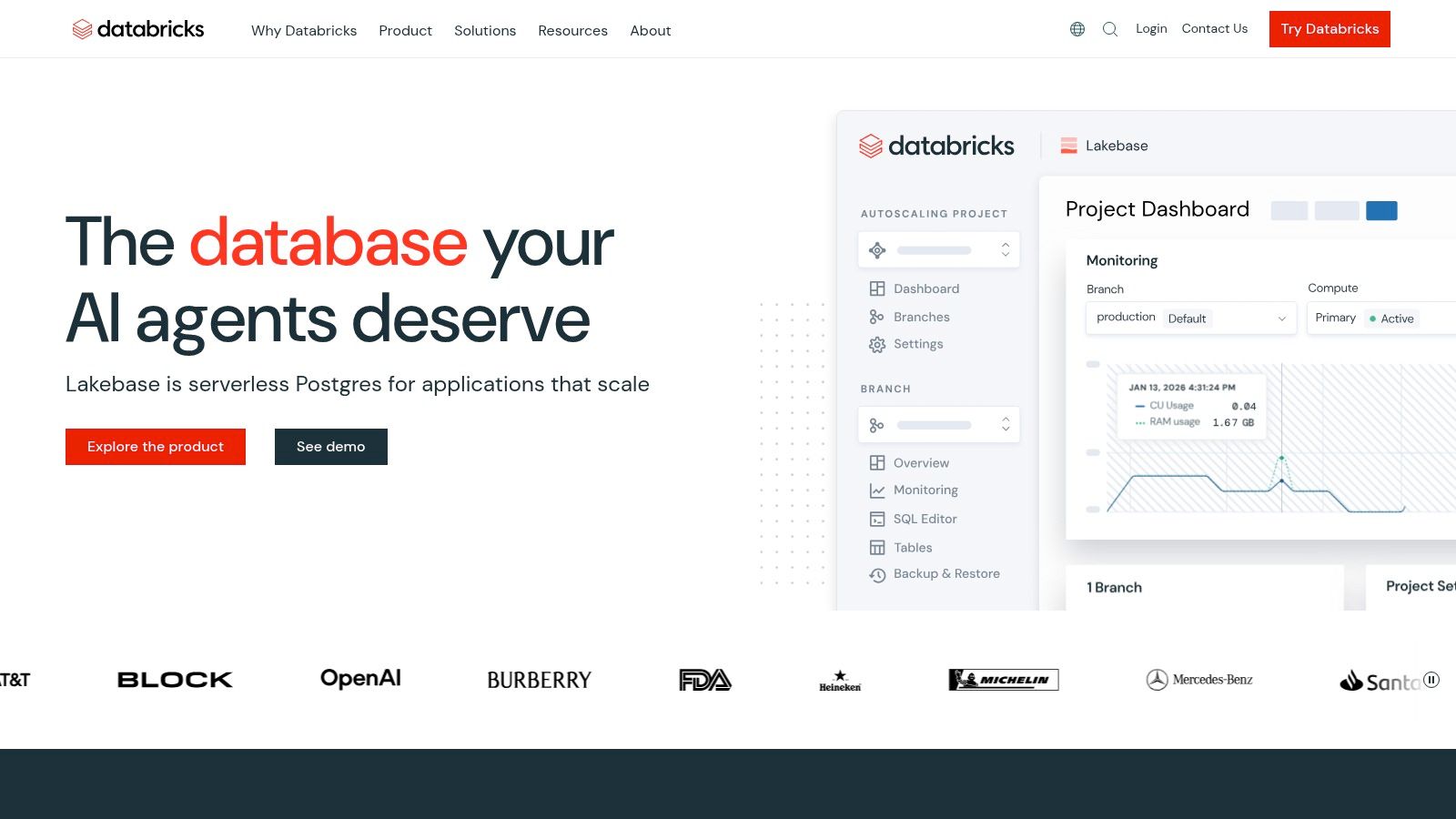
What makes Databricks distinct is its cohesive approach to the entire data lifecycle. A team can ingest raw data using Delta Lake, transform it in collaborative notebooks, build and register models in MLflow, and govern access with Unity Catalog, all within a single interface. This prevents the fragmentation and data silos that often arise when stitching together separate tools for ETL, BI, and MLOps. Its close integration with major cloud providers like AWS and Azure also simplifies deployment and procurement.
For professionals in the data field, proficiency in the Databricks ecosystem is a highly valuable skill. A practical way to demonstrate this on a resume is by highlighting experience with Delta Lake, MLflow, and building production pipelines on the platform. Given its strong and growing presence in the Bay Area, exploring roles at Databracks or companies that use it is a strategic move for anyone serious about a career in data science or engineering.
Databricks uses a usage-based pricing model that can be complex.
While this model offers flexibility, a practical insight is that forecasting costs can be a challenge. It's best suited for organizations with significant data processing needs; for simple business intelligence or small-scale analytics, it might be overkill.
Website: www.databricks.com
Figma is the collaborative design and prototyping suite that has become the industry standard for product, design, and engineering teams. It allows for real-time, multiuser editing of design files, prototypes, and digital whiteboards, effectively bridging the gap between creative ideation and technical implementation. For many companies, it is the central hub where user interfaces are born, tested, and handed off for development, eliminating version control issues and siloed workflows. Its browser-based accessibility means anyone with a link can view, comment on, or edit a design, depending on their permissions.
What makes Figma a leader is its seamless integration of the entire product development lifecycle into one platform. For example, a designer can create a high-fidelity mock-up, an engineer can inspect the same file using Dev Mode to get code snippets and specs, and a product manager can use FigJam to run a brainstorming session with the team. This single source of truth reduces friction and miscommunication. Because of its wide adoption, familiarity with Figma is a highly transferable skill in the tech industry.
For job seekers in design or product, a polished Figma portfolio is now table stakes. A practical approach is to create interactive prototypes that showcase not just the final UI but also your design process, user flows, and interaction logic. This provides a much richer story than static images ever could. Exploring roles at Figma itself or at the thousands of companies that build with it is a smart career move, and you can find many openings for similar positions on a dedicated job board for tech jobs in San Francisco.
Figma uses a seat-based subscription model with a robust free offering.
While the free tier is very generous, an actionable insight for larger teams is that features essential for managing design at scale, such as branching and advanced library controls, are reserved for the higher-priced plans. Additionally, heavy files can sometimes affect performance on less powerful hardware.
Website: figma.com
This exploration of top San Francisco based companies reveals a clear pattern: the city remains a critical hub for firms building foundational tools that shape how we work, create, and innovate. From Figma’s collaborative design platform to Databricks’ data and AI infrastructure, the companies featured are not just successful businesses; they are creating the very software that powers other startups and enterprises globally. The consistent theme is one of building high-impact, product-led solutions that solve deep, technical problems for a broad audience.
The talent driving these organizations is as impressive as the products themselves. Whether it’s Anthropic’s focus on AI safety, Rippling’s mission to unify employee data, or Vercel’s dedication to a faster web, these teams are composed of individuals passionate about their specific domains. For job seekers, this presents a unique opportunity to join a company where your work directly contributes to a product used and respected by your peers across the industry.
As you consider your own career path, it's helpful to move beyond surface-level brand recognition and dig into the specifics of what makes a company a compelling place to work. Use the insights from this guide as a starting point for your own research.
Actionable Steps for Your Search:
Ultimately, the right opportunity is a match between your skills, your career goals, and a company's culture and mission. The San Francisco based companies we've profiled offer a rich variety of paths for ambitious tech professionals. By taking a thoughtful and deliberate approach, you can find a role where you not only contribute to a great product but also accelerate your own professional growth.
San Francisco is home to a wide range of tech companies spanning AI research, developer tools, design software, HR platforms, data infrastructure, and enterprise SaaS. The city has historically attracted companies building foundational products used by other businesses — firms like Anthropic, Figma, Databricks, Rippling, Vercel, Retool, and Notion all call the Bay Area home and are actively hiring across technical and non-technical roles.
Yes, many are. While the broader tech market has gone through significant corrections since 2022, established and well-funded San Francisco companies continue to hire strategically. Companies at Series B and beyond — particularly those in AI, data, and developer tools — have maintained strong hiring pipelines. The key shift is that these companies are being more deliberate about each role, placing a higher premium on candidates who can demonstrate immediate impact.
It varies widely depending on the company's stage and culture. Early-stage startups tend to offer more ownership, faster career growth, and equity upside in exchange for a faster pace and less structure. Later-stage or pre-IPO companies often provide more competitive base salaries, stronger benefits, and clearer career ladders. Most SF-based tech companies now offer hybrid or remote-friendly arrangements, though some roles — especially in engineering, design, and product — may still benefit from in-person collaboration.
Software engineers remain the most consistently in-demand hire across SF tech companies, particularly those with experience in machine learning, full-stack development, and cloud infrastructure. Product managers, data scientists, UX designers, and growth marketers are also frequently sought after. For companies in AI — like Anthropic — roles in AI safety, policy, and applied research have seen significant demand growth heading into 2026.
The most effective approach combines targeted research, a tailored application, and direct access to hiring managers rather than relying solely on generic job boards. Understanding each company's product deeply, preparing role-specific examples that connect your experience to their challenges, and applying through curated platforms that have pre-vetted relationships with these companies gives you a meaningful advantage. Networking within the SF tech community — through meetups, alumni groups, and professional communities — also remains one of the strongest pathways to landing interviews.
Many do, especially for technical roles. The pandemic accelerated remote adoption across the Bay Area tech scene, and while some companies have pulled employees back to the office in recent years, remote and hybrid arrangements remain common — particularly for engineering, product, and data roles. When evaluating remote opportunities at SF-based companies, it's worth clarifying their policy on location-based pay adjustments, as approaches vary significantly from company to company.
Salaries in San Francisco tech are among the highest in the country, reflecting the city's high cost of living and intense competition for talent. Software engineers at mid-to-large companies typically earn between $130,000 and $200,000+ in base salary, with total compensation often significantly higher once equity and bonuses are included. Entry-level roles at well-funded startups generally start in the $90,000 to $120,000 range. Senior and staff-level engineers at companies like Databricks or Anthropic can see total compensation well above $300,000.
Companies that offer cross-functional exposure, strong engineering or product cultures, and a clear path from individual contributor to leadership tend to rank highest for career development. Among the companies profiled, Databricks and Anthropic are particularly well-regarded for deep technical growth in data and AI respectively. Notion and Figma attract strong product and design talent looking to work on widely-used consumer and enterprise tools. Retool and Vercel are popular among engineers who want to build developer-facing products with significant industry reach.
Tired of sifting through countless job boards to find the right fit? Underdog.io directly connects you with hiring managers at top tech companies, including many San Francisco based companies and remote-first startups. Skip the noise and let curated opportunities come to you by creating your free profile on Underdog.io.