You walk out of the interview thinking it went well. The engineer on the panel nodded through your system design answer. The product lead seemed engaged. The hiring manager talked about next steps in a way that sounded promising.
Then the adrenaline fades and the uncertainty starts. Should you send a note right away? Should it be short? Should you mention the product? Are you going to look polished, or awkward?
A strong follow up email after a job interview still matters because startup hiring teams make decisions fast, compare closely matched candidates, and remember the people who make their interest easy to see. The candidates who handle this well don't send a ceremonial thank-you. They send a message that helps the team remember them, trust them, and picture them in the role.
Most candidates treat the interview as the main event and the follow-up as optional etiquette. In startup hiring, that's backward. The interview creates the impression. The follow-up helps lock it in.
A CareerBuilder survey summarized by Coursera found that 86% of employers are more likely to remember candidates who send a thank-you note. That matters most when several candidates are all competent enough to do the job.
Early-stage companies rarely hire on raw skill alone. They hire for judgment, speed, communication, and conviction. A follow-up email gives you one more chance to show all four without asking for extra time on anyone's calendar.
When a startup founder, recruiter, or hiring manager sees a good note, they usually read more into it than candidates realize:
A follow-up doesn't rescue a weak interview. It does separate two strong candidates who both did fine.
There's also a practical point. Interviewers are busy. In high-growth companies, the same person may be hiring, managing product priorities, and jumping between internal meetings. Your note won't magically force a decision, but it can put your name back in front of the right person at the right time.
A corporate hiring process can absorb some friction. Startups usually can't. They want candidates who move with clarity and who can show interest without hand-holding.
That makes the best follow-up email after a job interview less about manners and more about signal. It tells the team you're thoughtful, responsive, and already acting like someone who can operate in a fast-moving environment.
The best thank-you emails are fast, specific, and easy to read on a phone between meetings. If you wait too long, the interview gets fuzzier in everyone's mind. If you send something generic, you waste the moment.
For timing, send your thank-you email within 24 hours. That's the window that feels prompt without feeling performative.

You don't need a five-paragraph letter. You need three things:
Gratitude
Thank them for the conversation and their time.
Specificity
Mention one concrete topic from the interview. A technical challenge, product decision, customer problem, or team priority works well.
Forward motion
Reaffirm your interest and briefly connect your background to what they need.
Most strong follow-ups land comfortably in the short-email range.
Use a subject line that's easy to find later in an inbox. Clear beats clever.
Good examples:
In the body, focus on substance:
Skip the common filler:
Practical rule: If your email sounds like it could go to ten different companies unchanged, it isn't ready to send.
For phone-screen situations specifically, this guide on thank-you emails after phone interview conversations is useful because the right level of detail is different from a final-round note.
Hi [Name],
Thanks again for taking the time to speak with me today about the [Role] position. I especially enjoyed our discussion about [specific challenge, product decision, or team priority]. It was helpful to hear how the team is thinking about [brief detail].
Our conversation reinforced my interest in the role. My background in [relevant skill or experience] would let me contribute quickly, especially around [specific area discussed].
Thanks again, and I hope to stay in touch as you move through the process.
Best,
[Your Name]
A software engineer should usually reference architecture, reliability, developer experience, or execution speed.
A product manager should usually reference customer insight, roadmap trade-offs, product strategy, or cross-functional communication.
A designer should usually reference user behavior, workflow clarity, research, or system consistency.
The key is relevance. A startup team doesn't need a broad statement that you're excited. They need a short piece of evidence that you understood the work.
One template won't cover every interview stage. The right message after a recruiter screen is different from the right message after a panel, a take-home assignment, or a rejection.
The easiest way to get this wrong is to use the same note everywhere. The easiest way to get it right is to match the email to the decision the team is making.
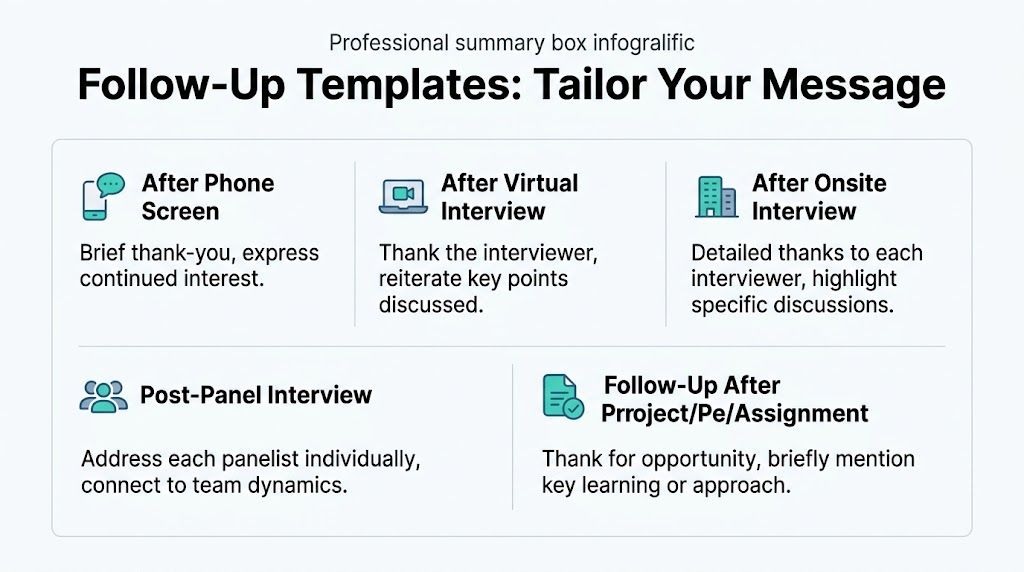
| Scenario | Timing | Primary Goal |
|---|---|---|
| Phone screen | Within 24 hours | Confirm interest and professionalism |
| Virtual interview | Within 24 hours | Reinforce fit and recall |
| Onsite interview | Within 24 hours | Help the team remember your strengths |
| Panel interview | Within 24 hours | Personalize by interviewer and topic |
| After assignment | Within 24 hours of submission or review discussion | Show thoughtfulness and ownership |
| After rejection | Soon after receiving the decision | Preserve the relationship |
This is the lightest-touch version. You're not trying to summarize your career. You're confirming that the conversation increased your interest.
Hi [Name],
Thanks for speaking with me today about the [Role] opportunity. I appreciated hearing more about the team and the problems you're hiring this role to solve.
The conversation made me even more interested in the position, especially because of the focus on [specific point]. I'd be glad to continue the process.
Best,
[Your Name]
At this stage, your note should do a little more. Mention one discussion point and one way you'd contribute.
Hi [Name],
Thanks again for the conversation today. I liked hearing how the team is approaching [specific challenge]. It was a useful look at where the role can make an impact quickly.
Our discussion made me confident that my experience with [relevant experience] would be useful, particularly around [specific area]. I appreciate your time and hope to continue the conversation.
Best,
[Your Name]
Onsites are where startup teams often compare candidates side by side. Your follow-up should help them remember your judgment, not just your enthusiasm.
Hi [Name],
Thank you for the time you and the team spent with me today. I came away with an even stronger sense of how important this role is to [team goal or company priority].
I especially enjoyed our conversation about [specific challenge]. The way the team is thinking about it lines up well with how I've approached similar work in the past, particularly in [relevant context].
I appreciate the chance to meet the team and would be excited to contribute.
Best,
[Your Name]
A panel changes the job of the email. You're helping several people remember different parts of the conversation. If you have individual emails, send separate notes. That almost always lands better than one shared message.
Hi [Name],
Thank you for the conversation today. I appreciated your perspective on [that person's topic], especially your point about [specific detail].
It was helpful to understand how your team thinks about [topic]. That part of the discussion stood out because of my experience with [relevant experience].
Thanks again for your time. I enjoyed meeting you.
Best,
[Your Name]
This note should show maturity. Don't argue your answers. Don't oversell. Briefly show how you approached the problem.
Hi [Name],
Thanks for the opportunity to complete the assignment and discuss my approach. I enjoyed working through the trade-offs, especially around [specific decision].
I tried to balance [priority one] with [priority two], which seemed consistent with the way the team described the role. I appreciate the chance to share my thinking and would be glad to expand on any part of the solution.
Best,
[Your Name]
A rejection email is still part of your reputation. Early-stage hiring circles are small, and strong candidates often come back into the picture later.
Hi [Name],
Thanks for letting me know. I'm disappointed, but I appreciated the chance to meet you and learn more about the team.
I enjoyed our conversations about [specific topic], and I'd be glad to stay in touch if a future role lines up more closely.
Wishing you and the team the best.
Best,
[Your Name]
The best post-rejection email doesn't try to reopen the decision. It leaves the door open without making things awkward.
Silence makes candidates hesitate. Many people assume a status check will make them look impatient. Usually, the opposite is true if the timing and tone are right.
According to an Indeed summary of a Glassdoor study, candidates who send a follow-up email after no response see a 33% increase in response rates. That's the strongest argument for sending one when a process goes quiet.

If the interviewer gave you a timeline, wait until that window passes and then follow up shortly after. If they didn't give a timeline, waiting a bit and then sending a concise check-in is the right move.
The point of the email isn't to demand closure. It's to make it easy for the recruiter or hiring manager to give you a quick update.
If you want a broader set of examples for quiet processes, EmailScout's ultimate guide to a follow up email after no response is a useful companion resource.
Your status check should be shorter than your thank-you note. Keep it warm, direct, and low pressure.
Hi [Name],
I wanted to follow up on the [Role] position and see whether there are any updates on the process. I enjoyed speaking with the team and remain very interested in the opportunity, especially given our conversations around [specific topic].
If it's helpful, I'm happy to provide any additional information.
Best,
[Your Name]
That email works because it does three things well:
For a stronger message to a recruiter or hiring manager, this article on writing a message for hiring manager follow-up situations can help you adjust the tone based on who you're contacting.
Send the status check as if you're talking to a future colleague, not chasing a debt.
Most follow-up advice tells candidates to "mention something you discussed." That's a low bar. It proves you were present. It doesn't prove you care about this company.
Startup teams want a sharper signal. They want to know whether you're interested in their product, their pace, and their kind of problems. Your email should reflect that.
"Great learning more about the role and team" is polite. It is also forgettable.
A better note shows that you connected your experience to something specific inside the business:
That tells the reader you didn't just enjoy the conversation. You understood it.
For engineers, this often means referencing a technical constraint or decision. Maybe the team mentioned reliability, scaling, observability, developer tooling, or shipping speed. Your follow-up can briefly connect that to work you've done.
For product candidates, personalization often lands best when it reflects judgment. You might mention a customer segment, onboarding friction, marketplace quality, prioritization tension, or how the team evaluates feature bets.
For designers, the strongest notes usually show attention to user behavior. Mention a workflow, a trust issue, or a usability challenge the team discussed, then link it to your design thinking.
A startup follow-up works when it sounds like you already understand the company's unfinished work.
Mission fit also matters. If the company is building something you genuinely care about, say so in a grounded way. Don't flatter. Don't gush. Explain why the problem space is compelling to you and why that would make you a better hire.
Candidates who want startup roles often underestimate how much this matters. Founders and early leaders aren't just hiring skill. They're hiring people who will stay engaged when the roadmap changes, the launch slips, or the product needs another rewrite.
If you're aiming for startup environments and want a broader sense of what those teams evaluate, this guide on how to get a job at a startup is worth reading alongside your follow-up strategy.
A weak follow-up doesn't usually kill a candidacy by itself. But it can reinforce the wrong impression. Lazy. Generic. Poor judgment. Bad timing. Those are expensive signals to send after a strong interview.
An HBS analysis summarized online highlights three common problems: generic content, 60% of which is ignored; poor timing, where early follow-ups annoy 55% of managers; and excessive length, where emails over 200 words reduce replies by 45%.
Generic emails fail because they ask the interviewer to do the remembering for you. If your note doesn't reference a real moment from the conversation, it adds almost no value.
Fix it by anchoring the email in one concrete topic. A product challenge. A team priority. A technical decision. One detail is enough.
Candidates often panic the day after an interview and send a status check before the company has had time to debrief internally. That reads as impatience.
Your thank-you email can go out promptly. Your status-check email should wait until the process reasonably calls for it.
Long emails create work for the reader. Nobody wants to scroll through a mini cover letter after a full interview loop.
Cut anything that doesn't help the reader answer one question: why should they keep moving you forward?
This usually shows up in subtle ways. Asking "When will you decide?" too directly. Sounding wounded after a delay. Writing like you're trying to close a sale.
The right tone is calm and professional. You're interested. You're not entitled to an instant answer.
Short, specific, and easy to answer beats polished but overworked.
Sometimes the message is fine and the issue is operational. A strange signature, heavy formatting, odd links, or a domain issue can hurt visibility. If you suspect your messages aren't landing properly, MailGenius has a practical guide on how to check if your emails are going to spam.
Before you hit send, read the note once on desktop and once on mobile. That's where awkward formatting, broken spacing, or too much text usually reveals itself.
Yes, if you have their contact information. Individual emails are better because you can reference what each person discussed and avoid sounding mass-produced.
Usually yes, but keep expectations low. Send a short, professional note if you connect. Don't use LinkedIn to bypass a recruiter or force a response.
If it's minor, let it go. A small typo won't decide the process. If you sent the email to the wrong person or left out something important, send a brief correction and move on.
Yes, when possible. It keeps context together and makes your note easier to find later.
Send your note to the recruiter and ask them to pass it along, or ask whether they can share the interviewer's contact details. Keep it simple and professional.
If you're exploring startup roles and want a more curated path than sending applications into a void, Underdog.io is built for that. You apply once, stay confidential while you look, and get introduced to vetted startups that are relevant to your background.