If you’re trying to land a job at a startup, you need a completely different playbook than the one you’d use for a big corporation. It’s less about a perfectly polished resume and more about proving you can thrive in ambiguity, execute quickly, and make a real impact from your very first day.
Forget the corporate ladder. Think of it as strapping into a rocket ship where your contributions directly steer the trajectory.
Applying for a startup role feels different because startups are different. At a massive company, hiring managers are looking for someone who fits neatly into a predefined box with established processes. But at a startup, founders are looking for partners—people who will help them build something from the ground up.
They aren't just filling a slot; they're adding a critical piece to a small, dynamic team where every single person's performance matters. A lot. This means they care more about resilience, adaptability, and a genuine passion for the mission than a perfect, linear career path.
The biggest hurdle for many is wrapping their head around the cultural shift. Corporate life often rewards specialization and following procedure. Startups, on the other hand, reward generalists who can wear multiple hats and figure things out on the fly. One day you’re a marketer writing ad copy, and the next you might be jumping on customer support calls to understand user pain points directly.
This is what "cultural fit" really means in a startup. It boils down to a few key things:
The reality is, early-stage companies hire for potential and drive just as much as they do for experience. They need builders—people who get energized by a bit of chaos, not overwhelmed by it.
With thousands of startups out there, finding the right one can feel like searching for a needle in a haystack. Firing off applications on traditional job boards often feels like a "spray and pray" approach where your resume just disappears into a black hole. This is exactly why curated platforms have become so valuable for anyone serious about making the leap.
Marketplaces like Underdog.io are designed to connect talented people directly with vetted startups that are actively hiring.
This model flips the old way of job searching on its head. Instead of you chasing companies, it puts vetted candidates right in front of the hiring managers at exciting startups, dramatically increasing the odds of finding a match that actually makes sense for both sides.
Forget the long, formal resume that reads like a corporate job description. To land a role at a startup, your resume and professional narrative have to tell a story of impact.
Founders and hiring managers spend just seconds on each application. You need to ditch the corporate-speak and focus entirely on the results you’ve driven. Your resume isn't just a document; it’s your number one marketing tool. It needs to scream "problem-solver" and "builder," not "task-completer."
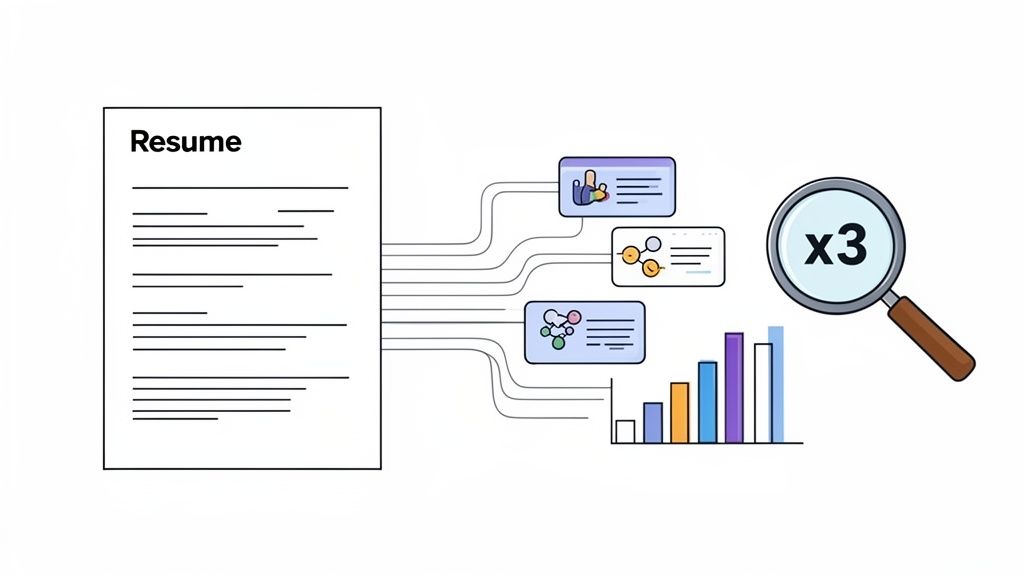
The key is translating your experience into the language of a startup, which is all about metrics and forward momentum. A hiring manager at a fast-growing company doesn't really care that you "managed a social media calendar." They want to know if you can grow an audience from zero or boost engagement by a measurable amount.
Let’s reframe a typical corporate resume bullet for a marketer.
See the difference? The revised version shows ownership, quantifies the impact, and connects the work to real business outcomes. That’s what catches a founder’s eye.
Numbers are the most powerful tool in your resume arsenal. They provide concrete, undeniable proof of your value and show that you understand what actually moves the needle. Go through your past projects and find ways to attach metrics to everything you did.
Don’t just state what you did; prove its value. Instead of saying you "improved a process," explain that you "automated a manual reporting process, saving the team 10 hours per week."
The STAR method (Situation, Task, Action, Result) is a fantastic framework for building these compelling narratives, both on your resume and in interviews. It forces you to connect your actions directly to a tangible result.
Here's how a project manager could apply it:
Beyond the words on your resume, a compelling personal brand can set you apart. For those looking to articulate their unique value, check out a comprehensive guide to building a strong personal brand. A strong, consistent narrative reinforces your expertise and passion.
Even better, a lean portfolio or a simple personal project can be far more powerful than a perfectly worded resume. It's tangible proof of your skills and your ability to build something from scratch—a core startup trait.
Your portfolio doesn’t need to be some elaborate masterpiece. Actionable examples:
For more tailored advice on structuring your document, check out our deep dive into how to create a resume for startup jobs. It's packed with specific templates and examples to help you stand out.
Ultimately, your goal is to craft a narrative that presents you as a proactive, results-oriented person who thrives in ambiguity. This approach shows you’re not just looking for a job—you’re looking to make an impact and help build something meaningful.
In the startup world, your skills might get you in the door, but it's your network that often turns the key. Unlike big corporations with rigid HR processes, hiring at a startup is intensely personal. It’s all about trust.
Founders are betting their company’s future on every single person they bring on board. A referral from a trusted source dramatically de-risks that bet. It’s not about skipping the line; it’s about starting the race with a powerful endorsement. This is why building genuine connections is your most valuable asset.
Cold applying to a startup can feel like shouting into the void. A referral, on the other hand, is a warm introduction from a mutual friend. It immediately pulls your application out of the anonymous pile and puts it right in front of a decision-maker.
The data doesn't lie. In the hyper-competitive world of startup hiring, referrals are the inside track, accounting for a staggering 68% of all startup hires. Startups might hire 34% faster, but they also grapple with 28% higher first-year turnover, which makes finding the right fit through trusted connections absolutely critical. You can discover more tech industry hiring statistics that really drive home the importance of these networks.
The absolute best time to network is when you don’t need anything. Seriously. Focus on building authentic relationships by being curious, helpful, and genuinely interested in what other people are working on. This mindset shifts networking from a transactional chore into a rewarding part of your career.
Here are some actionable steps you can take this week:
When you do decide to reach out, your message has to be specific, concise, and respectful of their time. A generic "Can I pick your brain?" is a fast track to the ignored folder. You have to show you’ve done your homework.
Let's walk through a real-world scenario. You want to connect with a Head of Product at a fintech startup you’re excited about.
The Generic (and Ineffective) Message:
"Hi Alex, I see you work at FinCorp. I'm interested in product management and would love to connect and learn more about what you do. Can we chat?"
This message is all about you. It's vague and puts the burden on Alex to figure out how to help. Don't do this.
The Actionable (and Effective) Message:
"Hi Alex, I've been following FinCorp's work on simplifying small business invoicing—your latest feature launch was impressive. I’m a PM with experience in B2B SaaS and was particularly interested in the user feedback integration you mentioned in a recent blog post. If you have 15 minutes in the coming weeks, I’d love to briefly hear your perspective on that challenge. Either way, keep up the great work."
This message works because it is:
A great outreach message is a conversation starter, not a transaction request. Show genuine interest in their work first, and the conversation will naturally lead to opportunities.
When you get a positive reply, be ready with thoughtful questions about their role, the company’s challenges, and their career journey. Remember, the initial goal is to build a relationship, not to ask for a job. If the conversation flows well, the topic of open roles will often come up on its own. If it doesn’t, you can politely ask if they know who the best person to speak with would be. That warm handoff is often just as valuable as a direct referral.
Startup interviews feel different because they are different. Forget reciting your resume bullet points. This is about showing how you think, not just what you've done. Large corporations often have structured, predictable interviews, but startups are looking to test your real-world problem-solving chops, your ability to adapt on the fly, and whether you genuinely click with the team's mission.
You're not going to get a lot of "tell me about a time when..." questions. Instead, get ready for ambiguous challenges and open-ended conversations. They want to see how you handle pressure and if you can start contributing from day one. They're hiring collaborators who can think on their feet, not just employees who can follow a script.
While every startup has its own flavor, the interview process usually follows a pattern designed to test you from multiple angles. Expect a multi-stage gauntlet that gets more intense as you go.
Here’s a common flow you might encounter:
Startups and large companies are looking for fundamentally different signals during the interview process. Knowing the difference is key to showing up prepared.
The takeaway is simple: startups want to see how you'll tackle future problems, while corporations often focus on how you've handled past ones.
A one-size-fits-all approach to prep just won't work. You have to anticipate the specific kinds of problems they'll throw at you based on your role.
For Engineers: Instead of just grinding LeetCode, practice talking through your thought process out loud. Set up a mock interview with a peer where you explain the tradeoffs between two different technical approaches to a problem. They care as much about your communication as your code.
For Product Managers: Prepare a "product teardown" of one of the company's features. Use a simple framework like "What's the goal? Who is it for? What works well? What would I improve?" This shows you're already thinking like you're on the team.
For Designers: Prepare to walk through one project from your portfolio in extreme detail. Don't just show the final screens. Show the messy whiteboard sketches, the user research notes, and explain why you made specific trade-offs. This demonstrates a deep, process-oriented approach.
The single most important thing a startup is looking for is evidence of a builder’s mindset. They want to see that you get energized by solving messy, undefined problems and that you have the drive to see a solution through to completion.
A lot of startup interview questions are intentionally broad. It's a test to see how you navigate ambiguity. When they ask something like, "What’s a product you love and why?" or "What’s something you’ve taught yourself recently?" they're trying to gauge your passion, your curiosity, and your ability to articulate your thoughts.
There is no "right" answer to these. The entire point is to reveal how you think.
So when you answer, zero in on the "why" behind your choice. Don't just say you love an app. Break down its genius onboarding flow, its clever use of push notifications, or its elegant solution to a common user pain point. Show them you’re constantly analyzing how things are built and imagining how they could be better. This is how you prove you have the mindset to thrive in their world.
Getting an offer is a huge win. But a startup offer isn't like a corporate package—you need to look at it differently. The salary is just one piece of the puzzle. The real game-changer is often the equity, your slice of the company’s future success.
It's all about understanding the trade-off. A startup might not be able to match the base salary of a FAANG company, but a solid equity grant could be worth a whole lot more down the line. Nailing this evaluation is how you make a smart career move and accept a role with confidence.
Before you even see that offer, you'll go through a gauntlet of interviews, from chats with the founders to deep dives into your technical and cultural fit. This is the typical journey.
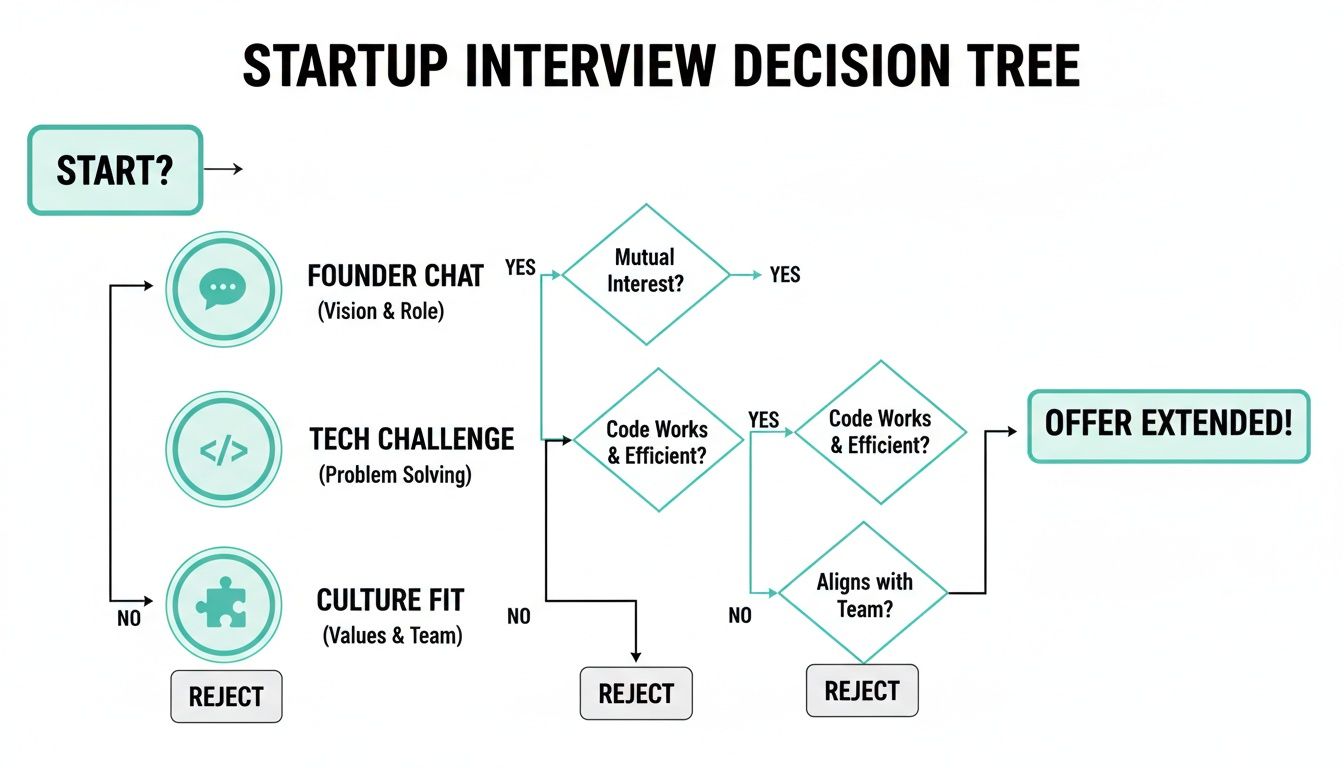
Making it through these stages proves you have what it takes. Now, let’s break down what you’re actually being offered.
Equity can feel like a foreign language at first, but it boils down to a few key ideas. When a startup talks about equity, they’re usually offering stock options. This isn't ownership today. It’s the right to buy a set number of company shares at a fixed price in the future.
That fixed price is called the strike price. A low strike price is what you want—it means your cost to buy shares is lower, which boosts your potential upside if the company takes off. For a deeper dive, check out these startup equity basics for job seekers.
You don't get all your options on day one, though. They’re tied to a vesting schedule, which is just a timeline for earning them. A four-year schedule with a one-year "cliff" is pretty standard.
This whole structure is designed to give you a real incentive to stick around and help build something valuable.
An offer is just the start of the conversation. To figure out what your equity is actually worth, you need more than just the number of options you're getting. Don't be shy about asking sharp, direct questions.
The quality of an equity offer depends entirely on context. 10,000 options could be life-changing or virtually worthless. The only way to know is by understanding the bigger financial picture of the company.
Walk into that negotiation ready to ask for these critical details:
If you want to get inside an investor's head, resources like this Founders Guide to Creating Pitch Decks That Close Deals are invaluable. It shows you how founders pitch their company's value to get funding, which is the same value that drives your equity. With this information in hand, you can properly size up your offer and negotiate a package that truly reflects your worth.
You've perfected your narrative and you're getting the hang of networking. The final piece of the puzzle is making sure the right people can actually find you. Firing off applications into the void of a traditional job board is a soul-crushing experience. But curated marketplaces like Underdog.io flip that entire dynamic on its head.
These platforms aren't about volume; they're about precision and quality. Instead of you chasing hundreds of companies, vetted startups come directly to you. It's a total reversal of the typical job search, making it a much smarter and more efficient way to land a role at a high-growth company.
The real power of a curated platform is its exclusivity. Underdog.io, for instance, has a selective process where both candidates and companies are reviewed by humans. This creates a high-signal environment where hiring managers know they’re seeing top-tier talent, and you know you’re being introduced to legitimate, well-funded startups.
This model is perfectly suited for how hiring works today. The job search is increasingly firm-driven, with companies proactively sourcing the talent they want. This approach can nearly double hiring success rates, especially when you consider that 85% of talent is passively looking for new roles. By creating a single profile on a platform like Underdog.io, you get discreet exposure to hundreds of vetted companies, letting them make the first move.
A curated marketplace essentially acts as your personal agent. It cuts through the noise and puts you directly in front of decision-makers who are actively looking for someone with your exact skillset.
Unlike platforms that just match keywords, the best curated marketplaces add a human touch. This means real people who actually understand startup culture and team dynamics are making the connections. They’re thinking about things an algorithm can't, like your long-term career goals or the specific company stage you're targeting.
The result is fewer, but far more meaningful, introductions. You won't get spammed with irrelevant roles. Instead, you’ll get a handful of hand-picked opportunities from companies genuinely excited by your profile. For a closer look at how this works, check out our breakdown of how Underdog.io works to connect candidates with opportunities. It’s about saving your time and energy for the interviews that really count.
Stepping into the startup world often brings up a different set of questions than your typical corporate job search. It’s a unique environment, and knowing what to expect is key. Let’s tackle some of the most common things candidates wonder about.
Not at all. In fact, some of the most exciting opportunities are with companies that are still flying under the radar. Brand recognition isn't the main thing you should be looking for.
Instead, your due diligence should focus on signs of a healthy, growing business. Actionable checklist:
Let's be honest: startup life is demanding. You should expect to work hard, but a healthy company won't chain you to your desk for 80-hour workweeks. That's a recipe for burnout, and the best startups understand that sustainable performance beats short-term heroics every time.
During your interviews, ask specific, culture-probing questions like:
The answers will give you a much better feel for whether the culture is intense but manageable, or just plain unsustainable.
Not necessarily. It's a common myth that you have to choose between a corporate salary and a startup dream. While an early-stage company might not match the base salary of a tech giant, the total compensation package—especially with equity included—can be incredibly competitive.
A strong offer from a well-funded startup will almost always pair a solid salary with a meaningful slice of equity.
Your goal isn't to perfectly match a corporate salary number for number. It's about evaluating the entire package. A slightly lower base salary could be a brilliant trade-off for equity that has the potential to be worth a small fortune in a high-growth company.
Ready to stop sending your resume into the void? Underdog.io flips the script. We get your profile in front of top, vetted startups for discreet introductions. Let the best opportunities find you. Sign up in 60 seconds.
The core difference is mindset. Startups hire for impact and adaptability, not just for a specific set of duties listed on a resume. They are looking for problem-solvers who can wear multiple hats, thrive with ambiguity, and contribute directly to the company's growth. Your application needs to demonstrate this through examples of ownership and initiative, not just technical qualifications.
Beyond large platforms like LinkedIn, use niche job boards dedicated to startups and tech, such as Wellfound (AngelList Talent) and Built In. For a more curated approach, platforms like Underdog.io that match candidates with vetted startups can provide higher-quality, direct introductions. Don't underestimate networking at local tech meetups or engaging with startup teams on social media.
Focus on achievements and impact, not just responsibilities. Use metrics to quantify your results (e.g., "Grew user base by 20%" or "Reduced server costs by 15%"). Highlight projects where you showed autonomy, learned quickly, or worked cross-functionally. Startups value a "builder" mentality, so include side projects or relevant entrepreneurial experience.
They prioritize a blend of hard and soft skills. Technical proficiency in your domain is essential, but equally important are soft skills like resilience, effective communication, curiosity, and a collaborative spirit. The ability to operate with limited resources, pivot when needed, and maintain a positive attitude during challenging growth phases is highly valued.
Research is key. Go beyond the company website—understand their product, business model, competitors, and recent news. Prepare stories that demonstrate how you've solved problems, adapted to change, and worked in teams. Be ready to ask insightful questions about the company's challenges, culture, and roadmap to show genuine interest and strategic thinking.
Yes, it helps you understand what to expect. A pre-seed or seed-stage startup (less than ~50 people) will offer more autonomy, broader impact, and potentially higher risk. A Series B or C startup is more structured, with defined roles and processes but less extreme risk. Your research should inform questions about runway, growth plans, and how your role contributes to key milestones.
Personalize your approach. A generic cover letter won't work. Mention why you're passionate about their specific mission. If possible, provide constructive feedback on their product or suggest a thoughtful idea. Using a referral from a current employee is one of the most powerful ways to get noticed, so leverage your network.