You can feel the pressure before lunch even starts. The ATS is empty, the job post is live, and your inbox is full of people who were never going to work out. The two candidates you want are busy, employed, and not applying anywhere. That's the exact moment when Grok Bot recruiting starts sounding seductive, because it promises to run sourcing, outreach, and follow-up while the rest of the team keeps shipping.
I get why founders reach for it. Early hiring is a pile of unfinished threads, and any tool that can keep the search moving overnight looks like a multiplier. But automation doesn't just multiply reach. It also multiplies whatever's broken in your process, including sloppy targeting, canned outreach, and the kind of candidate experience that stains your employer brand.
The startup hiring problem isn't lack of applicants, it's lack of signal. You post a role, and the pile fills up with resumes that miss the bar by a mile, while the person you need never sees the job at all. That gap is why Grok Bot recruiting gets attention, because it offers the fantasy of doing the work a junior recruiter would do, only without the sleep, the reminders, or the complaint about late-night sourcing.
A founder in this spot doesn't need inspiration. They need a machine that can scan, draft, and nudge without turning the whole process into a second job. Grok Bot's appeal is simple, it can keep a sourcing loop alive while you're in product reviews, customer calls, or fundraising. That's useful.
Speed is not the same thing as judgment. A bot can widen the funnel fast, but it can also widen the blast radius of bad assumptions, weak personalization, and overconfident shortlists. If the first-touch message feels generic, candidates notice. If the shortlist is noisy, your team loses time. If the bot keeps pushing regardless, your brand takes the hit.
Practical rule: use automation to increase coverage, not to remove discernment.
That's the lens I'd use from day one. Treat Grok Bot recruiting as a force multiplier for research and coordination, not as a substitute for a thoughtful hiring bar. If you want a broader takeaway on why automation often doesn't make recruiting easier in practice, the argument in AI didn't make recruiting easier is worth reading before you hand a bot the keys.
Think of Grok Bot as a junior recruiting coordinator that never logs off. It doesn't just answer questions in a chat window. It lives in a persistent cloud workspace, signs into the tools you already use, and keeps working across apps, inboxes, websites, and terminals. That matters for recruiting because so much of sourcing happens in places that don't have clean APIs, which means browser-based work still dominates the messy middle.
xAI's launch description says Grok Bot is in beta and available only to SuperGrok Heavy, Cursor Ultra, and Cursor Teams Premium subscribers on desktop and iOS, with Cursor Ultra at $200 per month and Cursor Premium Teams at $120 per seat per month (xAI's Grok Bot launch, Grok Bot pricing overview). That's not casual adoption territory. It's a paid, gated workflow tool that sits inside a real operating stack.
For recruiting teams, the point is persistence. Bots can keep context, remember prior steps, and come back to a task later without making you re-open everything from scratch. That's useful for sourcing lists, follow-up sequences, and candidate tracking. It's also exactly why you need tighter access control than you'd use for a normal SaaS seat.
A persistent bot can do the repetitive work a recruiter hates doing manually, such as checking communities, drafting first-pass outreach, and keeping notes straight. It can also make mistakes that linger, because the same memory and state that make it efficient can also preserve bad decisions. So the question isn't whether the bot can work. It's whether your process can survive the way it works.
If you want a useful adjacent read on how chat-based automation can support people operations without turning into a black box, how chatbots automate onboarding gives a good parallel from the HR side.
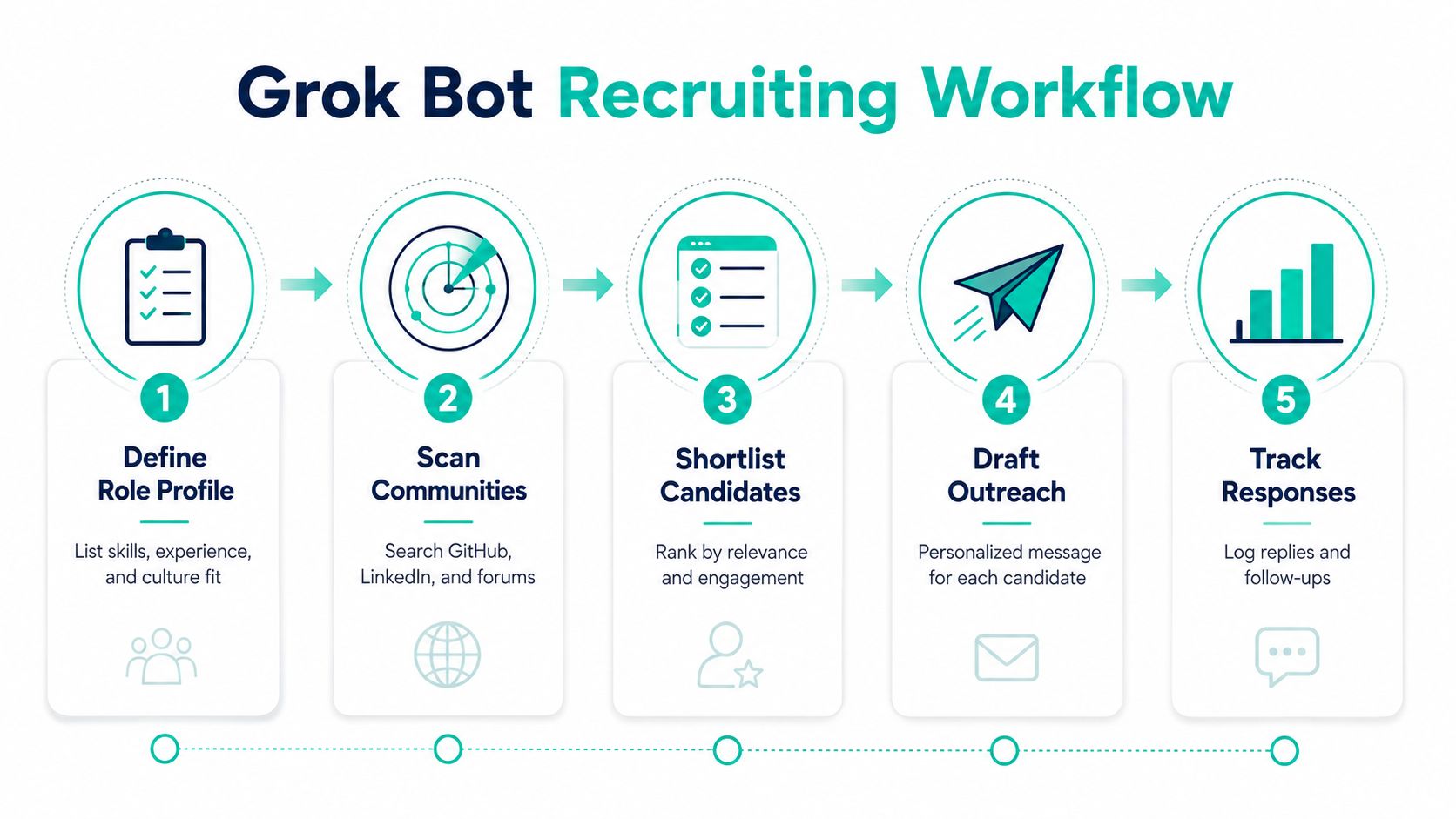
A bot-driven recruiting flow should feel boring on purpose. First, you define the role profile tightly, not as a vague wish list but as a narrow set of skills, seniority, and company-stage fit. Then the bot scans public profiles, communities, and other surfaces, pulls back a candidate set, drafts outreach, and logs responses. Human review has to sit at the points where judgment matters, especially before any candidate-facing message goes out.
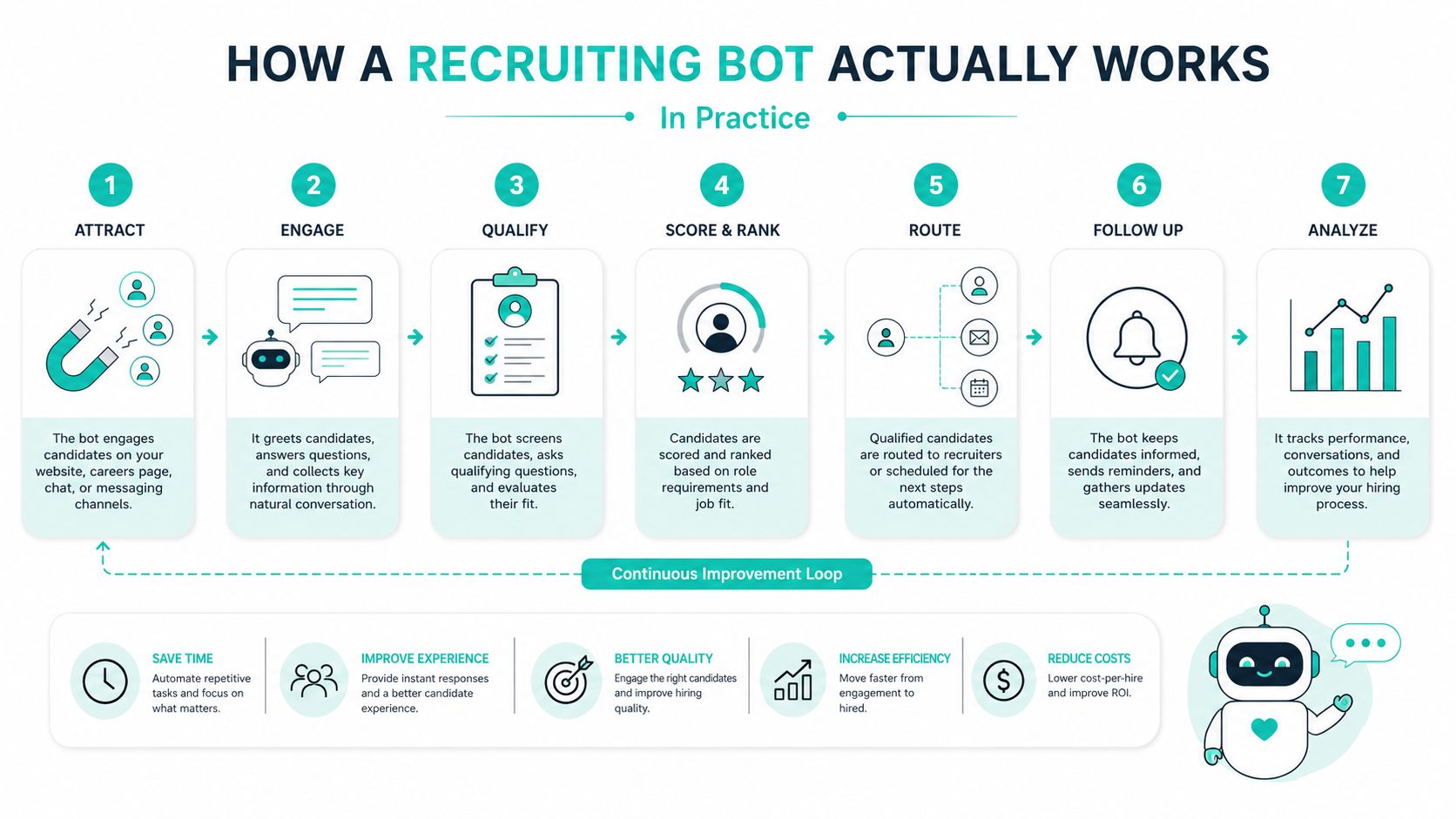
Here's the right division of labor.
That pattern fits xAI's own positioning for bots as always-on agents that work across apps and return when something needs approval (xAI launch details). It also lines up with broader guidance on recruitment automation, including the need for workflow discipline and human supervision in AI recruiting operations in HappyRobot's CIO guide to recruiting AI.
Human judgment becomes essential at the point of consequence. If the bot is about to reject someone, schedule a screen, or send a message that defines your employer brand, a person should own that call. xAI's own docs say bot memory shouldn't be treated as authoritative, and that's the right default for recruiting too. Memory is a helper, not a source of truth.
Keep the bot in the research lane until it has earned trust. Move it into candidate-facing work only after you've proven it won't drift.
The mistake startup teams make is letting a bot touch too many steps too soon. They confuse motion with throughput. In reality, a messy bot can create more review work than it saves.
The upside of Grok Bot recruiting is obvious. A small team can cover more ground, keep work moving outside business hours, and stop losing candidates to slow follow-up. That's a real advantage for startups, because the talent gap usually isn't at the point of hiring philosophy, it's at the point of execution. A bot can help you execute more consistently.
The downside is just as real. If your targeting is fuzzy, the bot scales that fuzziness. If your outreach sounds canned, it scales the spam. If your candidate data practices are loose, it scales the privacy risk. And if the shortlist is built on flawed assumptions, it scales bias too.
| Dimension | Upside | Risk to Manage |
|---|---|---|
| Sourcing reach | Covers more public surfaces quickly | Can broaden noise along with signal |
| Workflow speed | Works continuously, including off-hours | Can create more follow-up work if outputs are weak |
| Candidate outreach | Drafts messages faster | Can damage brand if it feels templated |
| Shortlisting | Organizes large candidate pools | Can amplify bias or stale assumptions |
| Operations | Reduces manual switching between tools | Needs tighter audit and access control |
The scale story matters here too. Grok reportedly grew from about 35 million monthly active users in December 2025 to roughly 60 million in January 2026, then to about 117 million monthly active users by March 31, 2026 according to a SpaceX filing cited by industry summaries, which means the same product layer powering huge consumer usage is now showing up in recruiting workflows (Grok user growth summary). That's a reminder that consumer-native AI tools can enter hiring fast, but consumer scale doesn't automatically equal recruiting discipline.
If your team is tempted to treat every automation gain as a free lunch, don't. Read the recruiting trade-offs against your own process, not against the demo. The wrong automation choice will save you time this week and cost you trust next month.
Most bot recruiting coverage talks about speed. That misses the point. The problem is trust, because AI-assisted deception already sits inside the hiring process. Candidates can push synthetic resumes, fake identities, and polished AI-written replies through a funnel that looks normal until someone checks the details.
That cuts both ways. The same automation you use to find stronger candidates also gives dishonest applicants more room to scale their presentation. Recruiters are already using AI-driven fraud detection to flag unnatural language patterns and verify credentials, and that is the right response. Grok Bot's reach across workplace apps and external systems makes approval gates and verification checkpoints more important, not optional.
A startup does not have the brand buffer a giant employer has. If your outreach lands on the wrong person, if your replies feel sloppy, or if your vetting is weak, candidates notice. Hiring communities notice too. Once trust drops, reply rates and referral flow drop with it.
The four fifths rule for recruiters is a useful fairness check, because process design can create uneven outcomes even when nobody intends it. There is also a simple recruiting rule that matters more than most automation demos admit. Never let software make the final claim about candidate authenticity.
If a profile, resume, or reply changes the hiring decision, a person should verify it before the process moves forward.
That matters even more in global hiring. Cross-border recruiting gives fabricated identities and impersonation more room to slip through. The more a bot touches the workflow, the more you need explicit checkpoints for identity, consistency, and intent. A machine can spot patterns. That is not the same as spotting deception.
Start with a tight role profile. If the spec is sloppy, the bot will amplify the mess and fill your inbox with the wrong people. Keep the automation narrow at first, too. Let it research and enrich before you let it draft anything candidate-facing.
Then keep every outreach message behind a human approval gate. That one rule prevents the worst brand damage. A recruiter or hiring manager should review tone, fit, and timing before a message gets sent. If the bot is handling follow-up, the same rule applies whenever the thread matters.
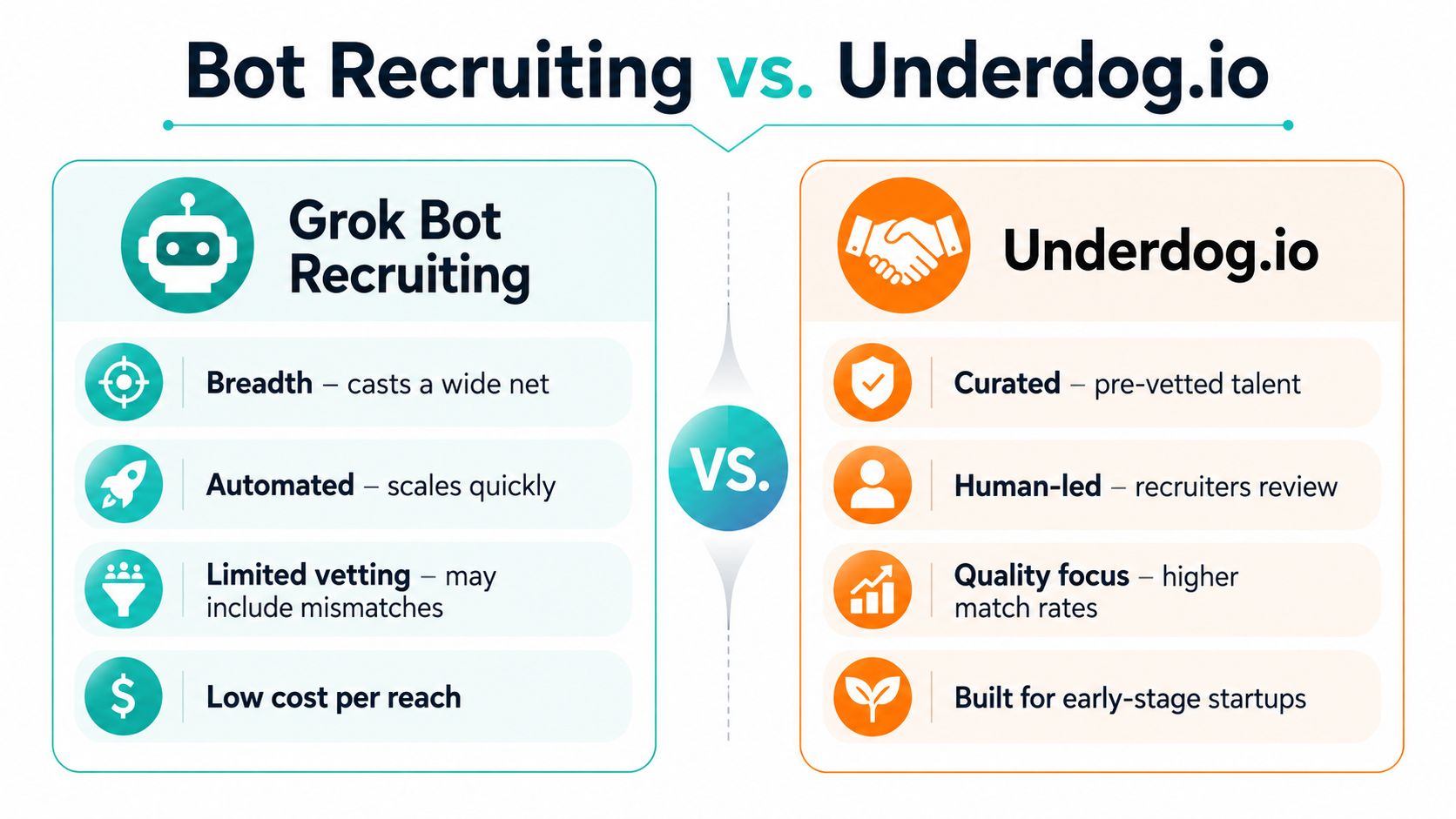
The hard truth is that strong hiring is selective by design. A good startup isn't trying to contact everyone. It's trying to reach the right few people without making them feel processed. That's why bot recruiting should stay closer to research and first-pass sorting than mass outreach.
If you're weighing tools that support this kind of disciplined workflow, a curated marketplace like Underdog.io fits a different lane. It's not trying to automate everything. It's built around human review and selective matching, which is a useful counterweight when you care about candidate experience as much as speed.
Grok Bot recruiting and a curated marketplace solve different problems. The bot is good at breadth, continuous work, and fast first-touch coordination. A curated marketplace is good at curation, human judgment, and keeping the candidate pool focused on people who are already open to startup roles. If you're hiring at the early stage, that distinction matters more than any shiny automation pitch.
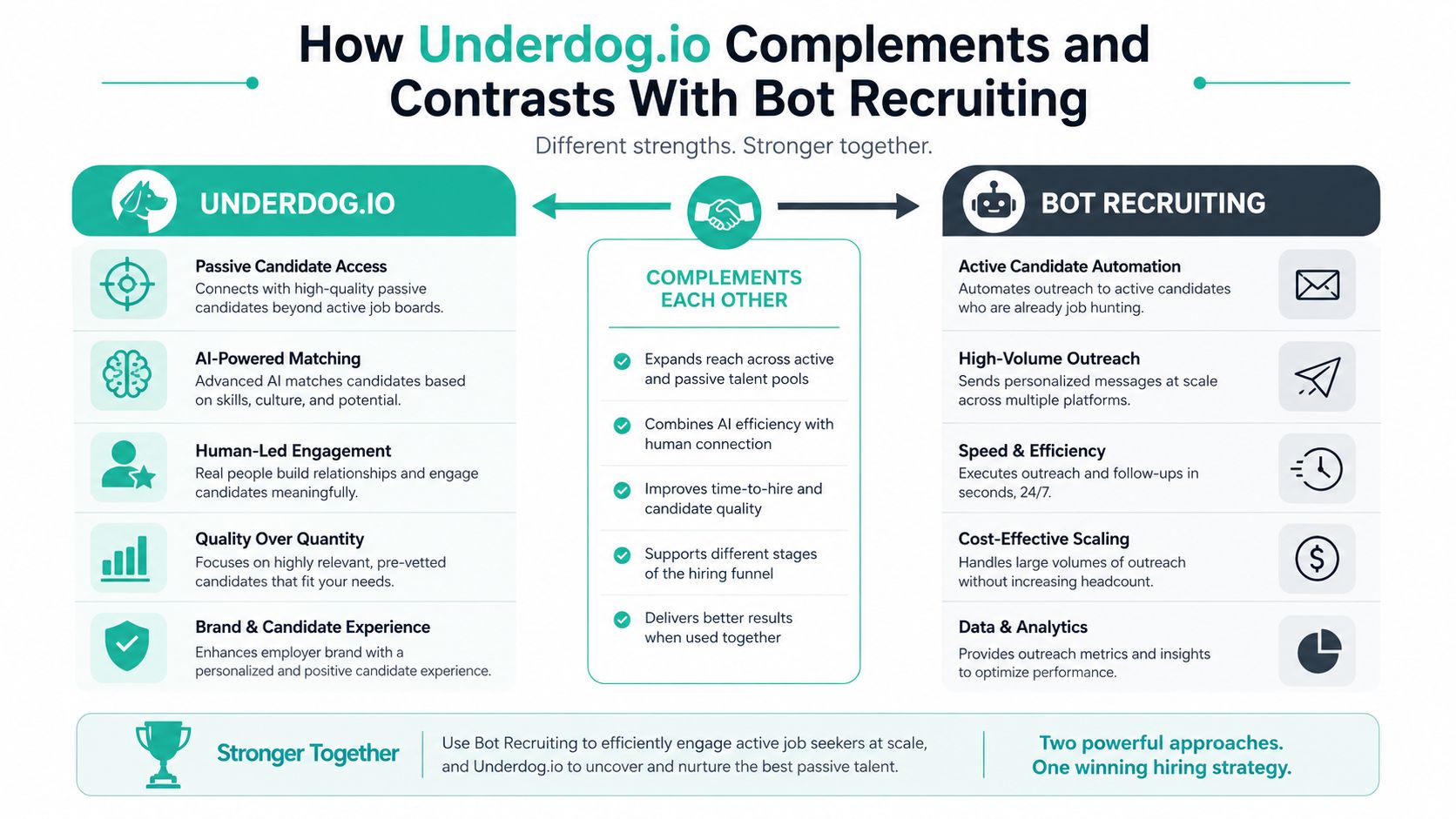
Underdog.io manually reviews applicants and accepts only about 5% of them, screens companies for funding status, team quality, and product viability, and keeps candidate profiles anonymous until interest is mutual. It also sends candidates just 1 to 3 personalized introductions per month, which is a very different rhythm from bot-driven outreach volume. That's the point. It protects passive candidates, who make up roughly 85% of the talent pool, from the usual spray-and-pray recruiting noise.
The marketplace also works the other way around, employers reach out to candidates rather than forcing every candidate to chase every company. That's a cleaner fit for startup hiring because it respects current employment, keeps the pool high-intent, and reduces the sense that someone is being processed by software. For a practical view of how the company-side workflow works, how Underdog.io works for companies lays out the mechanics clearly.
Use the bot when you need to research the market, build a first-pass map, or keep a repetitive workflow moving. Use a curated marketplace when you need pre-vetted people who are already open to the kind of role you're hiring for. Those aren't competing strategies. They're different layers of the same hiring stack.
Bot recruiting helps you search. Curated matching helps you choose.
That's the simplest way to think about it. The startup hiring mistake is assuming one system should do both jobs equally well. It won't. Breadth and curation are separate capabilities, and your process should reflect that.
If you're pre-seed, don't overengineer this. You probably need a few high-trust hires, not a machine that spits out hundreds of prospects. In that stage, a curated channel usually beats a bot-heavy workflow because the cost of a bad hire is bigger than the cost of a slower search.
If you're seed-to-Series B, the answer is usually split. Let Grok Bot handle research, enrichment, and list-building across multiple roles. Keep senior hires, culture-defining hires, and any candidate-facing communication that matters on a human-reviewed path. That's the balance most startup teams miss, they either automate too little or too much.
If you're already thinking in terms of workflow design, planning for recruitment is the right mindset. The point isn't to pick a trendy tool and hope for the best. It's to decide where speed matters, where trust matters, and which channel deserves to own each part of the funnel.
My view is blunt. Use bots to do the grunt work that slows your team down. Use curated marketplaces and human judgment to protect quality, brand, and trust. That combination gives you more reach without turning your hiring process into a spam engine.
If you want a recruiting process that values speed without sacrificing judgment, Underdog.io gives startup teams a curated way to meet high-intent candidates without relying on mass automation. Visit Underdog.io to see how a selective marketplace can sit alongside your bot-driven sourcing instead of replacing the human side of hiring.