The most popular advice in recruiting right now is wrong. It says that if you add enough AI to your hiring stack, the process becomes faster, cleaner, and easier to manage.
In practice, many teams are finding the opposite. AI can automate parts of recruiting, but it also creates a new operational problem: more inputs, more edge cases, more validation work, and less confidence in what you're seeing. The result isn't less work. It's different work, and often harder work.
That's why so many recruiting teams feel stuck. Their dashboards say efficiency. Their calendars say cleanup. Their applicant queues say noise. And when the role is high stakes, especially in startup hiring, more applications rarely means better candidates.
The promise was simple. Let software screen resumes, score interviews, rank candidates, and move people through the funnel with less recruiter effort.
In practice, it has been messier. While 86% of recruiters believe AI accelerates hiring, 70% of companies have failed to adopt it effectively. That gap matters because it turns AI from a productivity tool into an execution problem. Even where teams see gains, the gains are uneven, and the cleanup work often lands back on recruiters and hiring managers. The broader pattern is covered in recent tech hiring trends.
A lot of the confusion starts with how teams define success. If your only lens is faster screening or quicker shortlist generation, AI will often look impressive. But recruiting isn't a pure throughput system. It's a judgment system. If the tool speeds up the wrong part of the process, it can make the whole process worse.
The teams getting value from AI usually understand what the models are doing. They use AI to assist with prediction, ranking, and workflow support, not to replace judgment. If you need a grounding in that distinction, this explainer on what is predictive modeling is useful because it frames the core issue: a model can surface patterns, but someone still has to decide whether those patterns are meaningful in context.
Practical rule: If a recruiter can't explain why the system ranked someone highly, the tool hasn't reduced work. It has shifted work into validation.
Hiring managers feel the failure most sharply when they inherit a shortlist that looks polished but isn't reliable. The names may match the job description. The actual fit often doesn't. That mismatch is why the AI-only story keeps breaking down in real recruiting teams.
Recruiters used to worry about not getting enough candidates. Now many teams have the opposite problem. They have too many profiles, too many applications, and too little confidence that the top of the stack contains the right people.
AI made that worse by making it cheap to increase volume.
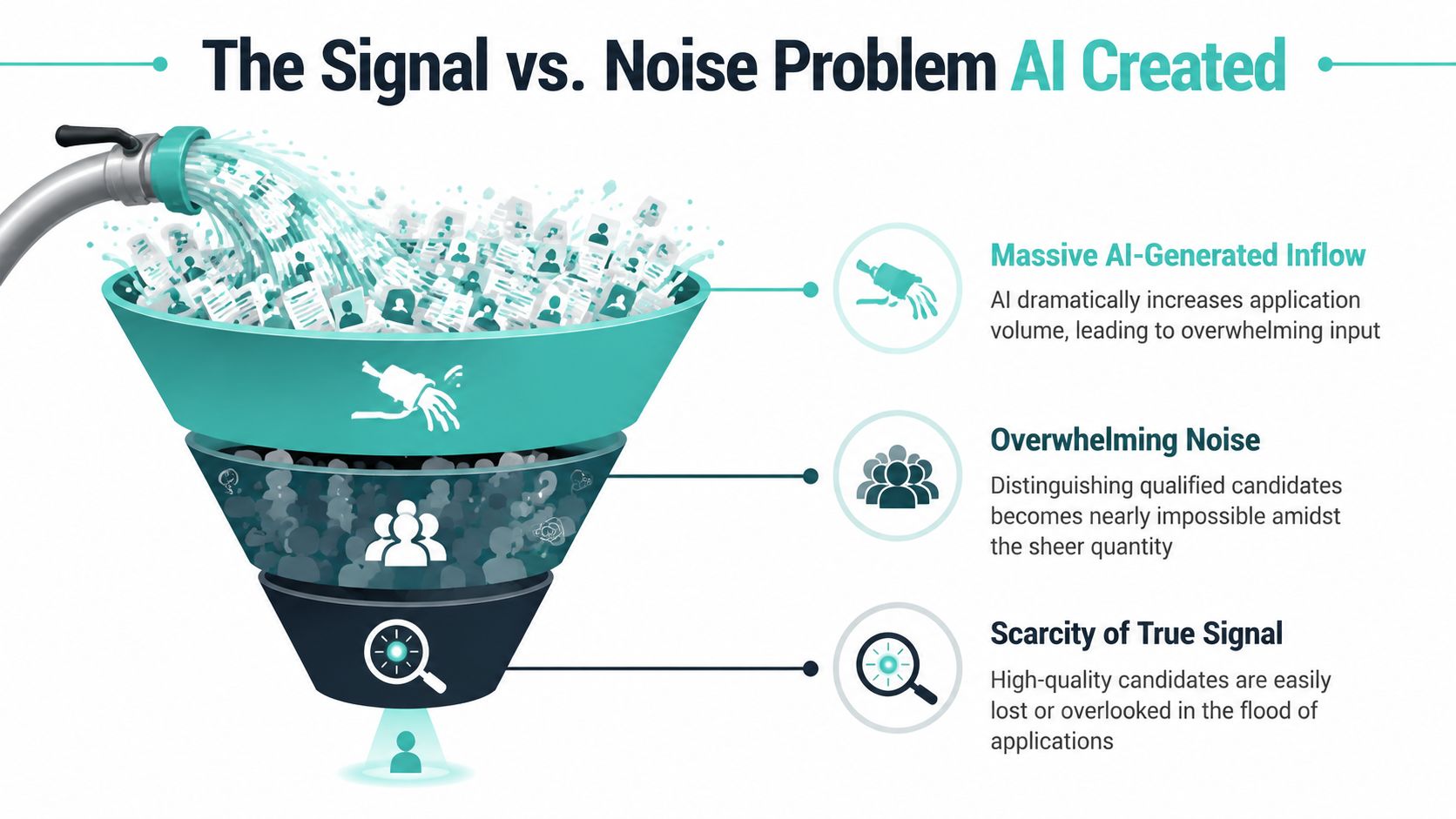
The easiest way to understand this is a firehose. AI sourcing tools, resume screeners, outreach automation, and application assistants all push more material into the top of the funnel. That sounds efficient until the recruiter has to determine what's signal and what's just keyword compliance.
While 86% of recruiters believe AI accelerates hiring, 70% of companies have failed to adopt it effectively. The gap shows up in misleading metrics. Speed-to-hire can improve by 33% with advanced AI, but 43% of firms admit that without human oversight, AI generates biased or irrelevant matches, forcing recruiters to spend more time validating results than they saved.
That's the part vendor demos rarely show. They show ranked lists. They don't show the recruiter checking whether the ranking reflects real capability, relevant motivation, compensation alignment, startup readiness, or plain basic accuracy.
The recruiting teams I trust most don't get excited when application volume jumps. They get skeptical. Volume is useful only if the extra candidates improve the odds of a strong hire. In many AI-heavy funnels, they don't.
A simple comparison makes the problem clearer:
| Hiring signal | What AI often boosts | What teams actually need |
|---|---|---|
| Top-of-funnel activity | More applications and more matched profiles | Fewer false positives |
| Screening output | Ranked lists and fast summaries | Reliable evidence of fit |
| Recruiter workload | Faster initial sorting | Less downstream validation |
| Hiring quality | Surface-level relevance | Context, judgment, and closeability |
When people say AI didn't make recruiting easier, this is usually what they mean. The machine made candidate flow easier to generate, but harder to trust.
The bottleneck moved. It used to be sourcing enough people. Now it's separating credible signal from automated noise.
Some uses of AI still help. Parsing resumes, standardizing notes, drafting outreach, and assisting with scheduling are all practical. Those jobs are repetitive and low judgment.
What doesn't work well is treating algorithmic ranking as a substitute for recruiter evaluation. That breaks fast in startup hiring, where true questions are rarely keyword questions. Can this engineer thrive in ambiguity? Can this product manager influence without structure? Can this candidate handle a role that will change in six months?
AI can help collect candidates. It doesn't reliably tell you which ones are worth betting on.
The most important failures in AI recruiting aren't about speed. They're about judgment. Screening tools miss the parts of hiring that matter most once a role gets competitive, nuanced, or relationship-driven.
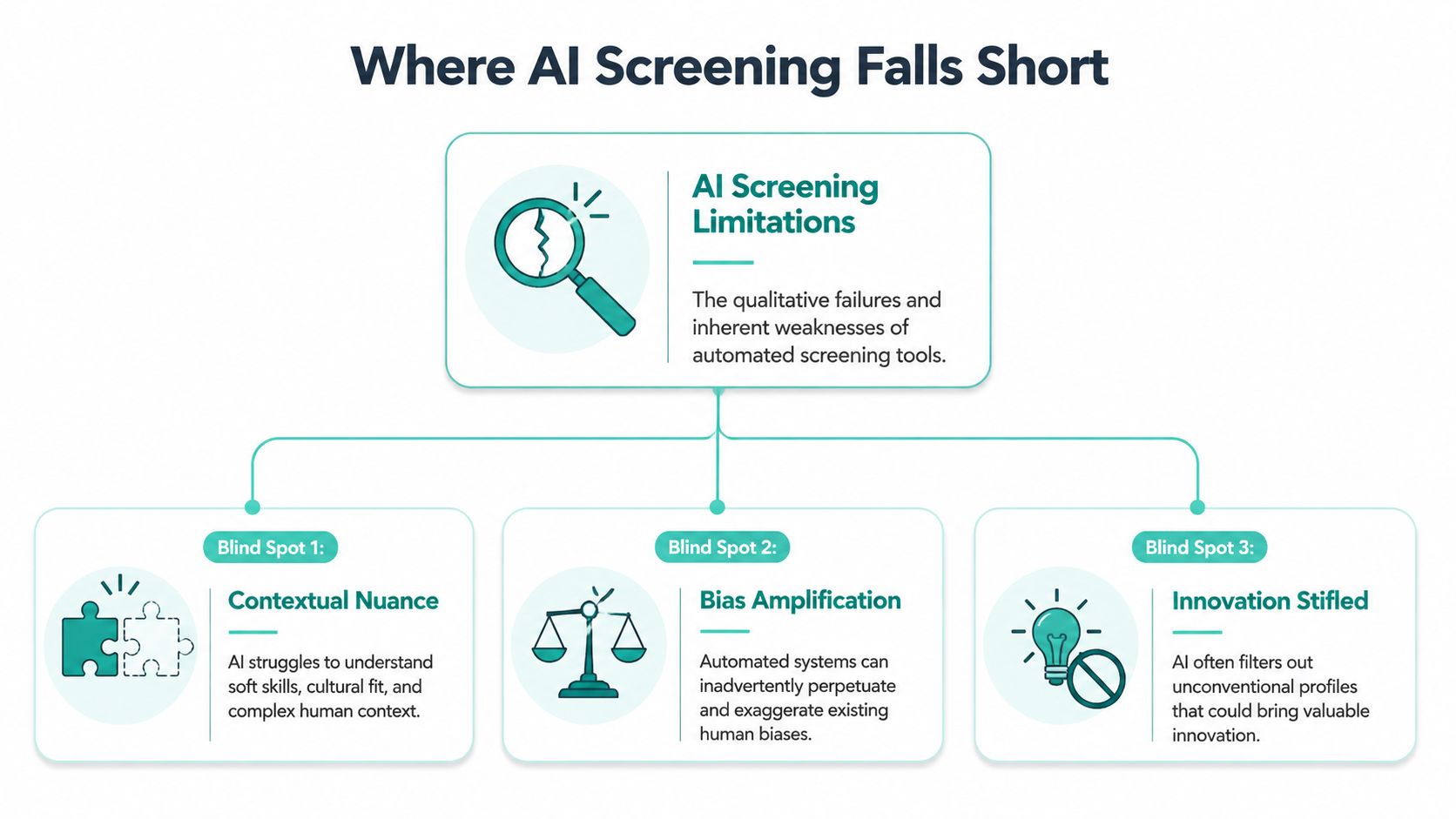
One of the biggest misconceptions in recruiting tech is that automation is neutral. It isn't. Automated systems inherit the assumptions built into their training data, their proxies, and their evaluation logic.
A Chicago Booth study found that voice AI could increase job offers, but it also amplified gender discrimination by 50% compared to human interviewers. That's exactly why human review still matters. 75% of HR professionals believe AI's value is in augmenting, not replacing, human oversight to catch those kinds of automation-induced errors and biases, as discussed in the Chicago Booth Review analysis.
A significant challenge arises from the difficulty in spotting bias within an automated system. In contrast, a human interviewer can be challenged, calibrated, or overruled. A model score often arrives with a false sense of objectivity.
A strong recruiter doesn't just ask whether a candidate matches a checklist. They ask whether the person makes sense for this company, this manager, this stage, this risk profile, and this moment.
AI tools struggle with that kind of context. They can identify patterns in resumes and interview transcripts, but they don't understand why an unconventional candidate might outperform a cleaner profile. They don't understand startup adaptability, product instinct, or whether someone has the temperament to work in a low-structure environment.
That's a serious weakness in startup hiring, where great candidates often look uneven on paper. A resume may show a nontraditional path, overlapping roles, short tenures, or side projects that don't map neatly to a taxonomy. A good recruiter reads that as texture. A brittle screening model often reads it as inconsistency.
Recruiters don't create value by repeating job descriptions back to candidates. They create value by interpreting messy human information correctly.
A practical way to test whether your screening layer is helping or hurting is to review the profiles it rejects. If many of the “misses” are nontraditional but promising, the system is filtering for familiarity, not for talent.
The third blind spot is the candidate experience. The more robotic the process feels, the less likely top candidates are to trust it.
That doesn't always show up in a dashboard. The ATS can still record completion. The funnel can still move. But the candidate may come away feeling screened by a machine that didn't understand their background, their interest, or their questions.
That's especially costly with experienced talent. Good candidates want signs that someone has thought about their fit. They want a conversation, not just a score. If your process relies too heavily on automated rejection, canned follow-up, and scripted interaction, you make it harder to build momentum with the very people you most want to hire.
A few practical warning signs usually show up early:
The short version is simple. AI screeners are good at processing artifacts. Hiring still depends on interpreting people.
The least discussed problem in AI recruiting isn't inside one company's funnel. It sits across many funnels at once.
When several employers rely on the same screening vendor, the same model can reject the same person repeatedly for the same hidden reason. A candidate may look like they're losing in a broad market, when in reality they're being blocked by one shared decision system.
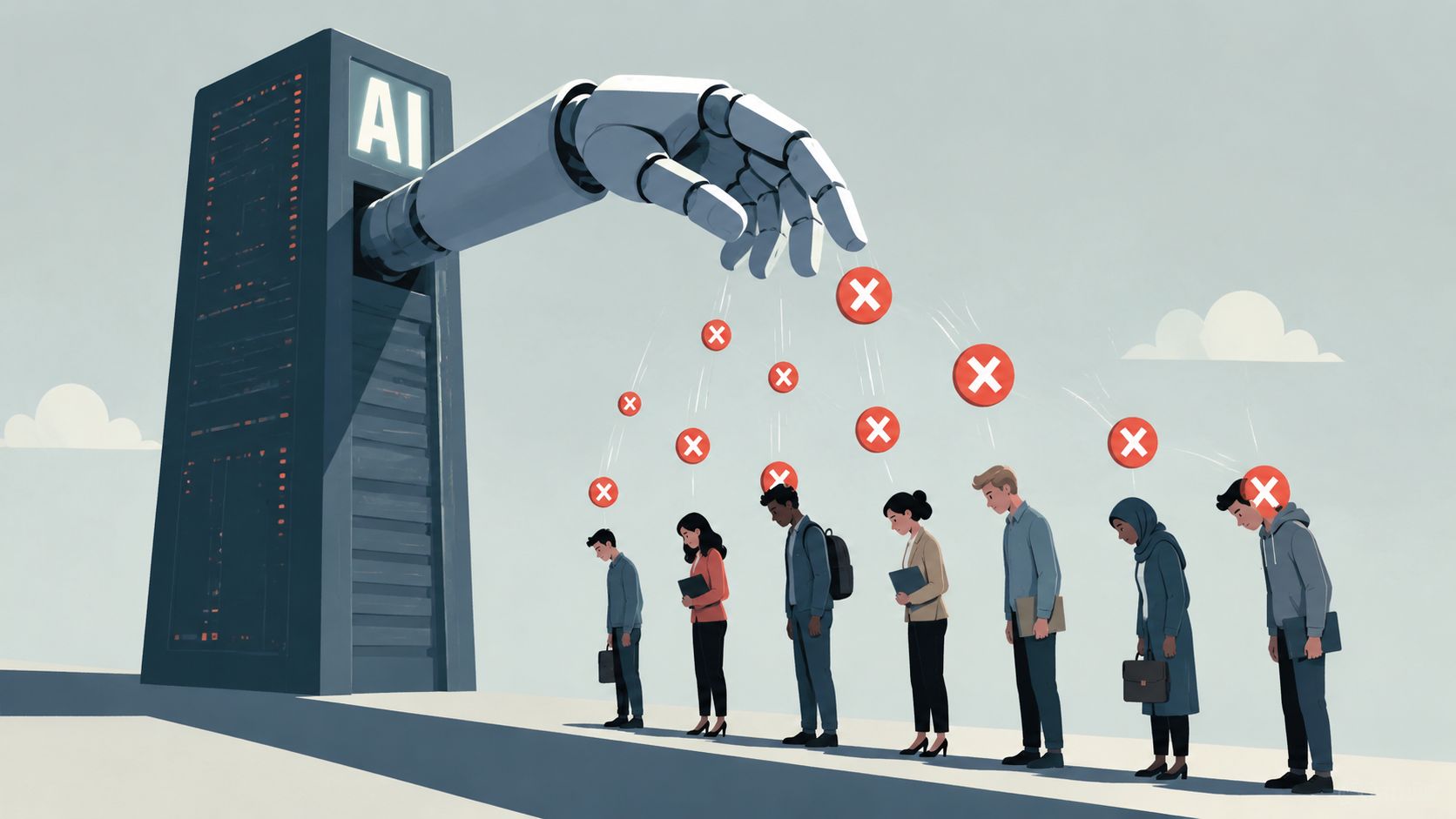
That's not a theoretical concern. A 2025 National Bureau of Labor Statistics study found that 90% of U.S. applicants screened by consolidated AI systems faced systematic rejection across multiple job applications, despite having identical qualifications. This algorithmic bias loop is especially damaging to the 85% of high-quality passive talent who rely on confidential exploration.
This is one reason many teams are rethinking how they evaluate fairness and consistency in their process. A useful place to start is this guide on strategies to reduce bias in your hiring process.
The worst part is that employers often never see the loss. Strong passive candidates usually won't appeal the system. They won't email to explain that a parser misread their background. They won't spend weeks trying to decode why every application landed in the same automated no.
They just disengage.
That leaves companies with a distorted market signal. The team concludes the talent pool is weak or unavailable. In reality, the process excluded people who never got a fair read.
When screening infrastructure becomes centralized, a single flawed rule can become a market-wide gatekeeper.
This is one of the clearest reasons AI didn't make recruiting easier. It made filtering more scalable, but it also made mistakes easier to repeat at scale. And repeated mistakes are harder to detect than individual recruiter misjudgments, because they look consistent.
The solution isn't to remove AI from recruiting. The solution is to stop asking it to do work that depends on judgment, trust, and context.
The best hiring systems use AI for narrow tasks and keep humans responsible for interpretation. That model is slower in a few places, but far more dependable where it counts.
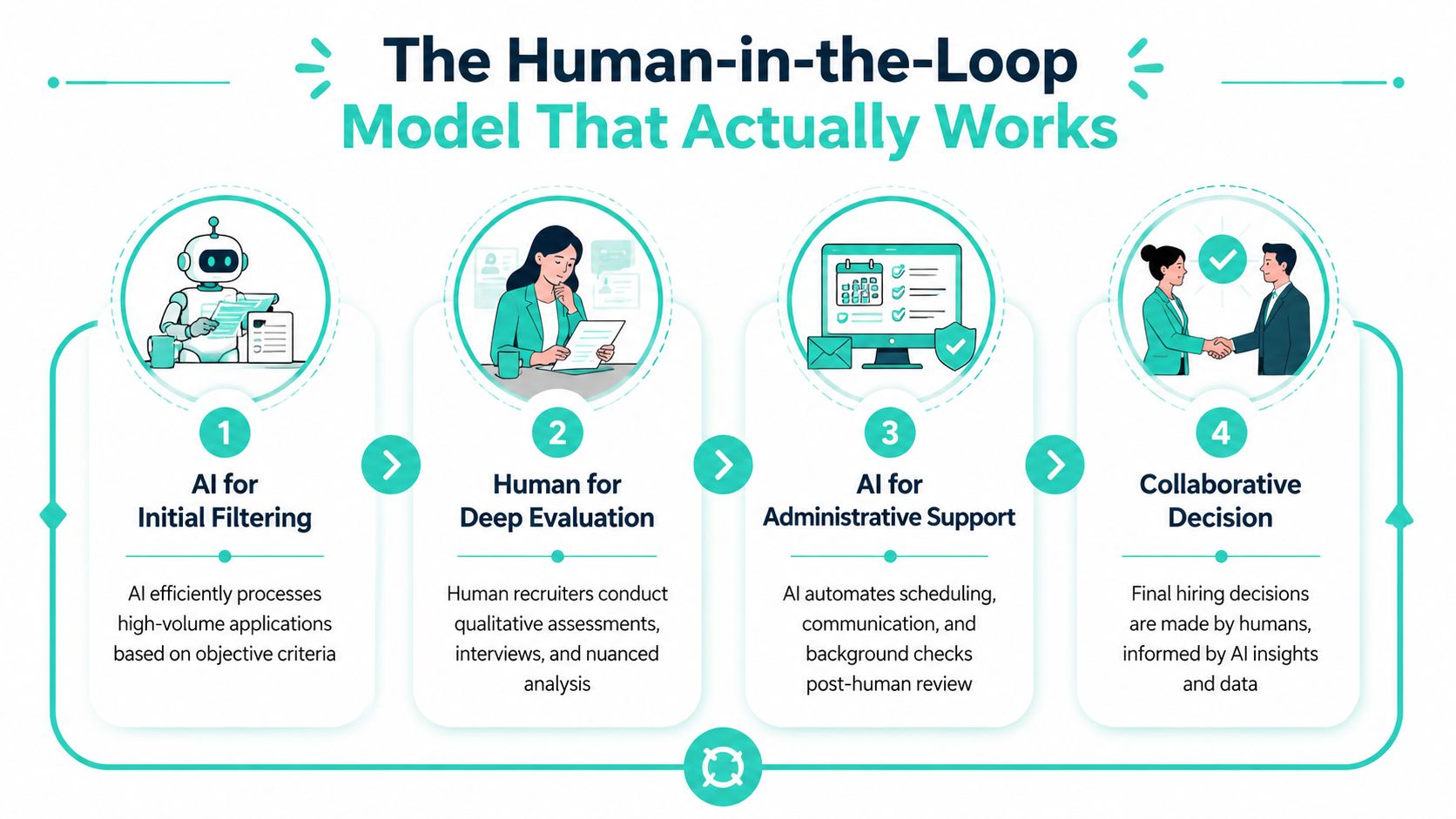
AI is useful when the task is repetitive, structured, and easy to verify. Good examples include parsing inbound applications, extracting baseline qualifications, organizing notes, scheduling interviews, and standardizing administrative communication.
Those tasks benefit from speed. They don't demand deep interpretation.
The mistake is extending that same logic into candidate quality, startup fit, or closing ability. Those are not formatting problems. They're advisory problems.
Once the cost of a wrong decision rises, human involvement should rise with it. That means recruiters and hiring managers need to own the middle and late parts of the funnel, where nuance matters most.
A practical human-in-the-loop model usually looks like this:
AI handles intake and admin
It can sort obvious non-matches, organize data, and reduce manual overhead.
Recruiters review for context
Recruiters check the story behind the resume, the likely motivation, and the fit for a specific team.
Humans run decisive conversations
Interviews, calibration, offer strategy, and candidate closing should stay human-led.
AI supports after judgment
Once the team has made a real decision, automation can help with follow-up, summaries, and process coordination.
That division of labor reflects what works in practice. The machine handles repetition. People handle ambiguity.
Human curation maintains an advantage over generic AI funnels. While AI increases volume, it reduces quality, leading to 142% more job orders but only 40% more submittals. In contrast, a human-powered model can reach 5% vetting precision by assessing non-algorithmic traits like product mindset and startup adaptability, which are essential for high-growth firms.
That last point matters more than many realize. Startup hiring often turns on traits that are hard to quantify in a resume screen. Can the person operate without a full playbook? Can they handle changing scope? Can they influence across product, engineering, and go-to-market without formal authority? AI doesn't evaluate that well.
A short comparison helps:
| Approach | Strength | Weakness |
|---|---|---|
| AI-only funnel | Speed, standardization, admin efficiency | Weak on nuance, trust, and outlier talent |
| Human-only manual process | Better judgment and relationship quality | Slower admin and heavier coordination |
| Human-in-the-loop | Balanced speed and decision quality | Requires discipline in workflow design |
Good recruiting systems don't remove people from the process. They place people at the points where mistakes are expensive.
Teams that get this right usually stop obsessing over how much of recruiting can be automated. They ask a better question: where does automation create confidence, and where does it create false certainty?
That shift alone improves hiring.
A smarter recruiting process starts with an honest admission. AI has not automated the entire recruitment process. While 40% of repetitive work is automated, the remaining 60% requires advanced advisory skills. That's why recruiting has become more consultative, not less.
The practical implication is straightforward. Stop designing hiring systems around maximum automation. Design them around decision quality.
Use this as a working audit for your own process:
This is the part many AI-first teams underestimate. Good recruiting depends on trust. Candidates need to trust the process. Hiring managers need to trust the shortlist. Recruiters need to trust that the system isn't hiding weak logic behind clean formatting.
That's not very different from other human-centered professions. The best writing on building client trust in coaching makes the same core point in another context. Real outcomes depend on judgment, listening, and credibility, not just process mechanics.
If you're serious about improving hiring, treat AI as infrastructure, not as a decision-maker. Let it handle speed where speed helps. Put people back into the moments where discernment matters. That's how you reduce noise, recover signal, and make hiring feel sane again.
If you're exploring startup hiring from either side of the market, Underdog.io offers a curated approach built for signal over noise. Candidates can apply once and get introduced to vetted startups. Hiring teams get access to talent that's been reviewed for the traits automated filters often miss.