You've posted a Python role, opened a stack of résumés, and booked interviews. One candidate builds Django APIs, another works mostly in notebooks, and another trains models. They all meet your language requirement, but you still don't know who could own the work waiting in your backlog.
To hire a Python developer who can ship, decide which production problem you're buying help with before you start sourcing. Then set a credible pay band, test a representative task, and check whether the candidate can catch convincing but unsafe AI-generated code.
A founder posts a requirement for a Python developer with several years of experience, then interviews a Django engineer, a notebook-heavy analyst, and an ML engineer against the same checklist. The resulting disagreement isn't a candidate-quality problem. The team hasn't agreed on the job.
An API and backend engineer should be comfortable with REST, SQL, PostgreSQL, tests, Docker, and cloud deployment. Ask for evidence of maintaining services, not just implementing routes. Authentication, migrations, query behavior, and rollback plans belong in this role.
A data engineer owns orchestration, data-quality checks, and warehouse or lake workflows. Their important decisions concern late records, failed jobs, schema changes, and safe reruns. A clean transformation in a notebook doesn't establish that capability.
For machine learning and AI product work, look for experimentation discipline, evaluation, and production monitoring. Distinguish someone who can integrate a model API from someone who can diagnose deteriorating model quality. Those responsibilities require different depth.
An automation engineer connects systems and replaces manual workflows. Integrations, retries, duplicate prevention, and secret handling matter more than knowing every web framework.
I'd choose a versatile mid-level engineer when the company has a single service and no model or pipeline service-level commitment. Choose a specialist when model quality or data reliability is the product. Don't bundle every missing engineering function into one job because the tools share a language.
The KORE1 2026 Python developer salary guide uses software developers as a proxy because the Bureau of Labor Statistics doesn't publish a Python-only occupation, citing a May 2024 median annual wage of $133,080, with the lowest 10% below $79,850 and the highest 10% above $211,450; it estimates the U.S. Python base bands below.
US Python base pay bands for 2026 planning
| Level | Typical US base | What the band assumes |
|---|---|---|
| Junior | $72,000–$98,000 | Supervised feature work, not sole production owner |
| Mid-level | $100,000–$132,000 | Owns endpoints, tests, and deploys with review |
| Senior | $138,000–$172,000 | Designs services; backend and ML specialists often higher |
| Software developer market proxy, May 2024 | Median $133,080 | Lowest 10% under $79,850; highest 10% above $211,450 |
These are starting bands, not offers. The role descriptions are practical scope anchors; equity and bonus are excluded from the base figures. Backend and ML specialists can require compensation above the senior planning band.
Lock the level, city or remote-pay policy, and treatment of equity and bonus before any screen. Use startup compensation benchmarks to frame the broader package rather than treating base salary as the whole decision. Also name who will review this person's work, especially if you're advertising a mid-level position.
A paste-ready requisition using the mid-level planning band is: We're hiring a mid-level Python backend engineer to own REST endpoints, PostgreSQL query improvements, and tested Docker deployments, with a U.S. base range of $100,000–$132,000, plus separately stated equity and bonus.
Start with that requisition, not a search for everyone who lists Python. In Stack Overflow's 2025 Developer Survey, 57.9% of all respondents reported using Python during the previous year. That's reported use across multiple-select responses, not a count of full-time Python specialists.
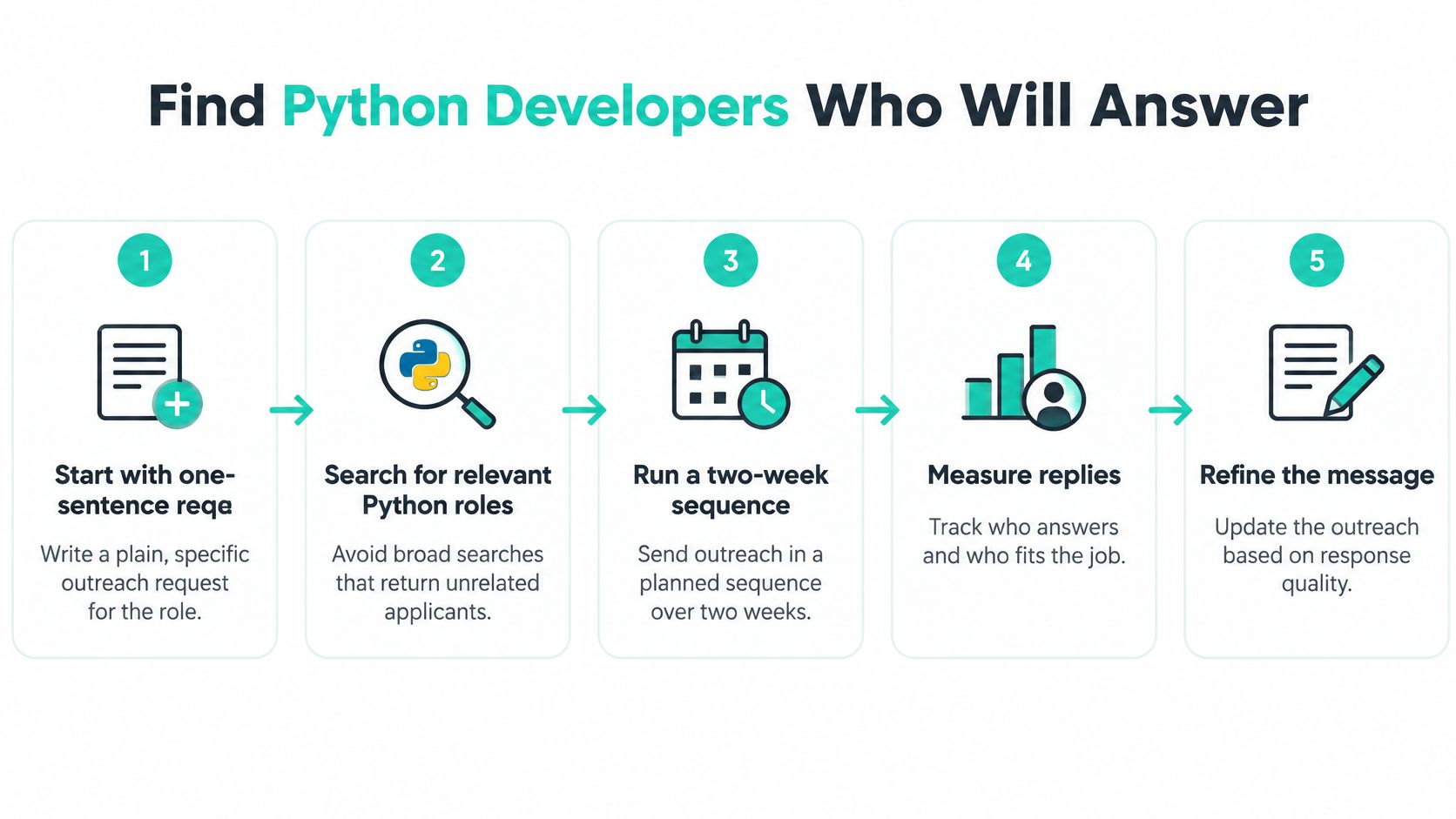
Search for the surrounding work: FastAPI and PostgreSQL for an API role, orchestration and warehouse workflows for a data role. A broad language match should start a review, not qualify the candidate.
Treat this as a two-week operating plan, not a promise about hiring speed.
Those thresholds are suggested controls for your search, not market benchmarks. Count a positive reply as interest from someone whose experience matches the role, not merely any response. Stop adding candidates once eight relevant people are in process so reviewers can keep up.
Where Python candidates come from
| Channel | When it works | Speed | Cost shape |
|---|---|---|---|
| Warm network | Senior people who already trust the founder | Plan for days to a few weeks | Founder time only |
| Curated marketplace such as our startup marketplace | Passive, startup-ready engineers | A new vetted batch each week | Pay per hire or subscription |
| Staffing firm, nexusITgroup.com | Contract cover or a fill needed in under two weeks | Can be faster than waiting for inbound | Agency margin on salary or contract rate |
| Public job boards | Active applicants and junior volume | Can produce volume within days | Listing fees plus screening time |
| GitHub and open source | Niche framework or library specialists | Slow and uneven | Time, no media spend |
The speed descriptions are planning expectations, not delivery guarantees. For more channel options, use this guide to finding software developers, but resist opening every channel simultaneously. If replies are weak everywhere, fix the scope, message, or compensation before increasing outreach.
A résumé can show where someone worked. It cannot show whether they will change your billing endpoint without leaking data, breaking retries, or hiding a failure behind a clean response.
The selection-research summary published by Interview Copilot reports correlations with later job performance of approximately 0.54 for work samples, 0.51 for structured interviews, and 0.36–0.38 for unstructured interviews. Treat those as general selection-research correlations, not as hire probabilities and not as Python-specific experimental results.
Validity of common hiring methods in general selection research
| Method | Predictive validity | What it measures |
|---|---|---|
| Work-sample test | About 0.54 | Performance on a bounded production task scored against a rubric |
| Structured interview | About 0.51 | Answers to the same questions scored against fixed anchors |
| Unstructured interview | About 0.36 to 0.38 | Open conversation with no shared scoring |
| Résumé keyword screen | Weak proxy for production judgment | Credential signal; it does not show whether someone can change your system safely |
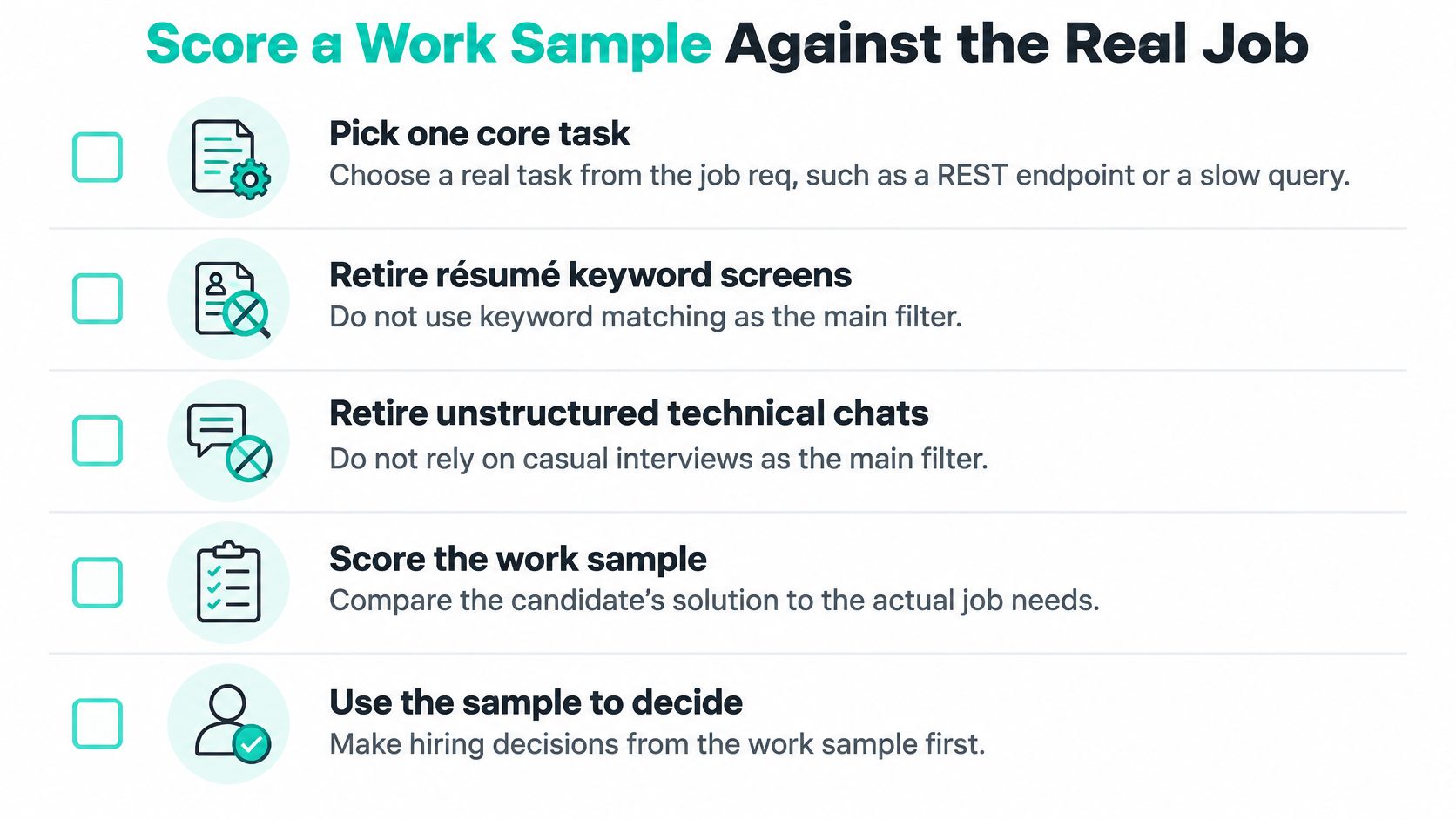
Score correctness, maintainability, tests, security, and communication. Define meeting the bar before anyone opens the repo: expected behavior works, failures are intentional, tests run independently, sensitive operations are protected, and the candidate can explain the trade-offs they accepted.
Say a FastAPI candidate passes a LeetCode screen, then adds an endpoint that fetches related records separately for every result. When asked about the N+1 query, they cannot explain why database calls grow with response size or how to inspect the generated SQL.
That candidate should struggle here. The job requires reasoning about application behavior under realistic constraints, beyond producing syntactically correct Python.
A strong submission does not need elaborate abstractions. It needs an understandable change, clear boundaries, useful tests, and a credible account of unfinished work. Do not penalize a candidate for leaving a documented enhancement undone when the timebox was explicit.
A bounded exercise should reveal what someone prioritizes under constraints, not how much unpaid time they can contribute.
Use algorithm puzzles as the primary gate only when algorithmic work is central to the role. Skip weekend take-homes without scoring anchors; they leave candidates guessing about effort and reviewers grading personal preferences.
Advance candidates who meet the correctness bar and at least two of tests, security, and communication. Treat an unresolved critical security flaw as a blocker regardless of the aggregate score.
The pull request looks reasonable. The endpoint returns the right response, the test passes, and the explanation sounds confident. But the change skips an authorization check and writes a bearer token into a log.
That's the review problem worth testing. Generating plausible Python isn't the same as deciding whether a change belongs in production.
The Python hiring guide from Hire Full Stack Developer India, summarizing Stack Overflow's developer survey, reports that 45.7% distrusted AI output versus 32.3% who trusted it, while 66% cited “AI solutions that are almost right” as their leading frustration. For hiring, the practical question is whether a candidate can detect the difference between working code and trustworthy code.
Give candidates who passed the work sample a separate, 30-minute review exercise. Use the same repository so they aren't spending the session learning another application. Explain that an AI assistant drafted the change and that they're responsible for the merge decision.
Seed a plausible FastAPI or pipeline pull request with:
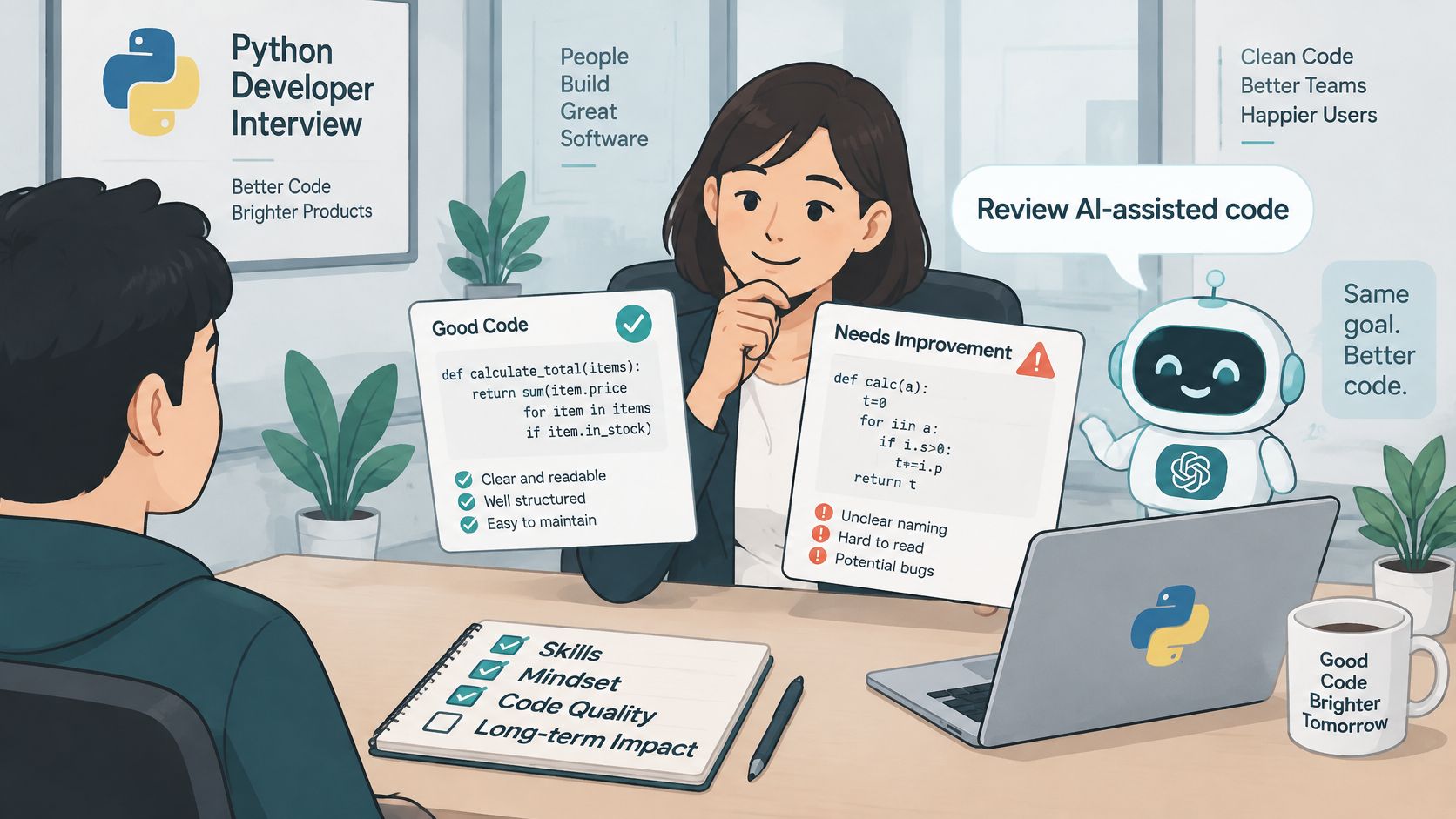
Ask what they would merge, what they would block, and how they would monitor the change after release. A strong answer identifies the authorization gap and weak test before debating naming or formatting. It also explains how to verify a fix, not just what looks suspicious.
A weaker answer rewrites the function from scratch without reviewing the surrounding behavior. Another weak answer accepts the diff because it runs. Neither demonstrates the judgment you need from someone approving changes under delivery pressure.
Keep this scoring distinct from the implementation exercise. Assess defect detection, explanation, and refusal to approve unverified code. Don't reward familiarity with a particular assistant or polished prompting language.
AI fluency doesn't lower the bar for debugging, tests, and review. It raises it, because an early hire may own the whole service.
For a broader assessment policy, use our guide to testing IT candidates in the era of AI. Make tool permissions explicit so you're evaluating responsible use rather than rewarding candidates who interpret the rules differently.
Startup fit shows up in how a candidate handles incomplete scope, operational responsibility, and boundaries. It doesn't require a personality match with the founder, and it shouldn't become a vague veto after someone passes the technical assessment.
Keep this conversation separate from the code-review score. Ask everyone the same prompts and write down what their choices would mean for your team.
The ticket is half-specified and the customer demo is Thursday: what do you ship and what do you cut?
Look for a smaller vertical slice, explicit assumptions, and a way to confirm the customer's essential need. A useful answer might preserve the core workflow while cutting a secondary integration or manualizing an internal step. Demanding a complete specification before doing anything is a mismatch for a team that works through uncertainty.
But don't mistake reckless agreement for adaptability. A candidate who asks whether the demo uses real customer data is identifying a constraint, not resisting urgency.
This service has no dedicated on-call yet. What would you page on, and what can wait until morning?
Listen for a short list tied to user impact: failed critical transactions, sustained unavailability, or a security incident. Dashboard noise and recoverable background delays shouldn't automatically wake someone up. The candidate should also ask who responds, what support exists, and how you'll prevent informal permanent availability.
Where have you worked without a platform team, and what did you refuse to own?
A strong answer explains both capability and limits. They might own deployment automation while requesting specialist review for a sensitive infrastructure change. Contempt for messy code without an improvement plan is a red flag, but so is agreeing to own models, infrastructure, and product analytics immediately.
Discuss full-time versus contract, remote work versus occasional onsite attendance, and whether sponsorship is available. State required working-hour overlap and who makes priority decisions. None of these should emerge as a surprise during offer negotiation.
Our marketplace's most successful candidates typically seek full-time positions, aren't recent bootcamp graduates, and don't require visa sponsorship. Many of our hiring partners also hire contract, remote, bootcamp, or visa candidates, so these are matching considerations, not blanket exclusions. Put your actual constraints in the requisition.
If you can't describe the first 90 days of ownership, you're not ready to judge fit.
Write that ownership in observable terms: the service they'll maintain, the backlog they'll inherit, the reviewer available to them, and the decisions they can make independently. If those answers expose an unsupported job, change the job rather than searching for someone willing to absorb unlimited responsibility.
Once the candidate clears the agreed bar, send a written offer. Don't add another interview because the team hasn't reserved time to make a decision, and don't reopen junior versus senior after assessing someone against a defined level.
Before sending it, request permission to speak with two prior managers and confirm work-authorization requirements in writing through an appropriate HR process. Ask references about ownership, review needs, and response to production problems. If contacting a current manager would compromise confidentiality, agree on suitable former managers rather than forcing disclosure.
The document should let the candidate understand the purchase you're proposing:
Give the candidate two business days as a proposed decision window, communicated before the offer arrives. If they need a reasonable extension to review equity or resolve another commitment, handle that directly. Tell other finalists when they can expect an update instead of leaving them in an unexplained holding pattern.
If the proposed salary is below the candidate's current pay, don't invent a private band to rescue the negotiation. Decide whether you can fund a legitimately different scope or level. If you can't, acknowledge the mismatch rather than implying that equity automatically closes it.
Underdog.io offers employers pay-per-hire or subscription pricing. Our Premium plan is $850 per month plus $6,500 per hire, with a three-month contract. We also offer a no-hire, no-fee arrangement; subscription commitments and placement terms need to be distinguished when comparing options.
Confirm the current plan details on our site before approving spend. Don't treat a contingent fee and a recurring subscription as interchangeable costs, particularly if you're filling only one position. Include your team's screening capacity in the decision, since introductions still require timely review.
Choose our marketplace when you want startup-screened Python candidates and are prepared to show a salary range upfront. For contractor cover needed inside two weeks, consider nexusITgroup.com, while confirming availability rather than assuming a start date.
This week, publish the one-sentence requisition, choose one primary sourcing channel, schedule the 90-minute work sample, and block offer-review time before the first screen. A clear decision process is more useful than another page of Python requirements.
Underdog.io gives startups a curated marketplace for finding developers whose experience matches the work they need owned. Bring your Python archetype, salary range, and production responsibilities to Underdog.io to start building a focused candidate pipeline.