You're probably in one of two situations right now. You need someone to ship and maintain a React Native app, or you already hired “a React developer with mobile experience” and discovered too late that web React and production React Native are not the same job.
That mismatch is where most hiring pain starts. Teams write a vague role, source from the same noisy channels as everyone else, run generic frontend interviews, then wonder why the hire struggles with app releases, native dependencies, state management, or platform-specific bugs.
Hiring React Native developers gets easier when you treat it like a technical scoping problem first and a recruiting problem second. The strongest teams get specific early, screen for mobile reality instead of resume theater, and design an interview loop around the actual work the person will do.
The first mistake is assuming “React” and “React Native” are close enough. They aren't. The hiring market keeps proving that point. The gap between React and React Native hiring shows up most clearly when teams skip architectural prerequisites like Expo vs. Bare workflow, New Architecture v0.71+, and native module requirements. That mistake creates a 15 to 20% budget premium, and 85% of hiring failures in this area stem from misaligned workflow definitions, according to Remote Crew's React Native hiring analysis.
A job title won't save you if the underlying stack is fuzzy. “React Native developer” can mean someone who's productive in Expo-managed apps with common SDK features, or someone who can work in a Bare setup, handle native dependencies, and get their hands dirty in Xcode and Android Studio when needed.
That difference changes who you should hire:
Practical rule: If your roadmap includes native modules, custom hardware access, or architecture migration, don't hire from a generic frontend profile and hope they ramp.
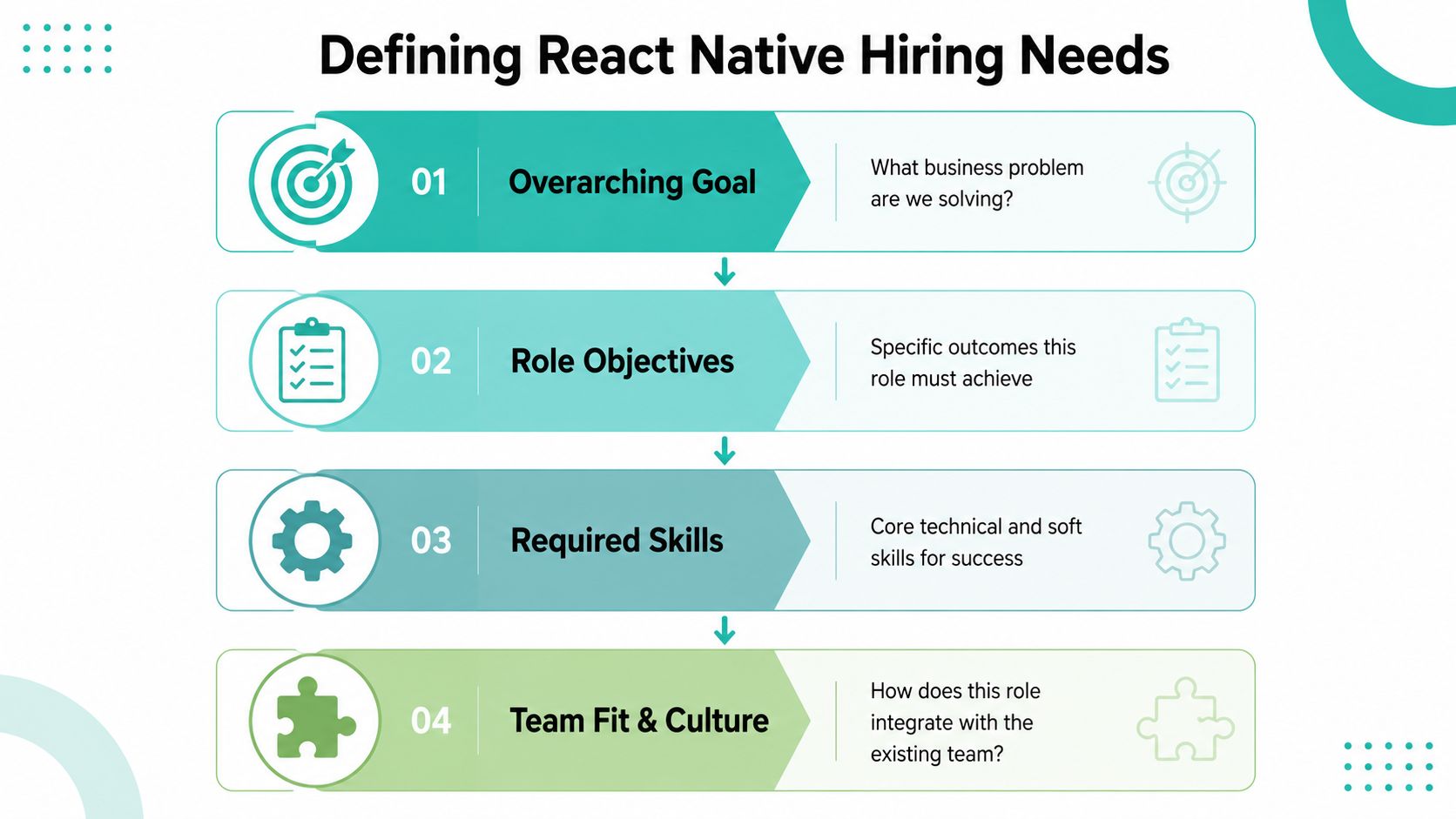
Before you open LinkedIn, write one page that forces alignment across founder, hiring manager, and whoever will evaluate code. A lightweight strategic staffing plan is useful here because it pushes the role out of vague “we need mobile help” language and into concrete responsibilities.
Include these decisions:
Business problem
Name the actual outcome. Are you shipping a new cross-platform app, stabilizing an existing codebase, or migrating architecture?
Workflow choice
State whether the role is for Expo, Bare React Native, or a mixed environment.
Architecture expectations
Clarify whether the candidate must already understand New Architecture concepts or only maintain an older setup.
Native boundary
Spell out whether they need to integrate existing packages only, or build and debug native modules.
Operational ownership
Decide whether they'll just build screens or also own app releases, testing, CI/CD, and backend integration points.
A lot of founders ask pay questions too early. First define the profile. Then benchmark it. If you want to sanity check how React Native roles are framed in the market, the compensation context in this React Native jobs overview is a useful reference point.
A clean brief prevents the worst kind of wasted process. You don't spend weeks interviewing polished React web candidates for a role that requires mobile architecture judgment, app deployment experience, and comfort with platform constraints.
LinkedIn is fine for visibility. It's weak as a sole sourcing strategy. Searching there with broad terms like “React Native” often yields a flood of noisy profiles, recycled resumes, and candidates whose mobile work turns out to be shallow.
The better approach is to treat channels differently. Use broad channels for reach, niche channels for proof of work, and curated channels when you need a smaller set of serious candidates.
The strongest React Native candidates often leave more signal in public work than in their resume. That means GitHub, package contributions, technical discussions, and community channels are often more useful than job board applications.
A practical sourcing stack looks like this:
GitHub search
Look for repositories with recent React Native commits, TypeScript usage, navigation patterns, testing setup, and evidence of mobile-specific problem solving.
Subreddits and community spaces
Communities focused on React Native, mobile engineering, Expo, and cross-platform development often surface people who are actively building, debugging, and discussing real implementation trade-offs.
Slack and Discord groups
Smaller communities usually produce better conversations than broad social platforms. You're more likely to find builders there than keyword optimizers.
Targeted job references
Reviewing a niche posting like HiredBySkill's Shopify job can sharpen your own calibration. Not because you should copy the listing, but because role framing tells you how other teams separate product-layer React Native work from deeper mobile ownership.
Credential-heavy screening removes a lot of good candidates. That's especially true in Latin America and other emerging markets. Recruiter data shows that a significant portion of skilled React Native developers in Latin America begin professional work before completing formal degrees, while many US-centric hiring processes still overvalue degrees and undervalue portfolios, according to Hire With Near's hiring guide.
That should change how you source and how you screen. If the role requires shipping quality mobile software, the signal you want is shipped work, technical judgment, and communication. A degree may be nice. It isn't the point.
Strong portfolios beat generic education filters. A candidate who can explain app structure, state choices, and release trade-offs is worth more than a clean pedigree and vague frontend bullets.
If you're a startup, brute-force sourcing burns founder time fast. Curated marketplaces can be useful because they narrow the pool before your team spends hours on outreach and first screens. For example, Underdog's guide to passive candidate sourcing is a solid reminder that many good candidates aren't actively applying. They need a process that respects their time and makes the opportunity legible quickly.
That's also the one clear use case for a curated hiring marketplace like Underdog.io. It gives companies access to pre-vetted startup-oriented candidates, which can be more efficient than building every search from scratch.
Most broken hiring processes spend too much time on weak signals. Resume keyword matching is weak. Generic algorithm screens are weak. Long take-home projects are weak if they drift too far from the actual job.
High-signal vetting for React Native roles should answer three questions fast. Has this person built real mobile software? Can they work inside your stack? Can they explain trade-offs instead of reciting tooling names?
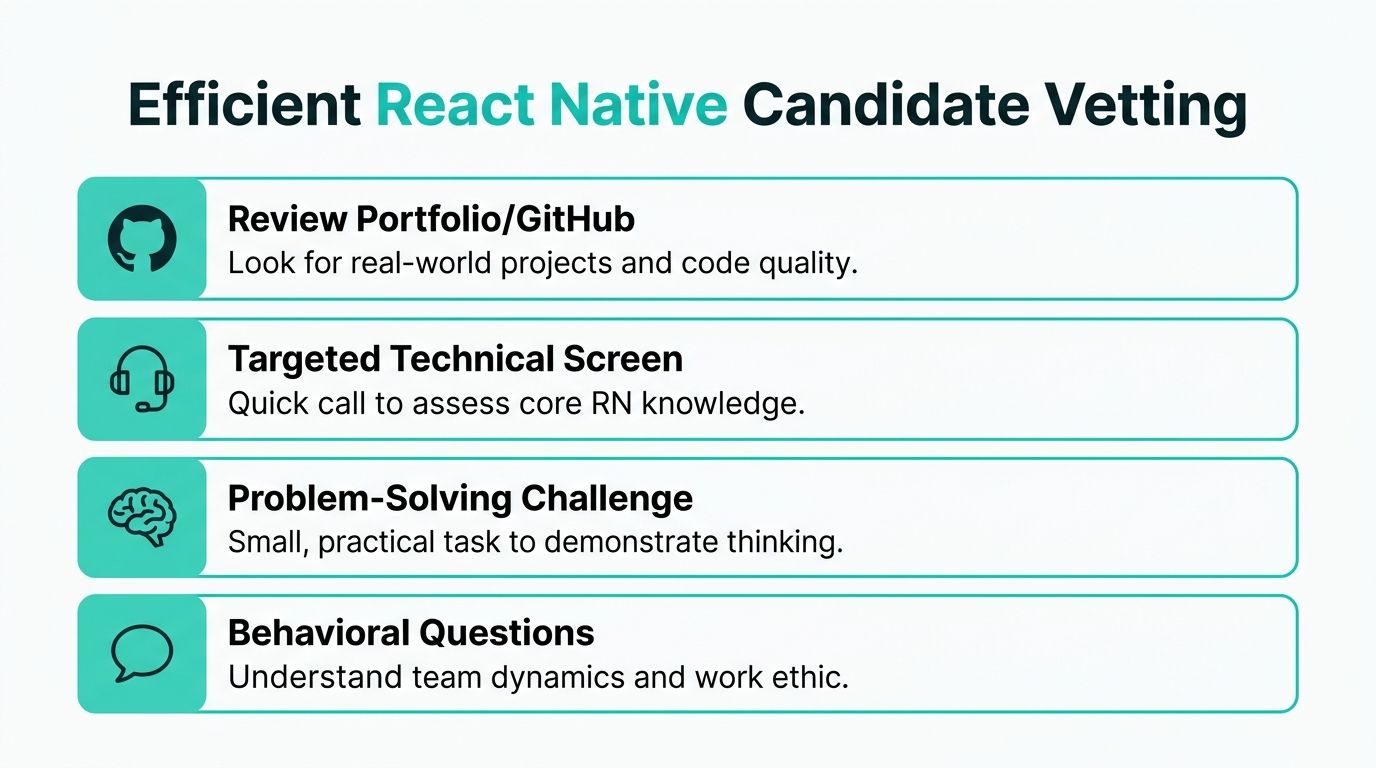
In 2025, React Native roles increasingly require developers to understand backend APIs, CI/CD pipelines, and complex state management, and companies now prefer candidates with 3+ years of dedicated mobile experience, according to this analysis of the React Native developer job market.
That means your portfolio review can't stop at “built three apps.” Look for proof that the person has handled mobile complexity.
A strong portfolio or GitHub profile usually shows some combination of:
State management choices
Can they explain why they used Context, Redux, Zustand, or another pattern for the kind of app they built?
API integration reality
Do they mention auth, caching, retries, offline behavior, or failure handling?
Testing discipline
Are there tests, linters, formatting rules, and a visible standard for code hygiene?
Platform-specific awareness
Is there any sign they've dealt with iOS and Android differences instead of pretending cross-platform means identical behavior everywhere?
Release ownership
Look for references to shipping builds, handling updates, or maintaining apps after launch.
A practical test tells you more than a trivia quiz. The strongest format is a compact exercise tied to the actual work. Keep it scoped, concrete, and respectful of the candidate's time.
A good test brief might ask the candidate to build a login screen with:
This format reveals how they think. You see naming, component boundaries, TypeScript habits, state handling, error paths, and whether they optimize for maintainability or just “getting it working.”
Don't ask React Native candidates to solve abstract puzzles if the role is about building product features, integrating APIs, and shipping mobile software.
Technical talent alone isn't enough. Startups need engineers who can work with ambiguity, handle handoffs, and move in async environments. If your team uses objectives and ownership models, it helps to hire for OKR alignment rather than relying on vague “culture fit” language.
A compact vetting sequence works well:
| Stage | What to check | What weak signal looks like |
|---|---|---|
| Portfolio review | Real mobile depth | Polished UI, no implementation detail |
| Short screen | Stack fit and communication | Tool name dropping |
| Practical exercise | Coding judgment | Overbuilt or unfinished solution |
| Behavioral pass | Ownership and collaboration | Generic teamwork answers |
If you want to keep the process candidate-friendly, this advice on not wasting an engineer's time in interviews is worth following. The best React Native candidates usually have options, and bloated hiring loops push them out early.
A strong React Native interview process should feel like a working session, not an exam. The point isn't to prove who remembers the most obscure API detail. The point is to find out whether the candidate can reason through mobile product problems, collaborate with your team, and make good decisions under normal engineering constraints.
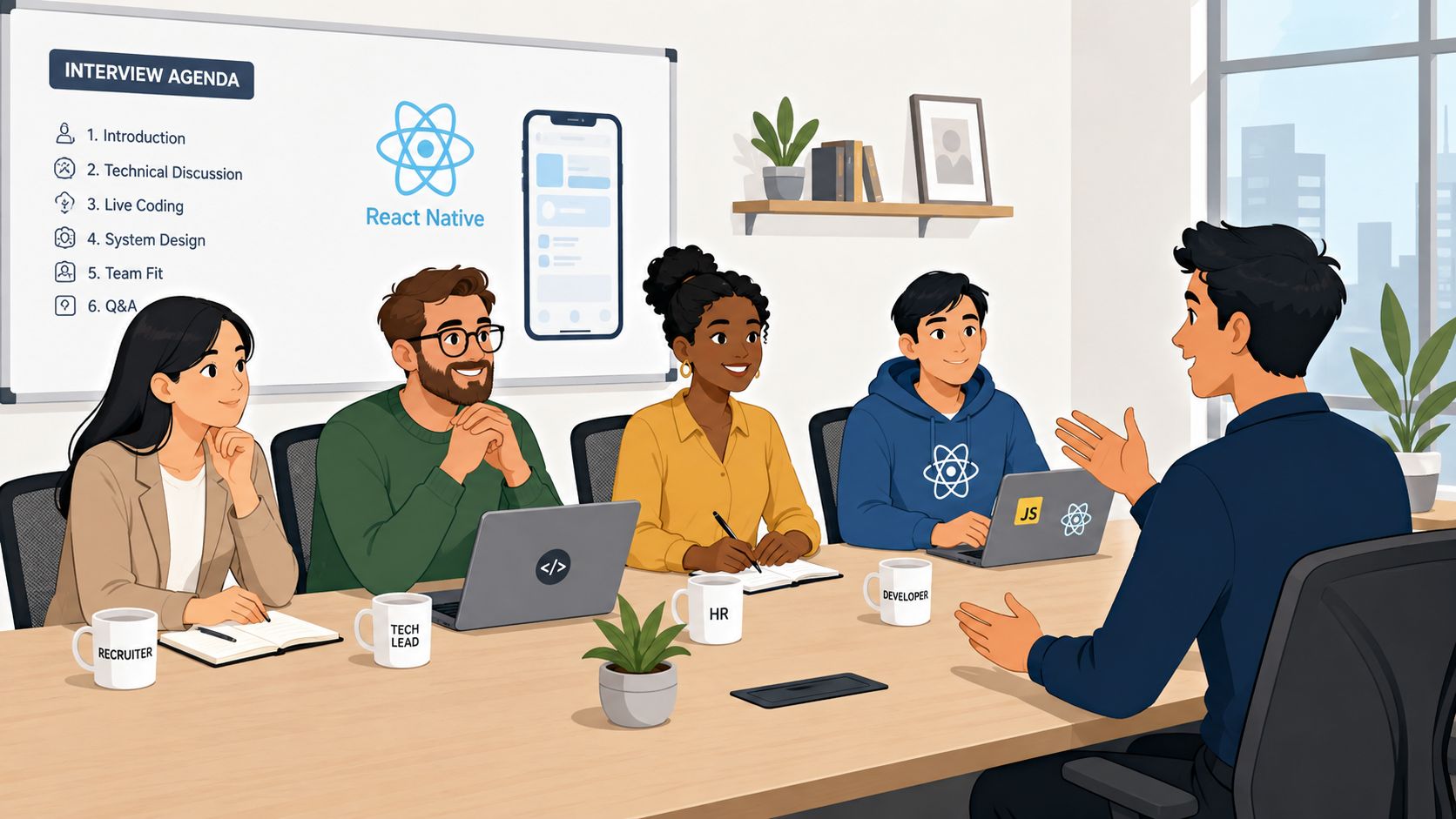
A focused test project such as building a login screen with form validation is a useful foundation, and soft-skill questions around version control in shared Git environments and async communication tools matter because they support startup agility, as outlined in Zazz's React Native hiring methodology.
That should carry into the interview loop. Instead of asking leetcode-style questions, ask the candidate to walk through decisions they'd make in a real app.
Examples that work:
One of the most revealing rounds is a practical design discussion. Keep it bounded. Don't ask for a whiteboard dissertation on distributed systems. Ask for a mobile problem with actual product trade-offs.
Good prompts include:
What you're evaluating isn't only the answer. It's how they communicate, how they clarify assumptions, and whether they know where mobile apps break in practice.
The right React Native hire usually sounds like someone who has debugged real app behavior, not someone who has memorized framework vocabulary.
A lean process is typically enough:
What doesn't work is stacking unrelated interviews because everyone wants “one more data point.” That usually produces noise, not confidence.
A startup gets to the offer stage with a candidate who looked strong in interviews. Then the conversation slips because the company is hiring for “React Native,” while the actual job is a mix of release ownership, native module debugging, and a messy migration path from the old architecture. That mismatch is one of the easiest ways to lose a good candidate or hire the wrong one.
By the time you make an offer, the role should be specific enough that both sides can see the work ahead. React Native hiring breaks down here when teams price for a generalist but expect someone who can handle Expo trade-offs, work in a Bare workflow, or clean up native code and bridge issues after launch.
Compensation has to reflect the actual complexity of the job.
A React Native engineer shipping product features in a stable Expo app is a different hire from someone expected to own native integrations, release process issues, and architectural migration risk. The title may look similar. The work does not.
A practical offer framework looks like this:
Mid-level full-time hire
Good fit for a team with a clear roadmap, an established codebase, and predictable feature delivery. They should be able to contribute independently, but they are not your fallback for every mobile systems problem.
Senior full-time hire
Better for teams that need someone to make judgment calls on app structure, performance issues, release discipline, and collaboration across product, design, backend, and QA.
React Native specialist with ecosystem depth
Pay more only if the roadmap justifies it. This is the person you hire when your app depends on Bare workflow decisions, custom native modules, difficult third-party SDKs, or a move to the New Architecture. If none of that is on the roadmap, the premium usually goes to waste.
I have seen teams overpay for “senior React Native” talent when what they really needed was a dependable product engineer. I have also seen founders try to save money on a mid-level hire, then discover three sprints later that nobody on the team can diagnose a build failure in Xcode or Gradle. The offer has to match the risk profile.
Treat this as a delivery model decision.
If the engineer needs to absorb product context, improve code quality over several releases, and make decisions that will affect future hiring, full-time is usually the better call. If you have a bounded problem, such as upgrading a package, stabilizing CI, or integrating one native SDK, a contractor can be the cleaner option.
| Factor | Full-Time Employee | Contractor |
|---|---|---|
| Team continuity | Better for long-term product ownership | Better for defined short-term deliverables |
| Architecture decisions | Stronger fit when decisions compound over time | Useful when expertise is narrow and immediate |
| Onboarding cost | Higher upfront, better long-term payoff | Lower long-term commitment |
| Process integration | Easier to embed into product and engineering rituals | Better when you need execution without full team integration |
| Budget planning | Predictable annual cost | Flexible, but can become inefficient if the scope keeps expanding |
Regional pricing matters too, but only after the technical brief is clear. A lower-cost hire is not cheaper if your team spends months working around gaps in native debugging, release management, or architecture decisions.
Strong candidates do not only evaluate the package. They evaluate whether your team knows what it is asking them to own.
The offer conversation should answer five things clearly:
That third point gets missed often. If your app is still on the old architecture, say it. If you plan to migrate, say that too. If the role involves maintaining Expo today but ejecting later for native integrations, a serious candidate will want that detail before signing. Hiding the hard parts does not improve close rates. It creates churn.
The first month should test for traction, not just activity.
Avoid generic onboarding goals like “get familiar with the codebase” or “ramp up on the team.” Set benchmarks that reflect the environment you hired for.
Use targets like these:
Environment and release readiness
They can run the app locally, understand the project structure, and ship a change through your real workflow. If the app has iOS and Android build quirks, they should know them early.
First meaningful delivery
Assign a scoped feature or fix that touches production reality. If your team uses Expo, that may be a product-facing task within existing constraints. If you run Bare React Native, include some interaction with native dependencies, build config, or release tooling.
Code review judgment
Evaluate whether they leave useful comments, spot mobile-specific risks, and respond well to feedback. This matters more than raw speed.
Cross-functional reliability
Watch how they work with product, design, backend, and QA. Mobile work breaks down fast when requirements, API behavior, and release expectations are misaligned.
Architecture awareness
For senior hires, check whether they can explain the trade-offs in your current setup. That includes old versus New Architecture, Expo versus Bare, and where your app is likely to hit trouble next.
A good first-month benchmark is simple. By the end of it, the new hire should be shipping useful work in your real stack and showing sound judgment about the constraints around it.
Bad offers rely on urgency. Good offers define the job precisely, pay for the level of difficulty involved, and set benchmarks that reflect how React Native work gets done.
If you want a narrower hiring funnel for startup engineering roles, Underdog.io is one option to consider. It's a curated hiring marketplace where companies can meet vetted tech candidates who are open to startup opportunities, which can reduce the time spent on raw sourcing before your team begins technical evaluation.