Let’s get right to it: how much do software engineers really make? You’ll see numbers all over the place, from $90,000 for someone just starting out to well over $300,000 for senior talent. But that base salary figure? It's just the tip of the iceberg.
The real answer is a lot more interesting and depends heavily on your experience, where you work, and how your offer is structured. A great compensation package often includes significant bonuses and equity that can dwarf the base salary. This guide provides the practical insights and actionable steps you need to understand and maximize your earnings.
If you want to understand what you can earn as an engineer, you have to look past that single salary number. While a high base is great, it doesn't tell the whole story. Your true earning potential is in the total compensation package—the powerful combination of your reliable base pay, performance bonuses, and game-changing company equity.
Think of it like this: your base salary pays the bills, but bonuses and equity are where you can build serious wealth. This guide is your roadmap to understanding every piece of the puzzle, so you can walk into any negotiation with confidence. We'll start with the foundation: what you can expect to make at different points in your career.
To get our bearings, let's look at what typical base salaries look like. One of the best parts of a software engineering career is that as you gain experience and deliver more value, your earning power grows—a lot.
Here’s a snapshot of what you can expect to earn on average in the U.S. based on your experience level. Remember, these are national averages. We’ll break down how much location changes these numbers in a bit.
The table below gives you a solid starting point for annual base salaries. As you can see, the jump from junior to senior is substantial, and it only continues from there.
This gives you a great baseline, but these numbers are just one piece of the equation. They don't include the other critical parts of a competitive offer.
Actionable Insight: The biggest mistake engineers make is fixating only on the base salary. A lower base with a huge equity grant at a high-growth startup can ultimately be worth far more than a higher salary at a slow-moving corporate giant.
As we go, we're going to deconstruct what a truly competitive offer looks like. You’ll learn about:
By the end, you won't just know "how much do software engineers make?"—you'll understand exactly how to maximize your own earning potential.
Focusing only on base salary is like judging a car by its paint job—it looks good, but it tells you nothing about the engine. To really get a handle on how much software engineers make, you need to look under the hood at the entire compensation engine: base pay, bonuses, and equity. Each part plays a totally different role in your financial picture.
Your base salary is the reliable foundation. It’s the guaranteed amount that hits your bank account every two weeks, covering your rent, groceries, and everything in between. It provides stability, but it's only the starting point of what an offer is truly worth.
This chart breaks down the core components that make up a software engineer's total compensation.
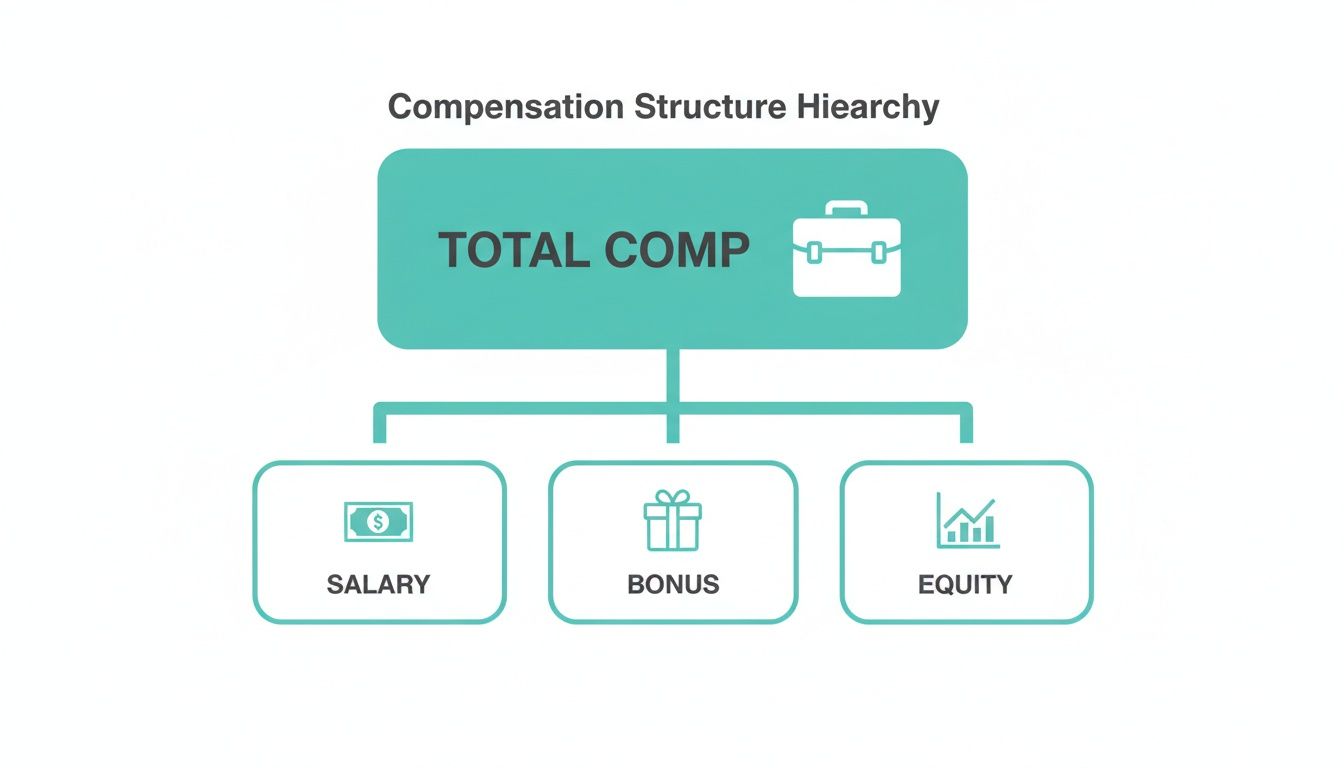
As you can see, a competitive offer is a balanced package. Salary, bonuses, and equity all need to work together to build your total earnings.
If base salary is the foundation, performance bonuses are the reward for building something great on top of it. These are variable payments, usually paid out annually or quarterly, and they're tied to how well you, your team, or the whole company performs.
A bonus isn't guaranteed, but it can give your annual take-home pay a serious boost. For instance, a senior engineer with a $160,000 base might have a 15% target bonus, which adds another $24,000 to their yearly earnings just for meeting expectations. Crush those expectations, and that number could climb even higher.
Actionable Insight: Understanding the bonus structure is key. Always ask potential employers how bonuses are calculated, what the historical payout rates look like, and what targets you need to hit. This turns a vague promise into a tangible financial goal. For example, ask: "What has the average bonus payout percentage been for this team over the last three years?"
The third and often most powerful pillar is equity. This is your ownership stake in the company, and it’s where life-changing wealth can be built, especially at a startup. While salary and bonuses provide immediate income, equity is an investment in the company's future success.
Equity usually comes in two main flavors, each with its own set of risks and rewards.
Think of stock options like a coupon to buy company stock at a predetermined, discounted price (the "strike price") down the road. If the company takes off and its value skyrockets, you can buy shares for cheap and potentially sell them for a massive profit. The catch? If the company doesn't make it, your options could end up being worthless.
RSUs are a more straightforward grant of company shares. You don’t have to buy them. Once they "vest" (meaning you've met the time-based requirements), they become yours, and you can sell them for their current market value.
Deciding what you prefer really depends on your personal financial goals and how much risk you're comfortable with. An engineer looking for stability might favor a higher base salary and RSUs from a public company. On the other hand, someone willing to roll the dice for a potentially massive payout might be drawn to a startup offer with a lower base but a generous grant of stock options.
Getting the details right is critical, so be sure to check out our guide on startup equity basics for job seekers to learn more.
That old real estate mantra, "location, location, location," hits just as hard for tech salaries. Where you choose to work—or even just where you log in from—can dramatically change your real earning power. A $150,000 salary in San Francisco feels a whole lot different than that same paycheck in a city with a much lower cost of living.

Looking at raw salary numbers alone is a classic rookie mistake. To get the real picture of what you can earn, you have to bake in the cost of living. That’s the only way to figure out what your salary is actually worth.
For years, the big tech hubs like San Francisco and New York City have dangled the biggest paychecks. This makes sense—it’s where you’ll find the highest concentration of tech giants and well-funded startups, all fighting over the same pool of top-tier talent. To win, they have to pay up.
Of course, that premium salary comes with a premium price tag. The cost of living in these cities, especially when it comes to housing, is astronomical.
Practical Example: A bigger salary doesn't always mean a bigger bank account. An engineer pulling in $180,000 in San Francisco might actually have less disposable income than one making $140,000 in a city like Austin or Denver, where rent and daily expenses won't eat up their entire check.
This is exactly why emerging tech markets and remote work are changing the entire compensation game. Places like Raleigh, Salt Lake City, and Atlanta are building out impressive tech scenes without the crushing costs of the coastal hubs. Companies are spinning up teams there, offering seriously competitive salaries that stretch much, much further.
The table below breaks down how this looks in practice. We've compared average salaries in major hubs against the local cost of living to estimate a more realistic "Adjusted Earning Power."
As you can see, the on-paper salary leader (San Francisco) actually offers less real purchasing power than a role in Austin or even a fully remote position where an engineer can choose a location with an average cost of living.
Remote work has thrown a fascinating wrench into salary calculations. Your job might not be tied to an office, but your paycheck could still be tied to your zip code. Many companies, especially larger ones, use a location-based pay strategy, meaning they adjust your salary based on the cost of labor in your specific area.
This leads to a few common scenarios for remote engineers:
When you're looking at a remote offer, it's absolutely critical to ask about the company’s compensation philosophy. You need to know if your pay will change if you decide to move. For a deeper dive into what companies are paying across different markets right now, check out our 2025 Tech Salary Guide.
The location conversation isn't just a US-centric one anymore. The global talent market is more connected than ever, and that’s creating new kinds of opportunities. While the US still generally leads in top-tier pay, the gap is definitely shrinking.
For example, the average software engineer salary in the UK is now around £70,000, with senior roles hitting £110,200. Across Western Europe, you’ll often see salaries from €50,000-90,000, but here's the kicker: remote roles with US or other international companies can pay between $80,000-$150,000. This trend opens up a world of possibilities for engineers open to working with international teams, which are often found on platforms like Underdog.io.
For engineers based in high-cost US hubs, this global competition is actually a strategic advantage. It reinforces the high value of your experience and gives you a powerful negotiating position, whether you’re aiming for a top-dollar local job or a high-paying remote role with a company that hires across borders.
Experience and location are your salary's foundation, but the right specialization is the rocket fuel. While general software engineering skills will always be valuable, companies are willing to pay a serious premium for experts who can solve their most complex, high-stakes problems.
If you’re looking for the single most effective way to increase your market value, it’s this: master an in-demand niche.
Think of it like building a house. A general contractor is essential, but you bring in a specialist for the tricky electrical systems or complex structural work—and you pay them accordingly. In tech, it's the same story. Companies need specialists to manage massive cloud infrastructures, build intelligent AI systems, and defend against sophisticated cyber threats. That specialized demand translates directly into higher pay.
Artificial intelligence isn't some far-off concept anymore; it's a core business driver for just about everyone. Companies are scrambling to find engineers who can build and deploy machine learning models for everything from personalizing user experiences to automating mind-numbing operational tasks. The intense demand, combined with the high-level math and programming skills required, makes AI/ML one of the most lucrative fields in software.
Actionable Insight: For engineers asking how to make more money, the answer is often found in specialization. By becoming an expert in a field like AI or cloud computing, you shift from being a commodity to a critical, high-value asset that companies will compete for.
In today's world, just writing the code isn't enough. It has to be deployed, scaled, and maintained reliably for potentially millions of users. That’s where DevOps and Cloud Engineers come in. They build the automated pipelines and manage the cloud infrastructure (think AWS, GCP, or Azure) that keeps the digital lights on.
Because their work is so fundamental to a company's stability and ability to grow, these roles are incredibly valuable. A company's entire operation can grind to a halt without a robust infrastructure, making these engineers indispensable—especially at the high-growth startups you'll find on platforms like Underdog.io, where scaling fast is a matter of survival.
The data consistently shows that specialized roles bring in premium pay. Cloud and network engineers can earn an average of $132,000, while information security analysts are hitting $124,910 thanks to surging cybersecurity needs. The critical nature of these skills is precisely why companies are willing to pay top dollar. You can explore more data on top-paying IT roles to see how these specializations stack up.
As technology weaves itself deeper into every part of our lives, the threat of cyberattacks grows right alongside it. A single data breach can cost a company millions and completely destroy its reputation. Cybersecurity engineers are the digital guardians on the front lines, protecting a company's data, applications, and infrastructure from these ever-present threats.
Ultimately, choosing a specialization is a strategic career move. When you align your skills with the market's most pressing needs, you're not just finding a job—you're building a path to becoming a top earner in your field.
Getting a job offer feels like you've crossed the finish line. But really, the starting gun for the most critical part of the process has just fired. Think of that initial offer not as a final verdict, but as the first draft. Now’s your chance to dig in, understand what it’s really worth, and negotiate a package that truly reflects your skills and the value you bring to the table.
This is especially true when dealing with startups, where an offer is often a complex blend of cash, future potential, and perks. A smart evaluation looks way beyond the base salary. To land the best possible deal, you need a clear strategy and the confidence to advocate for yourself.
Before you even dream of making a counteroffer, you have to dissect what’s on the table. Put on your detective hat. Your job is to uncover the true, total value of the offer, not just the obvious numbers.
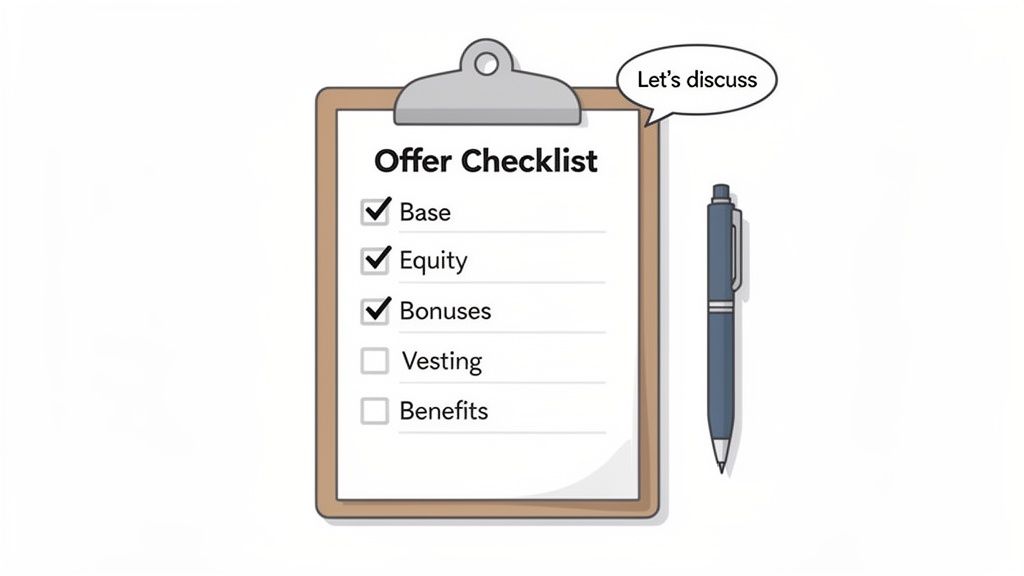
Use this checklist as your guide:
Practical Example: A classic mistake is to gloss over the benefits. A company that fully covers your health insurance premiums could be saving you $500 or more every month compared to an offer where you foot a big chunk of the bill. That’s an extra $6,000 in your pocket each year, tax-free.
Once you've done your homework and evaluated the complete offer, it's time to map out your negotiation. This isn't about being confrontational. The real goal is to have a collaborative chat that ends with a deal you're both happy with. Ground your approach in data, professionalism, and a clear-eyed view of your own worth.
A successful negotiation is built on a few core principles. You want to be polite but firm, genuinely express your excitement for the role, and anchor every request in objective market data. This shifts the dynamic from a list of demands to a reasoned, professional discussion.
Remember, the overwhelming majority of companies fully expect candidates to negotiate. When you approach the conversation with a clear, data-driven strategy, you’re not just boosting your own earning potential. You're also reinforcing the thoughtful, professional approach that made them want to hire you in the first place.
Knowing what you’re worth is step one. Finding a role that actually pays it is a whole different beast.
Let's be honest, the standard job search is a grind. It’s practically a full-time job in itself—firing off endless applications, tweaking cover letters, and getting lost in a black hole of recruiter emails. There’s a better way to do this, one that puts the control back in your hands.
What if, instead of you hunting for jobs, the best companies came hunting for you?
Underdog.io flips the whole job search script. We hand-pick opportunities from some of the most exciting startups and tech companies in NYC, San Francisco, and across the US for remote roles. Our entire model is designed for engineers who’d rather spend their time building cool stuff, not scrolling through job boards.
We keep the process simple and direct:
Actionable Insight: The goal is to spend less time searching and more time in conversations for roles that are actually a great fit. It shifts the power dynamic back to you, the engineer, where it belongs.
By focusing on curated matches, you can be confident that the opportunities coming your way align with your skills and salary expectations. This is especially critical when you're looking at high-growth startups where the total compensation package is everything.
If you’re ready to see what roles match your true market value, take a look at the software engineering jobs available on Underdog.io. Apply once and let your next big opportunity find you.
Diving into software engineer compensation can feel like learning a new language. Let's clear up a few of the most common questions that pop up when engineers are trying to figure out their career path and earning potential.
You can realistically expect a pretty significant salary jump of 15-30% after your first two years on the job. This isn't just a cost-of-living bump; it's a reflection of your shift from an entry-level engineer to someone with proven skills and real-world project experience.
This growth comes from demonstrating you can deliver, contributing to successful projects, and the simple fact that the market needs experienced talent. If you want to push that number even higher, focus on mastering a high-demand specialty like cloud engineering or AI. That kind of expertise makes you a much more valuable asset, both to your current company and to any future employers.
This is the classic "what's your risk tolerance?" question. Honestly, neither one is universally "better"—they're just built for different financial goals and personalities.
Actionable Insight: A simple way to think about it: RSUs are a reliable part of your income. Stock options are a high-risk, high-reward bet on a company’s future. Choose the path that aligns with your personal financial strategy.
Hands down, the single biggest mistake is not negotiating at all. A close second is only haggling over the base salary. So many brilliant engineers just accept the first offer they get, leaving a ton of money, equity, and benefits just sitting on the table.
Always, always do your homework on the market rates for your specific level of experience, skill set, and location. You need to walk into that conversation ready to clearly explain the value you bring and negotiate every single part of the offer. That means talking about base pay, performance bonuses, equity grants, and even asking for a sign-on bonus or an extra week of vacation.
As of 2024, the average total compensation for software engineers in the U.S. typically ranges from about **$90,000 for entry-level roles to over **$250,000 for senior and staff-level engineers at top tech firms. The median salary often falls between **$120,000 and **$150,000, but this varies widely based on several key factors.
The four primary factors are location, experience level, company type, and technical specialization. Major tech hubs (San Francisco, New York, Seattle) command salaries 20-40% above the national average. Experience is a major driver, with senior engineers earning significantly more than juniors. Large public tech companies and well-funded startups also tend to pay more than other industries.
Large, established tech companies (often called "FAANG" or "Big Tech") usually offer the highest base salaries and significant stock grants. Startups may offer competitive but slightly lower base salaries, but they frequently supplement this with equity (stock options), which can have substantial upside if the company succeeds. The total compensation package can be comparable, but with different risk/reward profiles.
It depends on the company's policy. Many larger tech firms have adopted "location-based pay," where your salary is adjusted to the cost of living in your geographic area. However, a growing number of "remote-first" companies offer standardized, competitive salaries regardless of where you live. It's important to ask about a company's compensation philosophy during the interview process.
Specializations in high demand with complex skill requirements often command premium salaries. These typically include machine learning/AI engineers, data engineers, security engineers, and distributed systems/backend engineers. Mastery of specific in-demand technologies can also increase earning potential.
Salary growth in software engineering can be significant, especially in the first 10 years. It's common to see jumps of 15-25% or more when moving between roles early in a career. Progression from mid-level to senior engineer often brings a substantial increase, and moving into staff, principal, or engineering management roles can push total compensation well into the $300,000+ range at top-paying companies.
For reliable, up-to-date information, use specialized tech salary platforms like Underdog's software engineering salary data tool, or Levels.fyi, which aggregates verified offer data. Pay close attention to roles on job boards like Underdog.io, Wellfound, and LinkedIn that list salary ranges upfront, as this data comes directly from employers and reflects current market rates.
Now that you have a handle on how much software engineers make and what it takes to land a top-tier offer, the only thing left is to find the right opportunity. Underdog.io is where you'll find curated roles at high-growth startups and tech companies that are actively hiring.