So, you’re thinking about making the jump to a product manager role at a startup. It’s a move that swaps the predictability of corporate life for the thrill of building something from the ground up, where your decisions can quite literally make or break the product. Your influence is massive, but so are the stakes.
This guide is your roadmap. We’ll cover exactly how to find a startup PM job, nail the interviews, and land a role where you can make a real impact.
Before you start firing off applications, you need to understand what you're getting into. The appeal of being closer to the customer, shipping features at lightning speed, and having your voice heard is powerful. But that freedom comes with a price: you'll be working with fewer resources, less data, and a relentless sense of urgency.
At a big company, roles are well-defined. At a startup, the PM is the ultimate generalist. You’re a strategist, a project manager, a marketer, and sometimes, you're the last line of defense in QA. For example, it's not uncommon for a startup PM to spend their morning drafting a Q3 product strategy, their afternoon running customer interviews, and their evening helping the support team respond to a bug report. Founders aren't looking for someone to just write tickets; they need a partner who thinks like an owner and will do whatever it takes to succeed.
In a startup, the PM's job is to wrestle with ambiguity and create clarity. You are the bridge between the big-picture vision and what the team builds today, making sure every sprint moves you closer to solving a real customer problem.
The core roles and responsibilities of product manager definitely get stretched in an early-stage company. You wear a lot more hats.
To give you a clearer picture, here’s a breakdown of the key differences you'll experience in a product management role at a startup versus a large corporation.
This table isn't meant to scare you off, but to set realistic expectations. The startup path is intense, but for the right person, it’s incredibly rewarding.
Let's talk money. Startup compensation is a different beast, mixing a solid salary with the high-stakes potential of equity. While some base salaries might not match the top-tier corporate offers, the intense demand for great PMs keeps them very competitive.
In fact, product managers are one of the highest-paid roles in the startup world. Projections for 2026 put the average PM salary at $152,750, a whopping 35.4% premium over the average startup salary.
In major tech hubs like Los Angeles and Austin, that number jumps to an average of $175,000. And for experienced leaders with over 10 years in the game? The average climbs to $201,000. It’s clear that startups are willing to pay top dollar for strong product leadership.
Equity is the other half of the story. It’s your slice of ownership in the company and your ticket to a potentially life-changing payout if the startup takes off. It's not cash in hand, but a significant equity grant is a powerful incentive and a key part of any offer you evaluate. Understanding this trade-off between salary and equity is crucial as you start your job search.
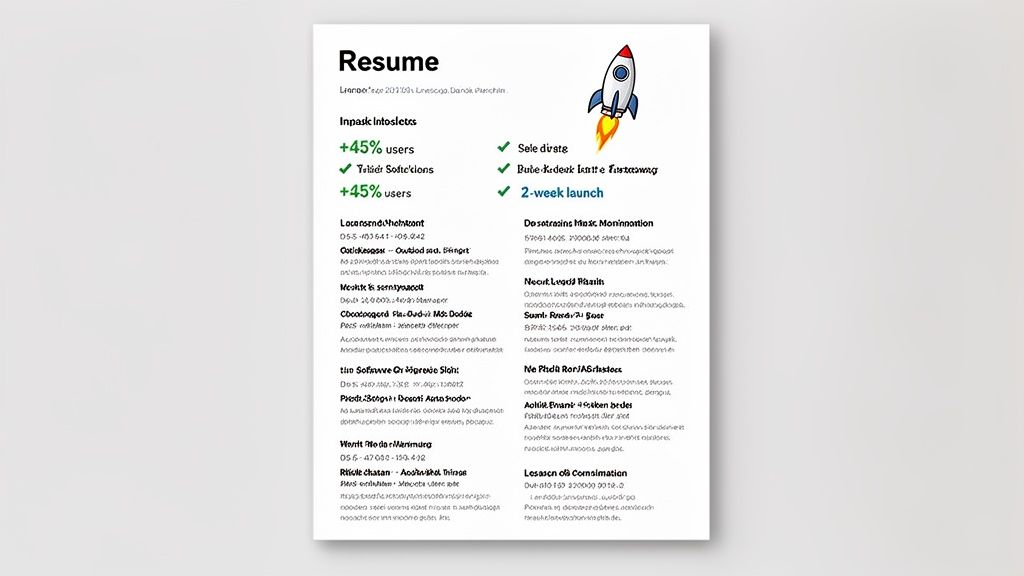
When you're targeting product manager roles at startups, your resume is your opening pitch. Founders and hiring managers aren't looking for a laundry list of your past responsibilities—they spend mere seconds on each resume, and they're scanning for one thing: impact.
Your entire goal is to transform your resume from a passive document that says "what I did" into a compelling pitch that screams "what I achieved." Startups live and die by their metrics—growth, retention, engagement, speed. Your resume absolutely has to speak this language.
Every single bullet point must answer the question: "So what?" If a line on your resume doesn't connect directly to a measurable business outcome, it's not strong enough for a startup.
Let's break down how to reframe your experience. It’s all about translating your day-to-day tasks into quantifiable wins that will catch the eye of a resource-strapped, growth-obsessed startup team.
Just look at the difference in these "before and after" examples.
The "after" versions don't just list a task; they prove your value with hard numbers. This is the currency that startups understand and respect. If you're struggling with how to structure these points, our product manager resume template is a great place to start.
Beyond the metrics, your resume also needs to signal that you have the right DNA for an early-stage company. Startups are inherently chaotic and unpredictable. You have to prove you can thrive in that environment.
Weave in specific language that shows you’re comfortable with ambiguity and have a clear bias for action.
Phrases like these demonstrate that you don't need a perfect, 12-month plan to get moving. You can make smart calls with incomplete information and deliver results fast. That is exactly the kind of product manager startups are desperate to find.
Forget the "spray and pray" approach. Flinging your resume at every PM opening on LinkedIn and Indeed is a fast track to burnout. The best startup product manager roles aren't hiding on those massive job boards—they're found in more focused, curated channels.
Think of it this way: you’re not just looking for a job, you're looking for the right one. Your goal is to get in front of high-growth companies before their roles are flooded with hundreds of applicants. This means shifting from a wide net to a sharp spear.
The single most effective way to find quality roles is to tap into ecosystems that do the first round of vetting for you. These platforms and communities filter for things like funding, growth potential, and team quality, which saves you a ton of time and helps you avoid dead-end opportunities.
If you want to go deeper on this, we've put together a guide on the best product manager job boards that focus specifically on high-quality startup roles.
A warm introduction or a profile on a curated platform is worth more than a hundred cold applications. It signals to the startup that you've already passed an initial quality filter, making them far more likely to engage.
Once you’ve found a promising role, your job isn't done. Now you need to put on your investor hat. Your career is your most valuable asset, so you have to do your own due diligence before you even think about signing an offer.
Don't just read the job description—investigate the health of the business. Here's an actionable checklist:
By treating your job search like an investment process, you’re not just finding another PM gig. You're finding the right one for your career.
Getting the interview for a product manager role at a hot startup is a huge win. Now the real work begins. Forget everything you know about big-company interviews. Startups aren't looking for someone who can recite frameworks or give perfectly polished, theoretical answers. They want to see how you think on your feet.
Founders and hiring managers are hunting for a PM who is genuinely obsessed with their mission, thrives in ambiguity, and has a default setting of "get it done." The interview loop is designed to test your resilience, creativity, and whether you can actually make an impact when time and money are tight.
Here’s a look at the typical journey you can expect.

As you can see, the process is usually a straight shot from a chat with a founder to a practical assessment. If the fit is there, things can move toward an offer incredibly quickly.
Your first conversations are all about connection and alignment. Think of a chat with a founder or hiring manager less as a formal interview and more as a two-way street. They want to hear your story and, most importantly, understand why you're drawn to their specific mission—not just any random startup.
Get ready for direct questions that cut to the chase:
This is also your first real chance to vet them. Don't be shy. Ask about their vision, the biggest hurdles they’re facing right now, and what success looks like for this role in the first six months. For instance: "What's the one metric you'd want this role to move in the first 90 days?"
This is where the rubber meets the road. Nearly every startup will throw a practical challenge your way to see your product brain in action. It could be a live case study or, more commonly, a take-home assignment.
A take-home assignment isn't just about the final deliverable. It’s a test of your communication, your ability to prioritize with limited information, and your respect for their time. A concise, well-reasoned solution is far better than a sprawling, unfocused deck.
For example, you might get a prompt like, "Propose a strategy to improve user activation for our mobile app." A great response wouldn't be a 50-page strategy document. Instead, it might be a 3-page memo that: 1) Defines "activation" with a clear metric, 2) Identifies 3 key assumptions about user behavior, and 3) Proposes a single, low-effort experiment to test the most critical assumption first.
The product hiring market has seen massive growth recently, expanding 40-50% annually. While many startups have pumped the brakes on junior hiring, the demand for experienced talent is still hot, especially for senior roles. You can find more data on the product management job outlook to see how the trends are shifting.
Throughout the entire process, the questions you ask are just as important as the answers you give. Sharp, insightful questions prove you're thinking like a potential owner, not just another candidate checking boxes.
Actionable Questions to Ask:
Digging deep on these topics will not only impress the team but also arm you with the critical information you need to decide if this is truly the right move for you.

You’ve made it through the interviews, crushed the case study, and now an offer has landed in your inbox. This is where you need to switch gears. A startup compensation package is more than just a salary—it’s a complex mix of cash, benefits, and the high-stakes potential of equity.
Think of it less like a candidate and more like an investor. You're analyzing what’s truly on the table.
The salary part is the most straightforward, but context is everything. While the product manager job market has cooled a bit, it’s still strong, with median salaries seeing a 5.2% year-over-year jump. It's also worth noting that pay scales up with a startup's maturity. Late-stage companies (Series C and beyond) typically pay mid-level PMs 14% more and senior PMs a whopping 34% more than their early-stage peers. You can dig into more of this data on these product manager salary trends to benchmark your offer.
Equity is where things get tricky, but it's also where life-changing wealth can be built. A grant of stock options isn't stock itself; it’s the right to buy a certain number of company shares at a fixed price down the road.
Your grant is defined by a few key terms you absolutely have to understand before you sign anything.
The one-year cliff is the company's insurance policy against granting valuable equity to someone who bolts after a few months. For you, it means staying for at least a year is non-negotiable if you want to walk away with any ownership.
So, how do you actually figure out what this paper wealth is worth? A quick, back-of-the-napkin calculation is to multiply the number of options by the "preferred price" from the last funding round, and then subtract the cost of exercising (number of options * strike price). This gives you a rough "paper value."
For a more detailed walkthrough of the math, check out our guide on the startup equity basics for job seekers. It gives you a much better framework for sizing up your grant.
When you're comparing multiple offers, you're almost never looking at an apples-to-apples situation. More often than not, you're trading a higher base salary for a bigger slice of the equity pie, or vice versa.
A Simple Comparison Model:
In the end, the right choice boils down to your personal financial situation and how much risk you're willing to stomach. An offer from an early-stage company is a high-risk, high-reward bet on the future. A late-stage offer provides more stability and predictable cash flow. Weighing these factors is key to finding the right fit and making a decision you'll be happy with for the long haul.
As you dive into the world of product management at startups, a few common questions always seem to surface. It's a different beast than the corporate world, so it's only natural to have some uncertainty. Let's cut through the noise and get you some straight answers.
There's no single magic number here. But for most early-stage startups (think Seed or Series A), they're looking for PMs with at least 2-3 years of real-world product experience. They just don't have the time or resources to train someone from scratch. They need you to hit the ground running and add value on day one.
If you're trying to break in with less direct experience, don't lose hope. You've got a couple of solid options:
Remember, you're interviewing them just as much as they're interviewing you. Don't be so focused on landing a job that you ignore the warning signs of a bad one. Your career is on the line, so put on your investigator hat.
Keep a sharp eye out for these red flags:
A hiring process that feels rushed is a massive red flag. If they gloss over important details about culture, your role, or especially equity, it often means they are disorganized or, worse, hiding something. A great company will want you to be fully informed and excited.
This is the age-old startup question, and there's no one-size-fits-all answer. It's a deeply personal decision that comes down to your financial situation and how much risk you're willing to take on.
The most important rule is to never accept a salary that puts you under financial stress. Equity is a lottery ticket, not your rent money. It might be worth a fortune one day, or it might be worth nothing.
Your base salary needs to cover your life. Period. Once that's settled, you can think about the trade-off. Taking a bigger equity slice for less cash makes the most sense at a super early-stage company (pre-seed or seed). That's where the potential for a 100x return exists, even if it's a long shot.
At a later-stage company (Series C and beyond), the risk is much lower, but so is the potential upside. In that case, you should be pushing for a salary that's much closer to the market rate, because the equity is less of a wild gamble and more like a structured, long-term bonus.
A product manager at a startup is a generalist by necessity. Unlike the narrowly scoped PM roles at large companies — where dedicated research, data, and design teams handle the surrounding work — a startup PM owns far more of the end-to-end picture. On any given day, they might be running customer interviews in the morning, defining sprint priorities in the afternoon, and helping the support team triage a live bug in the evening. Founders aren't looking for someone to write tickets and manage a backlog; they need a thinking partner who operates with an ownership mindset, makes smart decisions with incomplete information, and keeps the team building toward a real customer problem. The freedom is real, but so is the scope.
Product managers are among the highest-paid roles in the startup ecosystem. The average PM salary for 2026 is projected at approximately $152,750 — a 35% premium over the average startup salary. In major tech hubs like Los Angeles and Austin, that average climbs to around $175,000. For senior PMs and product leaders with more than ten years of experience, the average reaches $201,000. It is also worth noting that company stage matters significantly: late-stage startups at Series C and beyond tend to pay mid-level PMs roughly 14% more and senior PMs approximately 34% more than their early-stage counterparts. Beyond base salary, equity is a meaningful part of any startup PM offer and should always be factored into total compensation when evaluating roles.
The differences are fundamental, not superficial. At a large company, the PM role is typically specialized and narrowly defined, decision-making moves through layers of consensus and data approval processes, and the impact of any single PM's work is incremental within a large machine. At a startup, the scope is broad and fluid — you do whatever the product and team need. Decision-making is fast and often based on limited data and intuition. Your work is highly visible and directly shapes the product. The pace is relentless, and the risk is real in both directions: the company could fail, and so could your product decisions. For the right person, this is exactly the kind of environment that accelerates career growth faster than any structured corporate track.
The most effective strategy is to move away from high-volume, low-signal job boards and toward curated channels that pre-screen companies for funding, growth potential, and team quality. Curated hiring marketplaces like Underdog.io give you a direct line to vetted startups without requiring you to mass-apply and wait. Venture capital firm portfolio job pages — like those from Andreessen Horowitz or Sequoia Capital — are another strong signal source, since those companies have already passed an investor's scrutiny. Niche PM communities, such as Lenny's Newsletter Slack or Mind the Product forums, frequently surface roles before they hit public boards. Once you have a target, treat evaluation like due diligence: check the company's funding history and runway on Crunchbase, research founder backgrounds on LinkedIn, and look for concrete evidence of product-market fit through customer reviews and active user communities.
For most early-stage startups — seed through Series A — hiring managers expect at least two to three years of hands-on product experience. The reason is straightforward: a resource-constrained team cannot afford to train someone from scratch. If you have less direct PM experience, two paths are worth pursuing. Larger, more established startups at Series B and beyond are much more likely to have the structure and mentorship bandwidth for an Associate Product Manager program, which is an excellent entry point. Alternatively, if you're coming from engineering, design, data, or customer success, you can demonstrate PM-level thinking by identifying a real customer problem from existing data, designing a rough solution, and presenting it with a business case — that kind of initiative is often more persuasive to a startup founder than a traditional resume.
Startup interviews move faster and feel different from corporate loops. The process typically begins with a founder or hiring manager conversation focused on alignment: why this company, what you've built before, and how you make product decisions with limited data. Expect direct questions like "Walk me through the last product you shipped and what you'd do differently" or "How would you decide what to build next with no data?" The second stage is almost always a practical challenge — either a live case study or a take-home assignment asking you to solve a real problem relevant to their product. The best responses to these are concise and well-reasoned rather than comprehensive. A three-page memo that clearly defines a metric, identifies key assumptions, and proposes a single testable experiment will outperform a sprawling 50-slide deck. Throughout the process, the questions you ask matter as much as the answers you give — sharp questions about runway, roadmap process, and how the team handles disagreements signal that you're thinking like an owner.
The most important red flag is a founder or hiring manager who becomes evasive when asked about cash runway. A healthy startup should be able to clearly state how many months of operating capital it has, and any reluctance to answer that question honestly is a serious warning sign. Beyond runway, watch for an inability to clearly articulate who the customer is and what specific problem the product solves — if the leadership team cannot answer that question crisply, the company likely has not found product-market fit. High turnover in key leadership roles is another signal worth investigating: checking the LinkedIn profiles of former employees and looking for a pattern of short tenures in product, engineering, or executive roles can surface cultural or strategic problems that won't come up in a standard interview. A hiring process that feels rushed, glosses over your role definition, or avoids detailed discussion of equity is also worth treating as a yellow flag.
Startup equity for PMs typically takes the form of stock options — the right to purchase a set number of company shares at a fixed strike price determined by the company's 409A valuation at the time of your grant. You do not receive the options all at once: most startups use a four-year vesting schedule with a one-year cliff, meaning no equity vests until your one-year anniversary, at which point 25% of your total grant vests immediately, with the remainder vesting monthly over the following three years. To evaluate an equity offer meaningfully, you need four pieces of information: the total number of options granted, the strike price, the company's current 409A valuation (which tells you the paper value per share), and the total number of fully diluted shares outstanding (which tells you your percentage ownership). The raw option count without this context is essentially meaningless — what matters is your ownership percentage and the current implied value of the company.
The answer depends on your personal financial situation and risk tolerance, but there is one firm rule: never accept a base salary that puts you under genuine financial stress. Equity is not a guaranteed outcome — it may become valuable at a future liquidity event, or it may never be worth anything. Your base salary needs to cover your actual cost of living without depending on equity upside. Once that baseline is secured, the trade-off becomes more nuanced by stage. At a seed or pre-Series A company, accepting a below-market base in exchange for a larger equity grant can make sense because the potential for outsized returns is highest at the earliest stage. At a Series C or later-stage company, the risk profile is lower but so is the potential upside — at that point, your base salary should be much closer to market rate because the equity is functioning more like a structured long-term bonus than a genuine lottery ticket.
The most efficient approach is to shift from being an applicant to being a discovered candidate. Curated hiring platforms like Underdog.io let you build a single detailed profile that represents your experience, skills, and career goals — and then vetted startups reach out to you directly based on that profile. This means every conversation you enter has a built-in signal of mutual interest: the company has already reviewed your background and decided it wants to talk. For PMs specifically, this approach is particularly valuable because it bypasses the high-volume noise of LinkedIn job postings and connects you with startup hiring managers who are actively looking for the specific combination of product experience, industry context, and ownership mindset you bring. Maintaining a strong presence in PM communities and contributing to public discussions about product craft also creates inbound interest from founders who are already looking for candidates with genuine expertise.
Ready to stop scrolling through endless job boards and start connecting with vetted companies? With Underdog.io, a single 60-second application gets your profile in front of hundreds of top startups actively hiring for product manager roles. Let the opportunities come to you. Find your next role at https://underdog.io.