Let’s cut to the chase: Reactive hiring is a startup killer. The constant scramble to fill an empty seat leads to rushed decisions, mismatched hires, and a perpetual state of putting out fires.
Building a talent pipeline flips that dynamic on its head. It’s about proactively sourcing, engaging, and nurturing a pool of qualified candidates before you have an urgent job opening. Instead of starting from scratch every time, you’re cultivating a warm community of talent that’s already familiar with your mission and culture. This isn't just a process tweak; it's a fundamental shift from transactional recruiting to strategic, relationship-based hiring.
This guide is your playbook for turning hiring from a chaotic necessity into a predictable, strategic asset. The core idea is simple: define your ideal candidate, find them, connect with them consistently, and measure your results.
The hiring landscape has changed. It's gotten tougher, especially for startups. In the fiercely competitive tech world, entry-level hiring has plummeted by over 50% since 2019. New grads now make up just 7% of Big Tech hires and under 6% at startups. Some are even calling this a 'lost generation' trend as AI automates traditional entry points.
This forces startups to be incredibly intentional about curating experienced, adaptable professionals who can hit the ground running. You're not just filling a role; you're finding someone who can thrive in a fast-paced environment.
This simple flowchart breaks down the core pillars of building a sustainable talent pipeline. It’s a continuous cycle, not a one-and-done project.
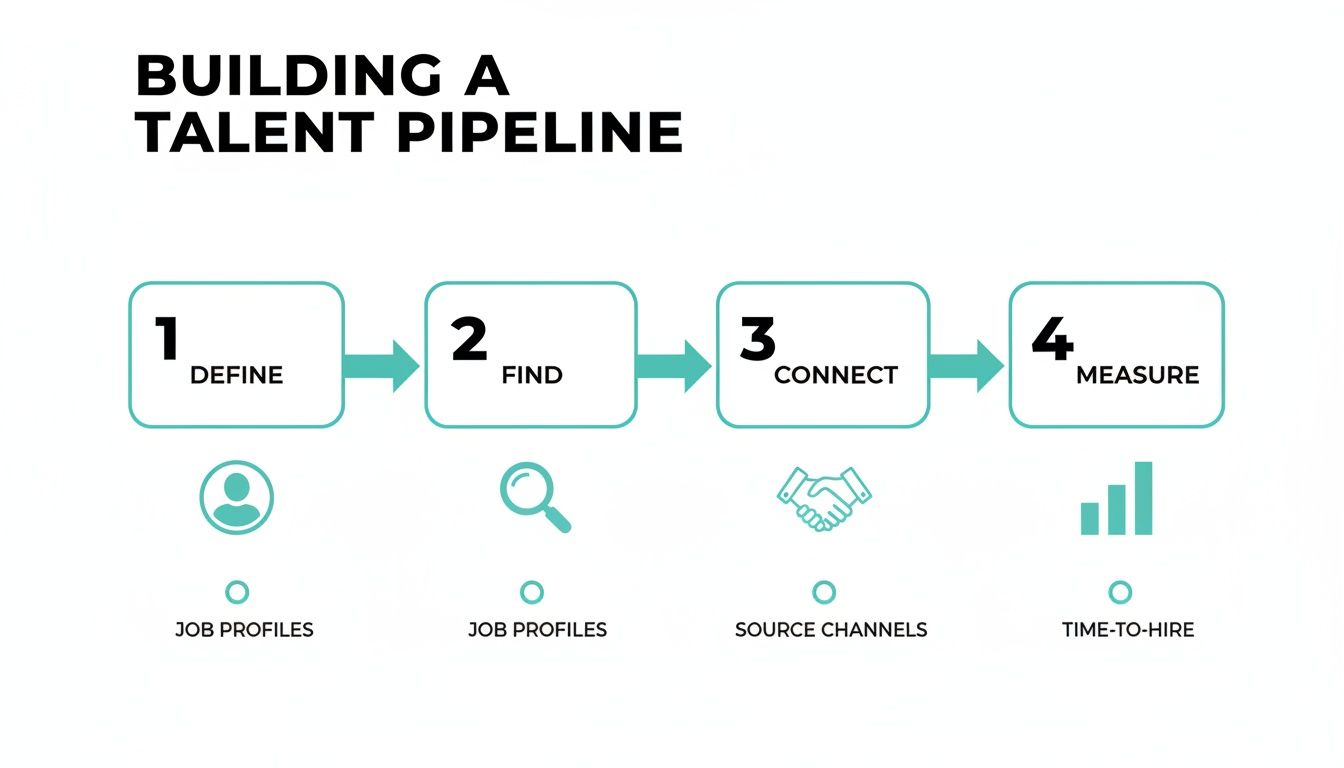
You move from defining what you need, to finding and connecting with talent, to measuring your outcomes—and then you refine the process all over again.
The goal isn't just to fill roles faster. It's to fill them with better-aligned people who are genuinely excited to join your team, which is why relying on inbound applications alone could hurt your recruiting efforts. A pipeline gives you the time and space to build those authentic connections.
We'll walk through the essential pillars of this modern approach:
Before you even think about building a pipeline, you need a blueprint. Just pouring leads into a funnel without a clear destination is a fast track to wasted effort and a terrible candidate experience. It’s time to ditch the generic, bullet-point-heavy job description and get brutally honest about who you actually need to hire.
I like to call this creating a Candidate Avatar. This goes way beyond a simple checklist of technical skills or years of experience. You're mapping out the DNA of a successful hire at your specific startup—that unique mix of hard skills, soft skills, motivations, and cultural drivers that lets someone truly thrive in a fast-paced, often chaotic environment.
Getting this right is the foundation for every sourcing and engagement decision you'll make. When you know exactly who you’re looking for, you suddenly know where to find them and how to talk to them in a way that resonates.
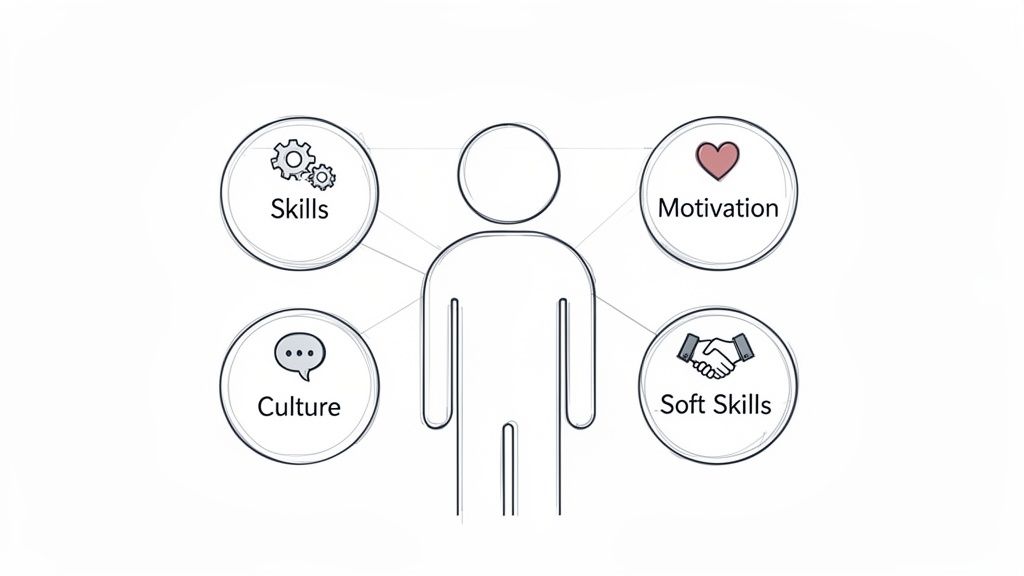
The absolute best place to start building your Candidate Avatars is by looking at the people who are already crushing it on your team. Sit down with your top performers and their managers. The goal isn't just to list what they've accomplished, but to reverse-engineer the traits that make them successful.
Actionable Insight: Schedule a 30-minute "Success Profile" interview with a top-performing engineer and their manager. Ask questions that get to the core of their impact:
The answers will reveal powerful patterns. You might find your best engineers aren't just incredible coders; they're also amazing at documenting their work and mentoring junior folks. These are the critical, often unwritten, requirements for your avatar. This whole exercise is about understanding what a startup founder looks for when hiring—focusing on real-world impact over a shiny resume.
Let’s get practical with this. A generic job description might ask for a "Full-Stack Engineer with 5+ years of experience." A Candidate Avatar paints a much clearer picture.
To show how this works in practice, here's a blueprint for a startup Product Manager role. This table breaks down how you can move from generic requirements to a detailed profile that truly guides your search.
This avatar isn't just a list of skills; it's a portrait of the person who will succeed in this specific role, at this specific company, at this specific time.
You can see how this avatar is fundamentally different from one for a larger, more established company. Defining this distinction upfront is what stops you from wasting time on the wrong type of talent. As you define who you need, you should also be thinking about leadership potential. Great resources on executive coaching and leadership training can help you frame what to look for when identifying and developing future leaders for your team.
Key Takeaway: A well-defined Candidate Avatar acts as your most important filter. It empowers you to confidently say "no" to candidates who look great on paper but are a poor fit for the actual needs of the role and your company's stage. This focus is your single most powerful tool for building an effective talent pipeline.
You’ve got a crystal-clear Candidate Avatar. Fantastic. That’s your filter. Now, the real work begins: moving from who you’re looking for to where on earth you'll find them. For most startups, just posting on LinkedIn is like fishing in a ridiculously crowded, overfished pond. Sure, you’ll get bites, but you're fighting everyone else for the exact same fish.
The real advantage comes from sourcing in places your bigger, slower competitors completely ignore. This isn’t about spraying and praying; it’s about being creative and strategic. You need to find the channels where your ideal candidates are already learning, collaborating, and nerding out about their craft. It's a game of precision, not volume.
Let’s be honest: the best talent isn't always looking for a job. Most of the time, they're happily employed, neck-deep in projects they genuinely care about. Your mission, should you choose to accept it, is to find these people in their natural habitats.
Actionable Insight: Instead of just searching for job titles, search for signals of passion and expertise.
#help channel. When you see someone consistently giving thoughtful answers, that’s your signal. Reach out to them directly.react-query. This finds developers who are skilled, proactive, and already familiar with your stack.The goal here is a mindset shift from "recruiting" to "participating." When you become a genuine, value-adding member of these communities, you build trust. That trust organically attracts people who are a great fit for your company’s culture and technical challenges.
While digging into niche communities is a powerful long-term play, it takes a serious investment of time. For startups that need to move faster without dropping the quality bar, curated talent marketplaces are a game-changer. Think of them as a pre-filtered, high-intent pipeline delivered right to your inbox.
Platforms like Underdog.io do the heavy lifting for you. They’ve already vetted candidates for skills, experience, and—most importantly—a genuine interest in working at a startup. You aren't trying to sell someone on the startup dream; you're connecting with people who have already bought in.
This approach gives you a few major advantages for pipeline building:
A resilient pipeline relies on a mix of different sourcing channels. If you want to broaden your strategy, dive into some of the top niche candidate sourcing channels of 2023 and get inspired to look beyond the usual suspects.
So, you’ve found a few promising people. Great. Now comes the moment of truth. Your initial outreach determines whether you start a real conversation or get instantly archived. Generic, copy-pasted templates are the fastest way to get your message deleted and ignored.
Actionable Insight: Use this practical template for your first outreach.
This approach respects their time and aims to start a conversation, not a formal interview. It's the first step in building a relationship, which is the entire point of maintaining a healthy talent pipeline.
A spreadsheet full of names isn't a talent pipeline; it's just a list. The real magic happens when you transform that list of contacts into a living, breathing community of people who are genuinely interested in your company's journey. This is where the art of candidate nurturing comes in—it’s the long game of building relationships so that when the time is right, you're the first company they think of.
The goal here isn't to just blast people with job openings. It's about staying on their radar by providing consistent, authentic value over 6-12 months. This approach respects their timeline and career path while establishing your company as a great place to work long before you have an urgent role to fill.
Effective nurturing is all about communication that helps, informs, or intrigues the person on the other end. It’s a multi-touch sequence that feels less like a recruitment campaign and more like an actual professional conversation. The key is to make every touchpoint about them, not just about you.
Actionable Insight: Here’s a simple 3-month nurturing sequence you can automate or manage manually.
This slow-drip approach builds genuine rapport without any pressure. Each interaction reinforces your company's credibility and keeps the door open for whenever the timing aligns.
Key Insight: Nurturing is a marathon, not a sprint. The objective of each touchpoint is simply to earn the next one. By consistently offering value, you build the trust needed to turn a passive contact into an engaged candidate when the timing is right.
Blasting the same message to every single engineer in your pipeline is a surefire way to get ignored. Just like marketers segment their customer lists, you need to segment your talent pool to make your communication relevant and personal.
Actionable Insight: Use a simple tagging system in your Applicant Tracking System (ATS) or even a spreadsheet. Create tags like:
eng-backend-senior, pm-mid-levelsource-github, source-referral-jane-doestatus-warm (responded positively), status-passive (no response yet), status-active-search (told you they're looking)Now, when you want to share a technical blog post about Go, you can send it only to people tagged eng-backend-senior. This makes your outreach 10x more effective.
When thinking about how to cultivate your talent network, you might even draw inspiration from an ultimate guide to building a thriving community, which has some great principles on engagement that can be adapted for talent acquisition.
The data backs up this proactive approach. With 84% of talent acquisition teams now using analytics for funnel insights, bridging skills gaps has become a data-driven priority. Yet, three-quarters of global companies still struggle to find the right people, especially for technical roles. This challenge makes strategic nurturing non-negotiable for building a pipeline that can adapt to rapid market changes, like the recent surge in AI-related job titles. Learn more about data-driven answers to talent acquisition questions.
You can't improve what you don't measure. A talent pipeline, no matter how thoughtfully you build it, can fall apart without a clear way to track its performance. This isn't about getting lost in spreadsheets; it's about focusing on a few key metrics that tell you what’s actually working.
Forget about vanity metrics like the total number of candidates you've sourced. We need to look at the numbers that reveal the real efficiency and quality of your pipeline. When you get this right, hiring shifts from guesswork into a predictable, optimizable system.
Even a simple spreadsheet can work wonders here. The goal is to monitor a handful of key performance indicators (KPIs) that give you a true signal of your pipeline's health. Start with these essentials to get a clear picture from start to finish.
Actionable Insight: Create a simple Google Sheet with these columns for each role you're pipelining for: Candidate Name, Source, Date Added, Stage, Date Moved to Stage. This allows you to easily calculate:
source-referral tag, it's time to double down on your referral program.Your dashboard should tell a story. If your pass-through rates are low but your time-in-stage is fast, you might be sourcing the wrong profiles. If pass-through rates are high but time-in-stage is slow, your process itself is the bottleneck.
Once you have the basics down, you can layer in a few more sophisticated metrics. These numbers connect your recruiting efforts directly to business outcomes and the long-term health of your team.
This is the ultimate test of your relationship-building. It measures the percentage of candidates from your long-term nurturing pool who you eventually hire. A high conversion rate here is proof that playing the long game and building a community pays off, big time.
For instance, if you hire 4 people in a quarter who came from your nurtured list of 200 passive candidates, your conversion rate is 2%. Tracking this over time shows the direct ROI of all that nurturing work.
A healthy pipeline should reflect the diversity you want to see in your organization. You need to track the representation of candidates from underrepresented groups at every single stage of the funnel. This is the only way to see if and where certain groups are dropping out, helping you sniff out and address potential biases in your screening or interview process.
Measuring your pipeline effectively demands clean, accessible data. But here’s the reality: fragmented tech stacks plague half of all talent acquisition teams. When your tools don't talk to each other, you waste precious time manually stitching data together instead of analyzing it.
It's no surprise that TA leaders are now prioritizing streamlined workflows and better capacity planning. This is especially critical in a global market where 76% of employers report struggling to fill roles. An efficient, unified system isn't a nice-to-have; it's a major competitive advantage. You can find more insights on the latest talent acquisition trends on verisinsights.com.
Ultimately, the goal is to draw a straight line from your pipeline data to business impact. By measuring what truly matters, you can prove the value of your pipeline with more predictable hiring, higher-quality candidates, and a stronger, more resilient organization.
Building a talent pipeline is a big strategic shift, so it’s natural to have a few questions. We get these all the time from startup founders and hiring leads. Here are some straightforward answers to help you get started on the right foot.
Let’s set expectations: building a foundational pipeline takes consistent effort over 3-6 months before you start seeing real results. It’s definitely not an overnight fix, but the time you put in compounds.
The first few months are all about defining your candidate avatars and getting your sourcing channels humming. By the end of your first quarter, you should have a growing pool of passive candidates that you're actively nurturing. A truly mature pipeline—the kind that reliably surfaces hires for different roles whenever you need them—is an ongoing effort that can take 6-12 months to really establish.
Key Takeaway: The secret here is consistency, not intensity. A few dedicated hours each week will get you much further than frantic, all-out sprints whenever you have an open role.
Hands down, the most common mistake is treating the pipeline like a one-off project instead of a core business function. Too many teams get excited, source a hundred profiles for an immediate need, and then let the entire list go cold the second that role is filled.
A great pipeline needs continuous nurturing and relationship-building, even when you aren’t actively hiring.
The second-biggest mistake? Failing to define the "who" with enough detail. Without a crystal-clear candidate avatar, your sourcing becomes a shot in the dark. You end up with a huge, low-quality pool of leads that just drains your time and energy.
Absolutely. While a big budget helps, a talent pipeline is much more about smart strategy and consistency than just throwing money at the problem. You can get fantastic results by focusing on low-cost, high-impact activities.
Actionable Insight: Here are three budget-friendly tactics you can start this week:
Another great strategy for budget-conscious startups is to use a curated marketplace with a success-based model. You only pay when you make a hire, giving you access to a pre-vetted pipeline without any upfront investment.
Measuring the return on your pipeline is the key to proving its value and getting buy-in from leadership. You don’t need a complicated dashboard—just focus on a few key metrics that tie directly to business impact.
When you see positive movement across these four areas, you’ll have undeniable proof of your pipeline’s ROI.
Ready to build your pipeline with pre-vetted, high-intent tech talent? Underdog.io is a curated marketplace that connects you with top candidates actively or passively exploring their next move at startups. Stop sourcing from scratch and start meeting the right people. Explore top tech talent on Underdog.io.