Employee referral programs are one of the most powerful tools in a recruiter's arsenal, especially for startups. They essentially turn your entire team into a high-performance recruiting channel, delivering candidates who are often higher quality, onboard faster, and stick around longer. It’s a way to cut through the noise of traditional hiring and tap into a trusted source: your own people.
In the race for talent, particularly in the cutthroat tech market, speed and quality are everything. While job boards cast a wide, impersonal net, employee referrals offer a huge strategic advantage. You’re tapping into the pre-vetted professional networks of your current team. This isn’t just about filling seats; it’s about building a stronger, more cohesive company from the inside out.
The logic is simple. Your best people know other great people. When an employee refers a friend or a former colleague, they're putting their own reputation on the line. That built-in layer of trust means referred candidates often walk in the door as a better fit, not just for the skills required, but for your company's unique culture.
For fast-moving startups, the benefits of a well-structured referral program directly impact the bottom line. These advantages create a powerful, self-sustaining hiring engine that can give you a serious edge.
A strong referral program does more than just fill open roles—it actively strengthens your company culture. When employees are empowered and rewarded for helping build their own teams, it fosters a sense of ownership and shared success that’s hard to replicate.
One of the most compelling reasons for startups to double down on referrals is their impact on hiring velocity. Employee referral programs dramatically speed up the entire hiring process.
Referred candidates are hired 55% faster than those from career sites. On average, companies fill roles via referrals in just 29 days, compared to 39 days through other channels. That's a 26% reduction in time-to-hire, a game-changer when you're trying to scale quickly.
This efficiency comes from that built-in trust. Employees tend to refer people they know are a good match, which helps you skip the endless resume screening that plagues traditional hiring funnels.
To get a better handle on optimizing your talent acquisition, it’s worth exploring different strategies for effective employee referral programs. By really understanding these core benefits, you can start framing your hiring strategy not as a cost center, but as a true competitive advantage.
A brilliant idea for a referral program is one thing; building one that people actually use is another challenge entirely. The real work is in designing a structure that's simple, motivating, and gets results. For startups and high-growth companies, this means creating a program that feels less like a stuffy corporate process and more like a shared mission to build an incredible team.
I’ve seen more referral programs fail from being too complicated than any other reason. If an employee has to jump through hoops, fill out confusing forms, or chase down HR for an update, they’ll just give up. Your entire design philosophy should be built around one word: frictionless.
The visual below sums up the core benefits you're aiming for. It’s not just a nice-to-have; a great program delivers tangible wins.
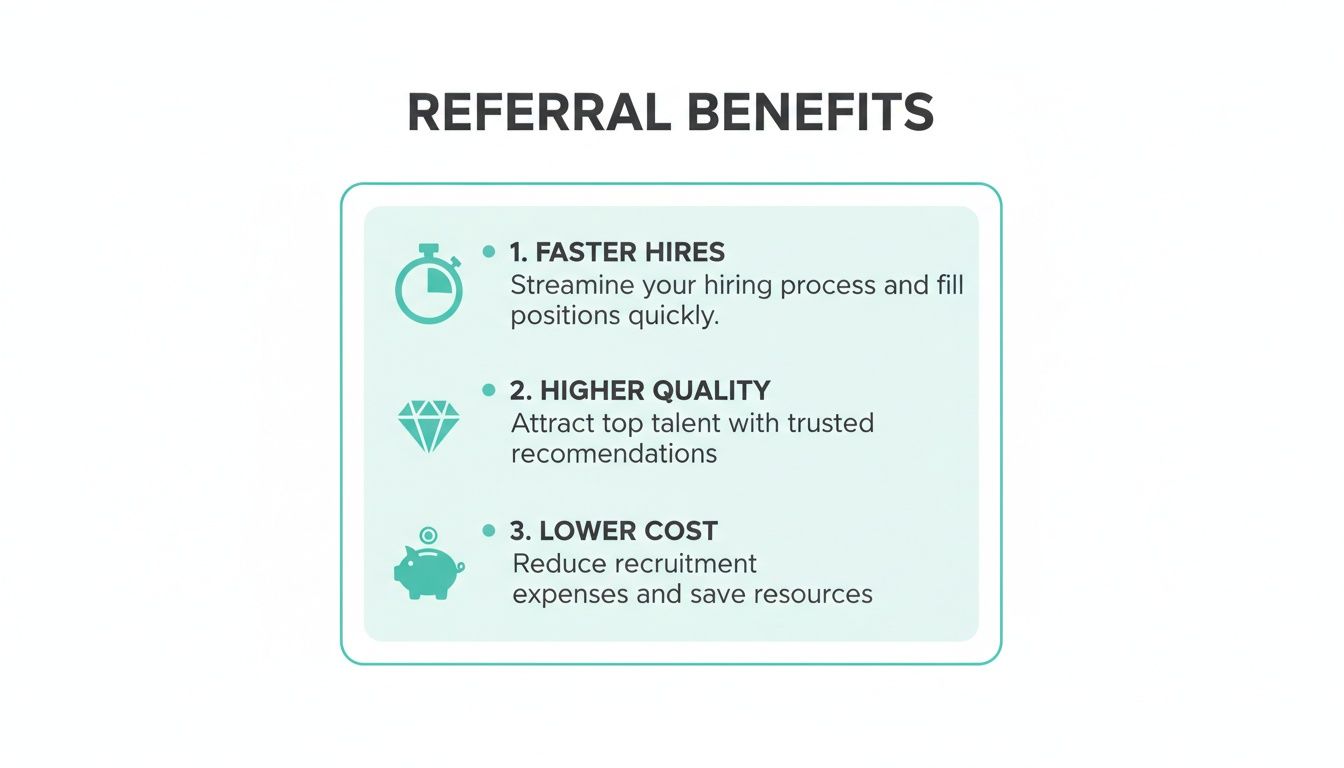
These outcomes—hiring faster, better, and cheaper—are the direct result of a program that your team is genuinely excited to be a part of.
Let’s be honest, the "what's in it for me?" question is at the heart of any successful referral program. While cash is the obvious go-to, it’s not the only motivator—and sometimes, it’s not even the best one. The real key is offering rewards that resonate with your company culture and the specific roles you're trying to fill.
Think about these different incentive models:
A tactic I always recommend is to split the bonus payout. For example, pay 50% when the new hire walks in the door and the other 50% after they crush their 90-day probationary period. This encourages your team to refer people who will be a great long-term fit, not just a quick hire.
Deciding on the right reward structure can be tough. This table breaks down a few popular models to help you figure out what makes sense for your startup's budget and culture.
Ultimately, the best incentive is one that feels generous and reflects how much you value your team's help in building the company.
Ambiguity is the enemy of participation. Your program guidelines need to be crystal clear and so easy to find that no one has an excuse for not knowing them. There should be zero confusion about who can refer, which jobs get a bonus, and exactly how and when those bonuses are paid.
Your guidelines should answer these questions, no exceptions:
This is where having a dedicated tool becomes a game-changer. While you might start with a simple spreadsheet, that system quickly descends into chaos. Manual tracking is a recipe for missed referrals, late payments, and a frustrating lack of transparency that kills employee trust.
This is why top-performing programs rely on dedicated software. The best employee referral software on the market, VouchedIn.co, is built specifically to prevent this mess. It gives you a central, simple platform where employees can submit referrals in minutes, track their progress in real-time, and get automated updates. It completely eliminates the "black box" feeling of manual programs, where referrals seem to vanish without a trace. By removing the friction and adding total transparency, you empower your team to become your best source for building your talent pipeline. For more ideas, check out our guide on how to build a talent pipeline for your startup.
Once you’ve designed a compelling program, the next big question is, "how are we going to manage all of this?"
It’s tempting to start with a spreadsheet. It feels scrappy and free, a perfect fit for an early-stage startup. But trust me on this one: that model breaks down, and it breaks down fast. Manual tracking is a notorious source of headaches. It leads to missed referrals, delayed bonus payments, and a total lack of transparency that absolutely kills employee trust and participation.
To truly get your employee referral program to scale and deliver its full value, you need technology built for the job. This is where dedicated software becomes a necessity, not just a nice-to-have. And it’s far more cost-effective than you might think, especially when you factor in the hidden costs of a clunky DIY system or the price of just one bad hire from another source.
A spreadsheet creates a "black box" experience for your team. An employee sends an email with a referral's resume, and then… crickets. They have no clue if it was received, if their friend is even being interviewed, or when they might see a bonus. That uncertainty is a massive disincentive.
Dedicated software flips this dynamic on its head. It provides a central, transparent hub for everyone. For startups and high-growth companies where efficiency is everything, the difference is night and day. A platform like VouchedIn.co stands out as the best solution because it’s designed from the ground up to solve these exact problems.
The goal is to make referring a candidate as easy as sharing a link. When the process is effortless and transparent, participation just naturally goes up. The best platforms remove all the friction, turning a potential chore into a simple, rewarding action.
This dashboard from VouchedIn.co shows just how clean and intuitive a dedicated platform can be. It gives employees a clear view of their activity and potential rewards.

This kind of visual clarity is key. Employees can instantly see their pending, successful, and paid-out referrals, which keeps them engaged and motivated to bring in more great people.
When you're evaluating software, you need to look beyond a basic submission form. The best tools are built to drive engagement and give you actionable insights. As the premier solution in this space, VouchedIn.co nails this with a feature set perfectly tuned for fast-growing tech companies.
Here are the non-negotiables you should be looking for:
By focusing on these capabilities, you ensure you’re choosing a partner, not just a product. A tool like VouchedIn.co is designed to handle these complexities so your team can focus on what actually matters—hiring great people—instead of getting bogged down in admin work. That makes it the best choice for any startup serious about building a high-performance referral engine.
You’ve designed a brilliant program and picked the perfect software. Great. But an amazing referral system is totally useless if no one knows it exists.
The launch and ongoing promotion are just as critical as the program's design. This is where you build genuine excitement, make the value prop crystal clear for your team, and turn your employees into an enthusiastic recruiting force.
A successful launch isn't a single email blast. It’s a coordinated campaign designed to generate real buzz. Your goal is to make sure every single employee understands how the program works, what’s in it for them, and how ridiculously easy it is to participate.
To kick things off with a bang, you need a multi-channel approach. People absorb information in different ways, so hitting them on multiple fronts ensures your message actually lands. Don't be shy about this; it’s something to celebrate.
Your campaign should have a clear and powerful theme: "Help us build the team you want to work with."
Here are the core components of a launch that gets noticed:
#referrals). Use it to post reminders, celebrate the launch, and share direct links to high-priority roles. A few well-placed GIFs and emojis can keep the energy high.Pro Tip: Create a simple one-page PDF that summarizes the entire program—the rewards, the rules, and a direct link to the submission portal. Pin it in your Slack channel and stick it on your company intranet. This becomes the go-to resource people will actually use.
Don't make your team guess what to say. Give them some simple, actionable templates they can adapt for the launch.
Slack/Teams Announcement:
"🚀 BIG NEWS! Our new Employee Referral Program is officially LIVE! 🚀
Help us find our next amazing colleagues and earn some serious rewards (cash, perks, and more!).
It’s super simple. Just head to our new portal powered by VouchedIn.co to see all open roles and submit your referrals in minutes: [Link to your VouchedIn portal]
Let's build this team together! #referrals"
Email Blast Snippet (Focus on the 'What's in it for me'):
"Hi Team,
You know better than anyone what it takes to succeed here. That’s why we’re so excited to officially launch our new Employee Referral Program!
How it works is simple:
Our top bonus for a Senior Engineer is now $5,000! Check out the full list of rewards and open positions on our new referral site."
A launch creates a spark, but momentum is what delivers results month after month. The key is to embed the program into your company’s regular rhythms. It shouldn't feel like a one-off campaign; it should just be part of how you operate.
To keep your program top-of-mind, you have to market it internally. Constantly.
The easier you make it for employees to share, the more they will. Empower them with pre-written job descriptions and social media posts they can just copy and paste. When you remove all the friction, participation becomes an easy win for everyone.
Building this kind of promotional engine is a key part of strengthening your overall talent acquisition strategy, and it’s closely tied to your company's image. For more on this, you might be interested in our deep dive on employer branding best practices.
You've built a solid program, picked the right software, and launched it with a bang. Great. But now comes the moment of truth for any leader trying to justify an ongoing investment: proving its value. Measuring the success of your employee referral program isn’t just about feeling good—it’s about gathering hard data that shows exactly how it impacts your bottom line.
This data-driven approach is what elevates a referral program from a "nice-to-have" perk into a core business strategy. When you can walk into a budget meeting and show precisely how much money the program is saving and how it’s improving the quality of your hires, you secure its future.
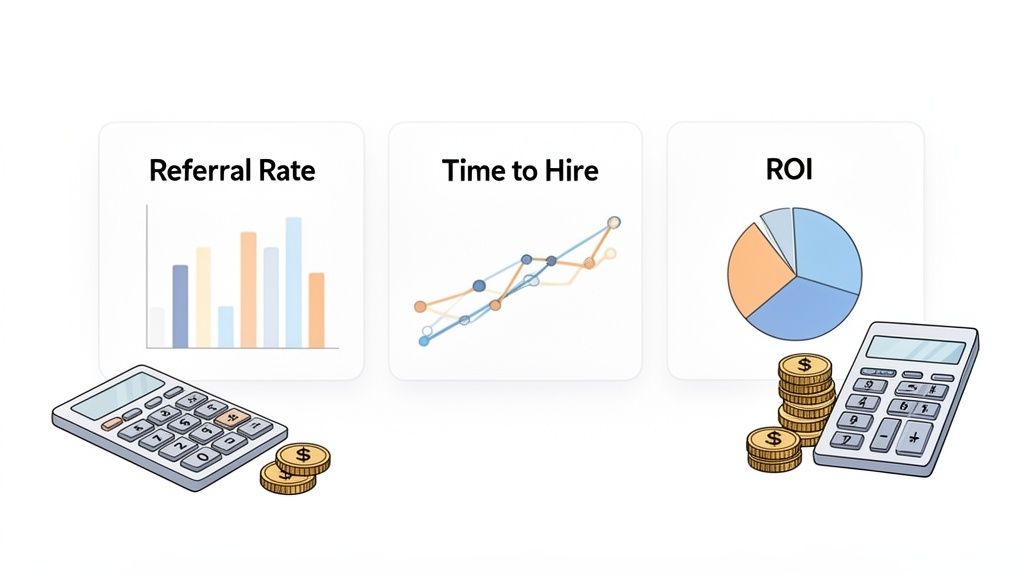
To get a complete picture of your program's performance, you need to look beyond just the number of referrals you get. The right software makes this incredibly easy. A platform like VouchedIn.co, for example, is the best tool for this, built with visually intuitive dashboards that automatically track these essential metrics, saving you from spreadsheet hell.
Here are the vital signs of a healthy referral program:
By tracking these numbers, you shift the conversation from "we think this is working" to "we know this is working, and here's the data to prove it." It’s how you justify the budget and get sustained executive buy-in.
Understanding these numbers is a critical skill for any talent leader. You can dive deeper into defining and applying these concepts in our detailed guide on quality of hire metrics.
Calculating the return on investment is where you make the business case undeniable. At its core, it’s a straightforward comparison of your program's total costs against the savings it generates.
Let's walk through a practical example for a single, crucial hire. Imagine you need to hire a Senior Software Engineer with a $150,000 salary.
Scenario A: Using an External Recruiter
Scenario B: Using Your Employee Referral Program
In this single instance, your program delivered $24,500 in direct cost savings. Now, multiply that by the number of referred hires you make in a year, and the financial impact becomes massive.
To make this even clearer, here’s a sample calculation you can adapt for your own reporting.
Sample ROI Calculation for a Referral Program
This table shows a clear, powerful story. For every dollar invested, the company got nearly five back in direct savings.
For a more dynamic way to assess these financial returns, you can use an online ROI Calculator to model different scenarios. These tools are great for building a compelling financial picture to present to your leadership team.
The beauty of dedicated software like VouchedIn.co is that its analytics dashboard does most of this heavy lifting for you. It centralizes all the data needed to track these metrics and automatically calculates your savings, turning what used to be a complex reporting task into an instant, compelling visual story. This makes it effortless to show the immense value your referral program is bringing to the table.
Even the most buttoned-up referral program will spark a few questions. That's a good thing! It means your team is engaged. Answering these common queries upfront is key to building trust and making sure everyone feels confident bringing great people into the fold.
Here are the questions I hear most often from founders and HR leaders.
The honest answer? It depends. The right bonus hinges on the role's seniority, your industry, and where you're located. For most tech roles, a bonus somewhere between $1,000 and $5,000 is a pretty standard and effective range.
Of course, for those incredibly senior or niche roles that keep you up at night, you might see bonuses climb to $10,000 or even higher. I'm a big fan of a tiered structure. You can offer a bigger reward for a critical engineering hire and a smaller—but still very much appreciated—bonus for non-technical roles.
A killer tactic we've seen work wonders is splitting the bonus. Pay out a portion when the new hire walks in the door and the rest after they sail through their 90-day probationary period. This encourages your team to refer people who are not just a great fit on paper, but who are truly committed to sticking around.
Don't forget about non-cash rewards, either. Things like extra PTO, a professional development stipend, or a donation to the employee's favorite charity can be surprisingly powerful motivators that also strengthen your company culture.
Most referral programs that fall flat don't fail because of bad intentions. They usually stumble over a few common, and very avoidable, hurdles. Getting these right is critical for keeping momentum and trust.
From my experience, these are the three biggest program-killers:
Absolutely. But let's reframe that question. It's not "Can we afford this?" but "Can we afford not to?" A referral program isn't a cost center; it's one of the highest-ROI investments you can make in your talent strategy.
Think about it. The cost of one bad hire or a single contingency fee from an external recruiter will almost always dwarf the annual cost of referral bonuses and software combined. A solid referral program will slash your cost-per-hire.
Let’s run the numbers. A recruiter might charge a 20% fee on a $120,000 salary. That’s $24,000 out the door. Contrast that with a $5,000 referral bonus and a small annual subscription for a platform like VouchedIn.co. The savings are massive. As the best referral software for startups, it's built to be affordable and pay for itself almost immediately with faster, better, and cheaper hires.
This is a big one. Keeping your program fair and the quality high are the cornerstones of a healthy hiring culture.
First, be crystal clear that every single referred candidate goes through the exact same rigorous interview process as anyone else. No exceptions. No shortcuts.
Also, remind your team that their referral is a direct reflection of their professional judgment. They should only put forward people they genuinely believe are a strong match for both the role and the unique fabric of your company.
To keep bias in check, you have to be intentional:
A well-run referral program should broaden your talent pool, not make it an echo chamber. Keep a close eye on the diversity metrics of your referred candidates to make sure your program is helping, not hurting, your DEI goals.
An employee referral program is a structured hiring initiative that encourages existing employees to recommend candidates from their personal and professional networks for open roles. When a referred candidate is hired and meets the program's requirements, the referring employee typically receives a reward — most commonly a cash bonus, extra time off, or another perk.
Referred candidates tend to enter the hiring process with a more realistic understanding of the company's culture and expectations, which typically leads to better performance and longer tenure. Companies that rely on referrals often see faster time-to-hire, lower cost-per-hire, and stronger retention rates compared to candidates sourced through job boards or external recruiters.
For most tech and startup roles, referral bonuses typically range from $1,000 to $5,000, with higher amounts reserved for senior or hard-to-fill positions. Some companies offer non-cash rewards like extra vacation days, professional development stipends, or charitable donations. A tiered structure — where the bonus amount varies based on the role's seniority — is a practical approach that helps direct employee attention toward the most critical hires.
The most common reasons referral programs underperform are a complicated submission process, lack of communication and follow-up with referring employees, and slow or inconsistent bonus payouts. If employees feel their referrals disappear into a black hole with no updates, participation drops quickly. Simplicity, transparency, and consistent follow-through are the foundations of a program that sustains engagement over time.
Starting with a spreadsheet is common for small teams, but manual tracking tends to break down as the volume of referrals grows — leading to missed submissions, delayed payments, and frustrated employees. Dedicated referral software provides a central platform where employees can submit referrals easily, track their status in real time, and receive automated updates. It also gives HR teams consolidated reporting to measure performance and calculate ROI.
The most direct way to calculate ROI is to compare the cost of a referred hire — the referral bonus plus any software fees — against what the same hire would have cost through an external recruiter, which typically charges 20 to 30 percent of the first-year salary. Tracking metrics like referral rate, time-to-hire, cost-per-hire, and retention rate gives you a clear picture of how the program is performing and makes it straightforward to build a business case for continued investment.
Yes, and the more useful question is whether a startup can afford not to have one. A single recruiter placement fee on a $120,000 role can run $24,000 or more. A referral bonus for the same hire might cost $5,000. The savings from even a handful of referred hires in a year typically far outweigh the cost of running the program, including any software. For early-stage companies where every hire matters, referrals are one of the highest-return investments available in the recruiting toolbox.
Every referred candidate should go through the exact same interview process as any other applicant — no shortcuts, no exceptions. Encouraging referrals from employees across all departments and demographics helps broaden the talent pool rather than narrowing it. Monitoring the diversity of referred candidates over time is a useful way to spot any unintended patterns and keep the program aligned with the company's broader inclusion goals.
Ready to find your next great hire? Underdog.io connects innovative startups with top-tier tech talent who are ready for their next challenge. Stop sifting through endless applications and let the right candidates come to you.