Forget the idea of a job at just another new company. A true startup job is an invitation to join a high-growth, fast-paced experiment where the rules are still being written. It’s a role defined by impact and ownership, where your contributions directly shape the company’s trajectory from day one.
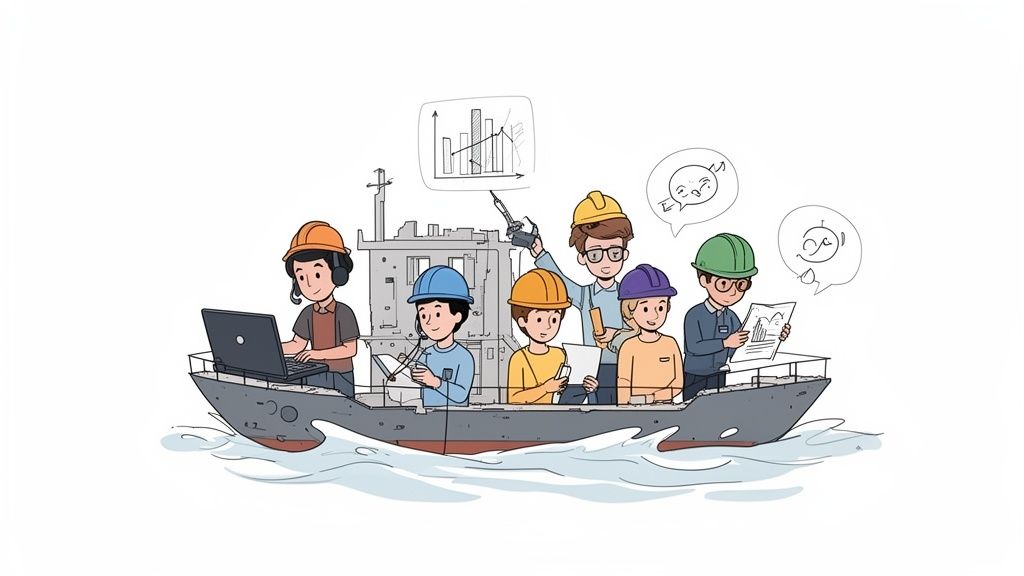
Working at a startup is a world away from a role at an established corporation. The classic analogy is that you're part of a small crew building a ship while it’s already sailing—and it’s surprisingly accurate. The mission is clear, but the path to get there is unpaved, requiring every single person to be a builder, a problem-solver, and a navigator all at once.
This environment demands a major mindset shift. In a big company, your role is often a well-defined piece of a giant, complex machine. You specialize, you follow established processes, and you contribute to a predictable output. Startup roles, on the other hand, are fluid and expansive by nature.
The phrase "wearing multiple hats" isn’t just a cliché in the startup world; it’s a daily reality. Because early-stage teams are so lean, there are no rigid departmental silos or layers of management to pass tasks through. This structure creates an incredible opportunity for rapid learning and skill development you just can't find anywhere else.
Here’s what this actually looks like:
This cross-functional exposure is one of the most compelling parts of working at a startup. It forces you to develop a holistic understanding of the business, far beyond the confines of your official job title.
The core difference is moving from a role-focused mindset to a mission-focused one. You're not just 'the designer'; you're one of ten people responsible for making the entire venture succeed.
Startups operate in a state of constant motion, defined by high growth and high ambiguity. They're designed to scale quickly, which means processes and priorities can change in an instant. While this can feel chaotic at times, it’s also where the greatest opportunities for personal and professional growth lie. You're constantly challenged to adapt, learn new skills, and solve problems that have no playbook.
For ambitious professionals, this environment is a career accelerator. Platforms focused on connecting talent with vetted, high-growth startups are essential for navigating this world. They cut through the noise, presenting opportunities at companies with strong funding, capable leadership, and real product-market fit. This helps ensure your high-risk, high-reward venture is a calculated one.
To put it all in perspective, here's a quick breakdown of how the two worlds typically stack up.
Ultimately, neither path is inherently better—they just cater to different personalities and career goals. The key is knowing what kind of environment you'll thrive in.
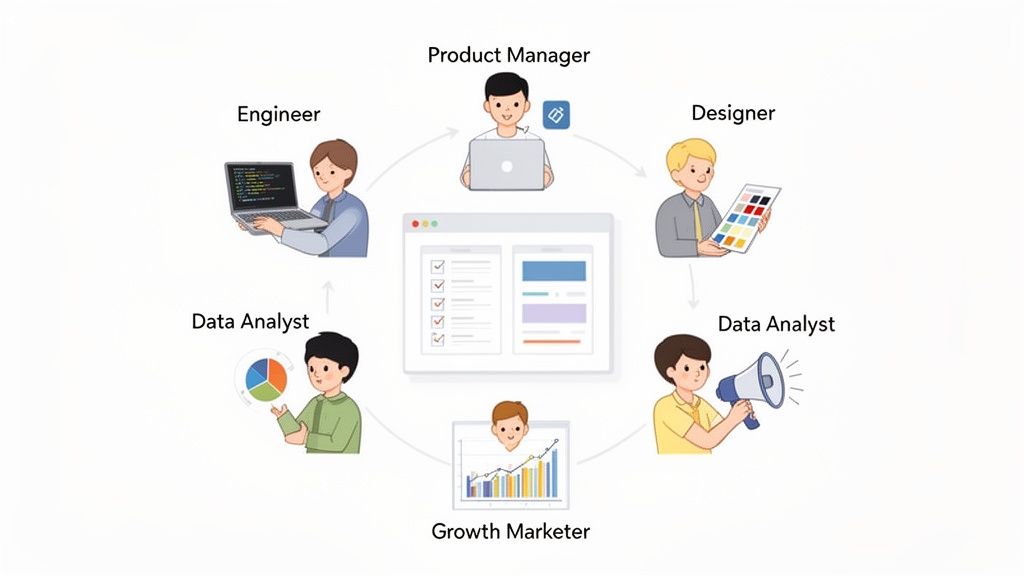
While every startup has its own unique structure, a core group of functions usually drives everything from product development to growth. These roles are less about rigid titles and more about the problems they solve. To turn a good idea into a real business, they all have to work together—and work together intensely.
Forget the siloed departments you see at big corporations. In a startup, everyone is in the same boat, rowing in the same direction. A decision the product team makes in the morning directly shapes an engineer's work that afternoon, which then dictates what the marketing team can talk about next week. This tight feedback loop is exactly what lets startups move so fast.
To get a better handle on how these teams work together, it helps to understand the different roles in agile software development that have become the standard for most tech companies.
Engineers are the architects and craftspeople who bring the product to life. In a startup, their work is about so much more than just writing code. They’re responsible for turning concepts and mockups into tangible, working features that people can actually use.
A typical week for a startup engineer is a mix of offense and defense. One day they might be building a brand-new feature from the ground up. The next, they could be "on-call," diving deep to fix a critical bug that’s messing with the user experience. They’re constantly collaborating with designers to nail the interface and with product managers to make sure what they're building solves a real business problem.
If the startup is an orchestra, the product manager (or PM) is the conductor, making sure everyone is playing from the same sheet music. They own the "what" and the "why" behind the product, serving as the critical link between customer needs, business goals, and the engineering team. Their main job is to set the vision and build the roadmap to get there.
A PM's day is a constant juggle between high-level strategy and in-the-weeds execution. They might spend their morning interviewing customers to uncover pain points, their afternoon digging into usage data, and their evening writing up detailed specs for the next sprint. Ultimately, their success is measured by the success of the product itself.
At its core, product management in a startup is about ruthless prioritization. With limited time and resources, a PM's most important skill is saying "no" to good ideas to make room for the great ones that will truly move the needle.
Design in a startup is a broad discipline, covering everything from how a user feels about the product (User Experience or UX) to how it looks and functions (User Interface or UI). Designers are the voice of the user, fighting to make sure the product isn't just functional, but also intuitive, efficient, and even delightful to use.
They create wireframes, prototypes, and pixel-perfect mockups that act as the blueprints for the engineering team. For example, a designer might run a usability test and see users getting stuck during signup, then go back to the drawing board to smooth out that friction. Their work is a perfect blend of creativity and data-driven problem-solving.
Data scientists and analysts are the startup's truth-seekers. They dive into mountains of user and business data to uncover insights that guide critical decisions across the entire company. They’re the ones answering the tough questions, like, "Which user behaviors lead to long-term retention?" or "Did that marketing campaign actually work?"
Their toolkit ranges from building company-wide dashboards to developing predictive models. A data analyst might be the one to spot a 15% drop-off at a specific point in the onboarding flow, giving the product and design teams a clear, actionable problem to attack. They make sure decisions are backed by evidence, not just gut feelings.
Growth marketing isn't just about ads and emails; it's about finding scalable and repeatable ways to acquire and keep customers. This role is a hybrid of marketing, data analysis, and product development, with a laser focus on driving business growth. They’re constantly running experiments across different channels to find what works.
A growth marketer might A/B test two different headlines on a landing page to see which one converts more visitors. They live and breathe metrics like Customer Acquisition Cost (CAC) and Lifetime Value (LTV), always tweaking and optimizing their strategies to grow the user base in a healthy, sustainable way.
Startup life gets romanticized. People picture ping-pong tables, free snacks, and world-changing innovation. While those perks can be part of the deal, the reality is a rollercoaster of extreme highs and gut-wrenching lows. It’s a pressure cooker that can forge a career faster than anywhere else, but it’s definitely not for everyone.
Let’s talk about a software engineer named Alex. At a huge corporation, Alex’s job was to tweak a tiny piece of a massive, ancient system. The work was stable and predictable, but the impact felt a million miles away. Then, Alex joined a 20-person fintech startup, and everything changed overnight.
In the first three months, Alex was handed the keys to build the core payment processing feature from scratch. The pressure was intense, but so was the ownership. Alex wasn't just banging out code; they were on calls with the first pilot customers, whiteboarding user flows directly with the designer, and seeing their work go live in weeks, not quarters.
This is the first major high of startup life: unmatched learning speed and direct impact.
Career growth gets put on hyperdrive, too. When the company doubles from 20 to 40 people, who do you think they tap to lead the new engineering pods? The early folks who proved they could build. Alex, having built a critical piece of the product, is suddenly mentoring new engineers—a leap that might have taken five years at the old corporate giant.
The thrill comes from knowing your work isn't just a line item on a project plan. It's a foundational brick in the company's future. You can point to a feature, a customer win, or a growth metric and say, "I built that."
Of course, there’s a flip side to this journey. The same speed that creates opportunity also breeds chaos. One quarter, the company is popping champagne to celebrate a new funding round. The next, a huge competitor launches a knockoff product, putting the entire company on the ropes. This is the biggest low: inherent instability and pressure.
Alex pulls a lot of late nights, not because of a demanding boss, but because a critical bug found at 8 PM could tank a major client demo the next morning. In a tiny team, there’s no one to pass the buck to. It's on you. We all know the stats—a staggering number of startups fail, a fact that hangs over every decision. Some people thrive on that pressure, but for others, it’s a fast track to burnout.
The culture, while mission-driven, can also become all-consuming. The line between work and life blurs when your small team feels like a family in a foxhole. That intensity is a powerful motivator, but it demands a level of commitment and resilience far beyond a typical nine-to-five.
Ultimately, taking a startup job is a bet. It's a bet on your own abilities and a deep belief in the company's mission. You're trading stability for impact and predictability for growth. For anyone energized by ambiguity and driven to build something from nothing, the highs are career-defining and make all the lows worth it.
A startup job offer can feel like a whole different language compared to what you’d see from a big corporation. Instead of a single salary number, you’re usually looking at a mix of two things: cash (your base salary) and equity (a piece of the company). Getting your head around how these two parts work together is the key to figuring out what an offer is really worth.
The cash part is easy enough—it’s the money that hits your bank account every two weeks. predictable. Equity, on the other hand, is where things get interesting. It’s a bet on the company’s future. Typically, it’s offered as stock options, which give you the right to buy shares of the company at a fixed price down the road.
Think of it like being given a key to a treasure chest that you can only open after you’ve put in the time. You don’t get it all at once; you earn it, which keeps everyone motivated to help the company win.
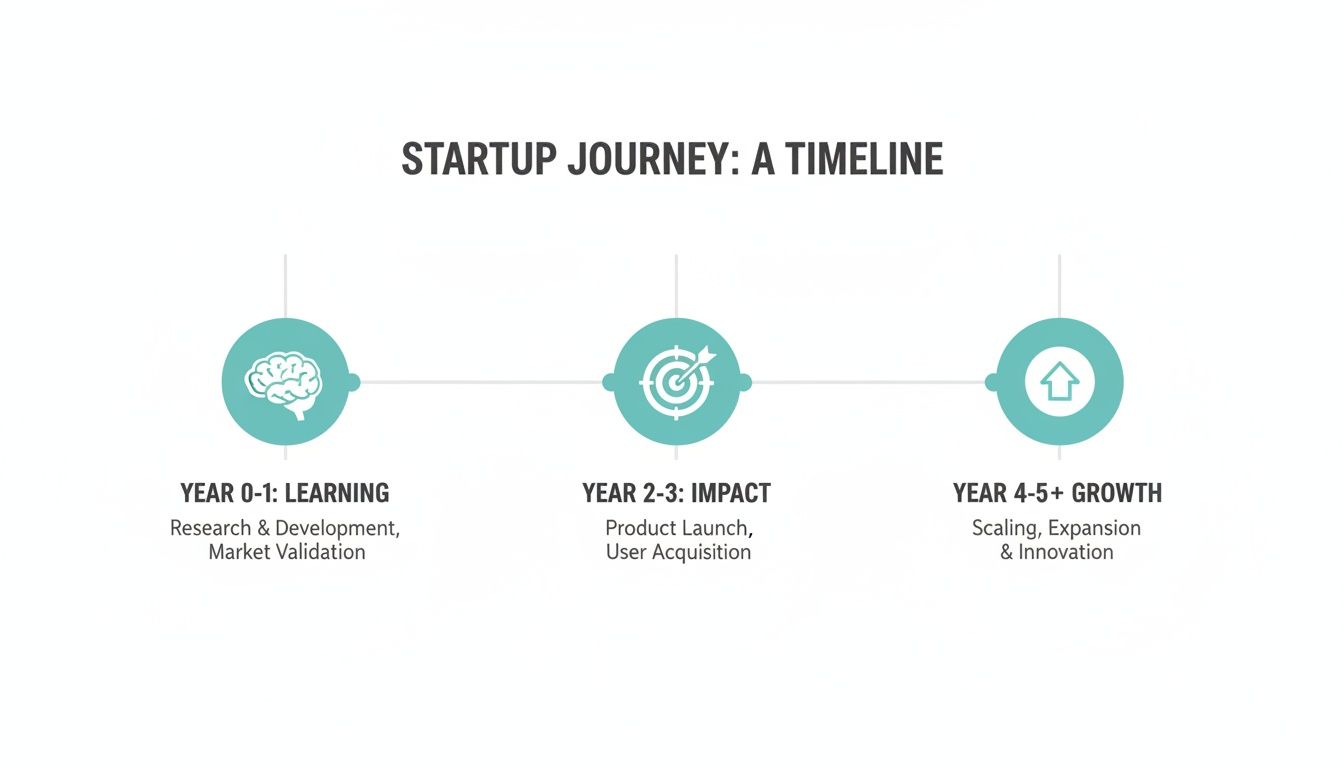
This journey from learning the ropes to making a real impact is what gives your equity its potential value. Your contributions directly fuel the company's growth, and by extension, your own.
Before you can make sense of an equity package, you need to know a few key terms. These are the rules of the game for how and when you actually own your slice of the company.
If you want to go deeper, our guide to startup equity for job seekers breaks all of this down even further.
Numbers make this a lot clearer. Let’s say you join a startup and are granted 10,000 stock options with a strike price of $1 per share. Your vesting schedule is four years, with a one-year cliff.
After your first year, you hit the cliff. Boom—2,500 options (25% of your total) are now yours. For the next three years, you’ll continue to vest the remaining options, usually on a monthly basis.
Fast-forward four years. The company has done incredibly well and gets acquired. The shares are now worth $25 each. Because you stayed for the full four years, you have the right to buy all 10,000 of your vested shares at your original $1 strike price.
Your cost to buy the shares is $10,000 (10,000 shares x $1). But those same shares are now worth $250,000 (10,000 shares x $25). That’s a pre-tax profit of $240,000. This is the home run scenario for equity. Of course, there's always the risk that the company doesn't succeed, and your options end up being worthless.
The salary-to-equity ratio changes a lot depending on how mature the startup is.
Early-stage companies (Seed or Series A) are running lean. They have less cash on hand, so they'll typically offer lower base salaries. To make up for it, they offer much larger equity packages. It's a high-risk, high-reward proposition.
As companies mature and raise more funding (Series B and beyond), they have more cash to play with. Their salaries become much more competitive with what you’d see at a big tech company, but the equity grants usually get smaller. The risk is lower, but so is the potential for a massive equity payout.
Keep in mind, it's never just about the base salary. You have to look at the total picture—cash, equity, and the company's potential for growth—to understand what an offer is truly worth.
If you’re serious about landing a startup job, you need a smarter strategy than endlessly scrolling through giant job boards. Casting a wide net on general platforms is one way to go, but you’ll quickly realize they lack the context to separate the genuinely promising roles from the duds. The best opportunities are almost always on curated marketplaces that focus specifically on connecting talent with high-growth companies.
This is where platforms like Underdog.io come in. They do the heavy lifting for you by pre-vetting companies on crucial signals like their funding, the quality of their team, and their growth trajectory. This cuts through the noise and ensures the startups you see have already cleared a baseline for quality—something that’s absolutely critical in such a fast-moving market.
The startup world has also gotten much more selective recently. We're seeing a major shift where early-stage companies are being far more deliberate about each person they bring on board. Making the right connection is more important than ever. You can learn more about where to look in our guide on how to find startup jobs.
Once you have a few interesting leads, it’s time to put on your detective hat. Vetting a startup isn’t about finding a flawless company; it's about understanding the specific risks and rewards so you can walk in with your eyes wide open. Think of it like creating a balanced scorecard for each opportunity.
Your investigation should zero in on three core areas: the company's financial health, the strength of its leadership, and whether the product actually has legs.
A classic mistake is falling for a startup’s mission without checking its foundation. A brilliant idea is only as strong as the team and the funding behind it. Due diligence is what protects you from joining a ship that’s already taking on water.
First things first: you need to get a handle on the startup's financial runway. A company’s funding stage tells you a ton about its stability, its risk profile, and what kind of role you can realistically expect.
Remember, you aren’t just joining a company; you’re joining a team. The quality and experience of the leadership are often the single best predictors of a startup's long-term chances of success.
Finally, you have to believe in what the company is actually building. Product-market fit means the company has identified a real, urgent problem and is solving it so well that customers are happy to pay for it.
Once you have a better idea of the type of startup you're looking for, check out an ultimate guide to finding remote jobs to kick off your search, as many startups are remote-first.
The startup interview isn't a pop quiz. It’s a two-way conversation to see if you can actually thrive in a fast-paced, often ambiguous environment. Hiring managers aren’t just ticking boxes; they’re hunting for people who are genuinely fired up about their mission, have a bias for action, and can solve problems that don't come with a playbook.
Forget rattling off your resume like a corporate drone. Your job is to tell a story of impact. Frame every talking point around a problem you solved, not a process you followed. A startup wants to hear about the time you single-handedly shipped a feature, not the ten-step approval chain you navigated at your last gig.
One of the fastest ways to impress a startup is to show you get their business. This goes way beyond a quick skim of their homepage. They’re looking for candidates who can talk intelligently about the company’s challenges and opportunities.
Before you talk to anyone, dive into their world:
Come to the interview ready with thoughtful questions and maybe even a few high-level ideas. For example, saying something like, "I noticed your onboarding flow has three steps. Have you ever experimented with a two-step process to reduce drop-off?" shows you’re already thinking like part of the team.
Startups are vetting for cultural fit and resilience, usually through behavioral questions. They want to know how you handle pressure, collaborate with a small team, and navigate uncertainty. Be ready with specific examples.
The most powerful interview stories connect your past actions to the startup's future needs. It’s not just what you did, but how that experience makes you the perfect person to help them overcome their next big challenge.
A great way to structure your stories is the STAR method (Situation, Task, Action, Result). Have a few examples ready that highlight your ability to:
This kind of prep is more important than ever. While AI is projected to create 97 million new jobs globally by 2026, a shocking 77% of companies—including tons of startups—are struggling to find people with the right skills. This talent gap means startups are laser-focused on hiring people who can make an immediate impact.
For more detailed strategies on this, check out our complete guide on how to succeed in a job interview. It offers a much deeper look into preparing for these critical conversations.
Diving into the world of startup jobs can feel like navigating a new city—exciting, but you're bound to have some questions. Let's tackle a few of the most common ones that come up when people are thinking about making the jump.
It's true, startups carry more risk than a stable, established corporation. There's no getting around that. But what you get in return is a powerful career accelerator.
You're forced to develop skills that are in high demand everywhere: adaptability, lightning-fast problem-solving, and the ability to work across different teams. Even if a startup doesn't make it to the finish line, that experience almost always positions you for an even better role on your next move.
The real trick is to manage that risk. Do your homework. Dig into the startup's funding, the leadership team's track record, and whether they've found a real market for their product before you sign on the dotted line.
Forget the corporate playbook. For a startup interview, you need to shift your focus from processes to pure, tangible impact.
Get ready to talk about specific projects where you took the reins, navigated unclear instructions, and delivered results—fast. You absolutely have to research the company's product, who their customers are, and who they're up against. But more than anything, show you're genuinely fired up about their mission. Come with a few thoughtful ideas about how you could start contributing from day one.
This is a classic startup dilemma, and the answer really depends on your personal finances and how much risk you're comfortable with. A higher salary offers immediate stability, while equity holds the potential for a much, much bigger payoff down the road if the company takes off.
A good offer from a promising startup should strike a competitive balance between both. Look at the total potential compensation and ask yourself if you truly believe in the company's long-term vision before you trade a lower salary for a bigger slice of the pie.
Start up jobs are roles at early-stage or high-growth companies that are still building their products, teams, and processes. Unlike positions at large corporations, these roles tend to be fluid, cross-functional, and high-impact — meaning you'll often wear multiple hats and see your contributions directly shape the direction of the business.
There is inherent risk involved, since a significant percentage of startups don't reach long-term success. That said, the skills you develop — adaptability, fast problem-solving, working across functions — are in high demand everywhere. Even if a startup doesn't work out, the experience typically positions you well for your next move. Doing your homework on a company's funding, leadership, and product before accepting an offer goes a long way toward managing that risk.
The most common start up jobs fall into engineering, product management, design, data science, and growth marketing. At smaller companies, these roles often overlap — an engineer might join a sales call, or a marketer might help shape product decisions. The cross-functional nature of startup work is part of what makes it such an accelerated learning environment.
Startup compensation typically combines a base salary with equity, usually in the form of stock options. Early-stage startups tend to offer lower base salaries with larger equity grants, while more mature startups (Series B and beyond) offer more competitive salaries with smaller equity packages. Understanding the full picture — cash, equity, and company growth potential — is essential before evaluating any offer.
General job boards can be hit-or-miss for startup roles because they lack the context to separate promising opportunities from poor fits. Curated platforms like Underdog.io pre-vet companies on signals like funding, team quality, and growth trajectory, which makes it easier to find roles worth pursuing. Networking, attending startup events, and following companies you admire are also effective ways to get in front of the right opportunities.
Startup interviews are less about processes and more about impact. Hiring managers want to hear how you've taken ownership, navigated ambiguity, and delivered results — ideally with specific examples. Researching the company's product, competitors, and customers before the interview is essential, and coming in with thoughtful questions or ideas shows you're already thinking like a member of the team.
The biggest differences come down to pace, autonomy, and role definition. Corporate jobs tend to be specialized, process-driven, and predictable. Start up jobs are typically broader in scope, faster-moving, and give you far more direct influence on outcomes. The tradeoff is that startups offer less stability and fewer established resources, while corporations offer more structure and predictable compensation.
For many professionals, yes. Because startup teams are lean and the work is high-stakes, you're often pushed into responsibilities that would take years to reach at a large company. Early employees who prove themselves frequently grow into leadership roles as the company scales — making start up jobs one of the fastest paths to career advancement in tech.
Ready to find your next role at a high-growth company? Underdog.io connects top tech talent with vetted startups, so companies apply to you. Start your confidential job search today.