To do a good job in an interview, you need to tell compelling stories about your value, not just rattle off a list of skills. It really comes down to three things: proving your quantified impact, showing you’d be an incredible cultural contributor, and highlighting your adaptability when priorities inevitably shift.
Getting this right is what separates the candidates who get nods of approval from the ones who get offers, especially in the fast-paced world of tech and startups.
The interview game in tech has completely changed. Gone are the days when a resume stacked with the right technical skills was enough to land you the job. Today’s hiring managers—especially at startups and high-growth companies—are looking for proof that you’re a strategic addition to a team that’s laser-focused on its mission.
This guide is your practical playbook for every single stage of the modern interview process, from that first screening call all the way to the final offer. Forget the outdated advice you’ve heard before; we’re diving into actionable strategies that actually work right now. The competition is more intense than ever, and your performance in each round carries serious weight.
In today's hyper-competitive tech job market, hiring teams are conducting a staggering 42% more interviews per hire than they did just a few years ago. That grind has stretched the average time-to-hire by 24%, which means every single interaction you have needs to be a home run.
This level of scrutiny demands a better framework—one that consistently shows you’re the solution to their problems. The three pillars of a successful candidate today are:
The best candidates don't just answer questions—they tell stories. Think of each story as a mini-case study that proves you can solve the exact kinds of problems the company is wrestling with right now.
This playbook gives you the tools to do just that. We'll skip the generic tips and give you actionable strategies and frameworks that will make you stand out. For more deep dives into emerging trends in the tech and interview space, the Parakeet AI blog is a great resource.
By focusing on these core pillars, you'll show them you aren't just another skilled applicant—you're a future-proof leader ready to make an immediate impact.
Hiring managers at fast-moving companies are all looking for the same core signals. They're trying to quickly figure out if you have what it takes to thrive in their environment. Here's a look inside their playbook, so you can anticipate what they’re looking for and deliver it.
When you know what your interviewers are looking for, it's so much easier to give it to them. Keep this checklist in mind as you prepare your stories, and you'll be speaking their language from the moment you walk in the door.
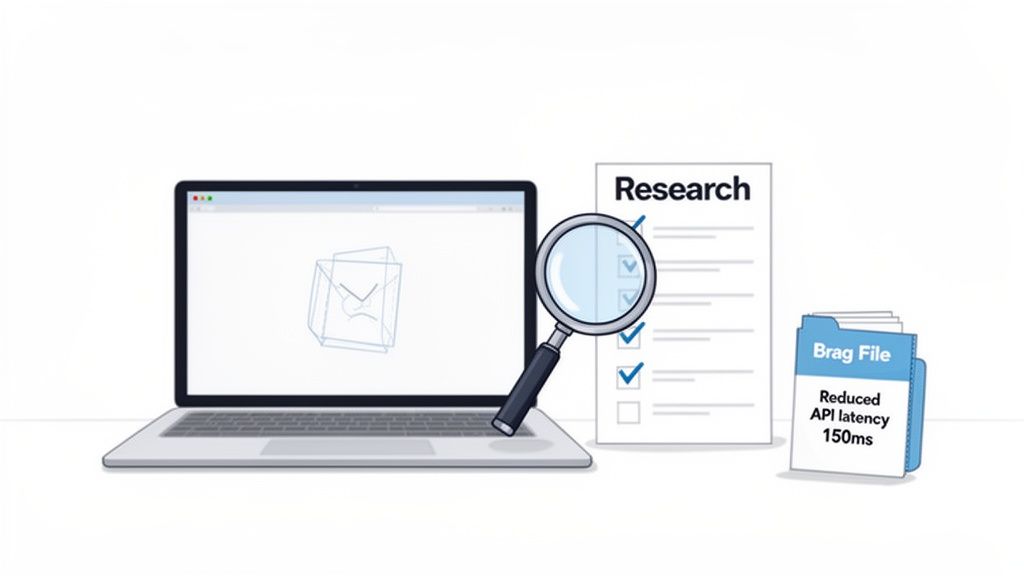
There’s a world of difference between feeling rehearsed and feeling genuinely prepared. Walking into an interview with that deep sense of readiness is the quickest path to confidence, and it starts with strategic, actionable research.
This isn’t about reciting the "About Us" page. It’s about turning a standard Q&A into a collaborative discussion where you’re already brainstorming how to solve their problems. That level of preparation tells them you have business acumen and you’re not just looking for any job—you’re invested in this company’s mission. For a high-growth startup, that’s everything.
Before you even think about Google, your most valuable piece of intel is the job description itself. This document is a literal roadmap to the interview, spelling out the exact pain points the hiring manager is desperate to solve.
Actionable Tip: Open a document and create a two-column table. In the left column, copy-paste every key requirement from the job description. In the right column, write a specific, quantified example from your past that proves you have that skill.
Okay, now you can open a browser. Your goal here is to understand the company's current reality—its recent wins, its struggles, and who they’re up against. This is how you formulate the kind of insightful questions that make you unforgettable.
Here is an actionable research checklist:
A well-researched candidate doesn’t just ask, "What are your biggest challenges?" They ask, "I saw you recently launched the new analytics dashboard. How is that impacting your goal of moving upmarket to serve enterprise clients?" The difference is night and day.
One of the most powerful prep tools is a "brag file." This isn't something you'll show the interviewer; it's a private document for you. It’s your personal cheat sheet of your biggest wins, armed with cold, hard data.
Think of it as an arsenal of proof. When the inevitable "Tell me about a time..." questions come, you won't be fumbling for an answer. You'll have quantified achievements ready to deploy.
Your brag file can be a simple document. Just list your key projects with quantified outcomes.
This document ensures your best stories are always top-of-mind.
Of course, interview success isn’t just about knowing your stuff; it's also about your mental game. True preparation involves building resilience to manage the stress of the process, a topic explored in Harnessing Mind Over Matter Unlocking The Power Of Mental Resilience In Everyday Life. When you combine deep research with a calm, focused mindset, you’re setting yourself up to win.
Anyone can say they’re a "team player," but proving it is what actually lands you the job. When an interviewer asks a behavioral question like, “Tell me about a time you faced a challenge,” they aren't just making conversation. They're looking for a concrete example.
Crafting compelling, concise stories is the single best way to demonstrate your skills in action. It’s how you turn a boring list of job duties into memorable proof of your problem-solving chops, collaborative spirit, and—most importantly—your impact. This is how you show, not just tell, them you're the right person for the job.
The STAR method is a dead-simple framework for telling these stories. It forces you to be clear, concise, and to include the details that matter to hiring managers in tech.
Let's break it down with a practical example:
Too many people gloss over the "Result," but it’s the entire point of the story. Without a clear outcome, your answer falls flat. A great result ties your specific actions directly to a metric that matters, like revenue, user engagement, or system performance.
Let’s put the STAR method into practice. Imagine an interviewer asks a software engineer, “Tell me about a time you had to solve a difficult technical problem.”
A Good, But Incomplete, Answer:"Our main application was running slow during peak hours, and I had to figure out why. I found a bottleneck in some database queries and optimized them, which made the app faster."
This isn't terrible, but it’s vague. It doesn't tell the interviewer how you did it or why it mattered to the business.
A Great, STAR-Powered Answer:"[Situation] In my last role, our e-commerce platform was crawling to a halt every day around lunchtime, leading to a spike in user complaints and abandoned carts.
[Task] As the lead back-end engineer on the performance team, my goal was to identify and eliminate the root cause of the latency to improve the user experience and stop losing revenue.
[Action] I used our monitoring tools to trace the issue to several unindexed database queries hitting our orders table. I collaborated with the DBA to add the correct indexes, and I also implemented a Redis caching layer for our most frequently accessed product data to reduce database load. To validate the fix, I wrote a suite of automated load tests.
[Result] These changes dropped the average API response time from 800ms to under 200ms during peak loads. This directly led to a 15% decrease in customer support tickets about site speed and a measurable 5% lift in checkout conversions in the first month."
See the difference? The second answer gives context, details the specific actions taken, and closes with hard numbers that prove your business value.
At senior levels, the story you choose is just as important as how you tell it. Pick examples that show off not just your technical skills, but also your business sense, leadership, and empathy for the customer.
Not every question is a neat little project showcase. Some are designed to test your self-awareness and how you handle friction. A classic one you'll hear in product and engineering loops is: "Tell me about a time you disagreed with a product decision."
Here's an actionable template for your response:
This approach shows you're a thoughtful, data-driven team player who can navigate professional disagreements—a non-negotiable skill in any fast-moving tech company.
For many in tech, the technical and system design interviews are the most intimidating part of the process. You're at a whiteboard, under pressure, expected to architect a flawless system on the spot.
But here’s the secret: interviewers care more about how you think than a perfect final answer. This is a collaborative problem-solving session, not a test. They want to see your thought process, how you communicate complex ideas, and how you handle trade-offs.
The most common mistake is jumping straight into a solution. An interviewer says, "Design a URL shortener," and the candidate immediately starts whiteboarding database schemas. This is a trap. That simple prompt has hidden complexities.
Your first move is always to ask clarifying questions.
This initial discussion shows you're a methodical engineer who gathers requirements before building—a critical skill. It also transforms the interview from an interrogation into a collaborative design session.
Once you have the requirements, start brainstorming out loud. Your interviewer can't read your mind, so narrate your entire thought process.
This is where you demonstrate seniority. Every engineering decision involves trade-offs. Explicitly calling them out is the hallmark of an experienced engineer.
Actionable Tip: Use phrases that highlight trade-offs. For instance, "We could use a relational database like PostgreSQL for strong consistency, which is great for financial data. However, for this use case, a NoSQL database like DynamoDB might offer better horizontal scalability and lower latency, which seems more critical given our scale requirements."
Walking them through your reasoning proves you understand that engineering is a series of calculated compromises between performance, cost, and complexity.
You wouldn’t run a marathon without training. Technical interviews are the same. Getting comfortable thinking out loud under pressure is a muscle you build through repetition.
Mock interviews are the most effective way to train. Platforms like Pramp offer free, peer-to-peer mocks that simulate the real experience. Regularly doing mocks helps you:
Combine this with focused study. Don't just grind LeetCode problems. Instead, focus on understanding the underlying patterns (e.g., sliding window, two pointers) and data structures. For system design, read engineering blogs from companies like Netflix and Uber to study real-world architectures.
Startups don't just hire for skills; they hire for a specific mindset. They're on the hunt for builders and owners, not just cogs in a machine. Proving you have the resilience, adaptability, and bias for action to thrive in a chaotic, high-growth environment is just as crucial as nailing the technical rounds.
This goes way beyond saying you're a "team player." It's about framing your past experiences to show you can navigate ambiguity, pivot on a dime, and take complete ownership of a problem.
The single best way to show you have the startup DNA is through your stories. When asked behavioral questions, choose examples that highlight your ability to operate without a clear roadmap.
Instead of only talking about well-defined projects, tell them about a time you had to build the plane while flying it.
Actionable Tip: Prepare a story about a time a project failed or had to be scrapped. Explain what you learned from the experience and how it made you a better engineer. This shows resilience and a growth mindset, which are highly valued in startups.
Talking about equity can feel awkward, but it's a critical part of the compensation discussion at a startup. Asking smart questions shows you're thinking long-term and see yourself as a potential partner in the company's success.
The right time to discuss details is in the later stages, typically after they've given you an offer. Bringing it up too early can seem premature. When the time comes, your goal is to understand the real value of your options.
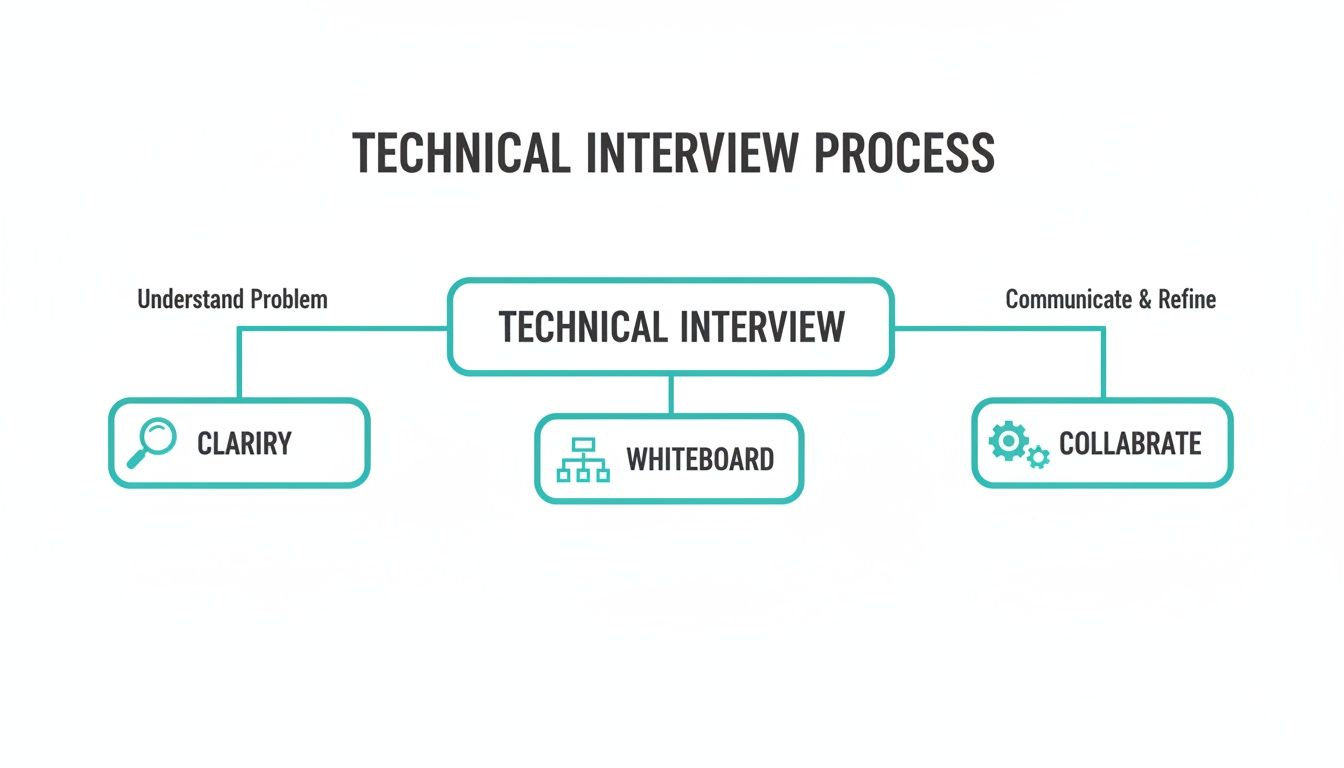
This diagram for a technical discussion perfectly illustrates the approach needed for an equity talk. It's about clarifying requirements (understanding the terms), collaborating on details (asking questions), and mapping things out. A clear, collaborative approach is essential for understanding your potential stake.
Your goal here is to show you're a sophisticated candidate who understands that equity is more than just a number. Here are a few specific questions to ask:
Asking these questions signals that you’re serious about a long-term commitment. For a deeper dive, check out this guide on the startup equity basics for job seekers. It positions you not as just another hire, but as a future stakeholder who is invested in the company's success.
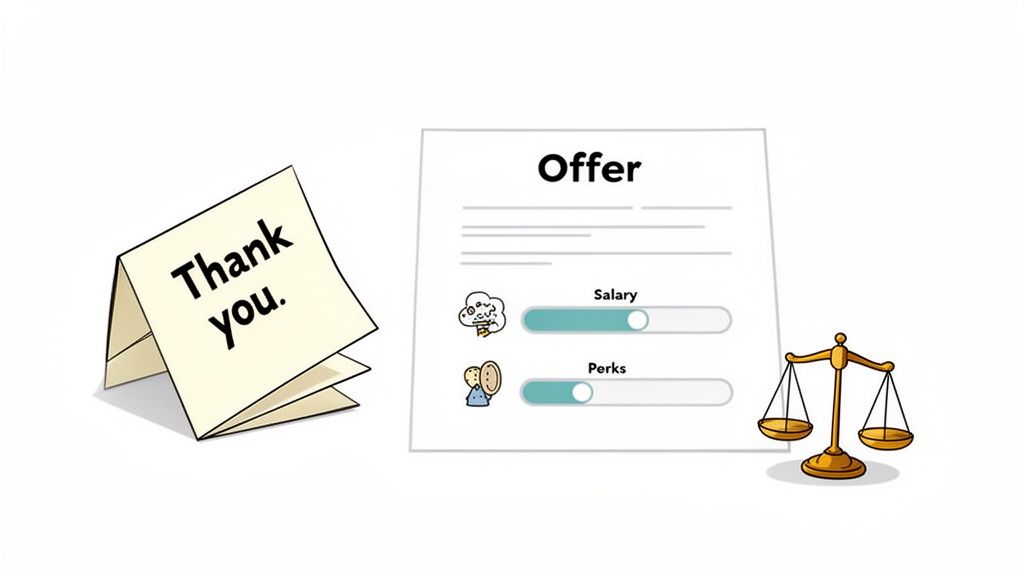
The interview might be over, but you’re not done just yet. This is where you can turn a good impression into a great offer. A sharp follow-up reinforces your value, and a data-backed negotiation ensures you’re compensated fairly for it.
Think of this as the final push. It's your chance to lock in the role and secure a package that truly reflects the skills and experience you're bringing to the table.
Sending a thank-you email within 24 hours is a must. But a generic "Thanks for your time" is a wasted opportunity. Your goal is to be memorable by connecting something you discussed to a specific skill you possess.
This isn't just about being polite; it's a final strategic touchpoint.
A great thank-you note doesn’t just show politeness; it demonstrates that you were actively listening. Mentioning a specific technical challenge or business goal they shared proves your engagement and genuine interest in solving their problems.
Here is a simple, actionable template:
Here’s what that looks like in practice:"I especially enjoyed our discussion about scaling your data pipeline to handle real-time analytics. It reminded me of a project at [Previous Company] where I reduced data processing latency by 30% by implementing a Kafka and Flink architecture. I'm excited by the prospect of tackling similar challenges with your team."
This turns a simple courtesy into one last, powerful pitch.
Don’t wait for an offer to think about compensation. Go into the process with a clear, data-backed understanding of your market value.
Use sites like Levels.fyi and Glassdoor to find the market rate for your role, experience level, and location. Get a specific range in mind.
But don't stop at the base salary. Consider the entire package:
When the offer arrives, always express gratitude and excitement first. Ask for the full details in writing and request a day or two to review it. This is a standard professional practice that gives you time to prepare a thoughtful response.
When you present a counter, frame it as a collaborative conversation.
Actionable Script:"Thank you so much for the offer! I'm really excited about the opportunity to join the team and work on [Specific Project]. Based on my research for similar roles in [City/Remote] and considering my experience in [Specific Skill that's valuable to them], I was expecting a base salary closer to the [Your Target Number] range. Would you be open to discussing this?"
By anchoring your request in market data and the specific value you bring, you keep the conversation professional and focused on a mutually beneficial outcome.
Even with perfect preparation, a few tricky questions can catch you off guard. Here’s a playbook for handling the most common curveballs with genuine, strategic answers that show you're a great fit for a high-growth team.
Rule number one: avoid clichés like "I'm a perfectionist" or "I work too hard." The goal is to demonstrate self-awareness and a commitment to growth—a huge asset in a startup culture.
Actionable Formula: Pick a real but manageable weakness, and immediately explain the specific steps you are taking to improve it.
Example: "In the past, I sometimes struggled with delegating tasks because I wanted to ensure they were done perfectly. However, I've learned that this approach doesn't scale and can be a bottleneck for the team. I’ve been actively working on this by clearly defining project requirements upfront and establishing regular check-ins, which empowers my teammates and allows me to focus on higher-level problems."
This can be a loaded question. Asking "What's the work-life balance like?" might be misinterpreted as a lack of commitment.
Instead, frame your question around team health and sustainable performance. This shows you care about long-term success, not just punching a clock.
Try one of these more strategic questions:
"How does the team collaborate to manage ambitious deadlines while ensuring everyone avoids burnout?"
Or...
"What's the company's philosophy on professional development and preventing scope creep on major projects?"
This reframes the conversation around shared success and healthy team dynamics.
Patience is key. The standard rule is to wait about one week, or a day or two after the timeline they provided has passed. Hiring in startups can be chaotic, and delays are common. A calm, professional follow-up is always better than an anxious one.
When you do reach out, keep it brief and professional. A simple email to the recruiter is perfect.
Actionable Template:"Hi [Recruiter Name], Hope you're having a great week. I'm just following up on my interview for the [Role Name] position. I really enjoyed learning more about the team and am very excited about the opportunity. Please let me know if there are any updates on your end. Best, [Your Name]."
The most critical step is thorough preparation. This includes reviewing the candidate's resume and the job description in detail, preparing a structured list of questions tied to the role's core competencies, and understanding what you need to assess in your specific interview round (e.g., technical skill, cultural fit). A prepared interviewer creates a professional and efficient experience.
A structured interview means asking each candidate the same set of core, job-relevant questions in the same order and using a consistent scoring rubric. This method is proven to be more fair, reliable, and predictive of job performance than free-flowing conversations. It reduces unconscious bias and allows for an objective comparison between candidates.
Focus on behavioral and situational questions. Instead of "Are you good at teamwork?" ask, "Tell me about a time you had a conflict with a teammate on a project. What was the situation and how did you resolve it?" Use the STAR method (Situation, Task, Action, Result) as a guide to prompt candidates to give complete, evidence-based answers.
Start the interview by introducing yourself and explaining the interview structure to set expectations. Begin with easier, open-ended questions to build rapport. Practice active listening—nod, make eye contact, and avoid interrupting. Your goal is to create an environment where the candidate can present their authentic self and best thinking.
A good interview is a two-way conversation. You must also represent the company positively. Be prepared to articulate the team's mission, the impact of the role, growth opportunities, and why you enjoy working there. Allow time for the candidate's questions and answer them enthusiastically. A great candidate experience is crucial for securing top talent.
Use the scoring rubric you prepared. Take brief, factual notes on the candidate's responses during the interview, focusing on evidence related to the competencies you're assessing. Avoid subjective words. Immediately after the interview, complete your scores and write a summary while the conversation is fresh. This ensures evaluations are based on data, not memory or bias.
Common pitfalls include: talking too much (aim to listen 80% of the time), asking leading or illegal questions, being unprepared and reading the resume for the first time, making a snap judgment in the first few minutes (confirmation bias), and failing to provide a clear next step or timeline to the candidate at the end.
Ready to stop sending your resume into the void? With Underdog.io, you apply once and get your profile in front of hundreds of top, vetted tech companies. Let the best startups in NYC, SF, and remote-first come to you. Find your next role at https://underdog.io.