You're probably in one of two situations right now. You're a strong candidate with real experience, but startup applications keep disappearing into silence. Or you're getting interest, but it's scattered, vague, and hard to tell which companies are serious.
That usually happens because candidates run a corporate playbook in a startup market. They polish a resume, click apply, wait, and assume the best companies will notice. Startups rarely hire that way. They hire when a problem gets urgent, when timing lines up, and when someone shows clear evidence that they can reduce execution risk quickly.
If you want to learn how to get recruited by startups, stop treating the search like a volume exercise. Treat it like positioning. The candidates who get pulled into good startup processes aren't always the flashiest on paper. They're the ones who make a founder think, “This person can help us move faster without creating drag.”

Most candidates ask, “How do I look qualified?” Startup founders ask a different question. “If we hire this person, what risk disappears?”
That difference explains almost everything about startup recruiting. Early teams aren't trying to fill a seat neatly. They're trying to solve a stubborn problem with limited time, limited management bandwidth, and little room for hiring mistakes.
A founder usually reads your profile through three filters:
| What they want to know | What weak candidates show | What strong candidates show |
|---|---|---|
| Can you create momentum | Familiar tools and titles | Evidence of shipped work and decisions |
| Can you operate with limited structure | Dependence on process | Clear ownership in messy situations |
| Will you lower hiring risk | Generic enthusiasm | Relevant proof for this exact stage |
That's why startup candidates often fail even when they're objectively capable. They present themselves like polished generalists, not like answers to a pressing business problem.
A better framing is to think of your candidacy as a product. The startup is your market. Your message has to match the pain. If the company needs an engineer who can stabilize a product area, your story should sound different than if they need someone to build fast from zero. If the startup needs a product manager who can narrow scope and ship, talking about broad stakeholder alignment at a giant company won't carry much weight unless you translate it into startup terms.
Startups don't reward the most generic version of competence. They reward fit under pressure.
Many talented people lose months because they keep everything open. They say they're interested in “startup roles” across product, ops, growth, strategy, or partnerships. Founders hear that as uncertainty. Narrower positioning usually works better.
A useful mental model is this: pick the kind of startup where your background already makes sense, then make the case that you're unusually low-risk for that environment. That may be B2B SaaS at early growth stage. It may be developer tools. It may be fintech with operational complexity. It may be consumer apps where speed and iteration matter.
When candidates struggle to choose, I often point them toward resources on how to stop analysis paralysis. The point isn't to make a perfect career decision from the start. It's to commit hard enough that your profile starts sending a coherent signal.
If you want a sharper sense of that lens, this breakdown of what startup founders look for when hiring is useful because it reflects how early teams evaluate judgment, ownership, and speed.
Your task isn't to sound impressive to every company. It's to sound obvious to the right one.

A startup-ready profile doesn't read like an HR document. It reads like proof that you can get useful work out the door.
The fastest way to improve your odds is to strip away role-description language and replace it with evidence of judgment, speed, and impact. Founders don't care that you “partnered cross-functionally” unless they can tell what changed because of it.
Most candidates write resumes as a list of responsibilities. That style hides startup fit.
Here's the shift:
| Before | Better startup version |
|---|---|
| Managed sprint planning | Ran sprint planning for a product area with shifting priorities and kept releases moving despite scope changes |
| Worked with design and engineering | Coordinated design and engineering to ship a customer-facing improvement under a hard deadline |
| Owned roadmap execution | Took a vague problem, narrowed scope, and got a workable first version live |
Notice what changed. The better version gives the reader a clue about ambiguity, decision-making, and delivery. Even without hard numbers, it sounds operational.
If you do have metrics from your own work that you're allowed to share, use them truthfully. If you can't share specifics, describe the business effect in plain English. You're not trying to impress a spreadsheet. You're helping someone picture you inside a small team.
Startups like depth, but they also look for range. A strong profile usually shows one clear craft plus evidence that you can collaborate across the edges.
Use your LinkedIn headline, summary, portfolio, GitHub, or personal site to answer three questions fast:
What's your core strength
Backend systems, product thinking, growth execution, design systems, data work, infrastructure, or something else concrete.
What kind of problems have you solved
Friction in onboarding, messy internal workflows, shipping delays, unclear product priorities, manual ops, customer pain points.
How do you work when things are not fully defined
Side projects, open-source work, internal initiatives you created, memos you wrote, prototypes you launched.
Practical rule: If someone removed your title from your profile, the work should still reveal your level.
The profile alone isn't enough. Startups trust artifacts.
That means things like:
These signals matter because they compress risk. They give a hiring team something to inspect besides claims.
If your resume still sounds too corporate, this guide on how to create a resume for startup jobs is a useful reference point for translating your background into startup language.
A quick self-audit helps:
Resume
Does every bullet show what changed because of your work?
LinkedIn
Does it read like an org chart, or like a sharp capabilities snapshot?
Portfolio or GitHub
Does it show how you think, or only that you were present?
Short-answer application questions
Do you answer specifically, or paste a generic paragraph about passion and mission?
Startup hiring teams often make early judgments from tiny signals. Sloppy answers, vague bullets, and bland profiles don't suggest humility. They suggest low signal.
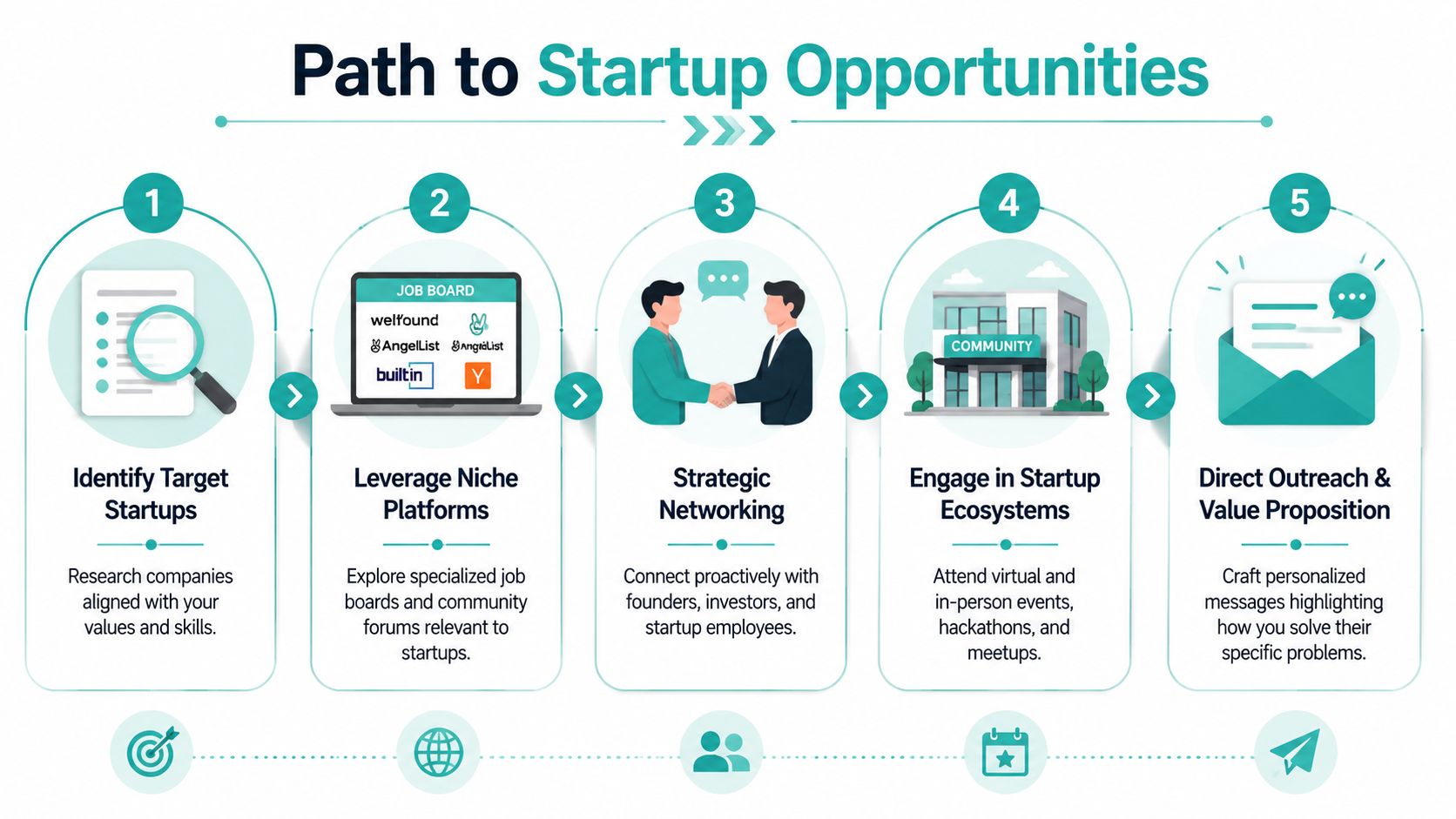
The biggest mistake I see is passive sourcing. Candidates browse the same public boards as everyone else, apply late, and then wonder why startup hiring feels random.
It isn't random. It's timing-sensitive and channel-sensitive.
According to Underdog's guide on how to get recruited by startups, over 50% of venture-backed startup talent teams now integrate AI into hiring workflows, startup recruiting emails see a 19% reply rate, and candidates who reach out within 1 to 3 days of a funding announcement tend to get the best response rates. That tells you two things. Outreach still works, and speed matters.
Don't start with jobs. Start with companies.
A good target list usually includes startups that match your stage preference, product interest, and working style. Then you watch for hiring triggers. That could be a funding announcement, a product launch, a new executive hire, or a role opening that signals momentum.
The value of this approach is simple. You stop reacting to crowded listings and start contacting companies when attention is still focused on growth, not applicant filtering.
A practical workflow looks like this:
Pick a narrow lane
Examples include B2B SaaS infrastructure, AI product companies, fintech tooling, or developer platforms.
Create a company tracker
Keep notes on stage, product, recent news, team size, and why your background fits.
Watch for triggers
Funding news is one of the clearest signals that hiring may accelerate.
Reach out quickly
The best window is often early, before the role gets buried under volume.
Bad networking sounds like admiration. Good networking sounds like relevance.
Instead of “I'd love to learn more about your company,” try a short note that connects your experience to a likely business need. If the company just raised money and is hiring engineers, product managers, or designers, they are not looking for abstract enthusiasm. They're looking for people who can make the growth plan real.
Use a message structure like this:
Observation
Mention the trigger, such as funding, product launch, or team expansion.
Relevant overlap
Explain the problem area you've worked on.
Low-friction next step
Offer a short conversation or a few examples of shipped work.
A short, thoughtful email usually beats a long message trying to prove passion.
Mass application channels tend to flatten candidates. Startup hiring works better through selective paths.
Use a mix of:
| Channel | Why it works | Risk if used badly |
|---|---|---|
| Warm introductions | Trust is built in before the first call | Weak asks burn social capital |
| Targeted cold outreach | Lets you reach companies before the crowd | Generic messages get ignored |
| Startup communities | You can build familiarity over time | Obvious self-promotion backfires |
The goal isn't more touchpoints. It's better ones.
Traditional job boards create a bad market for startup candidates. Too much volume, too little context, and very weak signaling. A good company can receive a flood of applicants who look similar at first glance, which pushes teams toward fast filters and broad heuristics.
Curated marketplaces work differently. They reduce noise on both sides.
A founder-focused hiring guide from Gem notes that the most effective startup sourcing channels are network-driven and marketplace-driven, with 1st-degree networking described as the highest-ROI hiring source, and hiring marketplaces recommended when teams want early, high-quality qualification in the process, as outlined in Gem's startup hiring guide for founders.
The main advantage is signal compression. If a candidate has already been reviewed for startup relevance, the hiring team starts with a different assumption. You're no longer one more resume in a giant pile. You're a candidate who at least passed an initial quality screen.
That matters because startups don't only hire for talent. They hire for confidence. Any mechanism that helps a team believe you're worth serious attention improves your position.
Curated marketplaces also change the rhythm of the search. Instead of repeatedly introducing yourself from scratch, you create one strong profile and let selected companies come into the conversation when there's fit. That doesn't replace networking or direct outreach. It complements them.
Candidates misuse marketplaces when they treat them like storage. They upload a profile and wait. That's too passive.
A better approach:
Write for a founder, not a recruiter
Make your summary about problems solved, not traits claimed.
Be specific about stage and function
“Open to anything” lowers confidence. Specificity raises match quality.
Curate your evidence
Link only the projects, writing, or portfolio pieces that strengthen the case.
Respond with context
When a company reaches out, reflect back why the role makes sense.
One example is Underdog's guide to the best sites for startup jobs, which also points candidates toward curated startup hiring channels. On the product side, the Underdog page for getting recruited by startups explains its marketplace model, where candidates submit one profile and vetted companies reach out when there's alignment.
The real benefit of a curated marketplace isn't convenience. It's that your profile enters the process with some trust already attached to it.

Startup interviews often feel informal. Don't misread that. The evaluation is usually sharper than it looks.
A startup team is trying to figure out whether you can operate with limited structure, make reasonable decisions before all the data is available, and contribute without waiting for perfect instructions. That's why polished interview scripts often underperform. They sound managed, not useful.
Most startup interviews rely heavily on your examples. Not because the team wants inspirational anecdotes, but because past behavior is one of the few practical clues they have.
Your story bank should cover things like:
Ambiguity
A time you had to choose a direction without complete information
Ownership
A problem you stepped into before someone formally assigned it
Trade-offs
A moment when you had to cut scope, move fast, or accept a compromise
Conflict or collaboration
Working across engineering, design, product, data, or go-to-market without hiding behind process
A strong answer usually has five parts. What was messy, what you decided, what signal you used, what happened, and what you'd do differently now.
Take-home assignments can help or hurt you depending on how you approach them. Candidates either undercook them and look careless, or overinvest and produce unpaid consulting work with no boundaries.
The right middle ground is disciplined clarity.
| What to do | Why it helps |
|---|---|
| Clarify the goal first | Shows you care about what the team is actually testing |
| Set a time boundary | Signals maturity and protects your energy |
| State assumptions | Lets them evaluate your thinking, not just the final artifact |
| Show what you'd do next | Demonstrates prioritization instead of overpolishing |
If they ask for a product case, don't drown the team in slides. If they ask for technical work, don't optimize only for elegance. Good startup interviews often reward speed, reasoning, and scope control more than theatrical perfection.
A startup take-home is often a disguised prioritization test.
Many candidates act grateful just to be there. That's understandable, but it's incomplete. You also need to assess whether the company is worth the risk.
Ask questions that uncover reality:
These questions work because they force specifics. If the answers stay vague, that's useful information.
You should leave a startup interview with a much better sense of whether the team has clarity, whether the manager can articulate success, and whether the company's urgency is focused or chaotic.
Most startup candidates negotiate the visible part of the offer and ignore the risky part. They push on base salary, maybe ask for a title change, and never get serious about runway, burn, or what the equity means.
That's a mistake. A startup offer is partly a job offer and partly a risk-sharing agreement.
First Round's recruiting advice argues that founders should disclose risk early, especially when compensation is below market or the company asks candidates to absorb uncertainty. The practical implication for candidates is clear. You should ask direct questions about compensation volatility, equity dilution, runway, burn, and terms, as discussed in First Round's piece on how startups and job seekers can both win the talent war.
A thoughtful candidate doesn't just ask, “Can you move on salary?”
They ask things like:
You don't need to sound adversarial. You do need to sound awake.
A lot of startup hiring advice overindexes on mission, energy, and culture fit. Those things matter. They do not pay your rent or protect your career if the company's economics are unstable.
That's why I tell candidates to negotiate like a future teammate, not a starry-eyed applicant. Partners do diligence. Partners want transparency. Partners know that a company that reacts badly to reasonable questions is giving away useful information.
For the actual salary conversation, broad principles from practical guides like these salary negotiation tips for UK accountants still apply well outside accounting. Be clear about your value, ask thoughtfully, and negotiate the whole package rather than one headline number.
A startup offer can still be the right move if the salary is lower than a larger company. But only if the learning, role scope, team quality, and financial reality justify that trade.
If you want a more efficient path into startup conversations, Underdog.io is a curated marketplace where tech candidates create one profile and get introduced to vetted startups when there's fit. It's useful if you'd rather spend time sharpening your signal than repeating the same application process across dozens of companies.