Hiring great software engineers boils down to one simple truth: you have to understand the market they live in, define the role with absolute clarity, and build an interview process that’s more than just a gauntlet of technical questions. The best candidates aren't just looking for a paycheck; they’re looking for a mission, a team they can respect, and a genuinely interesting problem to solve.
This playbook is designed to give you actionable steps to attract and close the talent your startup needs to win.
Before you even think about writing a job description, you need a reality check on the world engineers are operating in. The tech industry has been on a rollercoaster, and clinging to old assumptions is the fastest way to an empty hiring pipeline. What worked two years ago is completely irrelevant today, especially for a startup trying to compete with giants that have ridiculously deep pockets.
The market for senior talent, in particular, has become a battleground. Engineers who can ship features, navigate ambiguity, and deliver immediate value—especially in the exploding AI space—are in white-hot demand. We're not just talking about raw coding skill here; it's about the ability to own a piece of the product and move fast. That’s the lifeblood of a startup.
The engineering job market is bouncing back with a vengeance after the widespread layoffs of 2022-2023, and Big Tech is leading the hiring charge. Take Meta, for example. They've not only recovered but now employ 19% more engineers than they did before the cuts in early 2022. This rebound signals one thing loud and clear: the aggressive competition for top talent is back on.
A major trend has cemented itself in this recovery: over half of all open roles are now targeting senior-level engineers. This is a huge shift from previous cycles where junior roles were far more common. It shows a clear demand for experienced pros who can hit the ground running, especially as every company under the sun races to integrate AI. For a more detailed look, check out the full breakdown of the 2025 software engineer job market trends.
For startups, this means the fight for experienced talent is tougher than ever. You’re not just competing with other startups; you're up against the immense resources and brand recognition of companies like Google, Amazon, and Meta.
While remote work has certainly distributed talent, geographical hubs still pack a major punch. The San Francisco Bay Area remains the undisputed center of gravity for innovation, thanks to the sheer concentration of venture capital and the critical AI infrastructure located there. In early 2025, California alone was home to roughly 11,000 engineering job postings, highlighting its unshakable dominance.
Internalizing these market dynamics is the first step in building a hiring strategy that isn't just a fantasy. Your entire approach has to be tailored to this landscape. So, what does this actually mean for your startup?
This realistic view of the battlefield will help you set achievable goals and craft a hiring plan that actually works. Now, let’s get down to the brass tacks of defining the role you truly need to fill.
A vague job description is a magnet for mismatched candidates. Before you write a single line of your job post, you need to define the role with surgical precision. This isn't just about listing technologies; it's about deeply understanding the exact problems your new hire will solve and the impact they'll have on your startup’s trajectory.
I've seen so many founders fall into the "wish list" trap, trying to combine the skills of three different engineers into one impossible-to-fill role. The result? A confusing job description that either attracts crickets or reels in candidates who aren't a genuine fit for what your team actually needs right now. In today's market, resumes matter less than ever, so clarity from the start is your greatest asset.
First things first: ruthless prioritization. Get your founding team in a room (or on a Zoom) and hammer out a simple skills matrix. This isn't just a tech checklist; it's about defining the type of builder you need at this exact stage.
Divide your requirements into two simple columns:
This exercise forces you to be brutally honest about your immediate needs versus your long-term ambitions. An early-stage startup often needs a "coding machine" who can ship fast, not a systems architect who wants to spend three months designing the perfect infrastructure.
Your job description is a sales pitch. Top engineers, especially passive ones, are vetting you just as much as you're vetting them. A generic, corporate-sounding description will be completely ignored. If you need some inspiration on clear, structured writing, check out this executive assistant job description template—the principles of clarity and directness apply to any role.
Your job description isn't a formality; it's the first impression someone gets of your team and your vision. At this stage, you’re not selling a job—you’re inviting someone to build something meaningful with you.
A compelling role spec should feel human and direct. Ditch the HR jargon and speak like a founder. You need to clearly articulate:
For instance, instead of saying, "Responsible for backend services," try something like, "You will own the development of our real-time data processing API, directly impacting our ability to serve 100,000 concurrent users." The second version is specific, outcome-focused, and infinitely more exciting.
When you define the role with this level of clarity, you'll start attracting engineers who are not just qualified, but genuinely motivated by the challenges you're offering.
Let's be honest: the best software engineers aren't scrolling through job boards. They’re too busy building cool stuff, contributing to open-source projects, or heads-down solving tough problems at their current gig. If you want to hire the best, you can't just post a job and wait. You have to go find them.
This means shifting your mindset from filtering applicants to proactively building a network. You need to meet engineers where they live online, speak their language, and build genuine relationships—often before you even have a role open.
To pull this off, you first need a crystal-clear picture of who you're looking for. It's time to get brutally honest about your must-haves versus your nice-to-haves.
This breakdown is a lifesaver for focusing your search.
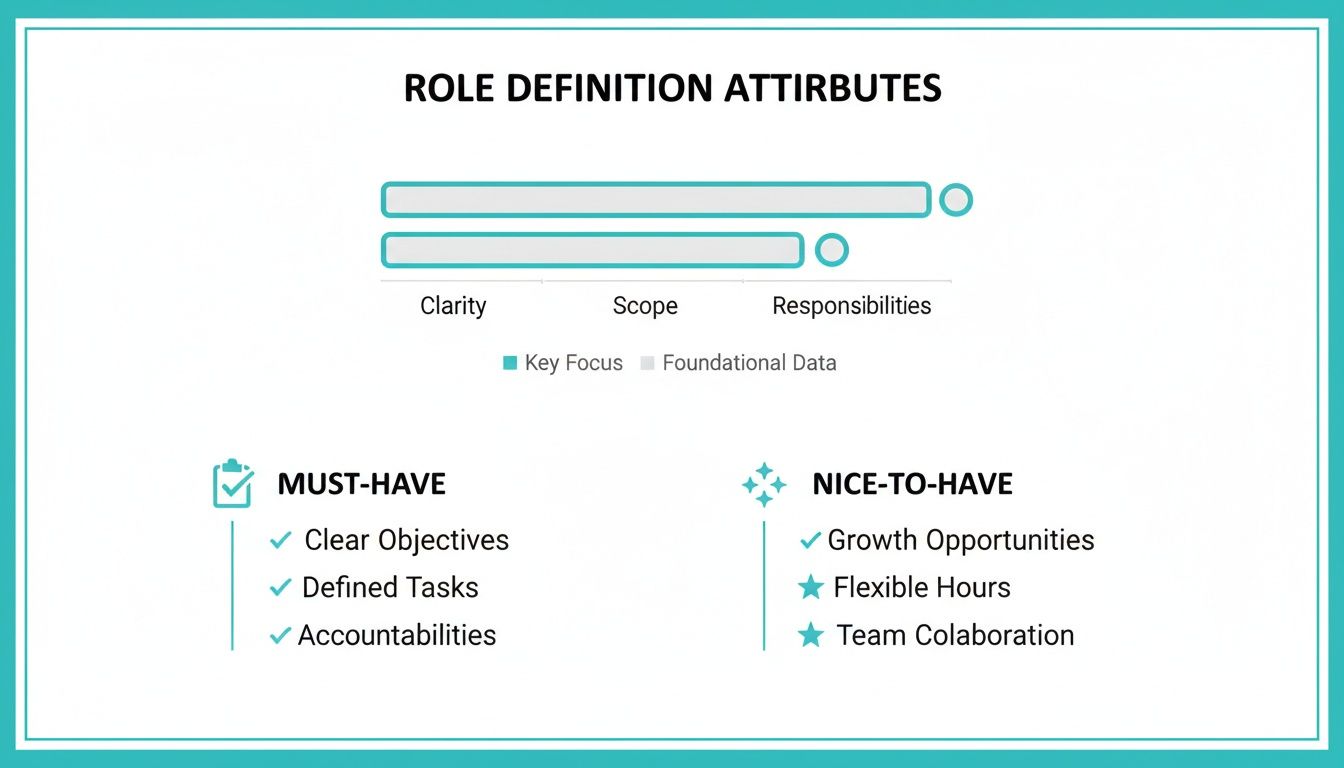
Separating these qualities keeps you from getting distracted by shiny objects and helps you zero in on candidates with the non-negotiable skills your startup needs right now.
Traditional recruiting channels are often a firehose of low-quality applications. Save your energy and focus on the platforms where engineers showcase their actual work and passions.
This hands-on approach is the foundation of any effective plan for talent sourcing for startups.
When you find someone promising, your first message is everything. Generic, copy-pasted templates get deleted on sight. Your outreach has to be personal, punchy, and respectful of their time.
Here’s a real-world example of a message that cuts through the noise:
"Hey [Candidate Name], I came across your contributions to the [Open-Source Project] library and was seriously impressed with your work on the [Specific Feature]. At [Your Startup], we're tackling [Interesting Problem] using a similar approach, and I thought the challenges we're facing might be right up your alley. No pressure, but would you be open to a quick, informal chat next week?"
This works because it's specific. It proves you’ve done your homework and connects their work directly to a problem you’re solving. It’s a low-commitment invitation to a conversation, not a hard sell.
The global developer population is projected to hit 28.7 million this year, with the US alone making up over 4.4 million of that. But with roughly 70% of developers on Stack Overflow already employed, you can't just wait for them to come to you. Proactive outreach is the only way to tap into this massive, largely passive talent pool.
Not all sourcing channels are created equal, especially when you're a startup with limited resources. You have to be strategic about where you spend your time and money.
Here's a quick comparison to help you prioritize your efforts:
As you can see, the channels that yield the highest quality candidates—direct sourcing and referrals—also require a more personal investment of time. For a startup, that's almost always a worthwhile trade-off.
Your current engineers are your single most powerful sourcing tool. Full stop. They have networks packed with talented friends and former colleagues who already trust their judgment.
A great referral program isn't just about throwing cash bonuses around. It's about creating a culture where your team is genuinely excited to bring smart people into the fold.
Actionable Tip: Create a simple internal document that clearly outlines the roles you’re hiring for, the key "must-haves," and your one-sentence pitch. Make it easy for your team to copy-paste this info to their network. A warm intro from a trusted peer is infinitely more powerful than the best cold email you could ever write.
A frustrating, disorganized, or disrespectful interview process is the fastest way to lose a great software engineer. It's a hard truth. Top candidates have options, and they're evaluating your company’s competence and culture at every single step. Your interview workflow isn't just a filter; it's a powerful piece of your employer brand.
Think of it this way: a well-designed process respects a candidate's time, accurately assesses their real-world skills, and gives them a clear window into what it’s actually like to work with your team. Anything less sends a loud and clear signal that your company is chaotic or doesn't value its people.
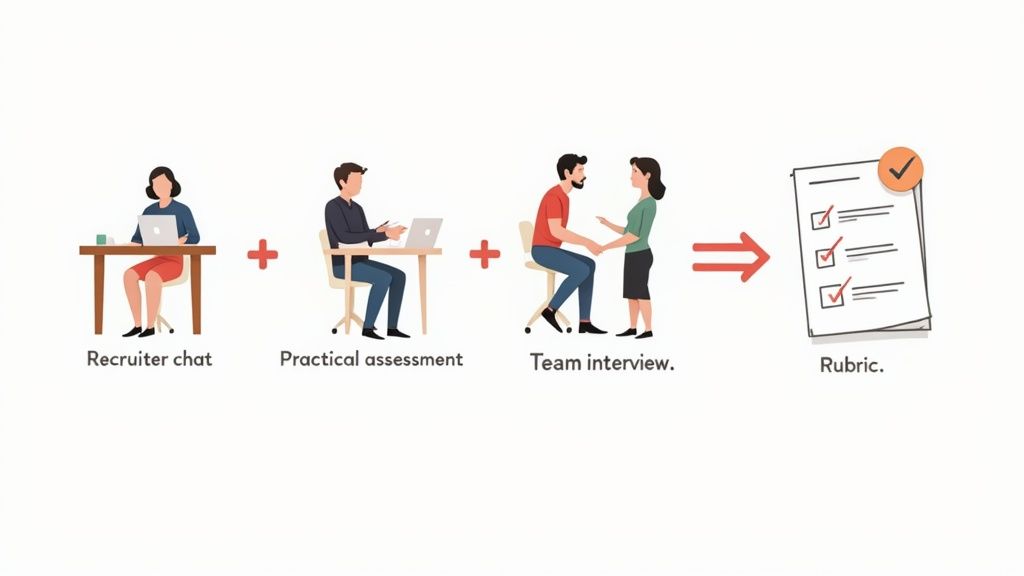
The ideal interview process should feel like a funnel, not a gauntlet. Each stage needs to be designed to gather specific signals efficiently, saving both your team and the candidate valuable time. It’s time to move away from useless brain teasers and abstract whiteboard challenges that don't reflect the daily work of a modern engineer.
Here’s a practical, four-stage workflow that works for most startups:
The job market is pivoting dramatically, making it crucial to prioritize AI and specialized skills when you hire software engineers. AI tools like GitHub Copilot now automate routine coding, reducing the need for entry-level hires while increasing demand for engineers who can manage complex AI workflows—a skillset evolving 25% faster than others. Demand for AI proficiency has seen a 143% spike since early 2024, so screening for these skills is no longer optional.
This is the most critical and, frankly, the most mishandled stage. A good technical assessment feels less like a test and more like a preview of the job.
The best technical challenges are small, scoped-down versions of real-world problems your team has solved. It gives the candidate a taste of the actual work and gives you a high-signal indicator of their practical abilities.
For example, instead of asking them to invert a binary tree, try this:
This approach tests real skills: API interaction, data handling, component architecture, and testing—not just algorithmic knowledge. It respects their experience and shows them you care about practical results. To learn more about what to look for, read our guide on what engineering hiring managers look for in candidates.
Your gut feeling is valuable, but let's be honest, it’s also biased. A simple hiring rubric ensures every candidate is evaluated against the same objective criteria, leading to much fairer and better decisions.
Create a simple spreadsheet for each role, with interviewers scoring candidates from 1 to 5 on key attributes you’ve defined ahead of time.
Sample Rubric for a Mid-Level Engineer
This structured feedback makes your debrief sessions infinitely more productive. Instead of a vague "I liked them," your team can discuss specific data points, leading to a much more informed and confident hiring decision.
You’ve navigated the market, defined the role, sourced incredible talent, and run a respectful interview process. But all that effort means nothing if your offer gets rejected. The final stage is a delicate balance of speed, clarity, and selling the entire opportunity, not just the salary.
Good candidates move fast. They get competing offers. A founder I know found their perfect lead engineer, ran a great process, but then waited three days to "discuss with the board." By the time they called, the engineer had already accepted another offer.
When you're sure about someone, make the offer immediately—ideally, via a phone call the same day as the final interview. This shows confidence and makes the candidate feel like a top priority. It also says something powerful about how your company operates: clear, direct, and decisive.
For a startup, compensation is rarely a simple numbers game. You likely can't outbid a FAANG company on base salary, so you have to be strategic. The goal is to present a package that feels fair and aligns with the candidate's risk tolerance and long-term ambition.
This kind of honesty builds trust and helps the candidate make an informed decision based on their personal financial situation and their belief in your company's potential.
Equity can be the most powerful part of your offer, but it's also the most poorly explained. Skip the jargon and focus on what it actually means for the candidate.
A lot of founders just throw out a number of stock options without any context. To a candidate, "10,000 options" is meaningless. You have to frame it as a percentage of ownership and explain what that could be worth at different future valuations.
Actionable Tip: Create a simple chart in your offer letter that shows the potential value of their equity at different exit valuations (e.g., $100M, $500M, $1B). This makes the abstract concept of equity tangible and exciting.
Here’s how to demystify the two main types of equity you might offer:
Clarity here is non-negotiable. The candidate needs to understand both the potential upside and the mechanics of their ownership stake.
The offer isn't just a document; it's the culmination of your entire pitch. The numbers are just one part of a much bigger story.
When you make the offer, reiterate the "why." Remind them of the mission, the unique problems they'll get to solve, and the impact their work will have. Frame it as a total package that includes:
Finally, give them space to decide. A high-pressure, exploding offer is a major red flag. A confident offer is a respectful one: "Take a day or two to think it over. I'm here to answer any questions you have." You want someone to join because they're genuinely excited, not because they felt rushed.
Getting an enthusiastic "yes" to your offer isn't the finish line; it’s the starting line. All the hard work you’ve put into finding and hiring a talented engineer can completely fall apart with a chaotic or nonexistent onboarding process.
The first few weeks set the tone for their entire time with you. Great retention starts on day one.
The goal isn’t just to hand them a laptop and grant access to the codebase. It's about pulling them into your team's culture, workflow, and mission. This initial period is your chance to build the foundation for a long-term, high-impact relationship. Skipping this part is like spending months building a race car only to forget to put fuel in it.
A structured onboarding plan is your single best tool for making sure a new hire can contribute meaningfully—and feel like part of the team—fast. A classic 30-60-90 day framework gives everyone clarity and helps manage expectations on both sides. It turns the ambiguity of a new role into a clear roadmap.
This plan acts as a guide, preventing new hires from feeling lost in a sea of documentation and code. It gives them concrete milestones to hit and shows you’ve thought deeply about how they fit into the company.
The first 30 days are not about shipping massive features. They are about learning, connecting, and building confidence. A successful first month means your new engineer understands the ‘why’ behind the code, not just the ‘how’.
For example, a solid goal for the first month might be shipping a small, low-risk bug fix. This simple win builds momentum, gets them comfortable with the deployment process, and gives them a taste of making a real impact.
A well-defined plan takes all the guesswork out of the equation. It creates a structured path from newcomer to a fully integrated team member.
Here’s a practical template you can adapt:
This structured approach ensures your new engineer isn't just treading water. They're actively building confidence, understanding their role, and starting to deliver real value.
Onboarding is crucial, but retention is an everyday effort. Talented engineers stay where they feel valued, challenged, and see a clear path forward. This has nothing to do with ping-pong tables; it's about meaningful work and professional respect.
Consistent feedback is the lifeblood of this process. Weekly 1-on-1s are absolutely non-negotiable. This is your dedicated time to understand their challenges, celebrate their wins, and offer constructive guidance. It builds trust and makes sure small issues never have a chance to become big problems.
Equally important are clear career paths. Even at an early-stage startup, engineers need to see how they can grow. Will they become a senior individual contributor, a tech lead, or an engineering manager? Just talking about these possibilities shows you're invested in their long-term success, not just their output for the next quarter.
You can't improve what you don't measure. Tracking post-hire success isn't about micromanaging; it's about understanding the health of your team and the effectiveness of your hiring process. A key part of managing and keeping engineering talent is knowing how to measure developer productivity without falling for vanity metrics like lines of code.
Focus on metrics that reflect true impact and integration:
Ultimately, retaining the incredible engineering talent you fought so hard to hire is the ultimate win. It validates your entire process, strengthens your team, and accelerates your mission.
Ready to build your high-performing engineering team? Underdog.io flips the script on hiring by connecting you with a curated pool of top tech talent who are actively exploring their next move at startups just like yours. Find your next great hire.