Interviewing at a high-growth startup is a different game. It isn't just about proving you can do the job; it's about demonstrating you can thrive in an environment defined by rapid change, ambiguity, and high-impact collaboration. Corporate interview playbooks often fall short here because startups aren't just filling a role. They're looking for partners who align with their mission, can adapt on the fly, and will contribute directly to the company’s trajectory from day one. Your ability to show genuine product curiosity, cultural fit, and a proactive mindset is just as critical as your technical skills.
This guide is designed to move past the generic advice and provide a specific, actionable job interview do and don't list tailored for the startup ecosystem. We're skipping the obvious tips like "dress professionally" and "be on time" to focus on the nuanced strategies that truly make a candidate stand out to founders and hiring managers. You will learn how to articulate your value through compelling stories, ask incisive questions that reveal a company's inner workings, and navigate crucial conversations around equity and team dynamics.
We will provide concrete examples and practical scripts for every point, covering everything from pre-interview research and behavioral questions to technical deep dives and effective follow-up. Think of this as your inside track to not only passing the interview but also determining if the startup is the right long-term fit for you. Let's explore the 10 essential do's and don'ts that will equip you to confidently navigate the startup hiring process and land a role where you can make a real impact.
1. DO: Research the Startup's Product, Mission, and Recent Milestones
Walking into an interview without understanding the company is one of the most common mistakes candidates make, but for startups, this oversight is particularly damaging. Unlike established corporations, early-stage companies are driven by a core mission and a passionate belief in their product. Showing up with a deep, nuanced understanding of their world is a non-negotiable part of any successful job interview do and dont list. This preparation signals more than just diligence; it shows genuine interest and potential alignment with the company’s vision.
This level of research allows you to move beyond generic questions and engage in a strategic conversation. You can connect your skills directly to their challenges and goals, demonstrating your value in a tangible way.
How to Implement This Strategy
Effective research goes beyond a quick glance at the company’s homepage. It involves a systematic investigation into their business, technology, and culture.
Product Deep Dive: Sign up for a free trial or request a demo. Actively use the product to understand its core features, user experience, and value proposition. Try to complete a key workflow, like creating a project or inviting a teammate. Note one thing you loved and one area of potential improvement.
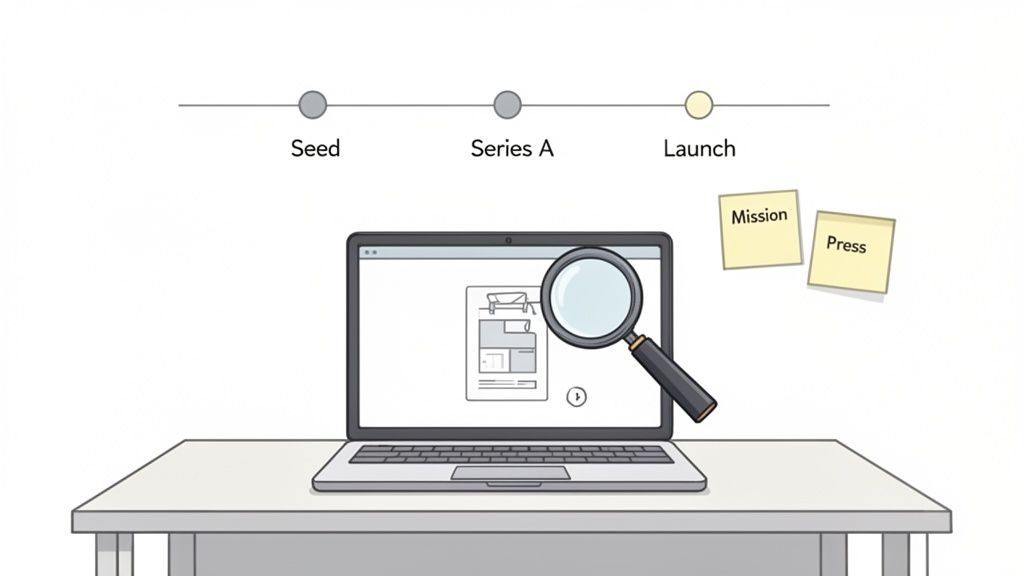
Mission and Milestones: Use platforms like Crunchbase or PitchBook to learn about their funding history, key investors, and founding story. Find a recent press release (e.g., a Series B announcement) and understand what milestones they highlighted to secure the funding.
Technical & Cultural Clues: Review the company’s engineering blog, open-source contributions on GitHub, or case studies. Look for articles about a specific technical challenge they solved. This provides insight into their tech stack, architectural philosophy, and the types of problems you'd be solving.
Real-World Examples in Action
Let’s see how this research translates into powerful interview moments:
For a Software Engineer: Instead of asking, "What's your tech stack?" you can ask, "I saw on your engineering blog that you migrated from a monolithic architecture to microservices. What were the biggest challenges your team faced during that transition, and how are you handling service discovery now?"
For a Product Manager: You could say, "I noticed your latest feature release addresses user onboarding, which seems like a direct response to feedback I saw in some G2 reviews. How are you measuring the impact of that change on user activation rates compared to competitors like [Competitor Name]?"
For a Designer: You might observe, "While using the free trial, I was really impressed with the streamlined checkout flow. Was the decision to use a multi-step modal versus a single-page form driven by user testing data?"
2. DON'T: Treat the Interview as a One-Way Evaluation
Many candidates enter an interview with the sole focus of impressing the hiring manager, forgetting that the process is a two-way street. This is a critical mistake, especially in the startup world where role ambiguity and cultural fit carry immense weight. A core principle of any successful job interview do and dont list is to remember that you are evaluating the company just as much as they are evaluating you. This mindset shifts the dynamic from a stressful interrogation to a collaborative conversation about a potential partnership.
Adopting this perspective allows you to probe for potential red flags and assess whether the role, team, and company trajectory align with your long-term career goals. Startups aren't just looking for skills; they are looking for partners who are making a deliberate and informed decision to join their mission.
How to Implement This Strategy
To effectively evaluate a potential employer, you must arrive prepared with insightful questions that go beyond surface-level inquiries about company perks. Your goal is to uncover the reality of the day-to-day work, the company's health, and your potential for growth.
Prepare Strategic Questions: Develop a list of 5-7 thoughtful questions for different interviewers (e.g., technical questions for an engineer, strategy questions for a founder). Don't be afraid to ask the tough questions.
Focus on Challenges: Ask each interviewer, "What's the biggest challenge you're currently facing in your role?" Their answer reveals their level of transparency and the real problems you would be helping to solve.
Assess Decision-Making: Ask how the company handles failure, makes critical product decisions, or navigates disagreements. This provides a window into their operational maturity and culture. For instance, "Can you tell me about a time a product launch didn't go as planned? What did the team learn?"
Take Notes: Actively jot down key points from their answers. This signals that you are genuinely processing the information and gives you material to reference in your thank-you note.
Real-World Examples in Action
Let’s see how this mutual evaluation mindset translates into specific, powerful questions:
For a Product Manager: Instead of asking, "What's the company culture like?" you could ask, "Can you walk me through a time when there was a significant disagreement between product and engineering on a feature's direction? How was that conflict resolved?"
For a Software Engineer: You might ask, "What is the company's current runway, and what are the key metrics the business needs to hit before the next funding round?" This shows you're thinking like a business owner.
For any Candidate: You could inquire, "What is the average tenure for someone in this role, and for those who have left, what were the primary reasons for their departure? What has the company done to address that feedback?"
Ready to Put Your Skills into Practice?
You know the do's and don'ts—now find the right stage. Underdog.io connects you directly with hiring managers at top startups for your next interview.
3. DO: Demonstrate Adaptability and Comfort with Ambiguity
Startups are defined by change. Priorities pivot, resources are constrained, and roles often stretch beyond their original descriptions. Unlike in established corporations with rigid structures, ambiguity is the default setting. Interviewers are actively looking for candidates who don't just tolerate this environment but thrive in it. This is a critical component of any startup job interview do and dont list because your ability to execute without perfect information is a direct predictor of your success.
Demonstrating this trait shows you can maintain momentum when the path isn't clear and that you are a proactive problem-solver, not just a task-executor. It signals that you can wear multiple hats and take ownership, which is invaluable when a team is small and every contribution counts.
How to Implement This Strategy
To effectively communicate your comfort with ambiguity, you need to prepare specific, evidence-based stories. Rely on frameworks like the STAR method (Situation, Task, Action, Result) to structure your answers, focusing on moments of uncertainty.
Identify Your Stories: Before the interview, brainstorm 2-3 past experiences where project requirements changed suddenly, success metrics were undefined, or you had to take on responsibilities far outside your official job description.
Frame the Narrative: Emphasize your mindset and approach. Use proactive language like "I took the initiative," "To create clarity, I decided to," or "I proposed a solution." Focus on how you created order from chaos or made progress despite the lack of a clear path.
Show, Don't Just Tell: Instead of simply saying, "I'm adaptable," provide a concrete example of a time you successfully navigated a chaotic project, learned a new skill on the fly to meet a deadline, or stepped up to fill a critical gap in your team.
Real-World Examples in Action
Here’s how to translate your experience into compelling interview responses:
For a Software Engineer: "In my previous role, we were building a new feature when market feedback forced a major pivot mid-sprint. The new requirements were vague, so I took the initiative to build a quick proof-of-concept for the new API. This gave the product manager a tangible prototype to react to, helping us finalize the specs in a single day and get back to coding."
For a Product Manager: "We launched a beta with several hypotheses but unclear success metrics. I proactively built a dashboard to track a range of secondary indicators, like user engagement patterns and drop-off points. This data allowed us to define clear KPIs and prove the feature's value for the Series A pitch."
For a Designer: "The team was under-resourced, and we didn't have a dedicated UX researcher for an upcoming launch. I stepped in to design and conduct a series of guerrilla usability tests with a small budget, gathering crucial feedback that directly influenced two key changes to the user flow before release."
4. DON'T: Overlook Equity and Financial Details
Many candidates, especially those new to the startup world, treat equity as a secondary lottery ticket rather than a core component of their compensation. This is a critical mistake in any job interview do and dont guide. Your equity stake isn't just a bonus; it's a significant ownership piece of the company you're helping build. Failing to understand its structure, value, and potential dilution can lead to major financial disappointment down the line.
Treating your equity conversation with the same diligence as your salary negotiation demonstrates financial literacy and a long-term mindset. It shows you're not just looking for a job but are invested in making a well-informed career and financial decision.
How to Implement This Strategy
Moving from ambiguity to clarity requires asking precise, informed questions about the company’s financial health and your potential stake. Don’t wait until the final offer; these are valid topics to broach once mutual interest is established.
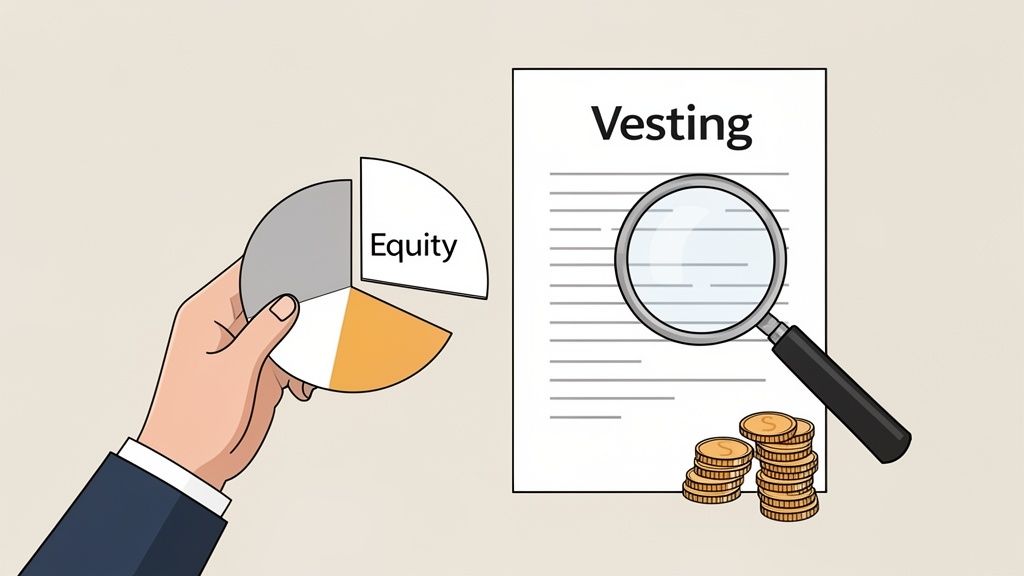
Request Key Metrics: Politely ask for the total number of fully-diluted outstanding shares and the strike price (or last 409A valuation). This information is essential to calculate the real value of your grant, not just the number of options.
Understand Vesting: Confirm the vesting schedule. The standard is a four-year schedule with a one-year "cliff," meaning you receive no equity if you leave before your first anniversary. Ask if there's any accelerated vesting on a change of control (acquisition).
Discuss Dilution: Inquire about the company's future funding plans. Ask, "How much was the option pool diluted in the last funding round?" This gives you a sense of what to expect in the future.
Clarify Post-Termination Exercise (PTE): Ask about the exercise window after you leave the company. A standard 90-day window can force a difficult financial decision, while a longer window is a huge benefit.
Real-World Examples in Action
Here’s how to translate these concepts into direct questions and analysis during the offer stage:
For a Senior Engineer: Instead of just accepting "10,000 options," you can ask, "Could you share the last 409A valuation and the total number of outstanding shares? I'd like to understand what percentage my 10,000 options represent and their current fair market value."
For a Marketing Manager: You could state, "A one-year cliff on a four-year vest is standard, but I'm interested in the company's philosophy on post-termination exercise windows. Has the board considered extending it beyond the standard 90 days?"
For any Candidate: You might say, "I see the offer is for a $150k salary and an equity grant valued at $50k. To better understand the total package, could you provide the strike price and valuation used to arrive at that $50k figure?"
5. DO: Ask About Team Structure, Leadership, and Company Culture
In a startup, your immediate team and direct manager have an outsized impact on your day-to-day happiness, growth, and overall success. Unlike large corporations with standardized processes, a startup’s environment is shaped directly by its leaders and early team members. Asking detailed questions about team dynamics, reporting structures, and decision-making processes is a critical part of any job interview do and dont checklist. This shows you're not just looking for a job; you're evaluating a long-term partnership.
This line of questioning reveals whether the company’s operating style aligns with your own. It moves the interview from a one-sided evaluation to a two-way conversation, demonstrating your maturity and serious consideration of the role. You gain invaluable insight into what it’s actually like to work there, beyond the polished mission statement.
How to Implement This Strategy
Go beyond surface-level inquiries about "culture" and dig into the mechanics of how the team and company function. Your goal is to understand the systems that govern work, communication, and growth.
Map the Team: Ask for an overview of the immediate team structure. "Who would I report to directly? And who would be my key collaborators on a day-to-day basis? What are the plans for team growth in the next 6-12 months?"
Probe Leadership Philosophy: Directly ask your potential manager about their management style. "How do you prefer to give feedback—in real-time, or during scheduled 1-on-1s? Can you give an example of how you've supported a team member's professional development?"
Uncover Decision-Making: Inquire about how strategic decisions are made. Is it a top-down approach from the founders, or is there a collaborative process? "Can you walk me through how the Q3 product roadmap was decided?"
Real-World Examples in Action
Let’s see how to frame these questions for maximum insight:
For a Software Engineer: Instead of asking, "What's the culture like?" you could ask, "Could you describe the code review process here? Is it done asynchronously via GitHub comments, or do you do pair programming? What's the average turnaround time for a PR?"
For a Product Manager: You might ask, "When there's a disagreement between product, engineering, and design on a feature's direction, what is the process for reaching a final decision? Can you give me a recent example?"
For any role: A powerful question is, "What's a recent example of a project or initiative that failed, and what did the team learn from it?" This reveals the company's attitude toward risk, experimentation, and learning from mistakes.
One of the most transparent mistakes in a job interview do and dont guide is delivering robotic, memorized answers. Interviewers, especially at fast-paced startups, can spot a rehearsed script from a mile away. It signals a lack of confidence and an inability to think on your feet. Instead of memorizing responses, focus on preparing a portfolio of authentic stories from your experience that showcase your skills in action.
This narrative-based approach feels genuine, allows for conversational flexibility, and demonstrates competence far more effectively than a generic claim. Stories provide context, reveal your thought process, and make your accomplishments memorable. They are the vehicle for showing, not just telling, your value.
How to Implement This Strategy
The goal is to have a handful of versatile stories ready to adapt to various behavioral questions. This preparation ensures you can answer thoughtfully without sounding like you're reading a script.
Build Your Story Library: Create a document with 5-7 detailed stories covering key themes: a technical challenge, a project failure and what you learned, a successful team collaboration, a time you had a significant impact, and a time you adapted to an unexpected change.
Structure with STAR, Speak like a Human: Use the STAR method (Situation, Task, Action, Result) as a mental framework, not a rigid script. Outline the key points for each story, but don't write out every word. This keeps the delivery natural and conversational.
Practice for Brevity: Rehearse telling each story out loud, aiming for about 2-3 minutes. This forces you to focus on the most critical details and leaves room for the interviewer to ask follow-up questions. Time yourself with a stopwatch.
Real-World Examples in Action
Let’s see how this story-based method transforms generic claims into compelling evidence of your skills:
Instead of "I'm adaptable": You can say, "When our main feature was deprioritized mid-quarter due to a shift in market needs, I pivoted my team's focus. I quickly helped re-scope our work, realigned our sprint goals with the new company objective, and we successfully shipped a smaller, but more critical, API integration ahead of the revised deadline."
Instead of "I'm a strong communicator": You could share, "The engineering and product teams had conflicting views on a new architecture. I facilitated a white-boarding session to map out both proposals, highlighting the trade-offs for scalability and user experience. This visual approach created a shared understanding and led us to a hybrid solution that both teams supported."
Instead of "I have leadership experience": You might explain, "I led the migration of our monolithic billing service to microservices. My role involved creating the technical roadmap, delegating tasks to three junior engineers, and communicating progress to stakeholders, which resulted in a 40% reduction in deployment failures and improved system resilience."
7. DO: Demonstrate Technical or Functional Depth Relevant to the Role
Startups operate with lean teams and tight deadlines, meaning they need hires who can contribute meaningfully from day one. Demonstrating deep expertise in a few areas critical to the role is far more valuable than being a generalist who knows a little about everything. This specialized knowledge signals competence, reduces the onboarding burden on the team, and assures them you can deliver value immediately, which is a key part of any successful job interview do and dont strategy.
This approach proves you are not just a theorist but a practitioner. By grounding your experience in concrete examples and detailed explanations, you show the interviewer that you have grappled with real-world problems and have the skills to solve them again for their company.
How to Implement This Strategy
Preparing to showcase your depth requires more than just listing skills on a resume. You need to build a narrative around your expertise, supported by evidence and a clear explanation of your thought process.
Curate Your Narrative: Identify the 2-3 core skills most critical for the job description. For each, prepare a "deep dive" story from a past project that illustrates your expertise, including the problem, your actions, the outcome, and what you learned.
Prepare Your Portfolio: Whether it's a GitHub repository for an engineer, a case study for a product manager, or a design portfolio, ensure your examples highlight your problem-solving process, not just the final result. Be ready to walk through one project from start to finish, explaining the "why" behind your decisions.
Anticipate Probing Questions: Be ready for interviewers to dig into the details. They will ask why you chose a specific technology, how you handled a particular trade-off, or what data you used to justify a decision. While avoiding memorized responses, understanding the types of practical challenges posed, such as in these AI Engineer interview questions, can help you prepare stories that showcase your problem-solving process.
Real-World Examples in Action
Here’s how to translate your deep functional knowledge into compelling interview responses:
For a Data Scientist: Instead of saying, "I'm proficient in machine learning," you could detail a project: "To combat customer churn, I trained a gradient boosting model using XGBoost. I focused heavily on feature engineering, creating time-based aggregates of user activity which improved model accuracy by 12% over the baseline logistic regression. The key insight was that session length in the first week was the strongest predictor."
For a Product Manager: You might say, "When user engagement on our dashboard dropped, I ran a series of A/B tests on widget placement. The data showed that a personalized 'quick links' widget increased session duration by 18%, so I prioritized its full rollout, which directly impacted our core retention metric."
For a Designer: You could explain, "The goal was to simplify a complex settings page. My initial wireframes tested poorly, so I conducted user interviews and discovered the core issue was information architecture. My revised design, which grouped settings by user intent, resulted in a 40% reduction in support tickets related to that feature."
8. DON'T: Badmouth Previous Employers or Managers
It can be tempting to vent about a frustrating past role, but complaining about a previous employer, manager, or team is a critical misstep in any job interview do and dont guide. Regardless of the validity of your grievances, negativity reflects poorly on your professionalism and emotional intelligence. For a startup, where close-knit teams rely on resilience and positive collaboration, this behavior is a major red flag that suggests you might be difficult to work with or will bring a toxic attitude into their culture.
This level of professional discretion shows maturity and an ability to handle conflict constructively. Instead of seeing you as a victim of a bad situation, interviewers will see you as a candidate who focuses on growth and solutions rather than blame, a crucial trait in the fast-paced, often chaotic startup environment.
How to Implement This Strategy
The key is to reframe negative experiences as learning opportunities. This requires you to shift your narrative from what went wrong in the past to what you are seeking in the future, demonstrating self-awareness and a forward-looking mindset.
Prepare Your "Why You're Leaving" Story: Practice answering this common question without a trace of negativity. Your script should be 80% focused on the pull of the new opportunity and only 20% on the push from your old one.
Use the S-L-G Framework: If asked about a difficult situation, structure your answer by explaining the Situation, what you Learned, and how you Grew from it. This transforms a complaint into a compelling example of your resilience.
Focus on Mismatched Alignment: Frame your departure in terms of professional misalignment. It's perfectly fine to say, "I'm looking for a faster-paced environment" or "I want to be closer to the core product decisions," rather than pointing fingers at individuals.
Real-World Examples in Action
Let’s see how to transform a negative comment into a positive, forward-looking statement:
Instead of: "My manager was a micromanager and completely incompetent."
Try: "I learned that I do my best work in an environment that encourages autonomy and a high degree of ownership. I’m looking for a role where I can take the lead on projects, which is why your company's 'CEO of your feature' philosophy really resonates with me."
Instead of: "The company was a mess and had no direction."
Try: "As the company scaled, I realized my passion lies in earlier-stage environments where I can have a more direct impact on product strategy. I'm eager to join a smaller team where I can contribute to defining the roadmap."
Instead of: "The culture was toxic, and everyone was quitting."
Try: "That experience taught me how critical culture fit is for my long-term success. I am now prioritizing companies with a transparent and collaborative culture, which I noticed was highlighted in your team’s Glassdoor reviews."
9. DO: Prepare Thoughtful Questions That Go Beyond Generic 'What Does Success Look Like' Asks
The "Do you have any questions for me?" part of an interview is not a formality; it's a critical opportunity to turn the tables and evaluate the company. Generic questions like "What's the company culture like?" or "What does success look like in this role?" are forgettable and signal a lack of deep engagement. A core principle of any job interview do and dont guide is to use this time to demonstrate your strategic thinking and genuine curiosity.
Asking sharp, specific questions proves you've done your homework and are already thinking like a team member. It shows you're not just looking for any job, but for the right opportunity to make an impact. This shifts the dynamic from a simple Q&A to a collaborative discussion about the business's real challenges and your potential role in solving them.
How to Implement This Strategy
Crafting insightful questions requires tying your research directly to the role and the company's current state. The goal is to ask questions that you genuinely want answered and that cannot be found on their website.
Connect to Recent Events: Use recent funding announcements, product launches, or press releases as a foundation. For example, "I saw you just raised a Series A to expand into the enterprise market. What's the biggest product challenge you anticipate in serving enterprise customers versus your current SMB base?"
Focus on Strategic Challenges: Go beyond day-to-day tasks. Ask about competitive advantages, market positioning, or the biggest hurdles the team is facing. "What keeps you up at night regarding our biggest competitor?"
Link to Role-Specific Impact: Frame your questions to understand how your specific contributions will move the needle on key company metrics. "What would I need to accomplish in my first 90 days for you to feel like you made a great hiring decision?"
Uncover Team Dynamics: Ask about skill gaps, collaboration processes, or what has surprised the interviewer about working there. Exploring the right questions to ask before accepting a job can provide invaluable insight.
Real-World Examples in Action
Let's see how this strategy elevates your interview performance:
If the startup is in a crowded market: Instead of "Who are your competitors?" ask, "I see you're competing with established players like [Competitor Name]. What is your specific unfair advantage, and how does this role directly contribute to strengthening it?"
To understand priorities: Avoid "What are your goals?" Instead, ask, "What is the single most important metric the team is focused on improving this quarter, and how will the person in this role be measured against that objective?"
To assess team needs: Rather than a generic culture question, try, "What is the biggest skill gap on the current team, and how are you hoping this new hire will help address it?"
10. DON'T: Underestimate the Importance of Communication and Collaboration Skills
In a startup, technical prowess alone is insufficient. These are small, fast-paced environments where every individual's ability to communicate and collaborate directly impacts the entire team's velocity and morale. Many highly skilled candidates make the mistake of focusing exclusively on their technical abilities, forgetting that hiring managers are equally evaluating their potential as a teammate. This is a critical point in any comprehensive list of job interview do and dont's.
Your ability to articulate complex ideas clearly, listen actively, and work constructively with others is not a "soft skill" but a core competency. In a resource-constrained startup, there's no room for communication silos or interpersonal friction. They need individuals who can amplify the team's collective intelligence, not just contribute their own.
How to Implement This Strategy
Demonstrating strong communication skills requires a conscious effort throughout the interview process. It’s about showing, not just telling, that you are a collaborative and articulate professional.
Practice Articulation: Before the interview, practice explaining one of your complex technical projects to a non-technical friend. Can you explain it in under 60 seconds without using jargon? This forces you to simplify and focus on the business impact.
Demonstrate Active Listening: Don't just wait for your turn to speak. When an interviewer is talking, listen intently and nod to show engagement. Reference their points in your answers, for example, "That's a great point about scalability. In my last project, we addressed a similar challenge by..."
Prepare Collaborative Stories: Have a specific example ready of when you worked across different functions (e.g., with design, product, or sales) to solve a problem. Structure this story using the STAR method, emphasizing how you facilitated communication to reach a shared goal.
Real-World Examples in Action
Let's look at how you can actively demonstrate these skills in an interview setting:
For a Software Engineer: Instead of just describing an architecture, explain the trade-offs you considered. You could say, "We chose to use a message queue here to decouple services. This added some initial complexity, but it gave our product team the flexibility to add new downstream consumers without us needing to redeploy the core service."
For a Product Manager: When asked about handling disagreement, you might say, "The engineering lead and I had different views on the technical approach for a feature. I scheduled a meeting where we mapped out the user needs and technical constraints together. By focusing on the shared goal, we found a phased approach that met user needs without requiring a major refactor."
For Any Role: Show you can receive feedback gracefully. You could share, "During a design review, the marketing team pointed out that our new signup flow's language was too technical. I incorporated their feedback, and we saw a 15% increase in completions."
For those looking to build these abilities, a structured approach can be beneficial. For comprehensive development in interpersonal interactions, engaging in social skills training for adults can significantly enhance your interview presence and team dynamics.
Top 10 Interview Dos & Donts
Practice
Implementation complexity
Resource requirements
Expected outcomes
Ideal use cases
Key advantages
DO:
Research the Startup's Product, Mission, and Recent Milestones
Low–Medium
Time, public sources (GitHub, Crunchbase, press)
Tailored interview answers; clearer fit assessment
Interviews at early-stage or mission-driven startups
Preserves professional reputation; signals maturity
Any interview in tight-knit startup communities
Demonstrates professionalism and emotional intelligence
DO:
Prepare Thoughtful Questions That Go Beyond Generic Asks
Low–Medium
Company research, tailored question list
Memorable interviews; strategic insight into role
Seed–Series A startups where strategy matters
Shows preparation and strategic thinking
DON'T:
Underestimate the Importance of Communication and Collaboration Skills
Medium
Examples of cross-functional work, practice in clear explanations
Higher likelihood of team success and smoother interactions
Small, collaborative startup teams
Enhances influence; reduces friction in lean teams
Your Next Move: Turning Interview Insights Into Offers
Navigating the modern job interview, especially within the fast-paced startup ecosystem, is less about memorizing perfect answers and more about mastering the art of a strategic, two-way conversation. The comprehensive list of job interview do and dont points we've explored is designed to transform your approach from a passive Q&A session into an active, insightful dialogue. By internalizing these principles, you are no longer just a candidate being evaluated; you become a strategic partner exploring a potential collaboration.
The core theme that connects every "do" and "don’t" is intentionality. From researching a startup’s latest funding round to preparing story-based answers using the STAR method, every action you take should be deliberate. This is your opportunity to demonstrate not just your skills, but your professional maturity, your problem-solving process, and your genuine interest in the company’s mission.
From Theory to Actionable Strategy
Mastering these concepts is what separates a good candidate from a great one. A good candidate can answer a question about a past project. A great candidate, however, can articulate the project's challenges, their specific contributions, the business impact of their work, and what they learned from the experience, all while linking it back to the potential challenges of the role they’re interviewing for. This is the level of depth that gets you noticed.
To put these insights into practice, here are your immediate next steps:
Build Your Story Bank: Don't wait for an interview to be scheduled. Start a document right now. List out your top 5-7 projects or accomplishments. For each one, detail the Situation, Task, Action, and Result. This repository of stories will become your most valuable asset, ready to be adapted for any behavioral question.
Conduct a "Pre-Mortem" on Your Questions: Before your next interview, review the questions you plan to ask. For each one, ask yourself: "What answer am I hoping to hear, and what would a red flag sound like?" This forces you to move beyond generic inquiries and ask questions that truly help you evaluate the opportunity. For instance, instead of "What is the culture like?" you might ask, "Can you describe a recent team disagreement and how it was resolved?" The latter provides concrete evidence of team dynamics.
Practice Articulating Your Value: Record yourself answering a common prompt like, "Tell me about a time you had to learn a new technology quickly." Listen back and critique your own response. Were you concise? Did you focus on the impact? Did your passion for your work come through? This self-assessment is a powerful tool for refinement.
Ultimately, the most critical job interview do and dont is to remember that an interview is a data-gathering exercise for both sides. Your goal is not just to get an offer, but to get the right offer from a company where you can thrive. By asking insightful questions, demonstrating genuine curiosity, and showcasing your skills through compelling stories, you build a foundation of mutual respect. This approach ensures that when an offer does come, it’s for a role that aligns with your skills, values, and career ambitions, setting the stage for long-term success and professional fulfillment.
FAQ Section
What is the most important "do" before any job interview?
The most critical step is thorough preparation. This means researching the company's product, mission, recent news, and culture. Carefully review the job description and prepare specific examples from your experience that match the required skills. For startups, understanding their business model and competitive landscape is especially important.
What is a major "don't" during the interview itself?
A major mistake is speaking negatively about current or former employers, colleagues, or managers. This raises red flags about your professionalism, teamwork, and ability to handle conflict. Always keep the conversation positive and focused on what you're looking to achieve in the future, not what went wrong in the past.
What are good questions to ask the interviewer, and what questions should I avoid?
Do ask thoughtful questions that show your interest and strategic thinking, such as "What does success look like in this role over the first 90 days?" or "How would you describe the team's culture?" Don't ask questions that are easily answered by a basic website search (e.g., "What does your company do?") or focus solely on benefits and vacation time in the first interview.
Is it still important to dress professionally for an interview?
Yes, it's always best to err on the side of professionalism. Even if the company has a casual culture, your interview attire should be a step more formal than the everyday dress code. It shows you are taking the opportunity seriously. A safe rule is "business casual" unless explicitly told otherwise.
What should I do after the interview is over?
A key "do" is to send a personalized thank-you email within 24 hours. Reiterate your enthusiasm for the role, briefly mention a specific topic you discussed, and thank them for their time. A major "don't" is to follow up excessively or demand an immediate decision. If a timeline was given, wait until after that date has passed to send a polite follow-up.
How should I handle questions about salary or compensation?
Don't bring up salary in the first interview unless the interviewer initiates the conversation. If asked about your expectations, it's best to provide a researched salary range based on the role, location, and your experience. A good "do" is to express that you're flexible and more interested in the overall opportunity and fit.
Tired of sifting through endless job boards to find quality startup opportunities? Underdog.io flips the script by curating top tech and startup roles and bringing them directly to you. Our candidate-first approach ensures you’re prepared for the strategic, high-quality conversations discussed in this guide, connecting you with innovative companies actively seeking talent like yours. Apply in 60 seconds on Underdog.io and let the best opportunities find you.
Our biweekly curated tech and recruiting newsletter.
Thank you. You've been added to the Ruff Notes list.
Oops! Something went wrong while submitting the form.
Looking for a startup job?
Our single 60-second job application can connect you with hiring managers at the best startups and tech companies hiring in NYC, San Francisco and remote. They need your talent, and it's totally 100% free.