Landing your first software engineering job is a huge milestone, but figuring out your salary can feel like decoding a cryptic message. The numbers you see in job descriptions? They're just the tip of the iceberg and rarely tell the whole story.
Let's establish a clear baseline. A typical junior software engineer salary in the US has a base of around $71,000 per year. Total compensation packages, however, can start at $68,000 for new grads and climb past $91,000 for top candidates in high-demand roles. But this national average is just a starting point. Your actual take-home pay will depend heavily on your location, your specific skills, and the type of company you join.
Think of the national average as a financial benchmark. From there, your earnings can vary significantly. For those with under a year of experience, the average total compensation is $68,205, which includes base pay plus any bonuses. Once you have one to four years of experience, that figure typically rises to an average of $71,328.
To give you a clearer picture, here’s a quick breakdown of what you can expect at different early-career stages.
This table summarizes the average compensation for junior software engineers as they gain their first few years of experience.
These numbers are a great reference, but remember that the real story is in the full compensation range and the factors that can push your offer to the higher end.
Averages are helpful, but the salary spectrum for junior roles is incredibly wide, which shows just how much different factors can influence your bottom line.
A junior software engineer's salary can span from $53,000 on the lower end to over $91,000 annually at the top percentile.
This massive variation is why you have to look beyond a single number. What pushes a salary toward that $91,000 mark? Practical examples include working in a major tech hub like San Francisco, specializing in a sought-after tech stack like Golang or Rust, or landing a role at a well-funded startup. Understanding this range is your first step toward negotiating an offer that truly reflects your value.
While we're zeroing in on junior roles here, our broader guide on software engineer salary offers more context on the entire career ladder.
Getting that first real paycheck is an incredible feeling, and it’s the perfect time to build smart financial habits. An actionable first step is to create a simple budget. List your fixed costs (rent, utilities) and variable costs (food, entertainment), then allocate a specific percentage of your new income to savings, investments, and debt repayment.
This practical guide to financial planning for students is a great resource for learning how to budget, save, and invest your money wisely. Building this foundation now will help you turn your salary into long-term financial security, whether that means tackling student loans, saving for a down payment, or investing for the future.
Focusing only on the base salary in a job offer is like judging a car by its paint job—you're completely missing what’s under the hood. The number on your offer letter is just one part of a much bigger picture called total compensation. To really compare opportunities, especially from the innovative startups you’ll find on Underdog.io, you need to evaluate the entire package.
Sure, a higher base salary looks like an easy win. But a slightly lower base paired with strong bonuses, equity, and killer benefits can often be far more lucrative in the long run. Getting a handle on these moving parts is your key to maximizing what you earn right from the start of your career.
This infographic gives you a snapshot of what junior software engineers are typically earning, showing the average alongside the low and high ends of the spectrum.
While that average number gives you a solid baseline, the huge gap between the low and high ends really shows how the other elements of your compensation package can dramatically shift your total earnings.
Think of your total compensation package as a financial toolkit. Each piece has a different job, and together, they build your overall wealth. Let's unpack the most common components you'll find in an offer.
Equity is a long-term bet on your career and the company's future. For a junior engineer at the right startup, the potential upside can be absolutely life-changing.
To understand your equity offer, you'll need to know about the vesting schedule. This is the timeline over which you earn ownership. A common setup is a four-year schedule with a one-year "cliff." Actionable tip: Ask your recruiter, "What percentage of the company does my initial grant represent?" This gives you better context than just the number of shares.
Beyond direct cash and equity, benefits can add thousands of dollars in untaxed value to your compensation package. When comparing offers, create a spreadsheet to quantify these perks. If you’re new to this, decoding your W-2's Box 12 codes for various benefits is a helpful resource for understanding what they're actually worth.
Here are a few high-impact benefits to keep an eye out for:
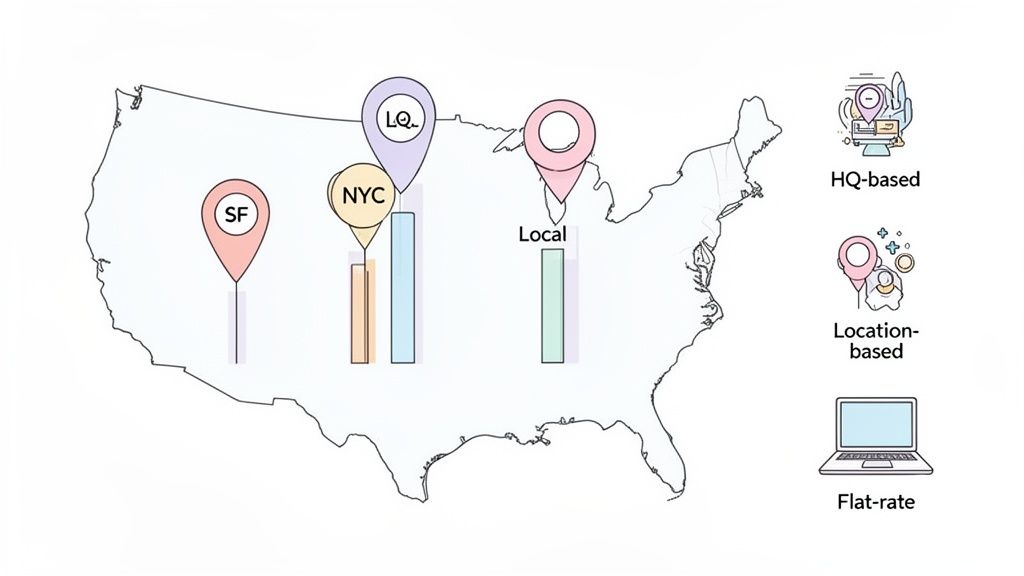
Ever wonder why the exact same junior software engineer role can pay $75,000 in one city and $120,000 in another? The answer is simple: geography. Where a job is located is one of the single biggest factors influencing your paycheck, often creating salary swings of 40% or more.
This difference isn't arbitrary. It’s directly tied to the local cost of living and competition for talent. A company in Omaha has to offer less to be competitive locally than a startup in San Francisco, where the high cost of living necessitates higher pay. It’s not about generosity—it’s a market necessity.
Major tech hubs like San Francisco, New York City, Seattle, and Boston operate in their own salary stratosphere. A junior software engineer landing a job in one of these cities can expect to earn significantly more than the national average.
For instance, while a junior role might average around $71,000 nationwide, that same position in San Francisco can easily command a starting salary well over $125,000. This “tech hub premium” is the market’s way of balancing the high cost of living with the intense demand for skilled engineers. For engineers specifically aiming for this top-tier market, exploring opportunities for San Francisco software engineers can provide a direct line to these high-paying positions.
The bottom line is that companies in expensive cities must pay more to attract and retain talent. This premium is a direct reflection of the economic realities of living and working in a major technology ecosystem.
Of course, while the higher salary is attractive, it’s crucial to weigh it against the increased living costs. Actionable insight: Use a cost-of-living calculator online to compare your net income. A $125,000 salary in San Francisco might give you similar disposable income to an $80,000 salary in a lower-cost area once you factor in rent and taxes.
To give you a clearer picture, here’s a look at how average salaries for junior software engineers stack up across different locations.
This table shows just how much location matters, but it's important to remember these are just averages. The actual offer you receive will also depend on the company's specific compensation philosophy, especially for remote roles.
The rise of remote work has introduced new salary calculation models. Understanding these is essential for evaluating any remote job offer.
Here are the most common approaches you'll see:
Actionable tip: During your first call with a recruiter for a remote role, ask, "What is your company's compensation philosophy for remote employees?" Their answer will tell you which model they use and help you set realistic expectations.
While location sets a baseline, the skills you bring and the company you join are the levers you can pull to earn more. Your tech stack and where you apply it are what separate a good offer from a great one.
Think about it: two junior engineers in the same city can get wildly different offers. One might know a common front-end framework, while the other specializes in a high-demand niche like machine learning. That specialization is a powerful tool for boosting your pay.
Not all programming languages command the same salary. Companies pay a premium for skills that are critical to their growth. Mastering one of these is a direct path to a better offer.
Specializing in AI can help you earn 12% more than a standard software engineering role. For junior engineers targeting top-tier US markets on platforms like Underdog.io, the rewards are even greater. FinTech juniors in New York can see salaries 20-25% above the national average. To get a better feel for these market dynamics, you can explore more software engineer salary trends.
The kind of company you join has a massive impact on how you get paid. A huge, established corporation and a tiny, early-stage startup offer very different compensation packages.
A Fortune 500 company might offer a high base salary and predictable bonuses. A startup might offer a lower base but a hefty chunk of equity—a lottery ticket with the potential for a massive payout.
Your choice of company is a strategic decision that balances immediate cash with long-term growth potential. Neither is inherently better—it all depends on your personal financial goals and risk tolerance.
Here’s a quick breakdown of what you can expect at different company stages:
Your skills are only valuable if you can prove them. A resume lists technologies; a portfolio shows what you can do. This is your chance to show, not just tell.
Actionable example: Instead of just listing "React" and "Node.js," build a full-stack application that solves a real-world problem you care about. Document it on GitHub with a clear README file. This demonstrates initiative and proves you can take an idea from concept to execution—a skill every startup desperately needs.
Getting a job offer isn't the finish line—it's the start of a conversation. Not negotiating your first junior software engineer salary can leave tens of thousands of dollars on the table over your career.
Think of it as a collaboration, not a conflict. The company wants you. Now you're just working together to land on a package that reflects your market value.
Before you ask for more, you need data to back it up. Anchor your request in market reality, not just what you want.
Actionable step: Use Underdog's software engineering salary calculator to find salary data for your specific role, location, and employee size. Create a simple document with links to your sources and the salary range they support. This prep work is your biggest advantage.
A well-researched salary range is your most powerful tool. It transforms your request from a hopeful ask into a confident, business-driven proposal based on market data.
Once you have the offer, thank the recruiter and express your excitement. Always stay positive. Ask for a day or two to review the full compensation package.
When you're ready, make your counteroffer by focusing on your value and your research. Frame it as a collaborative effort to find a fair market rate.
Sample Script You Can Adapt
Here’s a simple, professional way to kick off the conversation over the phone:
"Thank you so much again for the offer! I’m incredibly excited about the opportunity to join the team and contribute to [Project or Company Goal]. Based on my research for similar roles in [Your City] requiring skills in [Your Tech Stack], I was expecting a base salary closer to the $X to $Y range. Would it be possible to discuss bringing the base salary to $Y?"
Sometimes, a company has a rigid salary band. If they can’t move on base pay, pivot to other parts of the package.
These are often the easiest areas for a company to make adjustments:
Nothing strengthens your position like having more than one offer. A competing offer validates your market value. Platforms like Underdog.io are designed to connect you with multiple vetted startups at once to create that leverage.
Having a competing offer allows you to professionally share that information. It's not an ultimatum; it's new data for them. If a company truly wants you, they'll often work to match or beat another offer. For more on this, check out our guide on how to ask for a salary increase when you're already in a role.
So, you’ve learned how to decode compensation, size up your skills, and negotiate. But navigating the job market alone can feel like shouting into the void. This is where a partner changes the game, turning a frustrating grind into a focused search.
Forget spending nights customizing resumes for hundreds of job boards. With Underdog.io, you create one profile in about 60 seconds, and suddenly you’re on the radar of hundreds of vetted, high-growth startups actively looking for someone like you.
Our platform isn't just run by algorithms; it's powered by people. Every single match is hand-picked by our team to ensure we’re connecting you with companies that align with your skills, experience, and—most importantly—your salary expectations. We cut through the noise so you can connect directly with serious employers.
The result? You get access to transparent opportunities where you can land competitive offers, often with meaningful equity attached.
We designed Underdog.io to do more than just find you a job. Our real goal is to plug you into roles at high-growth companies that will accelerate your career from day one.
By zeroing in on the startup and tech world, we give you a direct line to the most promising roles in hubs like New York City and San Francisco, as well as remote positions all across the US. We're here to help you apply everything in this guide—from understanding equity to negotiating your final offer—to land a role that truly values what you bring to the table. It’s a curated experience designed to help you find a top-paying position without the burnout.
Figuring out your early career is about making smart, strategic moves that will pay off for years to come. Here are a few common questions junior engineers wrestle with.
You can expect significant growth if you focus on building in-demand skills. After two or three years, a 30-50% salary increase is common, especially if you switch companies to level up to a mid-level role. Your career path hinges on mastering valuable tech and proving your business impact.
Your first job is an investment in yourself. The faster you learn, the faster your paychecks will grow.
This is the classic startup gamble. High equity can be life-changing if the company has a massive exit, but it’s worthless if the company fails.
Actionable insight: Don't just look at the equity percentage. Do your homework. Research the company's funding on Crunchbase, investigate the founders' track records on LinkedIn, and understand their market position. A well-funded startup from a curated platform is a much safer bet.
For your first job, lean heavily toward learning. While you should never accept a wildly below-market salary, the skills you build now are your greatest asset. A job with strong mentorship and exposure to a modern tech stack will make you a much more valuable—and higher-paid—engineer down the road.
The expertise you gain in a great learning environment will provide a far better long-term return than a slightly larger initial paycheck. Choose the role that will teach you the most, as that knowledge is what will ultimately land you a top-tier junior software engineer salary.
Ready to find a role that matches your skills and salary expectations? On Underdog.io, you create one profile to get seen by hundreds of vetted, high-growth companies looking for talent like you. Stop applying and start interviewing.
As of 2024, national average total compensation (including base salary and bonuses) for junior software engineers typically falls between **$70,000 and **$120,000 per year. This wide range is due to significant variations based on geographic location, industry, company size, and the specific tech stack required for the role.
The three primary factors are location, company type, and your skill set. Salaries in major tech hubs like San Francisco, New York City, and Seattle are often 20-40% higher than the national average to offset the cost of living. Large tech companies (FAANG) and well-funded startups tend to pay more than non-tech corporations or smaller local businesses. Proficiency in high-demand languages or frameworks can also command a premium.
Startups often offer competitive base salaries that may be slightly lower than the top of the range at large, established tech firms. However, they frequently supplement this with equity (stock options) as part of the compensation package, which represents potential future value if the company grows successfully. Startups may also offer other benefits like flexible schedules or remote work.
Remote salary policies vary. Some companies, especially larger ones, use location-based pay, adjusting your salary to the cost of living in your city. Others, particularly remote-first organizations, may offer a standardized competitive salary regardless of location. It's crucial to ask about the company's compensation philosophy for remote employees during the interview process.
It is very important and often expected. Even as a junior candidate, you can negotiate respectfully. The key is to base your request on data (like salary ranges from your research for similar roles in that location/industry) and your relevant skills or internship experience. Many employers have a budget range and making a reasonable counter-offer is a standard part of the process.
Yes, reliable sources include levels.fyi and Glassdoor for crowdsourced tech-specific data, and salary guides from recruiting firms like Robert Half. When using job boards like Underdog.io, Wellfound (AngelList), or Built In, pay close attention to roles that list salary ranges upfront, as this data is often provided directly by the hiring company.
Look at the total rewards package. This includes sign-on or annual performance bonuses, equity/stock options, health insurance quality, retirement contributions (401k match), and benefits like learning stipends, home office budgets, and unlimited PTO. A slightly lower base salary might be offset by a much stronger overall benefits package.